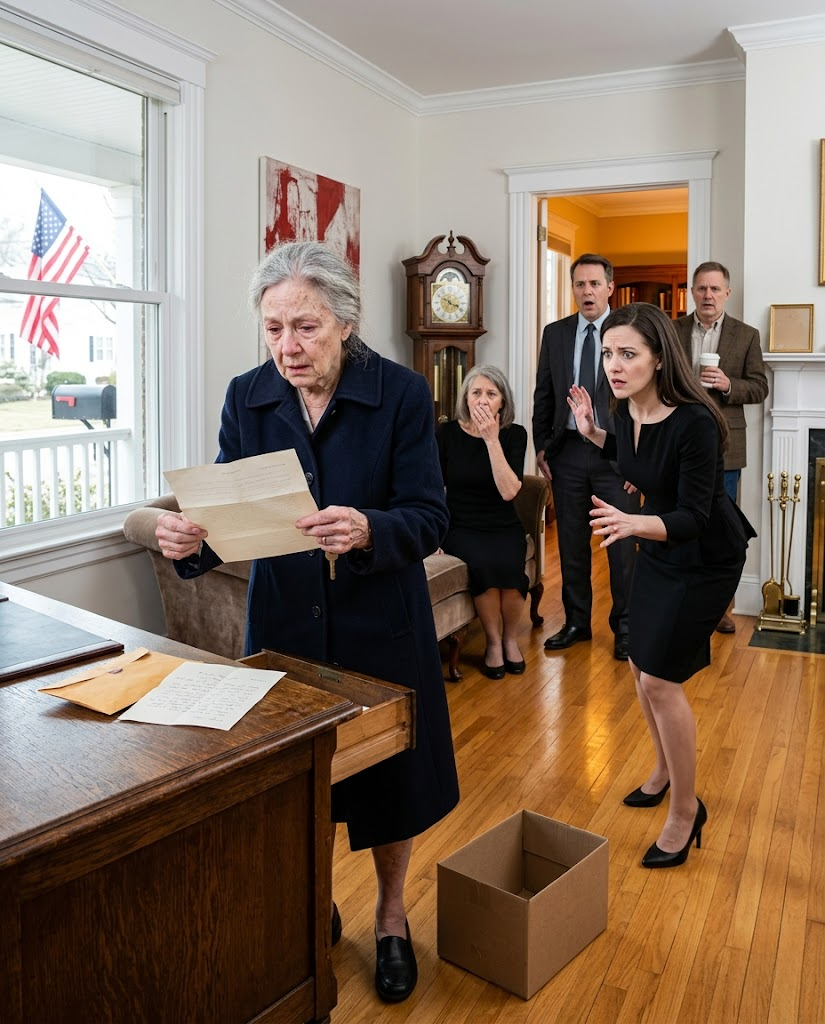

The word left my mouth so quietly that, for a second, I thought the room might swallow it.
“Okay.”
That was all I said when Vanessa told me to pack my things and go live on the streets.

Outside the front windows of 847 Maple Avenue, the March sky hung low and gray over the porch railings, the kind of cold light that makes every house look older than it is.
My funeral coat still smelled like damp wool, cemetery soil, and the cold wind that had blown across Daniel’s grave that morning.
The living room was too quiet after the burial.
Not peaceful.
Just quiet in the way a room gets when everyone in it has decided not to tell the truth.
Vanessa’s heels scraped against the old oak floor.
Her bracelet clicked every time she pointed at something that did not belong to her.
The fireplace.
The mantel.
The hallway.
The house.
Forty years of my life reduced to places she could gesture at.
My fingers closed around the small brass key in my coat pocket.
It was still warm from my hand because I had been holding it all day, through the service, through the drive home, through the catered sandwiches Vanessa ordered from a place Daniel never liked.
Three weeks before he died, Daniel had pressed that key into my palm from his hospital bed.
His hand had felt weightless, almost paper-thin, but his grip had surprised me.
“Maggie,” he whispered, “keep this safe.”
I bent close because the machines beside his bed hummed louder than his voice.
“Don’t tell anyone,” he said.
I asked him what it opened.
He closed his eyes for a second, not because he was sleeping, but because pain was moving through him in a wave he did not want me to see.
“Wait for Brennan,” he said.
Donald Brennan was Daniel’s estate attorney.
I had known his name for twenty-five years, though I had only met him in person twice.
He was the kind of man who returned calls, dated every document twice, and wore the same charcoal suit to every serious meeting.
Daniel trusted him.
That meant I trusted him too.
At least, I had.
But after the funeral, Brennan never called.
Vanessa said he was unavailable.
She said a junior associate had handled everything.
She said it while standing in my kitchen, holding one of my mugs, with a smile too bright for a woman whose father-in-law had been buried three hours earlier.
“There’s really nothing complicated here,” she told me.
That was the first sentence that frightened me.
Not because of what it said.
Because of how badly she wanted me to believe it.
Daniel Jacob Hayes and I had been married for forty years.
Forty years of coffee before sunrise.
Forty years of roof leaks, winter utility bills, school lunches, tax folders, hospital waiting rooms, and folding laundry while one of us listened for the other’s car in the driveway.
People praised Daniel for his discipline, his work ethic, his patience, his good judgment.
They were not wrong.
But they rarely saw the invisible scaffolding behind him.
They did not see me working double shifts at Saint Vincent’s Hospital when Robert was small.
They did not see me selling my mother’s bracelet when the college bill came due.
They did not see Daniel standing barefoot in the kitchen at midnight, rubbing his forehead over numbers he refused to let scare me.
They did not see the two of us learning, slowly and stubbornly, how to build a life from work nobody applauded.
Love is not always grand.
Sometimes it is a packed lunch, a warmed car, a pharmacy run, a bill paid quietly, or a chair pulled close to a hospital bed.
By the time Daniel became wealthy, we had already spent decades learning how not to waste anything.
That was why Vanessa never understood us.
She met Robert eight years before Daniel died.
She arrived at our house in a cream coat, black heels, and a smile that adjusted itself depending on who had more money in the room.
She called me “sweet” the way some people say “old.”
She asked Daniel questions about investments, property taxes, and the value of the house before she asked me how long I had lived in it.
Robert laughed nervously that first night.
“She’s just curious, Mom,” he said.
I wanted to like her.
That is the embarrassing part.
I gave her the spare key.
I taught her Daniel’s mother’s stuffing recipe.
I saved her a seat at Thanksgiving.
I gave her the alarm code because I told myself a woman married to my son was family.
Trust is not always handed over in grand speeches.
Sometimes it is a spare key, a recipe card, a chair at the table, or the numbers you type into a keypad because you think the person watching you has earned the right to enter your home.
Vanessa received all of those things.
Then she weaponized the door.
The morning of Daniel’s funeral, I stood beside his grave in my navy wool coat, the one I bought with a Christmas bonus in 1998.
The wind cut straight through it.
A man from the funeral home held an umbrella over me even though it was not raining, and I remember thinking Daniel would have hated that.
He hated fuss.
He hated waste.
He hated people making ceremonies out of things that should be handled plainly.
Vanessa had hired a professional eulogist.
“We need someone polished,” she told me two days earlier.
The man spoke for twelve minutes.
He talked about Daniel’s business acumen.
He talked about legacy.
He talked about leadership.
He mispronounced Hayes twice.
Haze.
As if my husband had been weather.
I did not correct him.
Some humiliations come when you are already too tired to raise your hand.
Robert stood beside Vanessa during the service.
He looked handsome and empty in his black suit.
When he was eight years old, he once told me I was the safest place in the world.
He said it after a thunderstorm knocked the power out and I let him sleep on the couch while Daniel lit candles in the kitchen.
He had held my hand until the thunder passed.
At forty-two, he could barely look at me over his wife’s shoulder.
After the burial, we returned to the house.
There were trays of sandwiches in the dining room.
There was coffee growing bitter in the kitchen.
There were neighbors moving gently through the rooms, using low voices, touching my arm, telling me Daniel had been a good man.
Then the neighbors left.
The caterer packed the leftovers.
The front door closed.
And Vanessa became herself.
“This house needs to be sold,” she said.
She did not ask.
She announced it.
My sister Linda was sitting on the couch, still wearing her black dress and the expression she used whenever she thought somebody else’s pain might finally prove her right about the world.
Linda came from Ohio with one suitcase and three questions about the estate.
We had not been close since 1987.
She said money changed people.
In my experience, money usually revealed what was already there.
“The market’s good right now,” Linda said.
Her voice had the false softness of someone pretending to discuss practical matters.
“You could get $890,000, maybe more.”
Nobody looked at me.
The room froze in the cowardly way rooms do when everyone understands cruelty is happening and no one wants their name attached to stopping it.
Linda studied the fringe of the rug.
Robert looked at the brass fireplace tools.
Vanessa adjusted her sleeve.
The grandfather clock kept ticking like it was documenting the silence.
Nobody moved.
Vanessa had already taken down our wedding photo.
That hurt more than the house talk.
Our photo had stood on the mantel for thirty-six years, in a silver frame Daniel bought at a department store because he said the one from the photographer looked too fancy for two people who knew how badly their feet hurt that day.
In its place, Vanessa had hung a red-and-white abstract painting from a SoHo gallery.
It looked like spilled wine on sadness.
“Daniel left everything to Robert,” Vanessa said.
She said Daniel’s name like she had practiced owning it.
“The will is very clear. And since Robert and I are building our future, we need liquidity. You understand?”
I looked at my son.
He flinched before I spoke.
That was how I knew there was still some boy left in him, trapped under all that cowardice.
“Robert,” I said, “is that true?”
He swallowed.
“Mom, Vanessa means we just need to be realistic.”
Realistic.
There are words people use when they want theft to sound mature.
Realistic is one of them.
Practical is another.
Family is the worst one, because it lets the cruelest person in the room pretend they are doing arithmetic with love.
Vanessa stepped forward.
“Now that he’s gone,” she said, “you need to cry, pack your things, and figure out where you’re going. We can’t carry you forever.”
I looked at her shoes.
Black Louboutins.
The red soles flashed whenever she shifted her weight.
Two months earlier, while Daniel and I were sorting papers in his study, I had seen a credit card statement with a $1,200 charge circled in his handwriting.
No note beside it.
No complaint.
Just the circle.
Dark.
Careful.
A quiet man recording the moment he stopped trusting what entered his house.
More than a month of my old night-shift wages, sitting on Vanessa’s feet while she told me poverty was where I belonged.
“What do you expect me to do?” I asked.
She smiled.
That smile was the whole point.
She wanted the question.
She wanted me to ask it in front of Robert and Linda so she could enjoy answering.
At 2:17 p.m., she placed a cardboard box at my feet.
It was small.
Too small for forty years.
“Start with essentials,” she said.
Linda inhaled sharply, but did not speak.
Robert’s face reddened.
Still, he said nothing.
For one ugly heartbeat, I wanted to throw the box at the fireplace.
I wanted to scream until the walls remembered who had painted them.
I wanted to slap the silence out of my son.
Instead, I kept my hand in my pocket.
Cold rage is useful when grief has made you tired.
The brass key pressed into my palm.
And suddenly Daniel’s warning came back whole.
Not the weak version grief had blurred.
The exact words.
“If something happens to me, don’t trust the paperwork. Wait for Brennan.”
Six months before his death, Daniel had said it over breakfast.
The toast burned in our old silver toaster because he was distracted, and he always forgot bread when worry had him by the throat.
I had laughed then, gently, and asked if he was being dramatic.
Daniel did not laugh.
“Maggie,” he said, “there are signatures I didn’t make.”
That was the first time he frightened me.
He would not say more.
He only told me not to confront anyone until he finished checking.
By the time he got sick enough for the hospital, he was too weak to explain.
But he still had the strength to put a key in my hand.
So when Vanessa told me to pack, I did not bend down for the box.
I turned toward Daniel’s study.
“Maggie,” Linda said.
It came out as a warning.
Vanessa laughed once.
“Where are you going?”
“To get something,” I said.
The study smelled like Daniel.
Paper, cedar, old coffee, and the faint sharpness of the lemon oil I used on his desk every spring.
His reading glasses were still beside the blotter.
A yellow legal pad lay open with three lines of numbers in his handwriting.
I had avoided that room for five days because grief has a way of making doorways feel violent.
Now I walked straight to the bottom-right drawer.
Vanessa followed me.
So did Robert.
Linda hovered in the doorway.
The lock had a scratch near the keyhole.
Fresh.
Somebody had tried to open it.
I looked at Vanessa.
She looked away too fast.
The brass key slid in smoothly.
It turned on the first try.
Inside was not jewelry.
Not cash.
Not some sentimental bundle of letters she could dismiss as widow nonsense.
There was a sealed legal envelope with Donald Brennan’s name printed on the return label.
There was a folded hospital notary form dated 9:42 p.m., three weeks before Daniel died.
There was a flash drive taped to a handwritten note.
My name was on the note.
Maggie.
Vanessa stopped smiling.
Robert moved closer.
“What is that?” he asked.
His voice sounded young suddenly.
I lifted the note.
My hand shook, but not enough to stop me.
The first line was Daniel’s.
I knew the slope of every letter.
I had seen that handwriting on grocery lists, anniversary cards, tax folders, and sticky notes he left on the coffee maker when he wanted me to sleep late.
Maggie, if they try to throw you out, tell them the penthouse is not the secret.
The room went so quiet that I heard Linda’s breath catch.
Vanessa’s eyes dropped to the envelope.
Robert stared at me as if he had never seen me clearly before.
“The penthouse?” he whispered.
I did not answer yet.
I opened the envelope.
Inside was a trust document.
The first page carried Daniel’s full name.
The second carried mine.
Margaret Elaine Hayes.
Sole beneficiary.
The document named assets I had never seen collected in one place.
A $28 million inheritance Daniel had kept separate after the sale of his private shares.
A penthouse in New York City purchased through a holding company.
Investment accounts.
A letter of instruction.
And a clause that made Vanessa’s hand fly to her throat.
Robert reached for the papers.
I pulled them back.
“No,” I said.
It was not loud.
It did not need to be.
Vanessa recovered first.
“This is ridiculous,” she said.
She reached for the envelope.
I stepped back.
For the first time all afternoon, she looked at me like I was not furniture.
She looked at me like an obstacle.
Then the doorbell rang.
Once.
Sharp.
Final.
Everybody turned.
Through the front window, past the small American flag Daniel liked to keep tucked into the porch planter every Memorial Day, I saw a dark sedan in the driveway.
A man in a charcoal suit stood on the porch holding a leather folder.
Donald Brennan had come.
Vanessa went pale.
Robert whispered, “Oh God.”
Linda sat down without looking behind her, as if her body had decided the couch was safer than the truth.
I walked to the door with Daniel’s note in my hand.
Brennan removed his hat when I opened it.
“Maggie,” he said softly.
He looked past me into the living room, where the cardboard box still sat on the floor like evidence.
Then his face changed.
Not surprise.
Confirmation.
“I’m sorry I’m late,” he said.
Vanessa stepped forward quickly.
“There has been a misunderstanding,” she said.
Brennan looked at her once.
It was the kind of look men like him save for people who mistake confidence for legality.
“I doubt that,” he said.
He opened the leather folder.
Inside were copies of emails, signature comparisons, a notarized statement, and a packet labeled amended estate file.
Vanessa’s name appeared on three pages.
Robert’s appeared on one.
His face broke when he saw it.
“I didn’t know,” he said.
Brennan did not answer.
I did.
“You knew enough not to look at me.”
That landed harder than I expected.
Robert sat down on the edge of the armchair Daniel used to read in.
He put his elbows on his knees and covered his face.
For a moment, I saw the boy from the thunderstorm again.
Then I saw the man who had stood silent while his wife put a cardboard box at my feet.
Both were real.
That was the problem.
Brennan laid the documents on the coffee table.
“The will Mrs. Hayes was shown was not the operative estate document,” he said.
Vanessa made a sound like a laugh that had cracked in the middle.
“That’s not possible.”
“It is,” Brennan said.
He pointed to the hospital notary form.
“Daniel executed the final trust amendment before two witnesses and a notary. He also requested review of certain signatures on prior drafts.”
Linda looked at Vanessa.
For the first time in years, my sister had nothing to add.
Brennan continued.
“The house at 847 Maple Avenue is held in trust for Mrs. Hayes for the remainder of her life. It is not available for sale by Robert or Vanessa Hayes.”
Vanessa’s mouth opened.
No words came out.
“The New York penthouse is also hers,” Brennan said.
Robert lifted his head.
His eyes were wet.
“Mom,” he said.
I knew that tone.
It was the sound of a grown man reaching for childhood because adulthood had failed him.
I wanted to comfort him.
That instinct embarrassed me.
Motherhood does not shut off cleanly just because a son becomes a coward.
It flickers.
It bargains.
It remembers fevers and lunch boxes and small hands gripping yours in the dark.
But then I looked at the box on the floor.
Too small for forty years.
And something in me settled.
Vanessa found her voice.
“You can’t just keep everything from your own son,” she said.
I looked at her.
“You told me to live on the streets.”
Her face tightened.
“That was emotional. We were all grieving.”
“No,” I said.
I picked up the cardboard box.
It was light.
Almost empty.
“You were planning.”
Brennan removed one more document from his folder.
It was a printed email chain.
Vanessa’s name appeared at the top.
The date was four days before Daniel died.
The subject line read: Timing of Occupancy Transfer.
Robert stared at it.
Linda whispered, “Vanessa.”
Vanessa did not look at either of them.
She looked at me.
There was hatred there now, clean and undisguised.
It almost relieved me.
Masks make people harder to mourn.
Brennan explained what would happen next.
There would be formal notices.
There would be review.
There would be consequences if forged or improperly obtained documents had been used.
He did not raise his voice.
He did not need to.
Every calm sentence stripped another layer from Vanessa’s performance.
Robert stood.
“Mom, I swear I didn’t understand all of it.”
“All of it?” I asked.
He flinched.
That was the answer.
He had understood some.
Maybe not the forged signatures.
Maybe not the full plan.
Maybe not the $28 million.
But he had understood enough to stand behind his wife while she put a box at his mother’s feet.
That is where forgiveness became complicated.
Not impossible.
Just no longer cheap.
I walked to the mantel.
The red-and-white painting still hung where my wedding photo belonged.
I lifted it off the hook.
Vanessa made a small sound of protest, as if a painting had more rights in my home than I did.
Behind it, on the wall, was the faint clean rectangle where our photograph had protected the paint from sunlight for decades.
I asked Robert to bring the frame from the hall closet.
He obeyed.
He moved like a man underwater.
When he handed it to me, his fingers brushed mine.
He started crying then.
Not loudly.
Just one silent break down the middle of his face.
I put the wedding photo back on the mantel.
Daniel and I looked impossibly young in it.
He was smiling like he had gotten away with marrying the best woman in the room.
I was smiling like I believed every hard thing would be easier if we faced it together.
I suppose, in a way, I had been right.
Even dead, Daniel had faced this with me.
The room that had tried to erase me had to look at us again.
Vanessa picked up her purse.
“You’ll regret this,” she said.
“No,” I told her.
I looked at the cardboard box in my hands.
Then I held it out to her.
“You can start with essentials.”
Linda gasped.
Brennan looked down at his papers, but I saw the corner of his mouth move.
Robert said my name.
I did not turn.
Vanessa did not take the box.
She walked past it, past me, past the mantel, and out the front door so hard the porch flag trembled in its holder.
Robert stayed.
That surprised me.
He stood in the living room with his hands hanging at his sides and looked around like he was seeing the house for the first time.
The fireplace tools.
The old rug.
The clock.
The couch where he had slept through chicken pox.
The kitchen doorway where Daniel used to measure his height in pencil until Robert turned thirteen and decided he was too old for it.
“Can I come back tomorrow?” he asked.
I did not say yes.
I did not say no.
I said, “You can call Mr. Brennan.”
It hurt him.
It needed to.
The next weeks were not cinematic.
There were no shouting matches on courthouse steps.
There were phone calls, certified letters, meetings with Brennan, and quiet mornings when I woke up reaching for Daniel before remembering the bed was half-empty.
There were bank statements.
There were document reviews.
There was a formal complaint over the estate file Vanessa had tried to push through.
There was a locksmith who changed every exterior lock at 847 Maple Avenue while I stood in the driveway holding a paper coffee cup I never drank.
There was a moving company that delivered several crates from storage, including Daniel’s private files.
In one of them, I found a letter he had written to Robert but never sent.
It was not angry.
That made it worse.
It said Daniel loved him.
It said he hoped Robert would find his spine before life took the choice away from him.
It said Vanessa had taught Daniel something painful, but Robert’s silence had taught him something worse.
I mailed Robert a copy.
Not the original.
Some things still belonged to me.
Three months after the funeral, I visited the penthouse in New York City.
I had never been inside.
The elevator opened into a quiet, sunlit space with tall windows and a view that made me understand, all at once, how much Daniel had carried alone near the end.
On the kitchen counter was another envelope.
Brennan had placed it there before meeting me.
Inside was a final note.
Maggie, if you are reading this there, good. That means they failed.
I laughed for the first time in months.
Then I cried so hard I had to sit on the floor.
Not because of the money.
Not because of the apartment.
Because Daniel had known me well enough to know I would not run to power.
I would have to be pushed there.
Vanessa tried to call me twice.
I did not answer.
Linda sent a long message about family healing and how grief makes everyone act strangely.
I wrote back one sentence.
Grief did not put a box at my feet.
Robert and I are not healed.
That is the honest truth.
Some stories want a clean ending where the son falls to his knees, the mother forgives, and every broken thing becomes whole because readers like symmetry.
Life is not that tidy.
He comes by once a month now.
Only after calling first.
He brings groceries I did not ask for and fixes things Daniel would have fixed.
The porch light.
A loose hinge.
The mailbox flag that sticks in winter.
Sometimes we sit in the kitchen and talk about ordinary things.
Sometimes we sit in silence and let the clock do the talking.
He has apologized.
More than once.
I believe he regrets it.
I am still deciding what that regret is worth.
As for Vanessa, Brennan says I should not discuss details while matters are still being reviewed.
So I do not.
I will only say this.
The woman who told me to pack my life into a cardboard box learned, eventually, that paperwork can be a door too.
And some doors do not open from the inside.
I still live at 847 Maple Avenue.
The wedding photo is back on the mantel.
The red painting is gone.
The cardboard box is in the attic, folded flat and tucked behind the Christmas wreaths.
I keep it because I want to remember the exact size Vanessa thought my life should be.
Too small for forty years.
Too small for Daniel.
Too small for me.
Every morning, I make coffee before sunrise, the way we always did.
For a while, I made only one cup.
Now I make two.
One for me.
One beside Daniel’s chair.
Not because I think he will drink it.
Because love is sometimes a packed lunch, a warmed car, a pharmacy run, a paid bill, a chair pulled close to a hospital bed, or a cup of coffee set down for someone who saved you one last time.
The house is quiet now.
But it is not the same quiet as that day.
That day, the silence belonged to cowards.
Now it belongs to me.