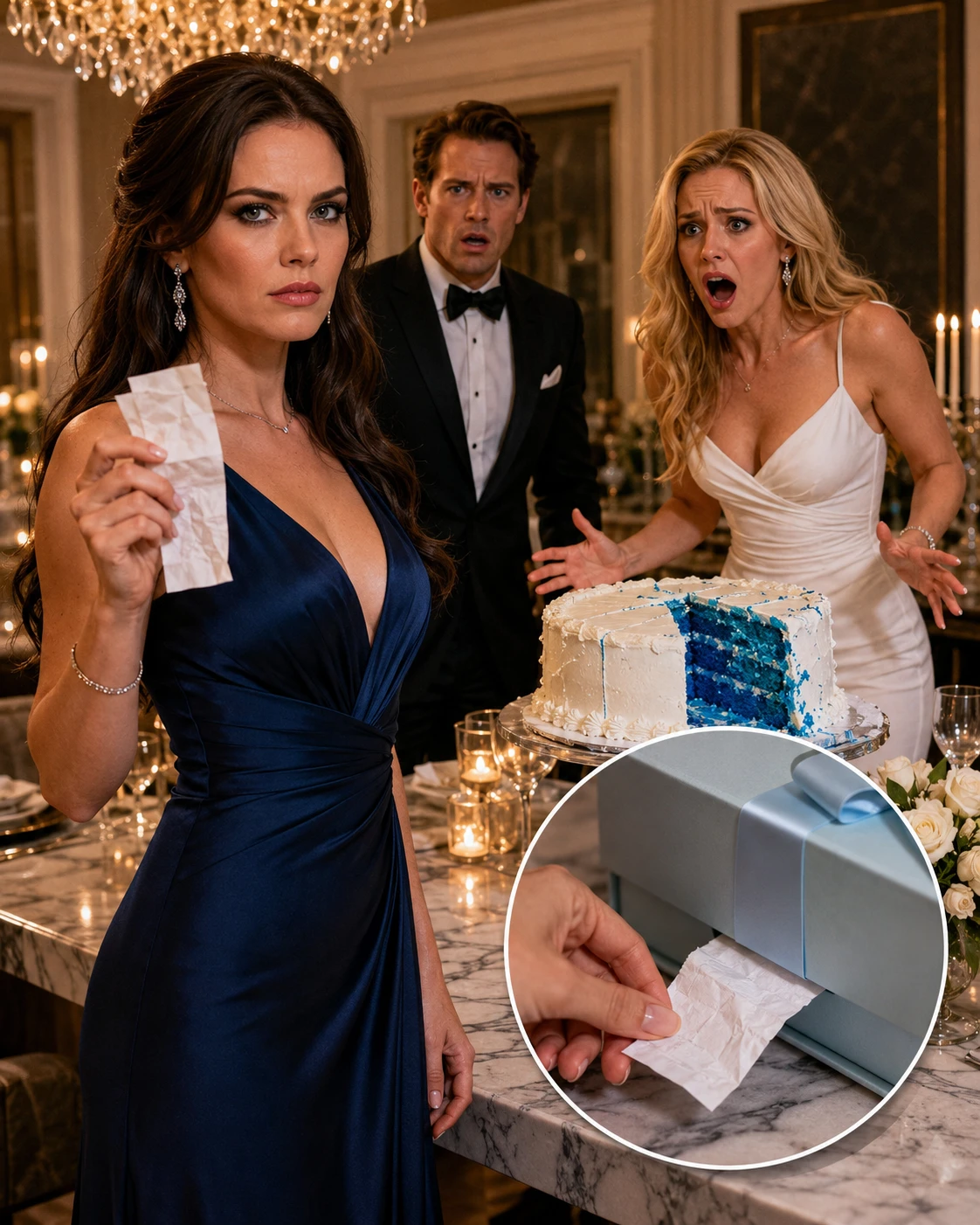

His mistress cut a pregnancy reveal cake at my mother-in-law’s birthday dinner.
The inside was blue.
For one second, the room went completely still, as if even the candles had forgotten how to flicker. Then the Whitmore dining room exploded.
Champagne glasses lifted. Silverware clattered against china. Someone screamed, “A boy!” My husband, Grant Whitmore, pushed back his chair so hard it scraped the marble floor, then covered his mouth with both hands and cried like a man receiving a kingdom.
His mother, Vivian, stood at the head of the table in a champagne silk dress, diamonds at her throat, seventy years old and still sharp enough to cut fruit with her smile. She looked at the blue crumbs falling from the knife in Sloane Mercer’s hand, then turned those cold gray eyes toward me.
“This,” Vivian said, loud enough for every guest to hear, “is what a real wife gives.”
The laughter softened into a hush. Twenty-two faces turned to me.
I did not cry.
I did not ask Grant why his hand was on Sloane’s waist.
I did not ask why his mistress was standing under my chandelier, in my house, at my table, cutting into a cake that announced a future he had promised me and betrayed with someone else.
I simply looked at the bakery box sitting on the sideboard.
Then I saw the receipt taped beneath it.
Chapter 1: The Blue Inside
The Whitmore estate sat on six acres in Greenwich, Connecticut, behind iron gates tall enough to keep out strangers and low enough to let gossip climb over.
Every December, Vivian Whitmore hosted her birthday dinner there because, according to her, “a woman should celebrate aging in a house that understands legacy.”
What she meant was that she liked reminding people that the house had a name.
Briar House.
It had been built in 1929 by a shipping family who imported marble, married bankers, and hid every scandal behind boxwood hedges. Grant loved telling guests that the study was paneled in walnut from an old Manhattan club, that the staircase had appeared in a Ralph Lauren campaign, and that the dining room table could seat thirty without using leaves.
He never told them I owned it.
Not once.
Not at cocktail parties. Not during fundraisers. Not when his mother corrected guests and said, “The Whitmore house has always attracted elegant women.”
I never corrected her, either.
Silence, I had learned, was not weakness. Sometimes silence was a mirror. People eventually walked close enough to see themselves.
That night, the mirrors saw everything.
Vivian’s dinner had been planned with the kind of precision usually reserved for royal funerals and federal raids. White amaryllis in silver bowls. Candlelight tall and trembling. A menu printed on thick cream paper: lobster bisque, beef tenderloin, roasted winter vegetables, Meyer lemon tart.
And, apparently, betrayal for dessert.
Sloane Mercer arrived at seven fifteen wearing winter white.
That was the first insult.
Everyone in Greenwich knows winter white is not a color. It is a statement. It says, I do not spill. I do not sweat. I do not apologize.
She walked in with a square bakery box tied in pale blue ribbon, her blonde hair falling over one shoulder in that effortless way women practice for hours. She kissed Vivian on both cheeks and said, “Happy birthday, Mrs. Whitmore,” as if she had not spent the last nine months sending my husband photos from hotel bathrooms.
Grant froze when he saw her.
Only for a second.
Then his face softened with panic, then longing, then something uglier. Hope.
I knew about Sloane before she knew I knew.
The first clue had been a hotel charge in Boston on a night Grant claimed he was meeting investors in Chicago. The second was a perfume note on his collar, too sweet and powdery to be mine. The third was the way he started placing his phone face down, then taking it into the shower, then sleeping with it under his pillow like it was a newborn.
I had not confronted him.
Confrontation gives liars a chance to rehearse.
Instead, I hired a private investigator named Mona Briggs, a former federal analyst with the emotional range of a locked filing cabinet and the eyes of a woman who had never been surprised by a man.
By the time Vivian’s birthday arrived, I knew the affair had begun in March at a charity auction in Palm Beach. I knew Grant had bought Sloane a Cartier bracelet in May, paid her rent in July, and called her “my clean start” in a text he sent while I was sitting across from him at our anniversary dinner.
I knew all of that.
I did not know about the cake.
Sloane set the box on the sideboard as though placing evidence in a courtroom.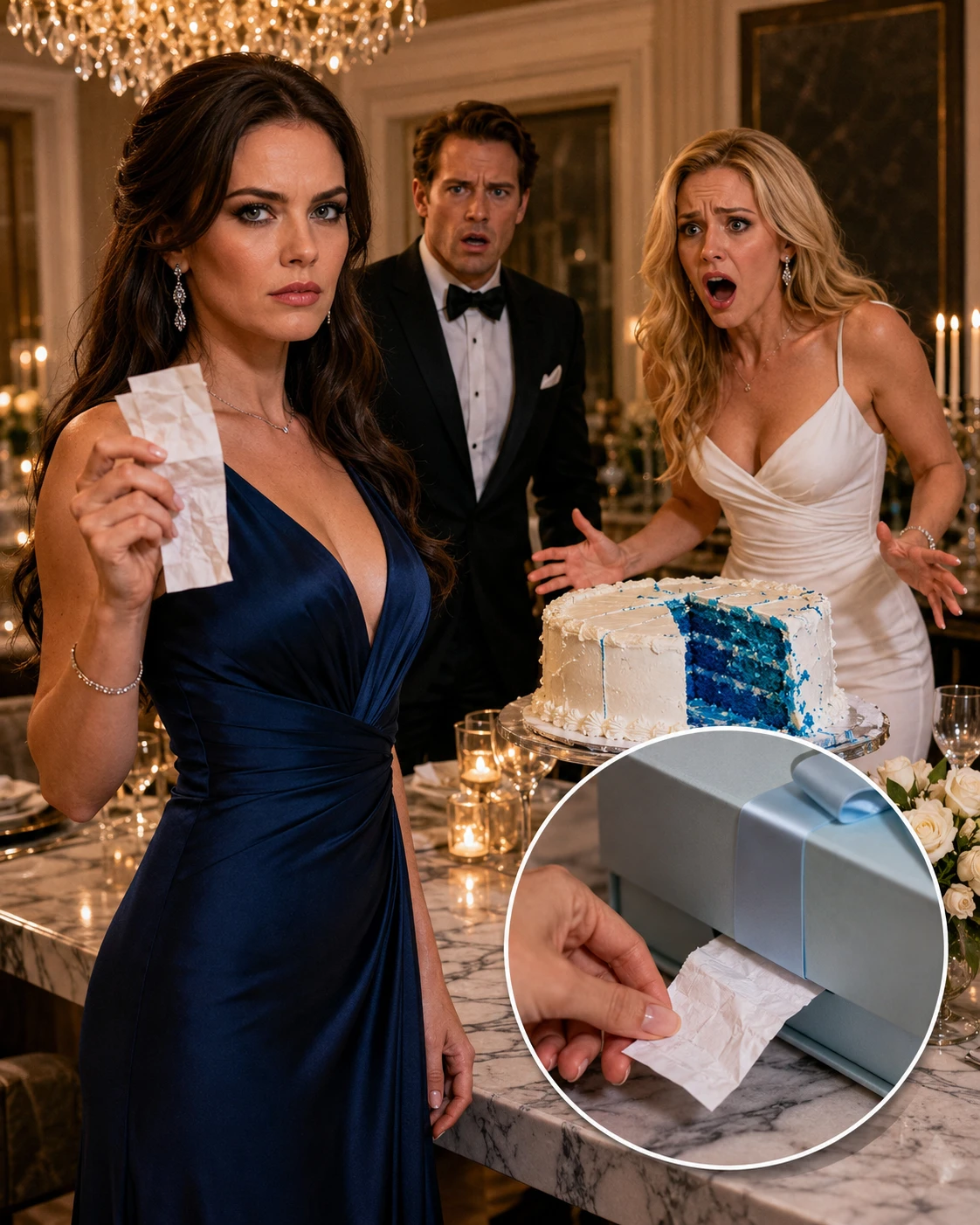
Vivian saw it. Her mouth twitched.
Not surprise.
Recognition.
That was when I understood this was not an accident. Sloane had not crashed the party. She had been invited.
Grant leaned toward his mother and whispered something. Vivian touched his sleeve. A little blessing. A little command.
I sat halfway down the table between Grant’s cousin Paige and a retired judge named Arthur Bell, both of whom suddenly became fascinated by their water glasses.
Grant had insisted I sit there instead of beside him.
“It’s Mom’s birthday,” he had said earlier while adjusting his cuff links in our bedroom mirror. “She wants me near her. Don’t make everything symbolic.”
That was Grant’s favorite trick. He would cut me, then accuse me of bleeding theatrically.
At eight thirty, after the tenderloin and before the lemon tart, Vivian tapped her knife against her glass.
“My dear friends,” she said. “Seventy is not for the faint of heart. But tonight, I believe my family has given me something far more important than another year.”
She looked at Sloane.
Sloane stood.
A sound moved through the room, not quite a gasp, not quite a murmur. The kind of sound people make when they realize they are witnessing something indecent but do not intend to leave.
Grant rose too slowly, like a man answering a call from heaven.
“Grant?” I said.
It was the only word I gave him.
He did not look at me.
Sloane untied the ribbon. Her fingers trembled, but not from fear. Excitement has its own kind of shaking.
“I know this is unconventional,” she said, voice breathy and sweet. “But love doesn’t always arrive neatly.”
No one laughed.
“And sometimes,” she continued, placing one hand on her stomach, “God gives a family exactly what it has been praying for.”
Vivian closed her eyes as though receiving communion.
Grant made a broken sound.
Sloane lifted the lid.
White cake. White frosting. Tiny sugared pearls around the edges. On top, in pale gold script, someone had written:
A NEW WHITMORE BLOOMS.
My stomach turned cold.
Sloane looked at me then.
Just once.
That look told me everything. She wanted me to break. She wanted tears, screaming, a thrown glass, a scene she could later describe as unstable. She wanted to become soft by comparison. Gentle. Pregnant. Chosen.
I folded my napkin in my lap.
“Go on,” I said.
Her smile flickered.
Grant finally looked at me then, but only because I had failed to perform the role he had written for me.
Sloane took the silver cake knife.
Vivian placed a hand over her heart.
The knife sank in.
The slice tipped.
Blue filling glowed between the layers like a bruise.
For a moment, nobody breathed.
Then the room erupted.
“A boy!”
“Oh my God!”
“Grant, congratulations!”
Vivian cried first. Of course she did. She had always been able to summon tears for an audience. Grant went to Sloane, wrapped both arms around her, and buried his face against her hair. His shoulders shook.
My husband cried.
Not when I lost our first pregnancy at eleven weeks.
Not when I came home from the hospital with an empty car seat because I had been too hopeful and bought it early.
Not when the doctor told us my scarring might make it difficult to carry again.
He cried for a blue cake.
Vivian raised her glass.
“To my grandson,” she said.
The word landed on my plate.
My grandson.
Not potential. Not baby. Not child.
Possession.
She turned to me then, her face shining with victory.
“This is what a real wife gives.”
The room went quiet enough for me to hear the candles hiss.
Grant whispered, “Mom.”
But he did not defend me.
Sloane touched her stomach and lowered her eyes in fake humility.
I looked at Vivian. Then at Grant. Then at Sloane.
I smiled.
Not warmly.
Just enough to make all three of them uneasy.
“Blue,” I said. “How lovely.”
Chapter 2: The Receipt Beneath the Box
People reveal themselves most honestly when they think you have no power.
That was the gift they gave me that night.
Vivian thought she had stripped me down to nothing in front of friends, donors, cousins, club members, and half the board of the Whitmore Family Foundation. Grant thought my silence meant shock. Sloane thought I was swallowing humiliation because I had no choice.
So they kept talking.
Vivian called for champagne. The staff hesitated, because every person who worked in that house knew what Grant had forgotten: their paychecks came from my accounts.
“Champagne,” Vivian snapped again.
I gave Marisol, our house manager, the smallest nod.
She brought the champagne.
Let them drink, I thought.
People confess more freely when they are celebrating.
Grant stood with one arm around Sloane, his other hand pressed to his eyes. “I don’t know what to say.”
That was the first truthful sentence he had spoken all night.
Sloane laughed softly. “You don’t have to say anything.”
“No,” Vivian said, lifting her glass. “He should. A Whitmore man should never apologize for continuing the family line.”
A few guests looked down.
Judge Bell’s jaw tightened.
Paige, Grant’s cousin, stared at me with something like pity, but pity has always been a cheap gift. It costs the giver nothing and leaves the receiver with nothing useful.
Grant cleared his throat.
“I know this is complicated,” he said.
Complicated.
A flat tire is complicated. A delayed flight is complicated. A man embracing his pregnant mistress in front of his wife at his mother’s birthday dinner is not complicated. It is cruel.
“But,” he continued, “I hope everyone can understand that life sometimes asks us to be honest about what we need.”
I almost laughed.
Honest.
Sloane leaned into him. Vivian beamed.
Someone at the far end of the table murmured, “How far along is she?”
There it was.
The question.
Sloane’s hand tightened around her glass. Grant looked at her. Vivian answered too quickly.
“Twelve weeks,” Vivian said. “Almost thirteen.”
Sloane nodded. “Yes. Almost thirteen.”
Almost thirteen weeks.
I felt the first click inside my mind.
Three days earlier, Mona Briggs had sent me a medical billing record from Greenwich Women’s Health. Sloane Mercer had taken a pregnancy test there on November 29.
Negative.
Mona had found another appointment scheduled for December 5, marked “confirmation bloodwork,” but the results had not been released yet. Not to the patient. Not to anyone.
Tonight was December 7.
If Sloane was almost thirteen weeks, she had known for months.
If she had known for months, why had there been a negative test nine days ago?
I looked at the cake.
The bakery box sat open on the sideboard, lid folded back, tissue paper crumpled like shed skin. The pale blue ribbon trailed down the side. Beneath the box, something white was taped flat against the cardboard bottom.
A receipt.
Most people throw receipts away.
Careful people keep them.
Guilty people hide them badly.
I rose from the table.
Every eye followed me.
Grant stiffened. “Claire?”
“I’d like a closer look at the cake,” I said.
Sloane’s smile came back. “Of course. It’s from Bellamy & Finch. Vivian said they’re the best.”
Vivian’s face twitched.
There it was again.
Recognition.
I walked to the sideboard slowly. I took the cake server and placed a small slice on a dessert plate. Blue crumbs smeared the porcelain. I set the plate down. Then, as if adjusting the box to make room, I slid my hand beneath it and felt paper.
Tape.
I peeled the receipt free with my thumb.
No one noticed at first.
They were too busy watching my face for cracks.
The receipt was folded twice. I opened it behind the cake lid.
Bellamy & Finch Custom Cakes
Order Date: October 18
Pickup Date: December 7
Cake: Vanilla almond, blue velvet filling
Message: A NEW WHITMORE BLOOMS
Customer: Vivian Whitmore
Paid: AmEx ending 4421
Special Instruction: Keep gender color concealed until cut.
October 18.
My fingers went still.
October 18 was not twelve weeks ago.
It was seven weeks ago.
And Sloane’s first documented pregnancy test—negative—had been taken more than a month after Vivian ordered the cake.
The reveal came before the baby.
I looked up.
Vivian was watching me now.
She knew.
Her eyes dropped to the receipt in my hand, and for the first time all evening, something like fear moved across her face.
Grant noticed.
“What is that?” he asked.
I folded the receipt once and slipped it into the small pearl clutch beside my plate.
“Nothing that needs frosting,” I said.
Sloane laughed too loudly. “Claire, you’re being weird.”
“No,” I said. “I’m being polite.”
That unsettled them more than anger would have.
I returned to my seat.
Grant came toward me, lowering his voice. “Can we not do this here?”
I looked at his hand, the one reaching for my shoulder.
He stopped before touching me.
“Do what?” I asked.
He swallowed.
“This isn’t how I wanted you to find out.”
“Isn’t it?”
His face flushed. “Sloane is pregnant.”
“Congratulations.”
He blinked.
Men like Grant are prepared for tears. They are prepared for accusations. They are prepared for anger because anger lets them become reasonable. Calm terrifies them. Calm suggests you have already left the room they are still trying to control.
Vivian stepped in, voice low and poisonous. “Do not embarrass this family, Claire.”
I turned to her.
“You did that without me.”
The judge coughed into his napkin.
Sloane’s cheeks pinked. “You know, I really didn’t want tonight to be hostile.”
That was when I smiled for real.
“You brought a pregnancy reveal cake to your lover’s wife’s dining room,” I said. “Hostility was baked in.”
A few guests inhaled sharply.
Grant snapped, “Enough.”
I looked at him. “Are you speaking to your wife or your audience?”
His mouth opened.
Nothing came out.
Vivian recovered faster. She always did.
“I think,” she said, lifting her chin, “that everyone here understands the tragedy of your situation, Claire. But grief does not give you ownership of a man’s future.”
There it was.
My miscarriages, reduced to an inconvenience. My marriage, reduced to his future. My pain, used as decoration for their moral superiority.
I let the silence stretch.
Then I picked up my champagne glass.
“To futures,” I said.
Grant stared at me like he had never seen me before.
Maybe he had not.
Chapter 3: The Woman Who Said Nothing
There is a particular kind of wife wealthy families prefer.
Grateful, but not needy.
Attractive, but not distracting.
Educated, but not louder than the men.
Useful, but never visibly powerful.
For nine years, the Whitmores mistook my restraint for obedience.
They forgot I had been raised by Evelyn Hart, a woman who built Hartwell Logistics from three trucks and a folding table in Savannah into one of the largest privately held freight companies in the Southeast.
My mother never raised her voice in a boardroom.
She did not need to.
When a man lied, she let him finish. When he exaggerated, she asked for dates. When he threatened, she requested documentation. Then she took his company apart one clause at a time.
“Never interrupt a person who is exposing themselves,” she used to tell me. “It’s rude, and it wastes evidence.”
So I let them speak.
Vivian took my silence as permission.
She began telling the room about legacy.
She spoke about the Whitmore men who had “built cities,” though Grant’s grandfather had mostly inherited rail money and invested in parking garages. She spoke about motherhood as sacrifice, though she had outsourced most of Grant’s childhood to boarding schools and women whose names she never remembered. She spoke about forgiveness while looking at me as if I were something stuck to the bottom of her shoe.
Sloane dabbed her eyes with a napkin.
Grant squeezed her shoulder.
It was theater.
And like all good theater, it needed an audience.
I gave them one.
I watched Vivian say, “A child heals everything.”
I watched Sloane whisper, “I never wanted to hurt anyone,” while wearing earrings Grant had bought with a card attached to my household account.
I watched Grant accept congratulations from men who had played golf with him, borrowed money from him, or wanted to. He kept glancing at me, waiting for the storm.
I gave him weatherless sky.
By nine o’clock, the guests had separated into clusters. Some gathered near Vivian, offering delighted whispers. Others drifted toward the fireplace, speaking in careful tones. Nobody left. Scandal has gravity.
I stood near the sideboard holding a cup of coffee I did not drink.
Paige came to me first.
She was Grant’s cousin, younger by five years, with the nervous kindness of someone who had survived this family by becoming decorative.
“Claire,” she whispered, “I’m so sorry.”
I looked at her.
Her eyes filled. “I didn’t know. I swear.”
“I believe you.”
She touched my wrist. “Do you want me to call someone?”
“No.”
“Are you okay?”
I looked across the room at my husband, who was laughing now, flushed with champagne, one hand resting possessively at the small of Sloane’s back.
“No,” I said. “But I am clear.”
Paige’s face changed. She understood there was a difference.
Then Vivian approached with two women from her garden club. She had waited until she had witnesses.
“Claire,” she said, all polished sorrow. “I want you to know there will always be a place for you in this family, if you behave with dignity.”
Dignity.
A word cruel people use when they want their victims quiet.
“What place?” I asked.
Vivian smiled. “That depends on you.”
Sloane appeared beside her, still holding her stomach. She had changed her posture since the reveal, pelvis forward, shoulders soft, already auditioning for maternity portraits.
“I know this must feel like a lot,” Sloane said. “But I hope someday you’ll see that I didn’t take anything that was still alive.”
The room near us quieted.
Grant turned.
I looked at Sloane.
She was twenty-seven. Twelve years younger than I was. She had been a development assistant at the Whitmore Foundation before Vivian promoted her to “special events consultant,” a title vague enough to cover meetings at hotels.
Her eyes were bright with triumph.
I thought of the baby I had lost at eleven weeks. The one Grant called “a medical thing” because saying “our child” made him uncomfortable. I thought of lying in the guest bathroom during a gala while blood soaked through my dress and Vivian knocked once, then said through the door, “Claire, people are asking where you are.”
I thought of the second loss, quieter and earlier, gone before we had told anyone.
I thought of the clinic appointments I attended alone because Grant had “board commitments.”
I thought of every time Vivian looked at my empty hands and sighed.
I wanted to slap Sloane.
Instead, I tilted my head.
“Not alive?” I asked.
Her confidence faltered.
“You know what I mean,” she said.
“No,” I replied. “I’d like you to explain.”
Grant crossed the room fast. “Claire.”
I kept my eyes on Sloane. “Explain what was not still alive.”
Sloane looked at Vivian.
Vivian’s mouth tightened.
There it was again: the tiny thread between them.
Grant saw it too. For the first time, uncertainty moved through his face.
“Sloane,” he said. “What does she mean?”
Sloane recovered. “Your marriage, Grant. I meant your marriage.”
“Ah,” I said. “Of course.”
Grant looked relieved because he wanted to be.
I set my coffee cup down.
Then the doorbell rang.
Once.
Clear and deep through the front hall.
Everyone paused.
Vivian frowned. “Who on earth—”
Marisol appeared in the doorway. Her eyes met mine.
“Mrs. Whitmore,” she said, “Mr. Price is here.”
The name entered the room like a winter draft.
Henry Price had been my family attorney for fourteen years. Sixty-two, immaculate, Southern by birth and surgical by profession. He had handled my mother’s estate, my company shares, the purchase of Briar House, and the prenuptial agreement Grant signed with a smile because he believed love made paperwork irrelevant.
Grant’s eyes narrowed.
“Why is Henry here?”
I lifted my clutch from the table.
“Because I asked him to be.”
Vivian laughed once. “At my birthday dinner?”
“No,” I said. “At my house.”
That was the first time I said it in front of them.
My house.
The words landed softly.
Then they detonated.
Chapter 4: The Doorbell at Eight-Forty-Seven
Henry Price entered in a charcoal overcoat, carrying a leather document case and the calm expression of a man who had billed by the hour through worse rooms than this one.
Behind him came Mona Briggs.
She wore a black pantsuit, no jewelry, and the expression of a locked door.
Grant stared at her. “Who is that?”
“Mona Briggs,” I said. “Private investigator.”
Sloane went pale.
Vivian’s fingers tightened around her champagne flute.
Henry nodded to the room. “Good evening. I apologize for the interruption.”
“You should,” Vivian snapped. “This is a private family event.”
Henry looked at me.
I nodded.
He removed several folders from his case. “Mrs. Whitmore asked me to be present tonight in the event certain disclosures became public.”
Grant barked a laugh. “Disclosures? Claire, what the hell is this?”
“This,” I said, “is the part where you stop performing.”
He stepped toward me. “You’re embarrassing yourself.”
“No, Grant. I’m documenting you.”
Mona lifted a small tablet.
“The dining room security system records audio in common areas,” she said. “As disclosed in the household employment agreements and posted at both service entrances.”
Vivian’s face drained of color. “You recorded us?”
“The house recorded you,” I said. “You were just loud.”
A ripple moved through the guests.
Judge Bell slowly set down his glass.
Grant’s voice dropped. “Claire, turn it off.”
“It has been on for six years.”
His mouth opened, then closed.
Henry handed him the first folder. “Grant Whitmore, you are being served with a petition for dissolution of marriage on grounds including adultery, financial misconduct, and intentional emotional cruelty.”
Grant looked at the folder as if it had bitten him.
Sloane whispered, “Financial misconduct?”
Henry handed her a folder too.
“Sloane Mercer, you are being served with notice of preservation of evidence related to civil claims concerning fraud, conspiracy, misuse of foundation resources, and unauthorized charges billed through accounts controlled by Mrs. Claire Hart Whitmore.”
Sloane looked at Grant. “You said those were your accounts.”
Grant did not answer.
Vivian placed her glass on the table. “This is absurd.”
Henry turned to her. “Mrs. Vivian Whitmore, you are being served with notice of removal from all advisory privileges related to the Hart-Whitmore Charitable Trust, effective immediately, pending investigation.”
Vivian laughed.
It was not a pleasant sound.
“You cannot remove me from my husband’s foundation.”
“My client can remove you from hers,” Henry said.
The room went silent.
Vivian looked at me.
For years, she had described the charity as “the Whitmore foundation.” She hosted its galas. She chose its flowers. She posed in magazines beside oversized checks.
She never mentioned the endowment.
My mother had funded it.
I had allowed the Whitmore name to sit beside Hart because I believed marriage was partnership. Vivian mistook generosity for surrender.
Henry continued, “The trust was established by Evelyn Hart prior to Claire’s marriage. Mr. Grant Whitmore has never held controlling authority. Mrs. Vivian Whitmore has served only at my client’s discretion.”
Sloane sat down abruptly.
Grant flipped open the folder. “This is insane.”
“No,” I said. “Insane was bringing your pregnant mistress to my dining room and letting your mother call her a real wife.”
He flinched.
Good.
Not because I wanted him hurt.
Because I wanted him awake.
Vivian’s voice sharpened. “You barren little—”
“Careful,” Henry said.
Vivian stopped.
That one word saved her from completing a sentence that would have cost her more than dignity.
I opened my clutch and removed the folded receipt.
“Since we’re discussing evidence,” I said, “let’s start with dessert.”
Grant frowned.
I handed the receipt to Henry.
He glanced at it, then passed it to Mona, who projected a copy onto the large television hidden behind the dining room paneling. Marisol had opened the cabinet without being asked.
The receipt filled the screen.
Order Date: October 18.
Pickup Date: December 7.
Cake: Blue velvet filling.
Customer: Vivian Whitmore.
The room changed.
Not loudly.
Deeply.
Like ice cracking under a lake.
Grant looked from the screen to his mother.
“Mom?”
Vivian lifted her chin. “I was excited.”
“October 18?” he said.
Sloane stood too quickly. “Grant, I can explain.”
I almost admired her instinct. Rats run toward exits. Liars run toward explanations.
Mona tapped the tablet again.
A second document appeared.
Greenwich Women’s Health.
Patient: Sloane Mercer.
Visit Date: November 29.
Urine hCG: Negative.
A sound came from Grant’s throat.
Sloane shook her head. “That was early. It can happen.”
Mona tapped again.
December 5 appointment.
Bloodwork pending.
No confirmed pregnancy on file as of December 7, 3:12 p.m.
Grant turned to Sloane.
She whispered, “I took a home test.”
Mona tapped again.
A photo appeared. A positive pregnancy test on a marble sink. The image Sloane had sent Grant two nights earlier with the caption: Our little miracle.
Then Mona zoomed in.
On the lower right corner of the photo, reflected in the chrome faucet, was a hotel logo on a hand towel.
The Langham, Boston.
The photo metadata appeared beside it.
Downloaded from public parenting forum.
Original upload date: August 3, 2021.
Sloane’s face crumpled.
Grant stepped away from her as if she had become contagious.
“You lied?” he said.
She started crying. Real tears this time. Messy, frightened, young.
“You were going to leave her,” Sloane said. “You promised me you were going to leave her.”
Grant looked at me, perhaps expecting sympathy because his mistress had deceived him while he deceived me.
I gave him none.
Sloane pointed at Vivian. “She told me to do it tonight.”
Vivian went perfectly still.
Grant turned. “What?”
Sloane’s mascara ran in dark lines. “She said if I waited for the bloodwork, Claire would find a way to ruin it. She said once everyone saw the cake, once everyone congratulated us, you’d have to choose. She said Claire would never fight in public.”
Vivian’s face hardened. “You ungrateful little idiot.”
Sloane laughed through tears. “You ordered the cake. You picked the message. You told me blue because Grant always wanted a son.”
Grant looked ill.
I watched him realize his mother had not protected him. She had used him.
It would have been satisfying if it had not been so pathetic.
He turned to me. “Claire.”
I hated the way he said my name then. Soft. Familiar. As if we were standing in our kitchen years ago, barefoot on a Sunday morning, before disappointment learned our address.
“Claire, I didn’t know the test was fake.”
I nodded.
That small mercy lit hope in his eyes.
Then I said, “But you knew she was your mistress.”
The hope died.
“You knew you were bringing her into my home,” I continued. “You knew your mother planned to humiliate me. You knew she would say something cruel about the children we lost, because she always does. You did not know the pregnancy was fake, Grant. But you knew everything that mattered.”
The room was so quiet I could hear Sloane crying into her napkin.
Henry placed another document on the table.
“This is also notice,” he said, “that all discretionary cards connected to Mrs. Whitmore’s personal trust were frozen at eight forty-five this evening.”
Grant’s head snapped up.
Vivian whispered, “What cards?”
Henry looked at her. “The American Express ending 4421, among others.”
The cake card.
Vivian gripped the back of a chair.
Henry continued, “Additionally, Briar House is held solely by the Hart Residential Trust. Mrs. Whitmore has instructed staff that any guests not personally invited by her may be removed at her discretion.”
Grant stared at me. “You’d throw my mother out on her birthday?”
I looked at Vivian.
Then at the blue cake.
“No,” I said. “I’m ending the party.”
Chapter 5: What the Cake Couldn’t Hide
People imagine revenge as shouting.
They are wrong.
Revenge, the kind that lasts, sounds like a printer. A pen. A lock changing. A bank card declined at a five-star hotel. A board secretary saying, “Your access has been revoked.” A doorman saying, “Mrs. Whitmore left no authorization for you.”
That night, revenge sounded like chairs scraping back from a dining room table.
Vivian tried to recover control.
“This is my son’s home,” she announced.
“No,” Paige said softly.
Everyone turned.
Paige swallowed, then looked at me. “It isn’t. Aunt Vivian, you know it isn’t.”
Vivian’s face twisted. “Stay out of this.”
But Paige had spent too many years staying out.
“Uncle Charles told me,” she said. “Before he died. He said Claire saved this family after Grant’s investment fund collapsed. He said she bought the house back quietly so nobody would know.”
Grant closed his eyes.
Another silence.
Another truth.
I had bought Briar House three years earlier after Grant’s private equity disaster nearly bankrupted the family’s holdings. Vivian had cried in my sitting room, not because she loved me, but because she could not bear the idea of losing the estate.
“Please,” she had said then, clutching a tissue. “If people find out, it will destroy Grant.”
So I bought the house through a trust.
I paid off the liens.
I let them keep their name on the gate.
In return, Grant promised honesty.
He gave me Sloane Mercer.
Vivian looked around the room, searching for allies.
She found witnesses instead.
Henry handed me the final envelope.
I recognized the handwriting on the front immediately.
Claire.
My heart tightened.
“Charles asked me to give this to you when you were ready,” Henry said.
Grant’s father, Charles Whitmore, had been quieter than Vivian, weaker in public, kinder in private. He died the previous spring after a short illness. In his last weeks, I visited him almost every afternoon. Grant came twice. Vivian came when photographers from the hospital charity board were present.
I opened the envelope.
Inside was a letter on thick stationery.
My hands trembled for the first time that night.
I did not read all of it aloud.
Some words belonged only to me.
But I read enough.
Claire,
If you are reading this, it means my son has mistaken your grace for emptiness, and my wife has mistaken your kindness for permission.
I am sorry.
You deserved a family when you married into ours. Instead, we gave you a stage and asked you to smile while we performed importance around you.
Grant is not cruel because he is unloved. He is cruel because he has been excused. Vivian has spent his life calling his selfishness destiny.
Do not let them use your silence as a coffin.
Briar House was never saved by a Whitmore. It was saved by you. If the day comes when they make you feel like a guest in the life you built, open the door and let them walk out of it.
With gratitude,
Charles
By the time I lowered the letter, Paige was crying.
Judge Bell removed his glasses.
Grant looked shattered.
Vivian looked furious.
That was the difference between them.
Grant had lost an illusion of himself. Vivian had lost control of everyone else’s illusion.
“You poisoned him against us,” she hissed.
“No,” I said. “You exhausted him.”
Sloane stood unsteadily. “I want to leave.”
Grant looked at her like he had forgotten she was there.
That, more than anything, broke her.
“I loved you,” she whispered.
Grant said nothing.
She laughed once, bitter and small. “Wow. Claire was right. You really only cry when you think you’re getting something.”
Then she walked toward the foyer.
No dramatic exit. No slammed door. Just heels clicking away from a room that had run out of use for her.
Vivian followed two minutes later, after Henry informed her that continued presence on the property would be considered trespassing. She did not take cake. She did not take flowers. She did not take the silver-framed photo of herself and Grant from the mantel, though she looked at it long enough for me to know she wanted to.
Grant stayed.
Of course he did.
Men like Grant always stay once the bill arrives.
The guests left in quiet waves. Coats gathered. Cars called. Apologies offered in whispers, most of them useless, a few sincere. Judge Bell took my hand in both of his and said, “Your mother would be proud.”
That nearly undid me.
After the last car disappeared down the drive, the dining room looked like the aftermath of a beautiful crime.
Candles burned low.
Champagne sweated in abandoned glasses.
Blue cake crumbs dotted the tablecloth like evidence markers.
Grant stood by the fireplace, tie loosened, face gray.
“Claire,” he said. “I know I don’t deserve anything from you.”
“That’s true.”
He flinched.
“But I need you to know,” he continued, “I never stopped loving you.”
I looked at this man I had once chosen.
I remembered him at thirty-two, laughing in Savannah rain, holding my shoes as we ran barefoot across a hotel lawn. I remembered him asleep beside me on our honeymoon, sunburned and peaceful. I remembered the first time he placed his hand on my stomach and whispered, “Maybe this time.”
I remembered love.
That was the cruelest part.
Not that it vanished.
That it had existed and still had not saved us.
“You loved what I made possible,” I said. “You loved my calm because it cleaned up your chaos. You loved my money because it dressed up your failures. You loved my grief because it made me quiet. But me? Grant, you have not looked at me in years.”
His eyes filled.
This time, I believed the tears.
They were useless, but real.
“What happens now?” he asked.
“Now you leave.”
He looked around the room. “Tonight?”
“Yes.”
“Where am I supposed to go?”
For nine years, I had arranged everything: the homes, the staff, the schedules, the anniversaries, the apologies he forgot to make. Even then, at the end, he expected me to solve the inconvenience of my own abandonment.
“I don’t know,” I said. “Ask your future.”
He bowed his head.
For a moment, I thought he would argue.
Instead, he walked to the foyer.
At the doorway, he stopped. “Was there ever a chance you would have forgiven me?”
I thought about lying. It would have been kinder.
But I was finished being kind at my own expense.
“Before tonight,” I said, “maybe.”
He nodded once, as if the word had struck him clean through.
Then he left.
The front door closed.
The house exhaled.
Conclusion: A House That Finally Felt Like Home
For a long time after everyone was gone, I stood alone in the dining room.
Not because I was frozen.
Because I wanted to remember the exact shape of the silence after cruelty leaves.
It was not empty.
That surprised me.
The room held candle smoke, winter flowers, old wood, and the faint sugar smell of ruined cake. It held my mother’s lessons. Charles’s letter. Paige’s courage. Marisol’s steady presence in the hall, waiting without intruding.
It held me.
At midnight, I took off my pearls and placed them beside the receipt.
Then I picked up the cake knife.
The blue filling had stained the silver edge.
I carried the entire cake to the kitchen, where Marisol was sitting with two members of the staff, all pretending not to worry about me.
“Throw it away?” she asked gently.
I looked at the cake.
All that money. All that planning. All that cruelty baked into vanilla almond layers and sugared pearls.
“No,” I said. “Cut it.”
Marisol blinked.
“Cut it?”
“Yes.”
So we cut the cake into slices and put them on plain white plates. No champagne. No speeches. No fake blessings. Just four women in a warm kitchen after midnight, eating evidence with forks from the staff drawer.
It tasted expensive and hollow.
We laughed at that.
Not loudly at first. Then harder.
The kind of laughter that comes after the body realizes it survived.
By morning, the locks were changed.
By Monday, Vivian’s garden club knew her card had been declined at the St. Regis.
By Wednesday, Grant’s attorney called Henry and used the word “reasonable” seventeen times.
By Friday, Sloane Mercer posted a black square on Instagram and deleted every photo of herself at Whitmore events.
Two weeks later, the bloodwork confirmed what the receipt had already told me.
No pregnancy.
No baby.
No grandson.
Only a performance staged by a desperate woman, a cruel mother, and a husband weak enough to mistake applause for love.
The divorce took eleven months.
Grant fought for money until discovery began. Then he settled quickly.
Vivian moved to Palm Beach and told anyone who would listen that I had destroyed her family. Maybe I had. Or maybe I simply stopped financing the illusion that it was whole.
Briar House changed slowly after that.
I took down the portraits of men who never knew my name. I turned Grant’s study into a library with green velvet chairs and a writing desk facing the gardens. I replaced Vivian’s silver dining room arrangements with wildflowers from the farmers market. I hosted Sunday dinners for people who never asked who owned what, only whether they could bring pie.
Paige came often.
Marisol stayed.
Henry retired the next spring and sent me a note that read, “Your mother would still be proud.”
I framed Charles’s letter, not for guests, but for myself. I kept it in my bedroom where I could read the last line whenever old guilt tried to knock.
Open the door and let them walk out of it.
A year after the birthday dinner, I turned forty.
I did not throw a gala.
I invited twelve friends into the kitchen. We made pasta by hand. Someone burned the garlic bread. Someone else spilled red wine on the counter. There was music, bad singing, and a chocolate cake from a bakery in town.
No hidden color.
No secret message.
When it came time to cut it, Paige squeezed my hand.
“You okay?” she whispered.
I looked around the kitchen at the faces turned toward me. Not waiting for me to break. Not waiting for me to perform. Just there.
“Yes,” I said.
And I meant it.
Because healing did not arrive as one grand moment. It came in small, ordinary proofs. A quiet morning. A door locked from the inside. A meal with people who loved me without needing my pain to make them feel powerful.
Sometimes freedom is not loud.
Sometimes it is a woman standing in the house she saved, holding the knife herself, choosing the first slice.
And sometimes the truth is taped underneath the box, waiting for the room to finish lying.
The cake had been ordered before the pregnancy test existed.