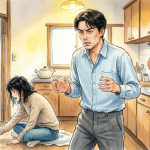
My sister left her five-year-old daughter with me for three days, and I thought I’d only have to put on cartoons and heat up some food. But on the first night, when I served her a bowl of homemade beef stew, the little girl didn’t even touch her spoon. Instead, trembling, she asked me: “Uncle… am I allowed to eat today?”

Part 2
I noticed an open seam on the doll’s belly.
It wasn’t a normal tear.
It had fresh, clumsy stitches made with black thread, as if someone had sliced it open and hurriedly sewn it back together. Ruby was clutching the doll tightly against her chest, but a tiny piece of white plastic was poking through her fingers.
A tracker.
I didn’t need Paula to explain a single thing to me. Sergio hadn’t guessed where my niece was. He had followed her.
“Ruby,” I said softly, “hand me the doll.”
She squeezed it tighter.
“He gets mad if I lose it.”
The knocks came again.
Three.
Slow.
“Robert,” Sergio called from outside. “Let’s not make a scene for the neighbors. Open up and let’s talk like family.”
Like family.
The phrase made my blood boil.


I took Ruby by the hand and led her into the kitchen, away from the front door. My house was located on a quiet street near South Congress, the kind of neighborhood where at night you can still hear the occasional car passing over the bridge, the echo bouncing off the walls. I had always considered it a safe area. Tonight, I understood that no street is safe if danger carries a copy of your key, a smile, and permission to enter.
“Paula,” I whispered into the phone, “call 911 right now. Go.”
“I already did,” she cried on the other end. “Robert, listen to me. He has keys to your house.”
I froze.
“What?”
“Months ago, he asked me for your spare copy ‘just in case something ever happened to you.’ I was such an idiot.”


I didn’t have time to reply.
The deadbolt clicked.
Sergio was putting the key in the lock.
I scooped Ruby up all at once and ran into the laundry room. I locked the door from the inside and shoved the washing machine with all my strength until it wedged tightly against the frame. Ruby didn’t scream. That was the worst part. A normal child would have cried, would have asked what was happening. She just balled herself up in my arms and placed her tiny hand over my mouth.


“Shh,” she whispered. “If we don’t make any noise, sometimes he goes away.”
Outside, the front door swung open.


Sergio’s footsteps entered my house as casually as if he were walking into his own backyard.
“Where are you, champion?” he said, using that warm, friendly tone he always put on during family dinners. “Look, I know you got scared. Paula exaggerates everything. You know how she is.”
Ruby began to tremble violently.
I dialed 911 with the speaker turned off.
A dispatcher answered. I gave her my address in a low whisper, doing the best I could. I said “domestic violence,” “minor involved,” “intruder inside my house,” “suspected camera in a child’s bedroom.” The woman didn’t interrupt me. She only instructed me to keep the line open and avoid confronting the aggressor.
Sergio was walking through the living room.
I heard him lifting things up.
The chair.
A glass.
The plate where Ruby had just eaten her dinner.
“Ah, so you did eat, princess,” he said.
Ruby closed her eyes and wet herself.
She didn’t make a sound.
I felt something inside me break forever.
“It’s okay,” I whispered into her ear. “It’s okay, my love. I’m right here with you.”
On the other side of the wall, Sergio reached the kitchen.
“Robert, don’t be ridiculous. That girl has behavioral issues. Paula can’t handle her. I was just instilling structure.”
The word structure made me sick to my stomach.
I knelt next to Ruby, took her doll, and found the uneven seam. She looked at me with sheer terror.
“I’m not going to throw it away,” I promised her. “I’m just going to take out something that shouldn’t be inside.”
Using a small pair of scissors from my sewing kit, I snipped the fabric belly open. Inside was old cotton stuffing, a tiny Ziploc bag, and a small, round tracking device. I stomped on it with my heel until it crunched.
Sergio went completely silent outside.
Then, he pounded on the laundry room door.
“That was a very bad idea.”
Ruby began to chant under her breath:
“I’m sorry, I’m sorry, I’m sorry.”
I wrapped my arms tightly around her.
“You have absolutely nothing to apologize for. Do you hear me? Nothing.”
Sergio shoved the door hard. The washing machine groaned against the floorboards.
“Open up.”
I didn’t answer.
“Open up, or I’ll tell everyone what Paula did. You think she’s innocent? You think your sister didn’t know?”
That sentence drove a painful wedge of doubt into my chest.
I looked at the phone. Paula was still on the parallel call, her breathing ragged, as if she were running.
“What did you do, Paula?” I asked.
It took her a long time to speak.
“I let him punish her.”
The silence that followed was worse than Sergio slamming against the door.
“Not like that,” she sobbed. “I swear to God I didn’t know about the camera. But I did let him send her to bed without dinner. He told me Ruby was manipulating me, that if I wasn’t firm, she would grow up ruined. I was so tired, Robert. I was afraid. I depended on him. And one day, I just stopped defending my daughter.”
I wanted to hate her.
In that moment, I did hate her.
But Ruby, who couldn’t fully comprehend everything, heard her mother weeping through the phone and whispered:
“Mommy is sad.”
That completely destroyed me.
Outside, a distant siren wailed.
Then another.
In Austin at night, sirens echo strangely between the old historic avenues and the highway grids. They sound close and far away at the same time, as if they were coming from Zilker Park and I-35 simultaneously. Sergio heard them too.
He stopped shoving the door.
“Robert,” he said, his friendly voice completely gone. “Think carefully about what you’re doing. That girl isn’t yours.”
I opened my phone’s camera app and started recording through the crack beneath the door.
“Say it again,” I replied. “Say it for the District Attorney.”
There was another silence.
Then Sergio laughed.
“You have nothing on me.”
Then Ruby, still wet and shaking, pulled away from me. She tugged at my sleeve.
“Uncle,” she said. “In the chair.”
“What?”
“Underneath the chair.”
I didn’t understand until she pointed her tiny finger toward the door.
The chair.
The one he used to block her door.
“What is underneath the chair, Ruby?”
She swallowed hard.
“The little black box. He hides it there when Mommy cleans.”
Sergio overheard.
He slammed against the door with such violence that the wood split slightly along the frame.
“Shut up!”
That word, screamed at a five-year-old girl, was what stripped away my remaining fear.
I didn’t open the door.
I didn’t go out.
I didn’t try to play the hero.
I simply put my body between the door and Ruby, while police cruisers screeched to a halt outside and neighbors began to peer out of their windows. Mrs. Higgins, the elderly lady from across the street who sold baked goods on weekends and always knew everything before anyone else, shouted from the sidewalk:
“The cops are here, you bastard!”
Sergio bolted toward the exit.
But he didn’t get far.
Two local police officers entered cautiously—one through the front door and the other through the side gate leading to the yard. They ordered him to the ground. Sergio threw his hands up immediately, instantly playing the victim of a misunderstanding.
“Officers, I’m her stepfather,” he said. “I came for the girl because they have her hidden away.”
“He is not her stepfather,” I yelled from the laundry room. “He doesn’t have custody. The child is terrified.”
When I finally managed to shift the washing machine and open the door, Ruby clung to my leg. An officer knelt down to talk to her, but she hid her face.
“Please don’t touch her,” I requested. “Please.”
A representative from the victim services unit arrived. She didn’t have the cold look of a bureaucrat. She brought a thermal blanket, water, and a voice that didn’t crowd the room. She asked Ruby if she wanted to sit down. She didn’t tell her “don’t cry.” She didn’t say “be brave.” She only said:
“You get to decide if you want to talk right now or later.”
Ruby looked at her as if she were being offered an entirely new language.
Part 3
Half an hour later, my house looked like a crime scene from a television show. Yellow tape, flashing lights, neighbors standing around in bathrobes, the harsh overhead light of the dining room shining down on the now-cold beef stew. Sergio was sitting on the curb, handcuffed, wearing the exact same crisp blue shirt he wore when he brought flowers to our family gatherings.
He was no longer smiling.
Paula arrived around two in the morning.
She hadn’t been in Dallas.
She had been hiding at a coworker’s house in West Lake Hills, where she had spent the day gathering the courage to file a report. She stepped out of a cab with her hair loose, no makeup, and a wrinkled blouse. The moment she saw Ruby, she broke down completely.
“My baby girl.”
Ruby didn’t run to her.
She stayed glued to my side.
Paula understood.
She stopped three paces away and sank to her knees on the pavement.
“Forgive me,” she said. “Forgive me, Ruby. I was supposed to protect you.”
The little girl stared down at the ground.
“Am I allowed to eat today, Mommy?”
Paula clapped her hand over her mouth to stifle a scream.
I had to look away, staring up at the city skyline, because if I looked at my sister, I was going to say something that wouldn’t help anyone. The city remained beautiful and indifferent, with its flashing lights and clean streets, as if the world could simply go on being lovely while a child had to ask permission to feed herself.
The victim services advocate spoke with Paula. Shortly after, representatives from Child Protective Services arrived. They threw around legal terms that I could barely process: failure to protect, child abuse, emergency protection orders, psychological evaluation, legal representation for minors.
Paula handed over her phone.
That was where the worst of it lay.
It wasn’t just the hidden camera.
There were text messages from Sergio to a friend, mocking the punishments. Photos of the list. Audio clips where he told Paula that a child “either breaks early or grows up useless.” And a video of Ruby crying behind a locked door while he wedged a chair against it from the outside, telling her that good girls don’t cause problems.
They didn’t let me see any more than that.
Thank God.
The police searched Paula’s house that very same morning; she authorized the entry. I rode with Ruby in the ambulance for a medical evaluation, though she refused to let go of my shirt fabric. At the Children’s Hospital, they checked her stomach, her hydration levels, and the small bruises that she automatically explained away as “I fell.”
Every “I fell” felt like a stone crushing my chest.
At six in the morning, the city began to wake up.
A pale grey light filtered through the hospital window. Outside, someone was selling hot coffee and breakfast pastries to family members who had spent the night waiting for news. That smell of warm dough made me cry without warning, because I thought of all the times a person buys food without a second thought, and of Ruby asking if I would let her eat tomorrow, too.
She was sleeping on the cot wrapped in a pink blanket.
She was squeezing my finger.
Paula sat on the other side, not touching her. Her eyes were swollen, carrying the look of someone who had just seen the full extent of her own guilt, stripped of all excuses.
“They aren’t going to let me keep her, are they?” she asked.
“I don’t know.”
“It’s better this way,” she said, her voice trembling. “They shouldn’t let me have her back until I learn how to be her mother.”
It was the first right thing I had heard her say in a long time.
The days that followed were a blur of state offices, formal statements, and absolute exhaustion. We went to the Family Justice Center, then to the District Attorney’s office, then to CPS. I learned that justice doesn’t arrive like it does in the movies, with dramatic music and a clean resolution. It arrives with photocopies, signatures, endless waiting rooms, psychologists who speak in quiet tones, social workers who look you dead in the eye, and a little girl who draws a picture of a house with no doors.
Sergio tried to fight the charges.
He claimed it was all just discipline.
He claimed Paula was unstable.
He claimed I wanted to take Ruby away just to punish my sister.
But the black recording device beneath the chair held a digital memory. And inside that memory was his voice. His calm, everyday voice. The one that dictated when a little girl could eat and when it was simply her water day.
He was formally indicted and held for trial.
I didn’t understand all the legal jargon, but I understood perfectly when the CPS attorney told me:
“For now, Ruby is not returning to that home.”
My legs felt weak with relief.
Paula signed every single document she was required to sign. She accepted court-ordered psychological therapy, protective orders, and constant supervision. She didn’t fight the temporary guardianship order. She looked at me as we walked out of the family court building and said:
“Love her better than I could.”
“That won’t be very difficult to beat,” I replied.
It hurt her.
It hurt me to say it, too.
But it was the truth.
Ruby stayed with me.
In the beginning, she would hoard bread underneath her pillow. Folded tortillas inside her clothes drawers. A banana hidden behind her coloring supplies. The child psychologist told me not to scold her, explaining that her body was still processing the fact that food wouldn’t suddenly disappear as a punishment.
So, every single night, I left a small basket right next to her bed.
An apple.
Some crackers.
A small cup of water.
And a note written in large block letters:
“YOU CAN EAT WHENEVER YOU ARE HUNGRY.”
The first time she read it, she looked up and asked:
“Even if it’s nighttime?”
“Even if it’s nighttime.”
“Even if I’m not perfectly good?”
“Even if you act exactly like a normal kid.”
She didn’t smile.
But that night, she went to sleep with the note tucked beneath her pillow.
Weeks passed.
One Sunday, I took her to the local Farmers’ Market. The air was filled with chatter, flowers, smoking brisket, vendors selling fresh produce, and kids begging for fresh-squeezed orange juice. Ruby walked glued to my side, but she was no longer asking for permission just to look around. She stopped in front of a Tex-Mex food stand and pointed at some fresh cheese.
“Am I allowed to try some?”
The words “am I allowed” still squeezed my chest tight, but this time, her voice sounded different.
It wasn’t terror.
It was an old habit slowly breaking apart.
“Yes,” I told her. “And you can also say, ‘I want to.’”
Ruby crinkled her nose, concentrating hard.
“I want to try some.”
I bought her a small plate.
She ate slowly.
She blew on it.
She chewed.
Nobody took a single thing away from her.
Afterward, we walked down toward Congress Avenue Plaza. The trees provided a deep shade, and a street musician was playing a violin near a bench. The historic stone storefronts looked freshly washed by the afternoon sun. Ruby had a purple balloon tied to her wrist and a brand-new doll tucked inside her backpack—one with no strange seams, and no dark secrets hidden inside.
“Uncle,” she said suddenly.
“What’s up, sweetie?”
“Is my mommy bad?”
I sat down with her on a bench.
I took my time responding, because easy lies do their own kind of damage.
“Your mommy did some bad things,” I told her. “Very bad things. She didn’t protect you when she was supposed to protect you.”
Ruby looked up at her balloon.
“And Sergio?”
“Sergio is dangerous. And he is never going to get anywhere near you again.”
“Never?”
“I am going to do everything humanly possible to make sure it’s never.”
She thought about that for a moment.
Then, she asked:
“Am I good?”
I felt that familiar knot tighten in my throat.
I lifted her up into my arms and set her on my lap, looking out toward the plaza—at the people walking past buying ice cream, at the tourists taking photos, at the city that just kept moving forward.
“Ruby, you don’t have to earn your food. Or hugs. Or a bed to sleep in. Or leaving the lights turned on. Or having someone protect you. You don’t earn those things. You have a right to them simply because you are a child.”
Her eyes welled up with tears.
“Even if I make a mistake?”
“Especially when you make a mistake.”
She wrapped her arms around my neck.
She wasn’t stiff anymore.
Her tiny body completely relaxed against my chest, as if she could finally rest, even if just a little bit. She cried out loud without covering her mouth. I let her cry. The sounds of the plaza continued all around us—distant bells ringing and footsteps echoing on the pavement.
That night, when we got back home, I made a fresh batch of beef stew.
The exact same one.
With potatoes, carrots, and rice.
I set two plates on the table along with a warm tortilla wrapped in a cloth napkin. Ruby climbed up onto her chair. She looked down at the steaming stew. Then, she looked up at me.
For a split second, I feared that old question would return.
But it didn’t.
She picked up her spoon.
She blew on it.
And right before taking a bite, she said:
“Tomorrow I want eggs and beans.”
I laughed.
I couldn’t help myself.
“Tomorrow we are having eggs and beans.”
Ruby took her first spoonful. Then another. She ate peacefully, her legs swinging back and forth beneath the chair, getting a tiny bit of broth on her pajamas.
When she finished, she left her spoon inside the bowl and wiped her mouth with her sleeve.
“Uncle.”
“Tell me, sweetie.”
“I was actually hungry today.”
I looked at her.
She looked right back at me.
And then, she smiled.
It wasn’t a huge smile. It wasn’t a miraculous cure. It was barely a sliver of light peaking into a house that had been locked in darkness for far too long.
But through that sliver of light, I swear to you, life finally began to find its way back in………
PART2: My sister left her five-year-old daughter with me for three days, and I thought I’d only have to put on cartoons and heat up some food. But on the first night, when I served her a bowl of homemade beef stew, the little girl didn’t even touch her spoon. Instead, trembling, she asked me: “Uncle… am I allowed to eat today?”
PART 4
THE FIRST THERAPY SESSION
Three days after the incident, I drove Ruby to her first therapy appointment.
She sat quietly in the back seat holding her new doll.
No tracker.
No stitches.
Just a normal doll.
The office was inside a small brick building surrounded by oak trees.
The waiting room had colorful books, puzzles, and stuffed animals.
Ruby stood beside me and whispered:
“Am I supposed to tell her what happened?”
The question broke my heart.
“You only tell her what you want to tell her.”
“What if she gets mad?”
“She won’t.”
The therapist’s name was Dr. Helen Martinez.
She greeted Ruby with a smile and pointed toward a shelf full of toys.
“You can talk if you want,” she said.
“Or we can just play.”
Ruby looked confused.
“That’s it?”
Dr. Martinez nodded.
“That’s it.”
For almost twenty minutes, Ruby didn’t say a single word.
She simply stacked wooden blocks.
Red.
Blue.
Yellow.
Over and over.


Then Dr. Martinez asked softly:
“What happens if the tower falls?”


Ruby froze.
Her tiny hands stopped moving.


The room became silent.
Then she whispered:


“Someone gets punished.”
Dr. Martinez didn’t react.
She didn’t gasp.
She didn’t interrupt.
She only asked:
“Who told you that?”
Ruby stared at the floor.
“Sergio.”
The rest of the session came slowly.
One small sentence at a time.
Like a child carefully walking across broken glass.
When we left, Dr. Martinez asked to speak with me privately.
“Ruby is showing signs of complex trauma.”
I swallowed hard.
“Can she recover?”
“Yes.”
The answer came immediately.
Without hesitation.
“Children are incredibly resilient when they’re finally safe.”
For the first time in weeks, I felt a tiny bit of hope.
But that hope didn’t last long.
Because later that afternoon, I received a phone call from the District Attorney’s office.
Sergio had hired an expensive defense attorney.
And he wasn’t planning to plead guilty.
He was planning to fight everything.
Every single charge.
Including the abuse.
Including the hidden camera.
Including the starvation.
The prosecutor sighed.
“He’s claiming your family invented the entire story.”
I nearly dropped the phone.
“What?”
“He says Paula is unstable. He says you’re manipulating Ruby.”
I stared out the kitchen window.
Ruby was drawing with sidewalk chalk in the backyard.
For the first time, she looked like a normal little girl.
And Sergio wanted to drag her through a courtroom.
The prosecutor continued.
“There’s something else.”
My stomach tightened.
“What?”
“The defense has requested temporary visitation.”
I felt pure rage.
“Absolutely not.”
“They won’t get it.”
“Then why ask?”
“Because abusive people often mistake control for love.”
That night, I barely slept.
At three in the morning, I heard footsteps in the hallway.
I opened my bedroom door.
Ruby was standing there.
Holding her blanket.
“Bad dream?” I asked.
She nodded.
“Can I stay here?”
For a moment, she looked terrified she would be told no.
I pulled back the covers.
“Of course.”
She climbed in beside me.
Five minutes later she was asleep.
But before she drifted off, she whispered something so quietly I almost missed it.
“Thank you for letting me be little.”
I cried after she fell asleep.
Because no child should ever have to thank someone for that.
PART 5
THE RECORDING
The next week was filled with meetings.
Lawyers.
Social workers.
Therapists.
People carrying clipboards and asking careful questions.
Through all of it, Ruby stayed close to me.
Not because anyone told her to.
Because she wanted to.
That alone felt like progress.
One afternoon, I received a call from Detective Ramirez.
“Robert, we found something.”
My stomach immediately tightened.
“What is it?”
“The black box.”
I remembered the device Ruby had mentioned beneath the chair.
The one Sergio had hidden whenever Paula cleaned the house.
The detective’s voice grew serious.
“Our tech team managed to recover the files.”
I sat down slowly.
“And?”
There was a pause.
Then he said:
“It’s worse than we thought.”
The words hit like a punch.
I drove to the police station immediately.
The evidence room was cold.
The fluorescent lights buzzed overhead.
Detective Ramirez looked exhausted.
He slid a folder across the table.
“We aren’t going to show Ruby any of this.”
“Good.”
“We’re also limiting what you see.”
“Good.”
The detective opened the folder.
Inside were photographs.
Dates.
Logs.
Records.
The black box had been recording audio for months.
Months.
Every punishment.
Every threat.
Every time Ruby cried.
Every time she begged.
Every time Sergio decided whether she could eat.
My hands shook.
“How long?”
“Approximately eleven months.”
Eleven months.
Nearly a year.
The detective pointed to one transcript.
“We think this is important.”
I forced myself to read.
RUBY: I’m hungry.
SERGIO: Then you should have listened.
RUBY: I’m sorry.
SERGIO: Sorry doesn’t fill stomachs.
I stopped reading.
I couldn’t continue.
Detective Ramirez quietly closed the folder.
“There’s more.”
My chest felt tight.
“What?”
“We found evidence suggesting Sergio wasn’t acting alone.”
The room spun.
“What do you mean?”
“He communicated with someone.”
I immediately thought of Paula.
My sister.
Ruby’s mother.
“No.”
Ramirez shook his head.
“Not Paula.”
I looked up.
“Then who?”
The detective slid over a printed text message.
One name appeared repeatedly.
A woman named Vanessa Cross.
I didn’t recognize it.
“Who is she?”
“We’re still investigating.”
The detective folded his arms.
“But whoever she is, she encouraged the punishments.”
A chill ran through me.
There were messages.
Dozens of them.
Sergio sending updates.
Vanessa responding.
Treat her like a dog and she’ll obey.
Children need consequences.
Don’t let the mother interfere.
The words made me physically sick.
“This woman knew?”
“We believe so.”
The investigation had just gotten much bigger.
When I arrived home later that evening, Ruby was sitting at the kitchen table.
She was coloring.
A giant purple dragon.
A green castle.
A yellow sun.
Normal kid stuff.
She looked up.
“You’re late.”
I smiled.
“Sorry.”
She pointed at the drawing.
“The dragon protects everybody.”
I sat beside her.
“Who’s everybody?”
She pointed.
“Those people.”
I looked closer.
There was a little girl.
A woman.
And a man.
The man had brown hair.
Just like mine.
I swallowed hard.
“That’s a nice dragon.”
She nodded proudly.
“He’s strong.”
I noticed something else.
The castle doors were wide open.
No locks.
No chairs.
No barriers.
Just open.
I didn’t realize how much that mattered until I saw it.
That night, while Ruby slept, I called Paula.
She sounded tired.
Therapy had started for her too.
Court-ordered.
Necessary.
Painful.
“They found more evidence,” I told her.
Silence.
Then:
“Against Sergio?”
“Yes.”
She began crying.
Not loudly.
Not dramatically.
Just quietly.
The way people cry when they finally stop lying to themselves.
“I should have left sooner.”
I didn’t answer.
Because we both knew it was true.
“I was scared,” she whispered.
“I know.”
“He always knew exactly what to say.”
“I know.”
“I thought I was protecting her.”
I closed my eyes.
“No.”
The silence that followed lasted several seconds.
Finally I continued.
“But you can start protecting her now.”
Paula cried harder.
The next morning brought another surprise.
A certified letter arrived at my front door.
From Sergio’s attorney.
I opened it at the kitchen counter.
The words made my blood boil.
FORMAL NOTICE OF CIVIL ACTION
The lawsuit claimed I had intentionally alienated Ruby from her family.
It accused me of kidnapping.
Manipulation.
Defamation.
Emotional abuse.
Every accusation was a lie.
Every single one.
Ruby walked into the kitchen carrying her blanket.
She looked at my face.
“What’s wrong?”
I quickly folded the papers.
“Nothing you need to worry about.”
She stared at me for a moment.
Children notice more than adults think.
Then she climbed onto a chair.
“Are bad people allowed to lie?”
I blinked.
“Sometimes they do.”
She thought carefully.
“Does that mean they win?”
I looked at her.
Really looked at her.
This little girl had survived things most adults couldn’t imagine.
Yet somehow she still believed justice was possible.
I smiled.
“No, sweetheart.”
She waited.
“Not forever.”
Ruby nodded.
Then she picked up a crayon.
And went back to drawing her dragon.
The dragon with the open castle.
The dragon that protected everybody.
The dragon that never let anyone go hungry.
What neither of us knew yet was that Detective Ramirez was about to uncover something hidden inside Sergio’s storage unit.
Something that would completely destroy his defense.
And expose a secret he had been hiding for years.
PART 6
THE STORAGE UNIT
Three days after the lawsuit arrived, Detective Ramirez called again.
This time, his voice sounded different.
Calmer.
More confident.
Like a man who finally had the missing piece.
“Robert, are you home?”
“Yes.”
“I need you to come to the station.”
My stomach tightened.
“What happened?”
“We executed a search warrant on one of Sergio’s storage units.”
I immediately stood up.
“And?”
There was a pause.
Then Ramirez said:
“We found enough evidence to bury him.”
An hour later, I was sitting across from the detective in an interview room.
The folder he carried looked twice as thick as the last one.
He set it on the table.
“The storage unit was rented under a different name.”
“Why?”
“He didn’t want anyone connecting it to him.”
The detective opened the folder.
Inside were photographs.
Shelves.
Boxes.
Plastic containers.
Everything carefully organized.
Almost obsessively organized.
The sight alone made my skin crawl.
“What’s in them?”
Ramirez slid one photograph toward me.
My blood froze.
Children’s belongings.
Dozens of them.
Tiny shoes.
Toys.
Drawings.
Blankets.
Hair ribbons.
School projects.
The room suddenly felt too small.
“Tell me those aren’t what I think they are.”
“We’re still identifying everything.”
The detective looked grim.
“But we believe many of those items belonged to children he had contact with over the years.”
I felt sick.
“You’re saying Ruby wasn’t the first?”
Ramirez didn’t answer immediately.
He didn’t need to.
The silence said enough.
“No,” he finally admitted.
“We don’t think she was.”
A cold wave of anger washed over me.
All this time, I had been imagining Sergio as a monster who destroyed one family.
The truth was worse.
He may have been doing it for years.
The detective opened another folder.
“This was hidden inside a locked filing cabinet.”
The photo showed a notebook.
A thick black notebook.
Filled with names.
Dates.
Notes.
Observations.
Children.
Their fears.
Their habits.
Their weaknesses.
The way a hunter might study prey.
I pushed the folder away.
I couldn’t look anymore.
Ramirez closed it immediately.
“I understand.”
“No.”
I rubbed my face.
“I don’t think I do.”
The detective leaned back.
“Neither do I.”
For several seconds, neither of us spoke.
Then he said:
“There’s something else.”
Of course there was.
There always seemed to be something else.
“We identified Vanessa Cross.”
“The woman from the messages?”
He nodded.
“She isn’t a girlfriend.”
“Then who is she?”
The detective slid another photo across the table.
I stared at it.
Then stared again.
I recognized her.
Not personally.
But I had seen her before.
At family events.
At birthday parties.
At barbecues.
Standing beside Sergio.
Smiling.
Friendly.
Normal.
“That’s his sister.”
Ramirez nodded.
“Yes.”
The realization hit me like a truck.
The person encouraging him.
Supporting him.
Defending him.
Was family.
His own sister.
The detective folded his hands.
“We’ve brought her in for questioning.”
“What did she say?”
“Nothing useful.”
“She lawyered up?”
“Immediately.”
Of course she did.
People like that always seemed prepared.
As I left the station, I sat in my truck for nearly ten minutes.
Just breathing.
Trying to process everything.
Trying to understand how someone could spend years hurting children.
Trying to understand how other people could watch it happen.
And then I thought about Ruby.
The answer became painfully obvious.
Monsters survive because enough people stay quiet.
When I got home, Ruby was sitting on the porch.
Waiting.
The sight made my entire day brighter.
She spotted my truck and waved.
A real wave.
Not a hesitant one.
Not one asking permission.
Just a normal kid waving.
I smiled despite everything.
“Hey, kiddo.”
“Hi.”
She climbed into my lap as soon as I sat down beside her.
The evening sun was setting behind the trees.
Everything looked golden.
Peaceful.
Safe.
Exactly what childhood should feel like.
“What did you do today?” I asked.
She grinned.
“I made pancakes.”
“You did?”
“I only burned one.”
“That’s actually pretty impressive.”
She laughed.
A genuine laugh.
The sound surprised both of us.
For a second, she almost looked shocked that it came out.
Then she laughed again.
Louder this time.
I joined her.
And for a moment, everything felt normal.
Then she became serious.
“Uncle?”
“Yeah?”
“Can I ask something?”
“Always.”
She looked down at her shoes.
“Am I going to stay here forever?”
The question hit harder than she realized.
Because I didn’t know.
The courts hadn’t decided.
The lawyers were still fighting.
The future remained uncertain.
But I knew one thing.
I would never willingly let her go back to that nightmare.
I gently brushed a strand of hair from her face.
“I don’t know exactly what happens next.”
She nodded.
“But I do know this.”
“What?”
“No matter where you live, you’re never going to be alone again.”
Ruby looked at me for several seconds.
Making sure I meant it.
Then she wrapped her arms around my neck.
And held on.
That night, after she fell asleep, I sat alone in the living room.
The house was quiet.
For the first time in weeks, I allowed myself to hope.
Not because justice was guaranteed.
Not because the case was over.
But because Ruby was changing.
Healing.
Slowly.
One day at a time.
Then my phone buzzed.
A text message.
Unknown number.
No name.
No explanation.
Just a photograph.
I opened it.
My blood instantly turned to ice.
The image showed Ruby.
Taken earlier that day.
Playing in my front yard.
Someone had been watching our house.
And beneath the photo was a single message:
YOU THINK THIS IS OVER?
PART 7
THE PHOTOGRAPH
For several seconds, I couldn’t breathe.
The photograph filled my screen.
Ruby.
Standing in the front yard.
Holding a piece of sidewalk chalk.
Laughing.
The picture had been taken that afternoon.
Maybe only hours earlier.
Which meant someone had been close enough to watch her.
Close enough to photograph her.
Close enough to know exactly where she was.
My hands immediately started shaking.
Beneath the photo were six words:
YOU THINK THIS IS OVER?
Nothing else.
No name.
No number I recognized.
No explanation.
Just a threat.
I stood up so quickly that my chair nearly tipped over.
The first thing I did was lock every door.
The second thing I did was check every window.
The third thing I did was call Detective Ramirez.
He answered on the second ring.
“Robert?”
I didn’t waste time.
“I got a message.”
His tone changed immediately.
“What kind of message?”
I sent him the screenshot.
Ten seconds later, his phone beeped.
The silence stretched.
Then:
“Don’t delete anything.”
“I wasn’t planning to.”
“Good.”
His voice grew serious.
“Stay inside tonight.”
That wasn’t exactly comforting.
“Can you trace it?”
“We’ll try.”
Try.
Not will.
Try.
I hated that word.
After the call ended, I walked upstairs.
Ruby was asleep.
Curled beneath her blanket.
One arm wrapped around her doll.
Her breathing was slow and peaceful.
I stood there for a long time.
Watching.
Making sure she was safe.
Eventually, I sat beside her bed.
The idea that someone had been watching her made me physically ill.
Nobody was going to hurt her again.
Nobody.
Not while I was alive.
The next morning, two police patrol cars parked outside my house.
One officer knocked on my door.
His name was Officer Daniels.
Tall.
Friendly.
The kind of face that made children feel comfortable.
“We’re increasing patrols around the property.”
“Any idea who sent the photo?”
He shook his head.
“Not yet.”
Not yet.
Another answer I hated.
Ruby came downstairs while we were talking.
She stopped when she saw the police cars.
Immediately, her shoulders tensed.
Fear.
Automatic.
Conditioned.
Officer Daniels crouched down.
“Good morning.”
Ruby looked at me first.
Making sure she was allowed to answer.
That old habit wasn’t completely gone.
“Good morning.”
The officer smiled.
“I heard you’re pretty brave.”
Ruby frowned.
“I’m not brave.”
“Why not?”
She thought about it.
“Because I’m scared a lot.”
The officer smiled gently.
“That’s actually what brave means.”
Ruby stared at him.
Confused.
The officer stood up.
“Have a good day, kiddo.”
After he left, Ruby followed me into the kitchen.
“Uncle?”
“Yeah?”
“Was that police officer nice?”
“He seemed nice.”
She thought about that.
Then nodded.
“Okay.”
Small victories.
That’s what recovery looked like.
Not giant breakthroughs.
Tiny moments.
Tiny steps.
Tiny pieces of trust.
Around noon, Detective Ramirez called again.
“We traced the phone.”
I immediately sat down.
“And?”
“It was purchased with cash.”
Of course it was.
“But?”
He sighed.
“But it was activated near Sergio’s storage unit.”
Hope flickered.
“Meaning?”
“Meaning whoever sent it probably has a connection to him.”
Vanessa.
The thought appeared instantly.
His sister.
The woman who encouraged the punishments.
The woman who lawyered up the second police started asking questions.
“You think it was Vanessa?”
“We don’t know yet.”
Not yet.
Again.
That evening, Ruby and I stayed home.
We made pancakes.
The second batch turned out much better than the first.
Only one slightly burned.
Ruby considered that a major achievement.
After dinner, we sat together in the living room.
She colored while I reviewed paperwork.
At one point, she looked up.
“Uncle?”
“Hmm?”
“Can I tell you a secret?”
I put the papers down immediately.
“Always.”
She looked toward the hallway.
Making sure nobody else was listening.
Then she lowered her voice.
“Sergio used to get angry when I smiled.”
My heart stopped.
“What do you mean?”
She focused on her crayons.
“He said happy kids become spoiled.”
I couldn’t speak.
“He said too much laughing makes people weak.”
I stared at her.
Trying to imagine an adult saying those words to a child.
Trying to understand how someone becomes that cruel.
Ruby continued drawing.
“He didn’t like singing either.”
“Did you like singing?”
She nodded.
A tiny nod.
“I used to.”
Used to.
Not anymore.
The realization hurt.
A piece of childhood stolen.
Another thing Sergio had taken.
I reached over and squeezed her hand.
“You know something?”
“What?”
“In this house, you’re allowed to smile.”
She looked at me carefully.
“Really?”
“Absolutely.”
“And sing?”
“As loudly as you want.”
Her eyes widened.
“Even badly?”
I laughed.
“Especially badly.”
For the first time all day, she smiled.
A real smile.
Not cautious.
Not forced.
Just happy.
Then something happened.
Something I will never forget.
Ruby started singing.
Quietly at first.
Barely above a whisper.
An old children’s song.
Off-key.
Completely imperfect.
Absolutely beautiful.
I sat there listening.
Not moving.
Not interrupting.
Just letting her sing.
Because every note felt like proof.
Proof that she was coming back.
Proof that healing was possible.
Proof that Sergio hadn’t won.
The song ended.
Ruby giggled.
Actually giggled.
Then she ran upstairs to get another coloring book.
I remained on the couch.
Smiling.
Until I heard a sound outside.
A car engine.
Slow.
Very slow.
I looked through the front window.
A black SUV rolled past the house.
Then slowed.
Then stopped.
Directly across the street.
My stomach dropped.
The windows were tinted.
Too dark to see inside.
The vehicle sat there.
Motionless.
Watching.
And after nearly thirty seconds, the driver’s side window lowered just enough for a hand to emerge.
The hand placed something on the curb.
Then the SUV drove away.
I waited until it disappeared around the corner.
Then I stepped outside.
My pulse hammering.
Lying on the curb was a small white envelope.
And written across the front in black marker were three words:
FOR RUBY ONLY.
PART 8
THE ENVELOPE
I stared at the white envelope lying on the curb.
Every instinct told me not to touch it.
The police had warned me.
The threats.
The photograph.
The black SUV.
None of it felt random anymore.
Someone was watching us.
Someone wanted us to know they were watching.
I immediately called Detective Ramirez.
Twenty minutes later, a patrol car arrived.
Officer Daniels stepped out.
He carefully photographed the envelope before placing on a pair of gloves.
“What if it’s dangerous?” I asked.
“We’ll find out.”
The envelope was sealed.
No return address.
No stamp.
No fingerprints visible.
Just three words written in thick black marker:
FOR RUBY ONLY
Officer Daniels opened it carefully.
Inside was a folded letter.
And a photograph.
The moment he saw the photograph, his expression changed.
“What?”
He handed it to me.
My stomach dropped.
The photo showed Sergio.
Much younger.
Maybe ten years younger.
Standing beside a little girl.
The girl couldn’t have been older than seven.
She looked terrified.
I flipped the picture over.
Written on the back were five words:
HE DID THIS TO ME TOO.
The entire world seemed to stop.
Officer Daniels immediately called Ramirez.
Within an hour, detectives were at my house.
The letter was sent to the crime lab.
The photo was scanned.
Every detail examined.
But before leaving, Ramirez said something that stayed with me.
“If this is real, Ruby may not be his first victim.”
I thought about the storage unit.
The toys.
The notebooks.
The recordings.
And suddenly a horrifying possibility emerged.
Maybe Ruby wasn’t the beginning.
Maybe she was simply the first child someone managed to save.
That night, I couldn’t sleep.
Around midnight, my phone rang.
Unknown number.
I answered immediately.
“Hello?”
Silence.
Then a woman spoke.
Her voice was shaking.
Barely audible.
“Is Ruby safe?”
My pulse jumped.
“Who is this?”
A pause.
Then:
“My name is Emma.”
I sat upright.
“Emma who?”
The woman inhaled sharply.
“That’s me in the photograph.”
The room went completely silent.
I gripped the phone tighter.
The little girl.
The terrified child standing beside Sergio.
“Where are you?”
“That doesn’t matter.”
“It matters if you’re in danger.”
Another pause.
Then:
“I’ve been in danger for fifteen years.”
A chill ran through me.
Fifteen years.
Fifteen.
I couldn’t even process that number.
“What happened?”
The woman began crying.
Not loudly.
Just enough for me to hear the pain.
“My mother dated Sergio when I was seven.”
I closed my eyes.
Already knowing where this was going.
“He used the same words.”
My stomach twisted.
“What words?”
She answered immediately.
“‘Good girls don’t ask for things.’”
I felt sick.
Those exact words.
The same words Ruby had repeated.
The same words Sergio had used.
The same script.
The same cruelty.
Emma continued.
“He controlled everything.”
The tears in her voice became stronger.
“Food. Sleep. Speaking. Smiling.”
Exactly like Ruby.
Exactly.
“He used chairs too.”
I froze.
The chair.
The one blocking Ruby’s bedroom.
The one hiding the recording device.
Emma’s voice broke.
“I thought I was the only one.”
I didn’t know what to say.
For years she had carried this alone.
Thinking nobody would believe her.
Thinking nobody else understood.
Then she saw Sergio on the news.
Saw the investigation.
Saw Ruby.
And finally realized she wasn’t alone.
“Why contact us now?” I asked gently.
“Because of Ruby.”
I looked upstairs.
Toward the bedroom where my niece was sleeping.
Safe.
For the moment.
Emma continued.
“When I saw her picture, I recognized the look in her eyes.”
The room became silent.
Then she whispered:
“Nobody came for me.”
The words shattered my heart.
Nobody came for me.
A sentence no child should ever have to say.
“But someone came for Ruby.”
I couldn’t speak.
“Tell her something.”
“What?”
Emma’s voice trembled.
“Tell her none of it was her fault.”
I swallowed hard.
“I will.”
“And tell her it gets better.”
The line went quiet.
Then:
“It takes time.”
A small laugh.
A sad one.
“But it gets better.”
Before I could ask another question, she said:
“I have evidence.”
My heart started racing.
“What kind of evidence?”
“Journals.”
I stood up.
“What?”
“I wrote everything down.”
Years of notes.
Years of memories.
Years of details.
The kind of evidence defense attorneys hate.
The kind of evidence juries remember.
The kind of evidence that destroys lies.
“I want to help.”
For the first time since this nightmare began, I felt something new.
Not relief.
Not hope.
Something stronger.
Momentum.
The truth was no longer standing alone.
It was growing.
And Sergio was starting to run out of places to hide.
The next morning, Detective Ramirez nearly kicked my front door down trying to get inside.
Not because something bad had happened.
Because he was excited.
Actually excited.
“Robert.”
“What happened?”
He held up a folder.
“We identified two more victims.”
My blood froze.
Two more.
Not one.
Two.
And both of them had something in common.
They remembered the same phrases.
The same punishments.
The same chair.
The same rules.
The same man.
Sergio’s carefully constructed defense was beginning to collapse.
Piece by piece.
Victim by victim.
Truth by truth.
But before Ramirez could explain further, another vehicle pulled into my driveway.
A black sedan.
Official.
Government plates.
A woman stepped out carrying a briefcase.
The District Attorney herself.
And judging by the expression on her face, she had news that was about to change everything………
PART3: My sister left her five-year-old daughter with me for three days, and I thought I’d only have to put on cartoons and heat up some food. But on the first night, when I served her a bowl of homemade beef stew, the little girl didn’t even touch her spoon. Instead, trembling, she asked me: “Uncle… am I allowed to eat today?”
PART 9
THE DISTRICT ATTORNEY
The woman stepped out of the black sedan and walked up my driveway with purpose.
She wasn’t smiling.
She wasn’t carrying the polite expression most officials wear when delivering difficult news.
She looked focused.
Determined.
Dangerously determined.
Detective Ramirez immediately straightened.
“Ma’am.”
She nodded.
Then turned to me.
“Robert?”
“Yes.”
“My name is Karen Whitmore.”
She handed me a business card.
“I am the lead prosecutor handling Sergio Alvarez’s case.”
My stomach tightened.
Prosecutors don’t usually visit people at home.
Not unless something important is happening.
“Would you mind if we talked inside?”
Ten minutes later, we were sitting at my kitchen table.
The same table where Ruby had asked if she was allowed to eat.
The memory still haunted me.
Whitmore opened a thick folder.
The first thing I noticed was how much paperwork was inside.
Far more than before.
Far more than any ordinary abuse case should contain.
She looked directly at me.
“Mr. Hayes, I need you to understand something.”
I braced myself.
“This investigation is no longer focused solely on Ruby.”
My chest tightened.
“What does that mean?”
The prosecutor took a breath.
“It means we have evidence suggesting Sergio has been targeting vulnerable children for over a decade.”
The room became completely silent.


Even Ramirez looked grim.
“Over a decade?”


Whitmore nodded.
“We currently have four confirmed victims.”


Four.
My mind immediately went to Emma.


Then the two additional victims.
Then Ruby.
Four children.
Four lives.
Four childhoods damaged by the same man.
And the investigation wasn’t finished.
Whitmore continued.
“We believe there may be more.”
I rubbed my face.
Trying to process everything.
“How many more?”
“We don’t know.”
That answer terrified me.
Because sometimes the worst number isn’t a number at all.
It’s not knowing.
The prosecutor opened another file.
“However, that’s not why I’m here.”
My stomach sank.
Of course it wasn’t.
There was more.
There always seemed to be more.
“What happened?”
Whitmore slid a photograph across the table.
At first, I didn’t understand what I was seeing.
Then my blood ran cold.
It was a bank statement.
Several bank statements.
Thousands of dollars.
Transferred repeatedly.
Different names.
Different accounts.
Different dates.
“What is this?”
The prosecutor’s expression hardened.
“We believe Sergio was being paid.”
I stared at her.
“What?”
“We don’t yet know by whom.”
The room seemed to tilt.
Paid.
Someone had been paying him.
For what?
For control?
For abuse?
For information?
My mind raced through possibilities I didn’t even want to consider.
Whitmore spoke carefully.
“We aren’t making accusations until we know more.”
“But?”
“But this case may be much larger than one abusive man.”
I couldn’t breathe for a moment.
Everything suddenly felt bigger.
Darker.
More complicated.
The prosecutor closed the file.
“We’re expanding the investigation.”
“Into what?”
“We don’t know yet.”
Those words again.
We don’t know.
The truth was still unfolding.
And every new piece seemed worse than the last.
Upstairs, a door opened.
Small footsteps crossed the hallway.
Ruby.
A few seconds later she appeared in the kitchen.
Still wearing her pajamas.
Holding her doll.
The prosecutor immediately softened.
“Hello.”
Ruby froze when she saw strangers.
Old habits.
Old fears.
I smiled.
“It’s okay, sweetheart.”
She walked over and climbed into my lap.
Something she never would have done a month ago.
Another small victory.
Whitmore watched quietly.
Then smiled.
“That’s a nice doll.”
Ruby nodded.
“No tracker.”
The room fell silent.
The prosecutor blinked.
Ramirez looked down.
My throat tightened.
To Ruby, that statement was perfectly normal.
A simple observation.
But every adult in the room understood how heartbreaking it was.
No tracker.
A child should never need to specify that.
Whitmore gently changed the subject.
“Do you like drawing?”
Ruby nodded again.
“What’s your favorite thing to draw?”
For the first time, a tiny smile appeared.
“Dragons.”
The prosecutor smiled.
“Why dragons?”
Ruby thought carefully.
Then answered:
“Because they protect people.”
Nobody spoke for a moment.
The answer hit every one of us.
Finally Whitmore nodded.
“I think that’s a very good reason.”
Ruby seemed satisfied.
Then she climbed off my lap and disappeared back upstairs.
As soon as she was gone, Whitmore looked at me.
“She’s stronger than she knows.”
I looked toward the staircase.
“No.”
I smiled sadly.
“She’s stronger than any child should ever have to be.”
The prosecutor left shortly afterward.
But before getting into her car, she stopped beside me.
“There is one more thing.”
I felt my stomach drop.
“What now?”
Whitmore hesitated.
Which scared me more than anything else.
Then she said:
“Vanessa Cross requested a meeting.”
Sergio’s sister.
The woman who encouraged the punishments.
The woman who helped him.
The woman who lawyered up.
I frowned.
“Why?”
Whitmore’s expression darkened.
“Because she wants immunity.”
My heart started pounding.
Immunity.
People ask for immunity when they know something valuable.
Or when they’re afraid.
Very afraid.
“What does she want in exchange?”
The prosecutor looked directly at me.
“The truth.”
That night I couldn’t stop thinking about Vanessa.
What could she possibly know?
Why talk now?
Why not weeks ago?
Why not years ago?
The questions followed me into the early hours of the morning.
Then, just after sunrise, my phone rang.
Detective Ramirez.
Again.
I answered immediately.
“What happened?”
For several seconds, he didn’t speak.
And that terrified me.
Then he finally said:
“Robert…”
His voice sounded stunned.
Completely stunned.
“We just opened Sergio’s laptop.”
I sat upright.
“And?”
The detective exhaled slowly.
“What we found changes everything.”
PART 10
THE LAPTOP
I was already grabbing my keys before Detective Ramirez finished speaking.
“What did you find?”
“Not over the phone.”
Those four words were enough.
Twenty minutes later, I was walking into the police station.
The atmosphere felt different.
Tense.
Focused.
People were moving quickly.
Doors opening and closing.
Phones ringing.
No one looked relaxed.
Ramirez met me in the hallway.
His face was pale.
“Tell me.”
“Come with me.”
He led me into a conference room.
The District Attorney was already there.
So were two investigators I had never seen before.
That alone worried me.
One investigator opened a laptop.
Not Sergio’s.
A police laptop containing copies of evidence.
“We recovered deleted files.”
I sat down.
“What kind of files?”
The investigator looked at Whitmore.
Whitmore nodded.
“Show him.”
The screen filled with folders.
Hundreds of folders.
Organized by year.
Each one labeled with initials.
Not names.
Initials.
A cold chill ran through me.
“What am I looking at?”
The investigator clicked one folder.
Inside were notes.
Schedules.
Observations.
Records.
The same kind of notes found in the black notebook.
Only far more detailed.
Far more disturbing.
“He documented everything,” Ramirez said quietly.
My stomach turned.
Everything.
Every punishment.
Every fear.
Every weakness.
Every child.
I felt sick.
Then I noticed something strange.
Several folders were marked with a star.
“What does that mean?”
Nobody answered immediately.
Finally Whitmore spoke.
“We believe those were children he considered ‘successful cases.’”
The room seemed to spin.
Successful.
That was how he thought.
Like a project.
An experiment.
Not a human being.
Not a child.
A case.
I looked away from the screen.
I couldn’t keep staring at it.
Then the investigator opened another file.
“This is what changed everything.”
The screen displayed financial records.
Payments.
Transfers.
Receipts.
Thousands and thousands of dollars.
The same transactions Whitmore had shown me before.
Only now there were names attached.
Real names.
Real people.
“What is this?”
The investigator took a breath.
“We believe Sergio was selling information.”
I stared.
“What kind of information?”
The answer came from Whitmore.
“Information about vulnerable families.”
The room fell silent.
I couldn’t understand.
“Why?”
“Custody disputes.”
My chest tightened.
“Explain.”
Whitmore folded her hands.
“We believe certain private investigators, attorneys, and other individuals paid him for information.”
The pieces started clicking together.
Slowly.
Terribly.
“He got close to families.”
Whitmore nodded.
“He gained trust.”
I felt nauseous.
“He learned secrets.”
Another nod.
“Then he sold them.”
“Or used them.”
Ramirez finished the thought.
The room went quiet.
This wasn’t just abuse anymore.
This wasn’t just one monster hurting children.
This was exploitation.
Manipulation.
Profit.
The destruction of families for money.
I rubbed my forehead.
“How many people knew?”
“That’s what we’re trying to determine.”
Then Whitmore slid a single document across the table.
My eyes immediately found one name.
Vanessa Cross.
Sergio’s sister.
The same woman now asking for immunity.
“What was her role?”
Whitmore looked grim.
“She managed records.”
I closed my eyes.
Of course she did.
The messages.
The encouragement.
The support.
She wasn’t standing on the sidelines.
She was involved.
Deeply involved.
Then Ramirez said something that surprised everyone.
“Not anymore.”
“What?”
He pointed toward another report.
“She turned over evidence.”
I blinked.
“She actually cooperated?”
Whitmore nodded.
“Last night.”
“Why?”
Nobody answered immediately.
Finally Whitmore spoke.
“Because she found out Ruby’s age.”
I stared.
“That doesn’t make sense.”
“It didn’t make sense to us either.”
Whitmore opened another file.
Inside was a statement from Vanessa.
Handwritten.
Signed.
Recorded.
Verified.
The woman claimed she thought Sergio was dealing with troubled teenagers.
Not little children.
Not five-year-olds.
Not kids Ruby’s age.
The moment she saw Ruby’s photograph on the news, she panicked.
Everything changed.
“She realized what she’d helped cover up.”
I leaned back.
Trying to process it.
Part of me wanted to believe her.
Part of me didn’t.
Whitmore seemed to read my thoughts.
“We’re verifying everything.”
“Do you trust her?”
“No.”
The answer came instantly.
“Do I believe she may finally be telling the truth?”
Whitmore paused.
“Possibly.”
That was the best anyone could offer.
Possibly.
After the meeting ended, I drove home.
My head was pounding.
The world felt heavier than ever.
But when I opened my front door, something unexpected happened.
I heard singing.
Not a radio.
Not a television.
Singing.
A child’s voice.
Ruby.
I followed the sound into the kitchen.
She was standing on a chair helping Mrs. Higgins make cookies.
The elderly neighbor laughed.
“Don’t tell me the dragon protector can’t crack an egg.”
Ruby giggled.
Actually giggled.
Then cracked the egg perfectly.
“See?”
Mrs. Higgins pointed.
“I told you.”
Ruby looked proud.
Confident.
Happy.
For a moment, all the darkness of the investigation faded.
The police.
The evidence.
The court case.
The threats.
All of it disappeared.
And I saw what mattered most.
A little girl learning how to be a little girl again.
That evening, after Mrs. Higgins left, Ruby carried a plate of cookies into the living room.
She handed me one.
“Careful,” she said.
“Why?”
“It’s still warm.”
I smiled.
“Thank you.”
She sat beside me.
Quiet for a moment.
Then:
“Uncle?”
“Yeah?”
“Am I allowed to be happy?”
The question hit me harder than anything else.
Harder than the recordings.
Harder than the evidence.
Harder than the threats.
Because it revealed how deep the damage truly went.
I put down the cookie.
Then turned toward her.
“Ruby.”
She looked up.
“You don’t need permission to be happy.”
Her eyes filled with tears.
“But what if somebody gets mad?”
I gently wiped a tear from her cheek.
“Then that’s their problem.”
The tiniest smile appeared.
Then another.
And finally she leaned against my shoulder.
Safe.
Comfortable.
Trusting.
A few minutes later she fell asleep.
For the first time ever, smiling.
I thought the day was finally over.
I was wrong.
Because at 11:43 p.m., Detective Ramirez called again.
And the first thing he said was:
“Robert, we found Ruby’s biological father.”
The room suddenly felt very, very quiet.
PART 11
THE FATHER
For several seconds, I couldn’t speak.
I simply stared at the phone.
“Robert?”
Ramirez’s voice brought me back.
“What do you mean you found him?”
“We found him.”
My pulse quickened.
“How?”
“Vanessa’s records.”
Of course.
More records.
More secrets.
More evidence hidden away for years.
I sat down slowly.
“Paula told everyone he left.”
“That’s what we were told too.”
The detective paused.
“Looks like that isn’t the whole story.”
An hour later, I was back at the station.
The file waiting for me wasn’t thick.
In some ways, that made it worse.
A thin file often means a simple truth.
And simple truths can destroy entire lives.
The man’s name was Daniel Mercer.
Thirty-six years old.
Former electrician.
No criminal history.
No arrests.
No protective orders.
No record of violence.
Nothing.
Absolutely nothing.
“You’re sure?”
Ramirez nodded.
“We checked everything twice.”
I looked down at Daniel’s photograph.
Brown hair.
Kind eyes.
Ordinary.
The face of someone you wouldn’t notice in a grocery store.
The face of someone who looked completely unaware that his daughter had spent years suffering.
“What happened?”
Ramirez slid over another document.
A custody filing.
Then another.
Then another.
The dates stretched back years.
My stomach sank.
“He fought for visitation.”
“Yes.”
I turned another page.
“He filed again.”
“Yes.”
Another.
“He kept filing.”
The detective nodded.
“Every time.”
I stared at the paperwork.
The picture was becoming clear.
Painfully clear.
Someone had told Daniel to go away.
Someone had convinced the courts he wasn’t needed.
Someone had convinced everyone that he abandoned his child.
And now I was terrified I knew who.
“Paula.”
Ramirez didn’t answer.
He didn’t need to.
The documents spoke for themselves.
Years ago, after a difficult breakup, Paula had claimed Daniel wasn’t interested.
Then she had slowly cut off communication.
Moved.
Changed numbers.
Ignored letters.
Ignored requests.
Ignored court notices.
And eventually Daniel had run out of money fighting.
The realization hit me like a freight train.
Ruby had lost two parents.
One through abuse.
The other through lies.
I drove home in silence.
The city lights blurred through my windshield.
Everything felt different.
Heavier.
By the time I arrived home, it was nearly two in the morning.
Yet someone was waiting on the porch.
Paula.
She stood when she saw me.
Her face immediately told me she knew.
“You found him.”
Not a question.
A statement.
I walked past her.
“How long?”
She closed her eyes.
“Robert…”
“How long?”
The pain on her face was real.
But so was my anger.
“Tell me the truth.”
Tears began rolling down her cheeks.
“Since Ruby was two.”
I felt sick.
Ruby was five now.
Three years.
Three years of separation.
Three years of lies.
“Why?”
Paula broke.
Completely.
The words poured out between sobs.
“Because Sergio hated him.”
The answer stunned me.
“What?”
“He said Daniel would take Ruby away.”
She wiped at her face.
“He convinced me Daniel didn’t really love her.”
I stared.
Unable to believe what I was hearing.
“He convinced me that if Daniel won visitation, I’d lose my daughter.”
The manipulation.
The control.
The isolation.
It was exactly how Sergio operated.
Not just on children.
On adults too.
That didn’t excuse Paula.
Not even close.
But it explained things.
The woman standing before me looked shattered.
Like someone finally seeing the full wreckage of her own choices.
“I was wrong.”
I said nothing.
“I was so wrong.”
Still nothing.
Then Paula whispered something that almost broke me.
“I stole years from both of them.”
For once, there was no excuse attached.
No justification.
No blaming someone else.
Just truth.
Raw and ugly.
The next morning, CPS approved a supervised meeting.
Not between Daniel and Ruby.
Not yet.
First they wanted to evaluate him.
Interview him.
Verify everything.
By noon, Daniel Mercer arrived.
I wasn’t prepared for what happened.
The moment he entered the room and saw Ruby’s photograph sitting on the conference table, he stopped walking.
Completely stopped.
The color drained from his face.
His hands started shaking.
Then he sat down heavily in the nearest chair.
Nobody spoke.
Not the social worker.
Not Ramirez.
Not me.
Daniel stared at the photograph for nearly thirty seconds.
Then tears began falling.
Silent tears.
The kind a person can’t stop.
The kind that come from somewhere deep.
“She’s gotten so big.”
Nobody knew what to say.
Finally Daniel looked up.
His voice cracked.
“Does she still like strawberries?”
The social worker blinked.
“What?”
Daniel laughed through tears.
“When she was little, she would steal strawberries from my plate.”
The room went quiet.
Because that wasn’t the answer of a man pretending to care.
That was a memory.
A real one.
A father’s memory.
Then Daniel asked another question.
One that shattered every heart in the room.
“Did she think I left?”
Nobody answered immediately.
Because nobody wanted to.
Eventually the social worker nodded.
Very slowly.
Daniel lowered his head.
And cried.
Not loudly.
Not dramatically.
Just quietly.
Like a man mourning years he could never get back.
That evening, when I returned home, Ruby was drawing in the living room.
A new picture.
A dragon.
A castle.
A little girl.
And something else.
A second adult standing beside me.
I pointed.
“Who’s that?”
Ruby shrugged.
“I don’t know.”
The answer seemed innocent.
But then she added:
“I think somebody is missing.”
I stared at the drawing.
Then at her.
Then back at the drawing.
Because for the first time since this nightmare began, I realized something.
This story wasn’t only about saving Ruby.
It was about giving her back everything that had been stolen.
Including a father who never stopped looking for her.
And three days later, the court approved their first meeting.
Neither Daniel nor Ruby knew it yet.
But that single meeting was about to change both of their lives forever.
PART 12
THE FIRST MEETING
The meeting was scheduled for Friday afternoon.
Neutral location.
Supervised.
One social worker.
One child psychologist.
One father.
One little girl.
And enough nerves to fill an entire building.
I barely slept the night before.
Not because I was worried about Daniel.
Everything we had learned suggested he was a good man.
A decent man.
A father who had spent years searching.
No.
I was worried about Ruby.
Because children don’t experience time the way adults do.
Three years to an adult is painful.
Three years to a child can feel like forever.
She was only five.
She barely remembered life before Sergio.
Barely remembered life before fear.
What if she didn’t remember Daniel at all?
The next morning, I helped her get dressed.
She chose a yellow shirt covered in little flowers.
Then spent fifteen minutes deciding which doll should come with her.
Eventually she selected the newest one.
The safe one.
The one without stitches.
The one without secrets.
As we drove to the family services center, she sat quietly in the back seat.
Watching the city pass by.
Finally she spoke.
“Uncle?”
“Yeah, sweetie?”
“Is today the day?”
I glanced in the rearview mirror.
“Yes.”
She looked down at her hands.
“What if he doesn’t like me?”
The question hit hard.
Because only a child who has been hurt asks something like that.
“He already likes you.”
She frowned.
“How do you know?”
I smiled.
“Because I’ve seen him cry when he talks about you.”
Ruby seemed surprised.
“Grown-ups cry?”
I laughed softly.
“More than we admit.”
That earned the tiniest smile.
The family services center was located in a quiet brick building surrounded by trees.
The waiting room felt warm.
Comfortable.
Deliberately designed to feel safe.
Still, Ruby immediately moved closer to me.
Old habits.
The social worker greeted us.
“Good afternoon, Ruby.”
Ruby nodded.
Then hid behind my leg.
The woman smiled kindly.
“Would you like a juice box?”
Ruby considered the offer.
Then whispered:
“Okay.”
Progress.
Small.
But progress.
A few minutes later, another door opened.
Daniel arrived.
The moment I saw him, I knew he hadn’t slept either.
His eyes were red.
His shirt was neatly pressed, but his hands shook.
He looked terrified.
Not of the meeting.
Of getting it wrong.
Of saying the wrong thing.
Of losing her again.
The social worker approached him.
Explained the process one final time.
Then everyone moved toward the meeting room.
Everyone except me.
I stopped at the doorway.
Ruby looked up.
“You aren’t coming?”
The question nearly broke me.
I crouched beside her.
“No, sweetheart.”
Her face immediately filled with panic.
The psychologist gently stepped closer.
“Remember what we talked about?”
Ruby nodded weakly.
I squeezed her hand.
“I’ll be right outside.”
“What if I need you?”
“Then I’ll be there.”
“What if I get scared?”
I smiled.
“Then you tell someone.”
The psychologist nodded.
“Exactly.”
Ruby took a deep breath.
Then another.
Finally she walked into the room.
The door closed.
And I began the longest forty-five minutes of my life.
I sat outside with a paper cup of coffee that I never drank.
Every minute felt like an hour.
Every time I heard movement behind the door, my heart jumped.
Then, after what felt like forever, the door finally opened.
The psychologist stepped out first.
She was smiling.
Actually smiling.
A good sign.
A very good sign.
“How did it go?”
Her smile widened.
“You should see for yourself.”
I stood immediately.
Then walked into the room.
And froze.
Daniel was sitting on the floor.
Cross-legged.
Holding a coloring book.
Ruby was beside him.
Drawing.
The two of them looked up simultaneously.
And for the first time, I saw something remarkable.
Ruby wasn’t scared.
Not nervous.
Not frozen.
Comfortable.
Daniel’s eyes were filled with tears.
Again.
But these were different tears.
Hopeful tears.
The social worker handed me a tissue.
Apparently my eyes weren’t exactly dry either.
Ruby pointed at her drawing.
“Look.”
I knelt beside her.
A dragon.
Of course.
A castle.
Of course.
And something new.
Three adults.
Not two.
Three.
Me.
Ruby.
And Daniel.
Standing together.
My throat tightened.
Daniel looked at me.
“I didn’t tell her who I was.”
I blinked.
“What?”
The psychologist nodded.
“She figured it out.”
I looked at Ruby.
“How?”
She shrugged.
As if the answer were obvious.
“He looked at me the same way Uncle Robert does.”
Nobody spoke.
Not for several seconds.
Daniel covered his eyes.
Trying unsuccessfully to stop crying.
The social worker handed him another tissue.
He laughed weakly.
Then looked at Ruby.
“You really like dragons, huh?”
Ruby nodded.
“They protect people.”
Daniel smiled.
“I like dragons too.”
That earned him a grin.
A real grin.
Then Ruby asked a question.
One simple question.
One devastating question.
“Did I do something bad?”
The room became silent.
Daniel immediately shook his head.
“No.”
Firm.
Certain.
Absolute.
“No, sweetheart.”
Ruby stared at him.
Waiting.
Daniel leaned forward slightly.
“You didn’t do anything wrong.”
The room felt very still.
“You never did.”
His voice cracked.
“But you left.”
The words were soft.
Honest.
Not accusing.
Just confused.
A child’s confusion.
Daniel closed his eyes.
For a moment I thought he might break completely.
Then he answered.
The truth.
The full truth.
“I tried to stay.”
Ruby watched him carefully.
“I tried really hard.”
Tears slid down his face.
“I just couldn’t find you.”
Nobody interrupted.
Nobody rushed the moment.
Ruby thought about his answer for a long time.
Then she did something none of us expected.
She climbed into his lap.
The room collectively stopped breathing.
Daniel froze.
Terrified of moving.
Terrified of ruining the moment.
Ruby wrapped her arms around his neck.
And hugged him.
Just hugged him.
No speech.
No dramatic music.
No perfect movie moment.
Just a little girl deciding she wanted a hug.
Daniel finally wrapped his arms around her.
Very carefully.
As if she were made of glass.
Then he cried harder than ever.
The social worker looked away.
The psychologist wiped her eyes.
Even I had to pretend something was suddenly very interesting on the ceiling.
After a few minutes, Ruby pulled back.
Then asked:
“Do you like strawberries?”
Daniel laughed through tears.
A shocked laugh.
A stunned laugh.
“Yeah.”
Ruby smiled.
“I do too.”
The room erupted into relieved laughter.
And for the first time in years, a father and daughter began building something that should never have been taken away.
But none of us knew that while this reunion was happening, Sergio had just learned about the meeting.
And inside the county jail, he was absolutely furious.
Because someone had finally given investigators a piece of evidence he thought had been destroyed forever………
PART4: My sister left her five-year-old daughter with me for three days, and I thought I’d only have to put on cartoons and heat up some food. But on the first night, when I served her a bowl of homemade beef stew, the little girl didn’t even touch her spoon. Instead, trembling, she asked me: “Uncle… am I allowed to eat today?”
PART 13
THE MISSING FLASH DRIVE
Sergio learned about the reunion two days later.
Not because anyone told him.
Because jail is full of rumors.
Lawyers talk.
Guards talk.
People overhear things.
And somehow, news travels.
When his attorney arrived for their weekly meeting, Sergio was already angry.
By the time the meeting ended, he was furious.
Because Daniel Mercer wasn’t supposed to be back in Ruby’s life.
The entire plan had depended on that.
Isolation.
Control.
Dependency.
Sergio understood those things better than anyone.
And now the people he had spent years separating were finding their way back together.
What Sergio didn’t know was that something even worse was happening.
Three hundred miles away, in a small town outside Houston, a woman named Emma was cleaning out her late grandmother’s attic.
The same Emma from the photograph.
The same Emma who had contacted us.
The same Emma who had survived Sergio fifteen years earlier.
Dust covered everything.
Old furniture.
Boxes.
Christmas decorations.
Family photographs.
She had spent most of the afternoon sorting through memories when she found an old metal lunchbox.


It wasn’t hers.
At least, she didn’t think it was.


The box was hidden beneath a loose floorboard.
Inside were childhood keepsakes.


A bracelet.
A ribbon.


Several folded drawings.
And one small flash drive.
Emma stared at it.
Something about it felt familiar.
Then she remembered.
Fifteen years earlier, when she was a child, she had secretly recorded something.
Just once.
One recording.
One moment.
One piece of evidence.
Then she had hidden it.
And forgotten where.
Her hands began to shake.
Within an hour, Detective Ramirez received a phone call.
By sunset, the flash drive was in police custody.
The following morning, Ramirez called me.
“Robert.”
His voice sounded stunned.
Again.
That was becoming a pattern.
“What happened?”
“We recovered the files.”
I sat down.
“And?”
Silence.
Then:
“You need to hear this.”
An hour later, I was back at the station.
The recording wasn’t video.
Only audio.
The timestamp showed it was nearly fifteen years old.
The room became quiet as the investigator pressed play.
At first there was static.
Then a little girl’s voice.
Emma.
Young.
Scared.
Trying not to cry.
Then another voice appeared.
Sergio.
Younger.
But unmistakable.
The same calm tone.
The same fake patience.
The same cruelty hiding beneath politeness.
I felt my stomach twist.
The recording lasted only six minutes.
Six minutes.
That was all.
But it changed everything.
Because for six minutes, Sergio spoke freely.
Confidently.
Without realizing anyone was listening.
The investigator stopped the recording.
Nobody spoke.
Nobody needed to.
The evidence was devastating.
Years before Ruby.
Years before Paula.
Years before any of us.
The pattern was already there.
The manipulation.
The punishments.
The control.
Everything.
Sergio’s attorney could no longer argue that Ruby’s case was a misunderstanding.
Or a parenting disagreement.
Or an isolated incident.
The flash drive proved otherwise.
It proved intent.
History.
Pattern.
The prosecutor called it exactly what it was.
Predatory behavior.
The strongest evidence yet.
As I left the station, I felt something I hadn’t felt in months.
Hope.
Real hope.
For the first time, I could actually imagine a future where Sergio never hurt another child.
When I got home, Daniel was there.
He had started visiting several times a week under supervision.
The process was slow.
Careful.
Healthy.
Exactly what Ruby needed.
I found them in the backyard.
Daniel was attempting to help Ruby ride a bicycle.
Attempting being the important word.
Because Ruby was clearly the better teacher.
“No, no, no,” she laughed.
“You have to run faster.”
“I’m trying.”
“You’re slow.”
“I am not slow.”
“You are absolutely slow.”
I stood on the porch smiling.
Daniel noticed me first.
“Hey.”
“Hey.”
Ruby immediately abandoned the bicycle and ran over.
Not walked.
Not cautiously approached.
Ran.
Another small miracle.
“Look!”
She pointed proudly.
“I almost rode by myself.”
“Almost?”
“Okay, I fell.”
I laughed.
“That sounds more accurate.”
She grinned.
Then her expression changed.
More serious.
“Uncle?”
“Yeah?”
“Can I ask something?”
“Always.”
She looked between Daniel and me.
Then asked:
“Can people have two safe people?”
The question caught both of us off guard.
Daniel looked down.
I swallowed hard.
“Absolutely.”
Ruby considered that.
Then nodded.
“Good.”
“Why?”
She shrugged.
“Because I think I do.”
Nobody spoke for a moment.
Because some answers are too important to interrupt.
That evening, after dinner, Ruby fell asleep on the couch.
Halfway through a movie.
Her head resting against my shoulder.
One sock missing.
Cookie crumbs on her shirt.
Completely normal.
Completely safe.
I carried her upstairs.
Tucked her into bed.
Placed her favorite dragon drawing on the nightstand.
Then turned off the light.
As I stepped into the hallway, my phone buzzed.
A text from Detective Ramirez.
Three words.
CALL ME NOW.
My stomach dropped.
I immediately dialed.
He answered before the first ring finished.
“Robert.”
“What happened?”
The detective sounded angry.
Furious, actually.
“The jail just intercepted a message.”
My pulse quickened.
“What kind of message?”
There was a pause.
Then he said:
“A message from Sergio.”
I gripped the phone tighter.
“To who?”
The answer made my blood run cold.
“To Paula.”
And according to the message, Sergio had one final secret.
A secret so serious that he believed it could destroy everything.
PART 14
THE MESSAGE FROM JAIL
I drove to the police station before sunrise.
The roads were nearly empty.
My mind wasn’t.
The entire drive, one question repeated over and over:
What secret could Sergio possibly still be hiding?
Detective Ramirez met me in an interview room.
Paula was already there.
She looked exhausted.
As if she hadn’t slept at all.
Maybe she hadn’t.
A printed copy of the message sat on the table.
Ramirez slid it toward me.
“Read it.”
I did.
The message was short.
Very short.
Only two sentences.
PAULA,
IF YOU DON’T WANT THEM TO FIND WHAT’S UNDER THE STAIRS, YOU NEED TO TALK TO ME FIRST.
My stomach dropped.
Under the stairs.
Paula looked like she might faint.
“What does it mean?”
Ramirez turned toward her.
“You tell us.”
Paula immediately shook her head.
“I don’t know.”
“Paula.”
“I swear.”
Her voice cracked.
“I don’t know.”
Ramirez studied her for several seconds.
Then nodded.
For the first time, I believed her.
Whatever was under those stairs…
She genuinely seemed unaware of it.
“Search warrant?” I asked.
Ramirez nodded.
“Already approved.”
Two hours later, we were standing outside Paula’s house.
The same house Ruby had been trapped in.
The same house where Sergio had hidden cameras.
The same house where a little girl learned to fear food.
Police officers entered first.
Then investigators.
Then forensic technicians.
The search began immediately.
The stairs Sergio mentioned led to a small storage space beneath the first floor.
An ordinary place.
Boxes.
Holiday decorations.
Cleaning supplies.
Nothing unusual.
At least at first.
Then one investigator noticed something.
A section of drywall.
Freshly painted.
Too fresh.
Ramirez looked at the wall.
Then at me.
Then back at the wall.
“Open it.”
The investigator used a small pry bar.
The drywall cracked.
Then pulled away.
And everyone froze.
Hidden inside the cavity were several sealed plastic containers.
Dozens of them.
Carefully stacked.
Carefully organized.
My blood ran cold.
Ramirez slowly opened the first container.
Inside were files.
Hundreds of pages.
Names.
Addresses.
Photographs.
Notes.
The same type of records found on Sergio’s laptop.
Only far more extensive.
The second container held flash drives.
The third held hard drives.
The fourth contained something that made the room go silent.
Children’s drawings.
Dozens of them.
Each labeled with dates.
Each preserved.
Each belonging to a different child.
I felt sick.
Truly sick.
One investigator whispered:
“My God.”
Ramirez looked furious.
Not shocked.
Not surprised.
Furious.
Because now it was undeniable.
This wasn’t one case.
This wasn’t four victims.
This was something much larger.
Something that had been hidden for years.
Then a forensic technician opened the final container.
And found a notebook.
A thick black notebook.
Different from the one in the storage unit.
Older.
Much older.
The first page contained a date from nearly twenty years ago.
Twenty.
Years.
The room became silent.
Sergio hadn’t started with Ruby.
He hadn’t started with Emma.
He hadn’t started recently.
He had been doing this for almost two decades.
Ramirez closed the notebook.
Very carefully.
As if touching something toxic.
Then he looked directly at me.
“This changes everything.”
I knew he was right.
Because if the notebook was authentic…
The investigation had just exploded.
And Sergio knew it.
That was why he sent the message.
Not to help.
Not out of guilt.
Out of fear.
Pure fear.
For the first time since his arrest, he was scared.
And that meant investigators were getting close to something he desperately wanted hidden.
Very close.
That evening, after hours of evidence collection, I returned home.
Completely exhausted.
But the moment I opened the door, Ruby came running.
Actually running.
She threw her arms around me.
“You’re back.”
I smiled.
“I’m back.”
She looked relieved.
“Good.”
I crouched down.
“Everything okay?”
She nodded.
Then hesitated.
“Mostly.”
That word caught my attention.
“Mostly?”
Ruby glanced toward the living room.
Daniel was there.
Helping assemble a bookshelf.
Poorly.
Very poorly.
Several pieces were backwards.
I immediately understood.
Ruby pointed.
“He doesn’t read instructions.”
Daniel looked offended.
“I absolutely read instructions.”
“You put the shelf upside down.”
“That happened one time.”
“It happened three times.”
I laughed so hard I nearly fell over.
For the first time in months, the house felt normal.
Messy.
Loud.
Warm.
Safe.
A real home.
The kind every child deserves.
Later that night, after Ruby fell asleep, Daniel and I sat on the porch.
The summer air was warm.
Quiet.
Peaceful.
For a while neither of us spoke.
Then Daniel finally asked:
“How bad was it?”
I knew what he meant.
How much had Ruby suffered?
How much had he missed?
How much damage needed healing?
I stared into the darkness.
Then answered honestly.
“Bad.”
Daniel nodded.
Tears filled his eyes.
Again.
“I should have found her.”
“You tried.”
“It wasn’t enough.”
No answer existed for that.
Not a good one.
Eventually he looked toward Ruby’s bedroom window.
A soft nightlight glowed behind the curtain.
Then he whispered:
“I’ll spend the rest of my life making sure she never feels abandoned again.”
I believed him.
Completely.
But neither of us knew that the notebook found under the stairs contained something even more shocking than the investigators realized.
Because hidden near the very end…
Was a name.
One name.
A name nobody expected to see.
And when Ramirez read it the next morning, he immediately ordered another arrest.
Because the name belonged to someone we all knew.
PART 15
THE NAME IN THE NOTEBOOK
The call came at 6:17 a.m.
I was making coffee.
Ruby was still asleep.
Daniel was snoring on my couch after staying late.
My phone rang.
Detective Ramirez.
Again.
I answered immediately.
“What happened?”
The detective sounded stunned.
Not angry.
Not excited.
Stunned.
“We identified the name.”
I leaned against the counter.
“What name?”
“The one at the end of the notebook.”
Silence.
Then:
“You’re not going to believe this.”
My stomach tightened.
“Try me.”
Ramirez exhaled.
“It was a judge.”
The coffee mug nearly slipped from my hand.
“What?”
“A family court judge.”
The room suddenly felt very small.
A judge.
Not a criminal.
Not a friend.
Not a relative.
A judge.
Someone trusted.
Someone powerful.
Someone involved in deciding children’s futures.
I couldn’t speak.
The implications were horrifying.
Ramirez continued.
“We don’t know the full extent yet.”
“But?”
“But we found payments.”
Of course they did.
Always payments.
Always money.
Always corruption hiding behind respectability.
The detective’s voice hardened.
“We’re moving carefully.”
“You think the judge helped him?”
“I think we need answers.”
That afternoon, federal investigators joined the case.
Federal.
Not local.
Not state.
Federal.
The situation had grown beyond anything any of us imagined.
Meanwhile, life continued.
Because somehow it always does.
Ruby still wanted pancakes.
Still argued with Daniel about bookshelf instructions.
Still drew dragons.
Still occasionally woke up from nightmares.
Healing wasn’t dramatic.
It wasn’t linear.
It happened in tiny pieces.
One safe day at a time.
That evening she sat beside me coloring.
Then suddenly asked:
“Uncle?”
“Yeah?”
“Do dragons ever get tired?”
I smiled.
“Probably.”
“Then who protects the dragon?”
I looked at her.
Really looked at her.
Then answered:
“The people who love it.”
Ruby thought about that for a moment.
Then quietly moved closer and rested her head against my arm.
Neither of us said another word.
But somehow the message felt understood.
The next morning, investigators uncovered the judge’s connection.
And what they found sent shockwaves through the entire case.
Because Sergio wasn’t the only predator hiding behind a respectable image.
Not even close.
:::
PART 16
THE SHOCKWAVE
By Friday morning, every major news station in Texas was covering the story.
The judge had resigned.
Federal agents had seized records.
Multiple investigations were underway.
And suddenly, victims were coming forward.
Not one.
Not two.
Dozens.
People who had stayed silent for years.
People who thought nobody would believe them.
People who thought they were alone.
Now they were speaking.
Because one little girl had survived long enough to tell the truth.
Ruby didn’t know any of that.
She was more focused on something else.
Her first day back at school.
A normal school.
A safe school.
A fresh start.
She stood by the front door gripping her backpack.
Nervous.
Excited.
Terrified.
All at once.
Daniel knelt beside her.
“You’ve got this.”
Ruby frowned.
“What if nobody likes me?”
I smiled.
“What if they do?”
She considered that possibility.
Apparently it had never occurred to her.
Then she nodded slowly.
And together, we walked her to the car.
A new chapter was beginning.
For Ruby.
For Daniel.
For Paula.
And maybe even for me.
But as we drove away from the house, none of us noticed the reporter parked half a block away.
Watching.
Waiting.
Because the story was about to become national news.
And suddenly, everyone wanted to know about the little girl who once asked:
“Am I allowed to eat today?”
PART 17
THE FIRST DAY OF SCHOOL
The school parking lot was packed.
Parents carrying backpacks.
Children laughing.
Teachers greeting students at the entrance.
It looked completely ordinary.
Which was exactly why Ruby was terrified.
She stood beside my truck clutching her backpack straps so tightly her knuckles turned white.
“Uncle?”
“Yeah, sweetheart?”
“What if I do something wrong?”
The question came automatically.
Like breathing.
Like blinking.
The old fear was still there.
Smaller now.
But still there.
I crouched beside her.
“You know what happens if you make a mistake at school?”
She shook her head.
“You learn.”
Ruby frowned.
“That’s it?”
“That’s it.”
She looked suspicious.
As if I were hiding the real answer.
Daniel stepped forward.
“And if somebody tells you that you aren’t allowed to make mistakes…”
He pointed toward himself.
“You send them to me.”
Ruby giggled.
The sound still felt like a miracle every time.
The school counselor met us at the entrance.
Mrs. Patterson.
Kind eyes.
Soft voice.
The type of person who understood that some children carried invisible wounds.
She knelt down.
“Ready?”
Ruby hesitated.
Then nodded.
Barely.
Mrs. Patterson smiled.
“Let’s go meet your class.”
For one second, Ruby grabbed my hand.
Hard.
Then she let go.
And walked inside.
I watched her disappear down the hallway.
My chest felt tight.
Daniel stood beside me.
Neither of us moved.
Finally he sighed.
“That was harder than I expected.”
I laughed.
“Welcome to parenthood.”
He smiled.
Then looked toward the building.
“I missed so much.”
The sadness in his voice was impossible to miss.
“You can’t change the past.”
“I know.”
“But I can show up now.”
I nodded.
“That’s what matters.”
Neither of us knew it then.
But inside classroom 2B, something important was happening.
Mrs. Patterson introduced Ruby to the class.
Twenty-two children looked up.
Twenty-two strangers.
Ruby immediately froze.
The room suddenly felt enormous.
The teacher smiled.
“Class, this is Ruby.”
A few children waved.
One little girl with curly hair smiled brightly.
“Hi.”
Ruby quietly waved back.
Then the teacher pointed toward an empty seat.
“Why don’t you sit next to Emma?”
Not THE Emma.
A different Emma.
A six-year-old girl missing her front tooth.
Ruby carefully walked over.
Sat down.
Opened her backpack.
And immediately dropped her pencil.
The pencil rolled across the floor.
The entire class saw it.
Ruby’s stomach dropped.
Her chest tightened.
She waited.
Waited for yelling.
Waited for punishment.
Waited for someone to tell her she ruined everything.
Instead…
Emma picked up the pencil.
And handed it back.
“Here.”
Ruby blinked.
“That’s okay.”
Then Emma returned to her own work.
That was it.
No punishment.
No lecture.
No anger.
Just kindness.
Ruby stared at the pencil for several seconds.
As if she couldn’t quite believe what had happened.
The rest of the day went similarly.
She accidentally spilled a little juice.
Nobody screamed.
She got a math question wrong.
Nobody took away lunch.
She laughed during recess.
Nobody called her spoiled.
By the time school ended, her entire understanding of the world had shifted just a little.
Not completely.
Healing doesn’t happen in one day.
But a little.
Enough.
When Daniel and I arrived for pickup, she came running out of the building.
Actually running.
Again.
A wonderful habit she was developing.
“Guess what!”
I smiled.
“What?”
“I got something wrong.”
I blinked.
“Okay.”
“And nothing happened.”
Daniel laughed.
“That’s usually how it works.”
Ruby looked amazed.
“School is weird.”
We all burst out laughing.
That evening she sat at the kitchen table doing homework.
Something else she’d never experienced properly before.
Halfway through a worksheet, she raised her hand.
I stared.
“Ruby.”
She blinked.
“What?”
“You don’t have to raise your hand at home.”
“Oh.”
She slowly lowered it.
Then whispered:
“I forgot.”
The words hit me harder than they should have.
Forgot.
Because that meant she was learning.
Learning safety.
Learning freedom.
Learning what normal looked like.
Later that night, after Ruby was asleep, I received a call from the District Attorney.
Karen Whitmore.
Her voice sounded serious.
Very serious.
“Robert.”
“What happened?”
“The trial date has been set.”
My pulse quickened.
Finally.
After months of evidence.
Months of investigations.
Months of waiting.
It was happening.
“When?”
“Six weeks.”
I sat down.
Six weeks.
The end was finally approaching.
Or at least the beginning of the end.
Then Whitmore said something unexpected.
“We need to talk about Ruby.”
My stomach tightened.
“What about her?”
A pause.
Then:
“The defense wants her to testify.”
The room became completely silent.
Because there was one thing I promised myself from the very beginning.
One thing.
I would protect her.
No matter what.
And suddenly the biggest battle of all was about to begin.
PART 18
THE TESTIMONY
For several seconds, I couldn’t respond.
The defense wanted Ruby to testify.
Ruby.
A six-year-old child who still sometimes hid crackers under her pillow.
A child who occasionally woke up from nightmares.
A child who was only now learning she didn’t need permission to be happy.
“No.”
The word left my mouth immediately.
Karen Whitmore sighed.
“I understand.”
“No, you don’t.”
My voice cracked.
“She has been through enough.”
“I know.”
“No, Karen.”
I stood up and began pacing.
“You didn’t hear her ask if she was allowed to eat.”
The prosecutor remained quiet.
“You didn’t watch her apologize for being hungry.”
Still silence.
Then Whitmore spoke carefully.
“I’m not saying she should testify.”
I stopped walking.
“What?”
“I’m saying the defense wants her to.”
The distinction mattered.
A lot.
I sat back down.
“Can they force her?”
“Not easily.”
That was not the answer I wanted.
Whitmore continued.
“We’re exploring alternatives.”
“What kind of alternatives?”
“Recorded interviews.”
“Previous statements.”
“Expert testimony.”
I exhaled slowly.
Better.
Still not good.
But better.
Then Whitmore added:
“There may be another option.”
“What?”
A pause.
Then:
“Someone else is willing to testify.”
The next morning, I learned who.
Emma.
The original Emma.
The woman from the photograph.
The first known victim.
She had agreed to take the stand.
Not because she wanted attention.
Not because she wanted revenge.
Because she wanted to protect Ruby.
When I met her for the first time, I understood immediately why.
She was twenty-two now.
Soft-spoken.
Thoughtful.
Nervous.
But there was strength in her too.
The kind that comes from surviving.
The kind that comes from rebuilding yourself after someone tries to break you.
We met in a conference room at the District Attorney’s office.
She looked exactly like the little girl from the photograph.
Just older.
Stronger.
“Thank you,” I said.
She smiled sadly.
“You don’t need to thank me.”
“I do.”
Emma shook her head.
“No.”
Her eyes filled with tears.
“If someone had done this for me, maybe things would have been different.”
The room fell silent.
Then she said something I’ll never forget.
“When I saw Ruby on the news, I recognized her.”
“Recognized her?”
Emma nodded.
“The way she looked at adults.”
I understood immediately.
The caution.
The fear.
The habit of apologizing.
The habit of asking permission.
Emma continued.
“I knew exactly what that meant.”
Her voice trembled.
“And I couldn’t stay quiet.”
For the first time in years, she had a chance to stop the man who hurt her.
Not through anger.
Not through revenge.
Through truth.
Weeks passed.
Preparations for trial intensified.
Experts reviewed evidence.
Witnesses met with attorneys.
The prosecution’s case grew stronger every day.
And throughout it all, Ruby kept healing.
One afternoon, I picked her up from school.
She climbed into the truck smiling.
A big smile.
A proud smile.
The kind children wear when they can’t wait to share something.
“What happened?”
She practically bounced in her seat.
“I got in trouble.”
I nearly slammed on the brakes.
“What?”
She grinned.
“I talked too much.”
For a second I just stared.
Then I laughed so hard tears came to my eyes.
The teacher had asked her to stop chatting during reading time.
That was it.
A normal childhood mistake.
A wonderfully ordinary problem.
Ruby laughed too.
“I wasn’t even scared.”
The words hit me harder than she realized.
Not scared.
For most children, that meant nothing.
For Ruby, it meant everything.
That night we celebrated with ice cream.
Not because she got in trouble.
Because she wasn’t terrified afterward.
Progress deserves recognition.
No matter how small.
A few days later, Daniel officially filed for shared custody.
The process wasn’t simple.
Nothing about this situation was simple.
But CPS supported it.
The therapists supported it.
Even Paula supported it.
That surprised everyone.
Including me.
She was changing too.
Slowly.
Painfully.
But genuinely.
One evening she stopped by the house.
Not to see me.
Not to argue.
Not to defend herself.
To bring Ruby a birthday present.
Early.
Her birthday was still weeks away.
But Paula was nervous.
Terrified, actually.
She handed over a wrapped box.
“Can you give this to her?”
I looked at it.
Then at my sister.
“You can give it to her yourself.”
The fear on her face was immediate.
“What if she doesn’t want it?”
That was the question, wasn’t it?
What if she didn’t?
What if forgiveness never came?
I answered honestly.
“Then you’ll respect that.”
Paula nodded.
Tears filling her eyes.
For once, she wasn’t asking for another chance.
She was accepting responsibility.
That mattered.
A lot.
The next afternoon, Ruby opened the gift.
Inside was a photo album.
Nothing expensive.
Nothing flashy.
Just photographs.
Pictures from before Sergio.
Pictures of Ruby as a baby.
Pictures of Daniel.
Pictures of birthdays.
Parks.
Family dinners.
Moments she couldn’t remember.
Ruby spent hours looking through it.
Quietly.
Thoughtfully.
Then she found one photograph.
A picture of herself sitting on Daniel’s shoulders.
She stared at it for a very long time.
Finally she looked up.
“That’s me?”
“Yep.”
She smiled.
“I looked happy.”
The room became very quiet.
Because she did.
She really did.
That little girl in the photograph looked completely safe.
Completely loved.
Completely free.
Ruby touched the picture gently.
Then whispered:
“I want to be her again.”
I sat beside her.
Then wrapped an arm around her shoulders.
“You will be.”
She leaned against me.
Trusting.
Comfortable.
Certain.
And for the first time, I believed it too.
But while Ruby was looking through old photographs, something unexpected happened across town.
Sergio’s attorney walked into the county jail.
And fifteen minutes later, he walked out looking completely defeated.
Because his client had just made a catastrophic mistake.
One that could destroy the entire defense…….
PART5: My sister left her five-year-old daughter with me for three days, and I thought I’d only have to put on cartoons and heat up some food. But on the first night, when I served her a bowl of homemade beef stew, the little girl didn’t even touch her spoon. Instead, trembling, she asked me: “Uncle… am I allowed to eat today?”
PART 19
THE MISTAKE
The call came from Karen Whitmore at 8:12 the next morning.
I was standing in the kitchen making breakfast.
Ruby was helping.
Or at least she claimed she was helping.
Mostly, she was eating pieces of bacon before they reached the plate.
Daniel pretended not to notice.
I pretended not to notice.
Everybody was happy.
Then my phone rang.
One look at the screen told me it was important.
Whitmore.
I answered immediately.
“Karen?”
The prosecutor sounded almost shocked.
Not angry.
Not stressed.
Shocked.
“Sergio made a mistake.”
I set down the spatula.
“What kind of mistake?”
“The kind defense attorneys have nightmares about.”
That got my attention.
“What happened?”
There was a pause.
Then Whitmore said:
“He talked.”
I frowned.
“Talked to who?”
“Another inmate.”
My stomach tightened.
“Oh no.”
“Oh yes.”
The prosecutor sounded grim.
“Apparently Sergio thought nobody was listening.”
That never ends well.
Especially in jail.
Whitmore continued.
“The conversation was recorded.”
I sat down.
Slowly.
“What did he say?”


Another pause.
Then:


“He admitted the punishments.”
The room seemed to stop.


Completely stop.
“What?”


“He called them necessary.”
I closed my eyes.
Of course he did.
Because people like Sergio rarely see themselves as villains.
They see themselves as right.
Even when they’re cruel.
Especially when they’re cruel.
The prosecutor continued.
“He described withholding food.”
I felt sick.
“He described locking doors.”
Sicker.
“He described controlling every aspect of Ruby’s routine.”
My hands clenched.
“And then?”
Karen’s voice hardened.
“Then he laughed.”
The silence that followed felt enormous.
“He laughed?”
“Yes.”
I stared out the window.
Unable to process it.
Unable to understand it.
The prosecutor spoke quietly.
“I’ve handled child abuse cases for fifteen years.”
Her voice trembled slightly.
“I’ve never heard anything like it.”
That afternoon, Sergio’s attorney requested an emergency meeting.
Not with prosecutors.
With Sergio.
Again.
Three hours later, word spread through the courthouse.
The defense was changing strategy.
Because the recording was devastating.
Absolutely devastating.
For the first time since his arrest, Sergio wasn’t looking confident.
He was looking desperate.
Meanwhile, life continued.
Ruby had soccer practice.
Her first one.
She was terrible.
Truly terrible.
The ball seemed personally offended whenever she kicked it.
At one point she managed to fall down while standing completely still.
The coach looked impressed.
I was impressed.
Daniel laughed so hard he nearly choked.
Ruby laughed too.
And that was what mattered.
Not goals.
Not winning.
Not talent.
Joy.
Pure joy.
The kind Sergio tried to erase.
The kind that kept coming back anyway.
That evening, after practice, we stopped for burgers.
Ruby ordered for herself.
No hesitation.
No asking permission.
No fear.
Just confidence.
“I want the cheeseburger.”
The waitress smiled.
“Excellent choice.”
Ruby grinned proudly.
A normal moment.
A beautiful moment.
The kind of moment healing is built from.
Later that night, after she was asleep, Daniel and I sat on the porch.
The trial was only days away now.
Everyone could feel it.
The tension.
The anticipation.
The fear.
Daniel stared into the darkness.
“What if he gets away with it?”
I understood the question.
I had asked myself the same thing.
More than once.
But tonight felt different.
Tonight, for the first time, I had an answer.
“He won’t.”
Daniel looked at me.
“You sound sure.”
I nodded.
“I am.”
The evidence.
The recordings.
The notebook.
The victims.
The flash drive.
The messages.
The truth.
There was simply too much.
For months, Sergio had controlled the story.
Controlled the people around him.
Controlled the narrative.
Not anymore.
Now the facts were speaking.
And facts don’t care how charming you are.
The next morning, I drove Ruby to school.
As she climbed out of the truck, she suddenly stopped.
Then turned around.
“Uncle?”
“Yeah?”
She smiled.
A big smile.
A fearless smile.
“I had a good dream.”
My chest tightened.
“Really?”
She nodded.
“What happened?”
She thought about it.
Then answered:
“I was flying.”
I watched her walk into school.
Back straight.
Head up.
Confident.
The image stayed with me all day.
Flying.
Because maybe that’s what healing really is.
Not forgetting what happened.
Not pretending it never hurt.
Learning that the sky still belongs to you.
That afternoon, Karen Whitmore called again.
This time her voice was serious.
Very serious.
“The judge made a ruling.”
My pulse quickened.
“What kind of ruling?”
“The defense requested Ruby testify.”
I stopped breathing.
“And?”
A pause.
Then Karen smiled through the phone.
I could hear it.
“Request denied.”
I sat down heavily.
Relief hit so hard I nearly cried.
Ruby wouldn’t have to face him.
Wouldn’t have to sit in a courtroom.
Wouldn’t have to relive everything.
For the first time in months, she could simply remain a child.
But Karen wasn’t finished.
“There is one more thing.”
Of course there was.
“What now?”
The prosecutor exhaled.
Then said four words.
“The trial starts Monday.”
And just like that, the moment we’d been moving toward since the night of the beef stew had finally arrived.
PART 20
THE TRIAL
Monday morning arrived gray and rainy.
The courthouse was already crowded when I got there.
Reporters.
Cameras.
Police.
Lawyers.
Victim advocates.
Families.
The case had become national news.
Not because of Sergio alone.
Because of what investigators uncovered around him.
The corruption.
The victims.
The years of abuse.
The system failures.
People wanted answers.
And today, they would start getting them.
I walked into the courtroom beside Daniel.
Paula sat several rows behind us.
Quiet.
Nervous.
Different.
The old Paula would have worried about appearances.
This Paula looked worried about Ruby.
That was progress too.
Then Sergio entered.
For the first time, I saw him in person since his arrest.
He looked smaller.
Not physically.
Spiritually.
The confidence was gone.
The charm was gone.
The mask was cracking.
And he knew it.
The jury filed in.
Twelve ordinary people.
Twelve people who had no idea how much pain was about to be laid before them.
Then the trial began.
And the first witness called to the stand was Emma.
The little girl from the photograph.
Only she wasn’t little anymore.
She walked confidently to the witness stand.
Raised her hand.
Took the oath.
Then sat down.
For a moment, she simply looked at Sergio.
The man who had haunted her childhood.
The man who thought she would stay silent forever.
Then she began to speak.
And by the time she finished, the entire courtroom had changed.
Because for the first time, the jury heard what Sergio really was.
Not from documents.
Not from recordings.
From someone who lived through it.
And Emma wasn’t the only survivor waiting outside that courtroom.
Not even close.
PART 21
THE SURVIVORS
By the time Emma finished her testimony, the courtroom was completely silent.
No one moved.
No one whispered.
Even the reporters had stopped typing.
Emma sat in the witness chair with tears in her eyes, but her voice never shook.
Not once.
She described the food restrictions.
The isolation.
The punishments.
The chair against the door.
The rules.
The constant fear.
Every detail matched Ruby’s experience.
Every single one.
The defense attorney stood up for cross-examination.
A tall man with silver hair and a reputation for dismantling witnesses.
He approached carefully.
“Ms. Collins, these events happened fifteen years ago, correct?”
“Yes.”
“So it’s possible your memory isn’t perfect.”
Emma looked directly at him.
“No.”
The attorney blinked.
“No?”
Emma’s voice remained calm.
“You don’t forget being hungry.”
The courtroom went silent again.
The attorney tried another angle.
“You were a child.”
“Yes.”
“Children can misunderstand situations.”
Emma nodded.
“Sometimes.”
The attorney looked hopeful.
Then Emma finished her sentence.
“But children know when they’re afraid.”
The attorney sat down five minutes later.
Defeated.
The prosecutor called the next witness.
Then the next.
Then another.
One survivor after another.
Different years.
Different families.
Different cities.
The same man.
The same patterns.
The same words.
The same cruelty.
By lunchtime, the jury looked exhausted.
Not because the testimony was confusing.
Because it was overwhelming.
The consistency was impossible to ignore.
Every witness described almost identical behavior.
No collaboration.
No contact.
No reason to lie.
Just truth.
Repeated again and again.
Like pieces of the same puzzle.
Then came the most devastating witness of all.
Vanessa Cross.
Sergio’s sister.
The courtroom practically exploded when she walked in.
Reporters sat forward.
Attorneys exchanged glances.
Even Sergio looked stunned.
For months she had protected him.
Defended him.
Supported him.
Now she was taking the stand.
She raised her hand.
Took the oath.
Sat down.
And immediately looked at the jury.
Not at Sergio.
Not at the attorneys.
The jury.
Then she said five words that changed everything.
“I knew more than I admitted.”
The room froze.
Sergio’s face turned white.
Vanessa continued.
Tears streaming down her face.
“He manipulated me.”
She swallowed hard.
“But I still helped him.”
The honesty was brutal.
Painful.
Necessary.
She described the files.
The records.
The messages.
The years of excuses she made for him.
The lies she told herself.
The things she ignored.
Then she looked directly at the jury.
“I thought I was helping my brother.”
Her voice broke.
“I was helping a predator.”
Sergio slammed his fist onto the defense table.
The judge immediately called for order.
The outburst lasted only seconds.
But the damage was done.
The jury saw it.
Everyone saw it.
The mask slipped.
For one brief moment, the charming, controlled image disappeared.
And something much darker emerged.
Court recessed shortly afterward.
Outside, reporters crowded the courthouse steps.
Inside, the atmosphere felt completely different.
The defense wasn’t winning.
The defense wasn’t surviving.
The defense was collapsing.
That evening, I returned home emotionally exhausted.
The house was quiet.
Peaceful.
Ruby sat on the living room floor drawing.
Daniel was helping with homework.
Or trying to.
The math worksheet appeared to be defeating both of them equally.
Ruby looked up.
“How was court?”
I sat beside her.
“Tiring.”
She nodded.
Then returned to drawing.
After a few moments, she held up the picture.
A dragon.
Of course.
But this time there were many people standing behind it.
Not just one child.
Lots of people.
I smiled.
“Who are they?”
Ruby considered the drawing.
Then answered:
“The people the dragon protects.”
Something tightened in my chest.
Because she didn’t know about the testimony.
Didn’t know about the survivors.
Didn’t know about Emma.
Yet somehow her drawing captured exactly what was happening.
No one was standing alone anymore.
Not anymore.
Later that night, after Ruby fell asleep, my phone rang.
Karen Whitmore.
Her voice sounded different.
Excited.
For the first time since the trial began.
“What happened?”
The prosecutor laughed softly.
“We found something.”
My stomach tightened.
“What?”
“A witness.”
I frowned.
“We already have witnesses.”
“Not like this one.”
A pause.
Then:
“This witness worked directly with Sergio.”
I sat upright.
“What?”
“He wasn’t a victim.”
The silence stretched.
Then Karen said something that made my blood run cold.
“He was Sergio’s former business partner.”
The room suddenly felt very quiet.
Because if someone from the inside was finally talking…
The trial was about to get a lot worse for Sergio.
And a lot better for the truth.
PART 22
THE PARTNER
The next morning, the courtroom was packed.
Word had spread overnight.
A new witness.
An insider.
Someone who knew Sergio personally.
The tension was palpable.
Even before proceedings began.
Then the witness entered.
His name was Mark Delaney.
Fifty-two years old.
Former private investigator.
Former business associate.
Former friend.
The keyword being former.
He looked nervous.
Very nervous.
The kind of nervous that comes from knowing your testimony might change everything.
After taking the oath, he sat down.
The prosecutor approached.
“Mr. Delaney, how long did you know the defendant?”
“About twelve years.”
The courtroom became still.
Twelve years.
Long enough to know someone.
Long enough to see who they really are.
“What was your relationship?”
“We worked together.”
“Doing what?”
Mark shifted uncomfortably.
“Background investigations.”
The prosecutor nodded.
“Did those investigations involve families?”
“Sometimes.”
The jury watched carefully.
The prosecutor continued.
“Did Sergio ever discuss children with you?”
Mark closed his eyes.
For a moment, it looked like he might not answer.
Then he did.
“Constantly.”
The room became silent.
The testimony lasted nearly three hours.
By the end, the picture was horrifying.
Mark described how Sergio collected information.
How he inserted himself into vulnerable situations.
How he gained trust.
How he learned weaknesses.
How he used them.
Then came the question that changed everything.
“Mr. Delaney, why are you testifying today?”
The witness stared at the defense table.
At Sergio.
Then answered.
“Because I was a coward.”
Nobody moved.
“I saw things that didn’t feel right.”
His voice trembled.
“I told myself it wasn’t my business.”
The courtroom remained silent.
“I told myself somebody else would stop him.”
A tear rolled down his cheek.
“I was wrong.”
Then he looked toward the jury.
“And a little girl paid the price.”
The room seemed to stop breathing.
Because everyone knew who he meant.
Ruby.
The child who asked permission to eat.
The child who believed hunger was punishment.
The child who accidentally exposed years of abuse simply by telling the truth.
When court ended that day, the defense attorney looked exhausted.
Sergio looked furious.
The prosecution looked confident.
For the first time, a verdict felt close.
Very close.
But as I drove home, I had no idea that something even more important was waiting for me.
Because when I opened the front door, Ruby came running toward me holding a piece of paper.
Her face was glowing.
“Uncle!”
“What happened?”
She practically bounced with excitement.
“I wrote something.”
I smiled.
“What?”
Ruby handed me the paper.
At the top, written in large, careful letters, were six words:
THINGS I DON’T HAVE TO EARN
My vision immediately blurred.
And as I started reading the list, I realized I might be holding the most important document in this entire story.
PART 23
THE LIST
I stared at the paper in my hands.
The handwriting was uneven.
Some letters were backwards.
A few words were misspelled.
It was perfect.
Because it was Ruby’s.
At the very top of the page she had written:
THINGS I DON’T HAVE TO EARN
My vision blurred immediately.
“Ruby…”
She shifted nervously.
“I made it in school.”
I looked down and continued reading.
- Food
- Water
- Hugs
- Blankets
- Being sleepy
- Asking questions
- Making mistakes
- Laughing
By the time I reached number eight, tears were already rolling down my face.
But the last item shattered me completely.
- Being loved
I couldn’t speak.
Not for several seconds.
Ruby stared at me.
“Were those good answers?”
Good answers.
As if this were a spelling quiz.
As if she hadn’t just summarized months of healing on a single sheet of paper.
I knelt down.
Then wrapped my arms around her.
“They’re perfect.”
Ruby smiled.
The kind of smile that no longer carried fear behind it.
The kind that belonged to a child.
A real child.
Not a survivor.
Not a victim.
Just a little girl.
That evening, I placed the list on the refrigerator.
Right in the center.
Where everyone could see it.
Daniel read it first.
Halfway through, he stopped talking.
By the end, he was crying.
Paula arrived later for a supervised visit.
She read it too.
Then quietly sat down at the kitchen table.
No excuses.
No explanations.
Just tears.
Because she understood exactly what that list meant.
It was a record.
Not of abuse.
Of recovery.
Every item represented something Ruby was finally learning.
Something she should have known all along.
That night, after everyone left, Ruby stood in front of the refrigerator.
Looking at the paper.
“Uncle?”
“Yeah?”
“Do grown-ups have lists too?”
I smiled.
“They probably should.”
She thought about that.
Then nodded seriously.
“I think yours would say coffee.”
I laughed so hard I nearly spilled my drink.
The next morning was the final week of the trial.
Closing arguments were approaching.
The courtroom felt different now.
Not tense.
Certain.
The evidence had piled too high.
The testimony had become too powerful.
Even the reporters seemed to know which direction things were heading.
Then the prosecution introduced one final exhibit.
Ruby’s list.
The defense objected immediately.
The judge overruled it.
The courtroom became silent as Karen Whitmore walked toward the jury.
She held up the page.
Not as evidence of abuse.
As evidence of impact.
“Members of the jury,” she said.
“This is what recovery looks like.”
Nobody moved.
Nobody spoke.
Whitmore continued.
“When this child was rescued, she believed food had to be earned.”
Silence.
“She believed mistakes deserved punishment.”
More silence.
“She believed love was conditional.”
The jury stared at the paper.
Every single one of them.
Then Whitmore delivered the line that would appear in newspapers across the country.
“This case is not about discipline.”
She held up the list.
“It is about what happens when a child forgets she is worthy of being loved.”
Even Sergio looked away.
For the first time during the entire trial.
He looked away.
And everyone noticed.
The defense gave its closing argument the following day.
But something had changed.
The confidence was gone.
The certainty was gone.
The story they were trying to tell no longer matched the evidence.
No longer matched reality.
No longer matched the truth.
When court adjourned, the jury received instructions.
The verdict was coming.
Finally.
Months of fear.
Months of waiting.
Months of healing.
All leading to this moment.
That evening, Ruby sat beside me on the couch.
Watching cartoons.
Completely unaware that twelve strangers were about to help decide the future.
She rested her head against my shoulder.
Then whispered:
“Uncle?”
“Yeah?”
“I’m happy today.”
I smiled.
“Me too.”
Ruby yawned.
Then fell asleep.
And for the first time since the night of the beef stew, I allowed myself to believe that tomorrow might finally bring justice.
But none of us knew that the jury would return far sooner than expected.
And when they did…
Everything would change.
PART 24
THE VERDICT
The jury returned after only six hours.
Six.
Not a day.
Not two days.
Not a week.
Six hours.
That was the first sign.
The second sign was the look on Karen Whitmore’s face when she called me.
“They’re back.”
My stomach immediately dropped.
I looked across the living room.
Ruby was building a blanket fort.
Daniel was helping.
Or trying to.
The structure looked one strong breeze away from collapse.
Neither of them knew what was happening.
Neither of them knew the day we had been waiting for had finally arrived.
“I’ll be there,” I told Karen.
Twenty minutes later, I was walking into the courthouse.
The atmosphere felt electric.
Reporters crowded the hallways.
Cameras lined the entrance.
Court officers stood at every door.
Everyone knew.
This was it.
Inside the courtroom, Sergio sat at the defense table.
For the first time, he looked nervous.
Not irritated.
Not angry.
Nervous.
His attorney looked exhausted.
Months of evidence.
Months of testimony.
Months of lies unraveling.
All leading here.
The jury filed in.
One by one.
Twelve ordinary people.
Twelve people who had listened to every recording.
Every witness.
Every survivor.
Every fact.
The judge entered.
Everyone stood.
Then sat.
And suddenly there was nothing left to do except hear the truth.
The courtroom clerk stood.
“Has the jury reached a verdict?”
The foreperson stood.
A woman in her sixties.
Steady voice.
Calm expression.
“We have.”
My pulse pounded.
The entire room seemed to stop breathing.
The clerk took the envelope.
Handed it to the judge.
The judge opened it.
Read silently.
Then looked up.
I will never forget Sergio’s face in that moment.
Because deep down…
He already knew.
The judge began reading.
“Count One.”
Silence.
“We find the defendant…”
A pause.
Then:
“Guilty.”
The room didn’t react.
Not yet.
The judge continued.
“Count Two.”
Another pause.
“Guilty.”
Then another.
And another.
And another.
Every count.
Every charge.
Every victim.
Every crime.
Guilty.
Guilty.
Guilty.
Guilty.
The word echoed through the courtroom over and over.
Like a hammer.
Like justice.
Like truth finally catching up.
By the time the final count was read, several jurors were crying.
Emma was crying.
Vanessa was crying.
Paula was crying.
I was crying.
Only Sergio wasn’t.
He simply sat there.
Staring forward.
Expressionless.
As if he still couldn’t believe consequences applied to him.
The judge wasn’t finished.
Because sentencing had already been partially agreed upon due to the overwhelming evidence.
The courtroom became silent again.
Then the judge delivered the final decision.
A sentence so long that Sergio would spend the rest of his life behind bars.
The rest of his life.
No release.
No second chance.
No future victims.
No more little girls asking permission to eat.
The judge finished speaking.
The courtroom remained silent.
Then something unexpected happened.
Emma stood.
Nobody stopped her.
She turned toward Sergio.
Looked directly at him.
Then said:
“You don’t get to be the voice in our heads anymore.”
The room froze.
Years of fear.
Years of pain.
Years of silence.
Reduced to a single sentence.
And somehow it was enough.
Because she was right.
He didn’t.
Not anymore.
Court adjourned shortly afterward.
Outside, reporters rushed toward everyone.
Questions.
Cameras.
Microphones.
Noise.
So much noise.
I avoided all of it.
I only wanted to go home.
When I opened the front door, Ruby looked up from inside her blanket fort.
“You’re back.”
I smiled.
“I’m back.”
She immediately noticed my eyes.
“Why were you crying?”
I sat beside her.
Then took a deep breath.
Because this mattered.
The truth mattered.
“He can’t hurt anyone anymore.”
Ruby stared at me.
Processing.
Thinking.
Then:
“Ever?”
“Ever.”
The room became very quiet.
Ruby looked down at her hands.
Then at the floor.
Then finally back at me.
And for the first time in the entire story…
She relaxed completely.
Not a little.
Not partly.
Completely.
The kind of relaxation that comes when danger is finally gone.
The kind of peace that arrives after surviving a storm.
Then she crawled into my lap.
Rested her head against my chest.
And whispered:
“Okay.”
Just one word.
Okay.
But inside that word was relief.
Safety.
Freedom.
A future.
I held her tightly.
And for the first time since the night of the beef stew…
Neither of us was afraid of tomorrow.
But the story wasn’t over.
Because justice is not the same thing as healing.
And the next chapter wasn’t about Sergio.
It was about family.
PART 25
THE BIRTHDAY
Two weeks after the verdict, Ruby turned six.
It was the first birthday she could actually remember.
Not because previous birthdays hadn’t happened.
Because previous birthdays had been spent surviving.
This one was different.
This one was safe.
I woke up early that morning and quietly decorated the kitchen.
Nothing extravagant.
A few balloons.
Some streamers.
A banner that read:
HAPPY BIRTHDAY RUBY
Daniel arrived carrying a cake box almost as big as he was.
Mrs. Higgins brought cookies.
The neighbors brought gifts.
Even Paula came.
Nervous.
Terrified.
Hopeful.
The entire house felt warm.
Alive.
Happy.
At exactly 8:03 a.m., Ruby came downstairs.
Still wearing dinosaur pajamas.
Still half asleep.
Then she stopped.
The kitchen exploded with cheers.
“Happy Birthday!”
Ruby jumped.
Then stared.
Balloons.
Decorations.
Cake.
Presents.
People.
For several seconds she didn’t move.
Then tears filled her eyes.
My heart nearly stopped.
“Oh no.”
I crouched beside her.
“Sweetheart?”
She looked at me.
“Is all this for me?”
The question hit everyone at once.
Daniel immediately looked away.
Mrs. Higgins started crying.
Even Paula covered her mouth.
Because yes.
All of it was for her.
And the fact that she had to ask broke every heart in the room.
I smiled.
“Every single bit.”
Ruby looked around again.
Then whispered:
“Nobody’s mad?”
The room became silent.
I gently shook my head.
“No one is mad.”
A tear slid down her cheek.
Then another.
Then she smiled.
A real smile.
The kind that reaches all the way to the eyes.
And suddenly she ran.
Straight into the middle of the kitchen.
Straight into the celebration.
Straight into being six years old.
For the next several hours, she opened presents.
Played games.
Ate too much cake.
Got frosting on her face.
Got frosting on Daniel.
Then somehow got frosting on the dog next door.
Nobody knew how.
Not even Ruby.
Especially not Ruby.
The laughter filled the house.
And for the first time, I realized something.
The sound no longer felt fragile.
Months ago, happiness felt temporary.
Like something that might disappear at any moment.
Now it felt stronger.
Permanent.
Real.
Later that afternoon came the moment everyone had been quietly worried about.
Paula’s gift.
The room became noticeably quieter when Ruby picked it up.
Even Paula looked like she might faint.
Ruby carefully unwrapped the package.
Inside was a scrapbook.
Handmade.
Every page created by Paula herself.
Photographs.
Stories.
Memories.
Letters.
Little moments from Ruby’s life.
The final page contained a handwritten note.
Ruby read slowly.
Sounding out the difficult words.
Then she reached the last sentence.
I am sorry for the times I failed you.
I will spend the rest of my life trying to do better.
Love,
Mom
The room became completely silent.
Ruby stared at the page.
Then looked up.
At Paula.
Neither spoke.
Several seconds passed.
Then Ruby climbed off her chair.
Walked across the room.
And hugged her mother.
Paula broke instantly.
Completely.
Years of guilt.
Years of shame.
Years of regret.
Everything poured out at once.
She held her daughter carefully.
As if she were holding something precious.
Something she almost lost forever.
Nobody interrupted.
Nobody rushed the moment.
Some things deserve silence.
That evening, after the guests left and the decorations started coming down, Ruby sat beside me on the porch.
The sun was setting.
Orange and gold across the sky.
Beautiful.
Peaceful.
She leaned against my shoulder.
Tired from the best day of her life.
“Uncle?”
“Yeah?”
“This was my favorite birthday.”
I smiled.
“I’m glad.”
She thought for a moment.
Then asked:
“Do I get another one?”
I laughed.
“That’s usually how birthdays work.”
Her eyes widened.
“Every year?”
“Every year.”
Ruby looked genuinely amazed.
As if the future itself were a gift.
Then she smiled.
A sleepy smile.
A content smile.
And rested her head against my arm.
For several minutes neither of us spoke.
Finally she whispered:
“I think I’m lucky.”
The words caught me off guard.
Lucky.
After everything she survived.
After everything she lost.
Lucky.
I looked down at her.
Then gently kissed the top of her head.
“No, sweetheart.”
She frowned.
“No?”
I shook my head.
“You’re loved.”
Ruby considered that.
Long and carefully.
Then finally nodded.
As if understanding the difference.
And as the sun disappeared beyond the horizon, I realized something.
The little girl who once asked permission to eat no longer measured her worth by what she earned.
She measured it by the people who loved her.
And that changed everything.
But one final decision still remained.
A decision that would determine where Ruby’s future truly belonged.
Because next month, the family court would make its permanent custody ruling.
And no matter what happened…
Someone’s heart was going to break……….
PART6: My sister left her five-year-old daughter with me for three days, and I thought I’d only have to put on cartoons and heat up some food. But on the first night, when I served her a bowl of homemade beef stew, the little girl didn’t even touch her spoon. Instead, trembling, she asked me: “Uncle… am I allowed to eat today?”
PART 26
THE CUSTODY HEARING
The custody hearing arrived on a Tuesday morning.
I had been dreading it for weeks.
Not because I was afraid of the outcome.
Because I knew the outcome would hurt someone.
Maybe everyone.
The courthouse looked different this time.
Quieter.
Smaller.
The criminal trial was over.
The reporters were gone.
The cameras had disappeared.
Today wasn’t about punishment.
Today was about the future.
Ruby’s future.


Daniel arrived first.
He looked nervous.


More nervous than he had looked during the criminal trial.
Paula arrived shortly afterward.

Her hands were shaking.
She had spent months in therapy.


Completed every parenting class.
Followed every court order.
Never missed a supervised visit.
She had worked harder than anyone expected.
Including me.
And still…
There were no guarantees.
Inside the courtroom, the judge reviewed reports from therapists, social workers, teachers, and child advocates.
The stack of documents seemed endless.
Every professional involved in Ruby’s recovery had submitted recommendations.
The judge spent nearly an hour reading.
Then came testimony.
The psychologist spoke first.
“Ruby has made remarkable progress.”
The judge nodded.
“What contributed most to that progress?”
The answer came immediately.
“Consistency.”
The psychologist smiled slightly.
“Safety. Predictability. Love.”
Then she added:
“And being listened to.”
The judge made notes.
The school counselor testified next.
Then Ruby’s teacher.
Then the CPS caseworker.
Every single person described the same child.
A child who was healing.
Growing.
Learning.
Laughing.
Trusting.
Living.
Then Daniel testified.
I watched him walk to the witness stand.
The same man who cried when he saw Ruby’s photograph.
The same man who missed years he could never recover.
He took the oath.
Sat down.
And told the truth.
Not a polished version.
Not a perfect version.
The truth.
“I can’t get those years back.”
His voice cracked.
The courtroom became silent.
“I’ll regret that for the rest of my life.”
The judge listened carefully.
Daniel wiped his eyes.
“But I can show up now.”
Nobody moved.
“I can be there tomorrow.”
His voice trembled.
“And the day after that.”
Then:
“And every day after that.”
The courtroom remained silent.
Because there wasn’t anything else to say.
Love is often simpler than people think.
It’s showing up.
Again.
And again.
And again.
Then Paula took the stand.
I honestly didn’t know what she would say.
Neither did she.
You could see it.
She looked terrified.
Not of punishment.
Of honesty.
She sat down.
Took a deep breath.
Then spoke.
“I failed my daughter.”
No excuses.
No explanations.
No blaming Sergio.
Just truth.
Raw and painful.
“I let fear make decisions for me.”
Tears rolled down her cheeks.
“I ignored things I should have seen.”
More tears.
“I chose comfort over courage.”
The judge listened quietly.
The courtroom listened quietly.
Everyone did.
Then Paula looked toward me.
“I will spend the rest of my life regretting that.”
The room became still.
“But regret isn’t enough.”
Her voice steadied.
“I have to become better.”
For the first time since this began, I saw something different in my sister.
Not guilt.
Responsibility.
Real responsibility.
The kind that doesn’t ask for forgiveness.
The kind that earns trust slowly.
Over time.
One choice at a time.
Finally, the judge asked the most important question.
“What outcome are you requesting?”
Everyone expected a fight.
A battle.
An argument.
Instead, Paula surprised us all.
She looked directly at the judge.
Then answered:
“Whatever is best for Ruby.”
The room froze.
Even the attorneys looked shocked.
Because that answer costs something.
It requires surrender.
Humility.
Love.
The judge nodded slowly.
Then recessed for lunch.
The decision would come later that afternoon.
The waiting was torture.
Pure torture.
Daniel paced.
I paced.
Even Paula paced.
Nobody could sit still.
Then, around 3:30 p.m., the courtroom reconvened.
The judge returned.
Everyone stood.
Then sat.
The ruling was several pages long.
Careful.
Detailed.
Thoughtful.
The judge reviewed the abuse.
The recovery.
The therapy.
The relationships.
Everything.
Then finally came the decision.
The permanent custody arrangement.
The future.
The judge looked up.
And smiled.
Not a big smile.
A gentle one.
The kind people wear when delivering good news.
The ruling granted shared custody between Daniel and Paula.
With ongoing safeguards and court supervision for a period of time.
But that wasn’t the part that made everyone cry.
The judge wasn’t finished.
He looked directly at me.
“Mr. Hayes.”
I blinked.
“Yes, Your Honor?”
The judge smiled again.
Then said:
“The court wishes to formally recognize the extraordinary role you played in protecting this child.”
The room went silent.
I wasn’t prepared for that.
Not at all.
The judge continued.
“When others failed, you acted.”
My throat tightened.
“When she needed safety, you provided it.”
I looked down.
Unable to speak.
Then came the final sentence.
One I’ll never forget.
“Every child deserves an uncle like you.”
The courtroom blurred.
Because suddenly I couldn’t see through the tears.
And across the room, Ruby—who had been allowed to attend only the final portion—jumped out of her chair.
Ran across the room.
And launched herself into my arms.
The entire courtroom laughed.
Even the judge.
And in that moment, I knew something important.
This wasn’t the end of our story.
It was the beginning of a new one.
A healthier one.
A happier one.
A future.
PART 27
THE NEW NORMAL
For months, my life had revolved around emergencies.
Police calls.
Court dates.
Therapy appointments.
Meetings.
Reports.
Evidence.
Fear.
Then one morning I woke up and realized something strange.
Nothing was wrong.
No crisis.
No phone calls.
No bad news.
Just Tuesday.
An ordinary Tuesday.
And somehow that felt miraculous.
Ruby was spending part of the week with Daniel.
Part with Paula.
And plenty of time with me.
The arrangement wasn’t perfect.
No family ever is.
But it was healthy.
And more importantly, it was working.
One Saturday morning, I stopped by Daniel’s house.
The front door was open.
I could hear laughter inside.
Real laughter.
The loud kind.
The messy kind.
The kind that fills a home.
I stepped inside and immediately found the source.
Ruby.
Covered in flour.
Absolutely covered.
The kitchen looked like a small baking disaster.
Daniel wasn’t much better.
In fact, he looked worse.
“Should I call emergency services?” I asked.
Ruby gasped dramatically.
“Uncle!”
“What?”
“We’re baking.”
I looked around.
At the flour on the floor.
The flour on the counter.
The flour somehow on the ceiling.
“Clearly.”
Daniel sighed.
“I lost control of the situation.”
“You never had control of the situation.”
Ruby laughed.
Daniel laughed.
I laughed.
And for a moment, I simply stood there watching them.
Father and daughter.
Together.
Finally.
It wasn’t perfect.
Nothing ever is.
But it was real.
And that mattered more.
Later that afternoon, Ruby and I sat in the backyard.
The weather was beautiful.
Warm sunlight.
Blue sky.
A light breeze moving through the trees.
Ruby was drawing.
Of course she was.
Dragons still appeared in nearly every picture.
Some things never change.
Then she held up her latest masterpiece.
I studied it carefully.
A dragon.
A castle.
A little girl.
Three adults.
A dog.
Two cats.
A soccer ball.
And what appeared to be a flying taco.
I pointed.
“What’s that?”
Ruby looked offended.
“It’s a dragon taco.”
“Of course it is.”
She nodded seriously.
“Dragons get hungry.”
Reasonable.
Very reasonable.
Then her expression changed.
She became thoughtful.
Quiet.
“Uncle?”
“Yeah?”
She stared at her drawing.
“Do you think I was bad?”
The question caught me off guard.
Not because she’d asked it before.
Because she hadn’t asked it in months.
The old wound was still there.
Smaller.
But there.
I set the drawing down.
Then turned toward her.
“Why are you thinking about that?”
She shrugged.
“I don’t know.”
A pause.
“Sometimes I still wonder.”
I nodded slowly.
Then took a deep breath.
“Can I tell you something?”
She nodded.
“When you were hungry…”
Her eyes lifted.
“When you were scared…”
A tiny nod.
“When you thought everything was your fault…”
She watched me carefully.
“You were never bad.”
The breeze moved softly through the yard.
The trees rustled overhead.
The world felt very still.
Then I continued.
“You were a little girl trying to survive.”
Ruby looked down.
Thinking.
Processing.
Finally she whispered:
“Okay.”
It wasn’t dramatic.
It wasn’t some magical breakthrough.
But it felt important.
Because healing isn’t one big moment.
It’s hundreds of tiny moments.
Tiny truths.
Repeated over and over until they’re stronger than the lies.
That evening, something unexpected happened.
Paula stopped by.
Not for a scheduled visit.
Not for paperwork.
Not for therapy.
She came carrying a small box.
“What is it?” I asked.
She smiled nervously.
“Found something while cleaning.”
Inside the box were old photographs.
Family photographs.
Pictures from before everything went wrong.
Before Sergio.
Before the fear.
Before the damage.
There were photos of me holding baby Ruby.
Photos of Daniel teaching her to walk.
Photos of birthday parties.
Picnics.
Holidays.
Normal life.
Ruby spent hours looking through them.
Laughing at everyone’s hairstyles.
Especially mine.
Which was rude.
Accurate.
But rude.
Then she found a picture of herself sitting between Daniel and Paula.
She stared at it quietly.
Then looked up.
“Was I happy?”
Paula’s eyes filled with tears.
“Very.”
Ruby studied the picture again.
Then smiled.
“I think I am again.”
Nobody spoke.
Because nobody trusted their voice.
That night, after everyone left, I tucked Ruby into bed.
A routine that had become one of my favorite parts of the day.
I adjusted her blanket.
Turned on the nightlight.
Then started toward the door.
“Uncle?”
I smiled.
“Yeah?”
Ruby looked thoughtful.
Then asked:
“Remember when I asked if I could eat tomorrow?”
My chest tightened.
Of course I remembered.
I would remember that moment for the rest of my life.
She smiled.
“I can’t believe I thought that.”
Neither could I.
But I also understood why.
The little girl who asked that question wasn’t weak.
She was surviving.
The little girl asking questions now?
She was living.
And there is a difference.
A huge difference.
I leaned down and kissed her forehead.
“Goodnight, kiddo.”
“Goodnight.”
I turned off the light.
Started toward the hallway.
Then heard her voice one last time.
Soft.
Sleepy.
Happy.
“Uncle?”
“Yeah?”
A smile spread across my face before she even spoke.
Because I knew.
I just knew.
And sure enough:
“Can we have beef stew tomorrow?”
I laughed.
The kind of laugh that comes from relief.
From gratitude.
From love.
“Absolutely.”
And as I closed the door behind me, I realized something.
The story had started with a bowl of beef stew.
Maybe it was fitting that the ending was waiting there too.
PART 28
THE STEW
The next evening, I made beef stew.
Not because it was my favorite meal.
Not because Ruby begged for it.
Because some stories deserve to come full circle.
The smell filled the house before sunset.
Potatoes.
Carrots.
Rice.
Slow-cooked beef.
Home.
Real home.
The kind that doesn’t come from walls.
The kind that comes from people.
Ruby was helping.
Or at least she claimed she was helping.
Mostly she was stealing carrots from the cutting board.
Daniel was setting the table.
Paula was folding napkins.
Mrs. Higgins had somehow appeared carrying fresh bread.
Nobody questioned it.
Mrs. Higgins simply existed wherever food happened.
That seemed to be one of the laws of the universe.
The kitchen was noisy.
Comfortably noisy.
People talking over one another.
Laughing.
Moving around.
Living.
A year earlier, none of this would have seemed possible.
Yet here we were.
Together.
When dinner was finally ready, everyone sat down.
The bowls were served.
Steam rose into the air.
Conversation filled the room.
Then something happened.
Something small.
Something ordinary.
Something perfect.
Ruby picked up her spoon.
Looked down at the stew.
And started eating.
That’s all.
No hesitation.
No fear.
No question.
She simply ate.
Because hungry people eat.
Children eat.
Families eat.
The moment lasted less than two seconds.
But it nearly broke me.
Because I remembered.
I remembered another bowl.
Another night.
Another little girl.
A frightened little voice asking:
“Am I allowed to eat today?”
The difference between then and now felt impossible to measure.
Across the table, Daniel noticed my expression.
He knew exactly what I was thinking.
Paula did too.
Nobody said anything.
Nobody needed to.
Some victories speak for themselves.
Halfway through dinner, Ruby looked up.
“Can I tell everybody something?”
The table became quiet.
“Of course.”
Ruby set down her spoon.
Then thought carefully.
As if choosing the most important words she knew.
Finally she smiled.
“I’m happy.”
Silence.
Not awkward silence.
Emotional silence.
The kind that arrives when nobody trusts their voice.
Ruby looked confused.
“Was that weird?”
Daniel immediately shook his head.
“No.”
Paula wiped away tears.
“No, sweetheart.”
Mrs. Higgins was crying openly.
Which honestly surprised no one.
The woman cried during weather reports.
Ruby looked around the table.
Then smiled again.
“I’m really happy.”
This time nobody even tried to hide the tears.
Because happiness is ordinary.
But for Ruby, it had once seemed impossible.
After dinner, everyone helped clean up.
The dishes.
The leftovers.
The crumbs.
Normal family things.
Then the adults drifted into conversation while Ruby disappeared upstairs.
A few minutes later she returned carrying something.
A folder.
The folder.
The one containing all her drawings.
“Show us!” Mrs. Higgins demanded.
Ruby grinned.
Then opened it.
Hundreds of drawings.
Dragons.
Castles.
Soccer games.
Birthday cakes.
Dogs.
Cats.
Flying tacos.
Apparently dragon tacos had become a recurring theme.
Then she reached the final drawing.
The newest one.
The room became quiet.
It showed a house.
Not a castle.
Not a fortress.
A house.
Inside were people.
Daniel.
Paula.
Me.
Mrs. Higgins.
A dog.
Two cats.
And Ruby.
Everyone was smiling.
Everyone.
Above the house was a dragon.
Watching.
Protecting.
Happy.
I pointed toward the dragon.
“Who’s that?”
Ruby looked surprised.
“You know.”
“No.”
“Yes you do.”
I smiled.
“Tell me.”
She rolled her eyes dramatically.
Then answered:
“It’s all of us.”
The room went still.
Because she was right.
The dragon wasn’t one person.
It was everyone.
Every person who showed up.
Every person who protected her.
Every person who helped her heal.
The dragon was family.
Real family.
Not perfect.
Not flawless.
But present.
And sometimes that’s enough.
Later that night, after everyone left, I tucked Ruby into bed.
The same routine.
The same nightlight.
The same blanket.
But something felt different.
The chapter was ending.
Not our lives.
Not our family.
Just this chapter.
As I adjusted the blanket, Ruby yawned.
Then looked up.
“Uncle?”
“Yeah?”
She smiled sleepily.
A smile completely free of fear.
Completely free of doubt.
Completely free.
“Thank you for letting me eat.”
The words hit me harder than anything else.
Harder than the trial.
Harder than the verdict.
Harder than the list.
Because in those seven words was the entire story.
A little girl who once believed hunger was punishment.
A little girl who now understood she deserved care.
Deserved safety.
Deserved love.
I leaned down and kissed her forehead.
Then smiled.
“You never needed permission.”
Ruby thought about that.
Then nodded.
As if she finally believed it.
Really believed it.
A few minutes later she was asleep.
Peacefully.
Comfortably.
Safely.
I stood in the doorway for a long time.
Watching.
Thinking.
Remembering.
Then I quietly turned off the hallway light.
And before heading to bed, I stopped by the refrigerator.
The list was still there.
THINGS I DON’T HAVE TO EARN
Food.
Water.
Hugs.
Blankets.
Being sleepy.
Asking questions.
Making mistakes.
Laughing.
Being loved.
I read it one more time.
Then smiled.
Because the little girl who wrote that list no longer needed it.
She already knew.
And that, more than any verdict or courtroom victory, was the real ending…….
PART7: My sister left her five-year-old daughter with me for three days, and I thought I’d only have to put on cartoons and heat up some food. But on the first night, when I served her a bowl of homemade beef stew, the little girl didn’t even touch her spoon. Instead, trembling, she asked me: “Uncle… am I allowed to eat today?”
PART 29
FIVE YEARS LATER
The first thing I noticed was that Ruby no longer asked permission.
Not for food.
Not for water.
Not for hugs.
Not for anything.
She was eleven years old now.
And she was currently raiding my refrigerator like she owned the place.
“Those are my leftovers,” I said.
“They were your leftovers.”
I laughed.
Some things never changed.
Others changed completely.
Five years earlier, Ruby had been afraid to touch a spoon without permission.
Now she was standing barefoot in my kitchen at six in the morning stealing cold pizza.
Honestly?
I considered that progress.
The house felt different these days.
Lighter.
Healthier.
Normal.
The kind of normal I once thought we’d never have.
“Uncle?”
“Yeah?”
Ruby held up a carton of orange juice.
“Did you know this expired yesterday?”
“Did you know you’re avoiding school?”
She sighed dramatically.
“I liked you better when you were old.”
“I am old.”


“Older.”
The front door opened.


Daniel walked in carrying breakfast tacos.
Ruby immediately abandoned the orange juice.


“Dad!”
Five years.


And I still wasn’t tired of hearing that word.
Dad.
Not Daniel.
Not awkward silence.
Dad.
The smile on his face said everything.
“Morning, kiddo.”
The future had finally arrived.
And it looked pretty good.
PART 30
THE SCHOOL DANCE
Ruby hated the dress.
That was how the argument started.
“It has flowers.”
Daniel looked confused.
“Flowers are nice.”
“It has too many flowers.”
“How many flowers is too many flowers?”
“Any flowers.”
I sat at the kitchen table drinking coffee and enjoying the show.
Five years ago, Ruby had asked permission to breathe too loudly.
Now she was arguing passionately about floral patterns.
Again.
Progress.
Beautiful progress.
Daniel held up another dress.
“This one?”
“It looks like a curtain.”
“A curtain?”
“A fancy curtain.”
I nearly choked on my coffee.
Daniel looked personally offended.
“I spent forty minutes picking this out.”
“And now you’ve learned a valuable lesson.”
Ruby grinned.
Daniel pointed at me.
“You’re supposed to be helping.”
“I am helping.”
“No, you’re watching me suffer.”
“Correct.”
Ruby burst out laughing.
The school dance was scheduled for Friday night.
Nothing major.
Just a middle-school event.
Music.
Snacks.
Friends.
The sort of thing most parents barely remember.
But for Ruby, it felt enormous.
Because it wasn’t really about dancing.
It was about belonging.
The eleven-year-old version of her would never admit that.
But I knew.
Daniel knew.
Even Paula knew.
That evening, Ruby finally settled on a simple blue dress.
No flowers.
Apparently that was very important.
Then she spent an hour pretending she wasn’t excited.
Which fooled absolutely nobody.
Friday arrived.
The dance started at seven.
By six-thirty, Ruby had changed outfits three times.
Changed hairstyles twice.
And asked approximately four hundred questions.
“What if nobody asks me to dance?”
“What if the music is terrible?”
“What if I trip?”
“What if—”
“Ruby.”
She stopped.
I smiled.
“You are allowed to have fun.”
She stared at me.
Then laughed.
“That’s one of your old speeches.”
“No.”
I pointed toward her.
“That’s one of your old questions.”
The realization hit her immediately.
For a second she looked surprised.
Then thoughtful.
Because she remembered.
The little girl who once needed permission for everything.
The little girl who had written the list.
The little girl who wasn’t little anymore.
Daniel drove her to the school.
I stayed home.
Mostly because apparently middle-school dances are not improved by uncles hanging around the gymnasium.
At least according to Ruby.
The moment they left, the house felt strangely quiet.
I wandered into the living room.
Then noticed something.
A frame hanging on the wall.
The list.
The original list.
THINGS I DON’T HAVE TO EARN.
It had been framed years ago.
Protected behind glass.
A reminder.
Not of pain.
Of recovery.
I stood there looking at it.
Then smiled.
Because some victories deserve to be remembered.
Around nine-thirty, my phone rang.
Daniel.
I answered immediately.
“Everything okay?”
There was laughter in the background.
Loud laughter.
Then Daniel spoke.
“You’re going to want to hear this.”
“What happened?”
More laughter.
Then Ruby grabbed the phone.
“UNCLE!”
I pulled the phone away from my ear.
“Hi, Ruby.”
“I danced.”
I smiled.
“Good.”
“No, you don’t understand.”
Her excitement practically exploded through the phone.
“I danced in front of people.”
I laughed.
“That is generally how dancing works.”
“Uncle.”
Her voice became serious.
Very serious.
“I wasn’t scared.”
The words hit me right in the chest.
Not scared.
Five years earlier she had been afraid to eat.
Now she was dancing in front of a gym full of classmates.
Life is strange sometimes.
Wonderful.
But strange.
“I’m proud of you.”
A pause.
Then:
“I know.”
I blinked.
Then laughed.
Because confidence sounded good on her.
Really good.
When they returned home later that night, Ruby was exhausted.
Happy.
But exhausted.
She collapsed onto the couch.
Shoes kicked off.
Hair messy.
Smile still present.
“Best night ever?”
I asked.
She considered it.
Then shook her head.
“No.”
I looked surprised.
“No?”
She smiled.
“My sixth birthday was better.”
My throat tightened.
Because I knew exactly which birthday she meant.
The first real one.
The one with the balloons.
The cake.
The scrapbook.
The day she learned celebrations weren’t something other people got.
They were something she deserved too.
Ruby yawned.
Then looked around the room.
At the family photos.
The framed list.
The drawings.
The life she’d built.
And quietly said:
“I like being me.”
The room became very still.
Because that sentence?
That sentence was worth every court hearing.
Every sleepless night.
Every therapy session.
Every tear.
Every fight.
Every single thing.
Five years ago, Ruby had wondered if she was good.
Now she liked being herself.
And honestly?
I couldn’t think of a better victory.
PART 31
THE APOLOGY LETTER
The letter arrived on a Wednesday.
Not in the mail.
Not in an envelope.
Not with a stamp.
Paula handed it to me herself.
Folded carefully.
Worn around the edges.
As if she had opened it a hundred times before finally deciding to share it.
“What is it?” I asked.
Paula looked nervous.
More nervous than I’d seen her in years.
“A letter.”
I waited.
She swallowed.
“For Ruby.”
I stared at the folded pages.
Then at my sister.
“You could give it to her yourself.”
Paula shook her head immediately.
“No.”
The answer came too quickly.
Too honestly.
“I’m not ready.”
For a moment neither of us spoke.
Then she laughed weakly.
“Actually, that’s not true.”
“What isn’t?”
“I’m ready.”
Her eyes filled with tears.
“I’m just scared.”
That made more sense.
Fear.
Not of rejection.
Of consequences.
Of finally saying the things she’d avoided saying for years.
I looked down at the letter.
“What’s in it?”
“The truth.”
That answer surprised me.
Not because it was dramatic.
Because it wasn’t.
It was simple.
And simple truths are usually the hardest ones to tell.
That evening, after dinner, Paula sat with Ruby on the back porch.
The summer air was warm.
The sky was turning orange.
Everything felt calm.
Peaceful.
The kind of evening that invites honesty.
Ruby noticed the letter immediately.
“What’s that?”
Paula smiled nervously.
“A letter I wrote.”
“For who?”
“You.”
Ruby blinked.
“Why didn’t you text me?”
I laughed so hard I nearly spilled my drink.
Paula laughed too.
“Because some things are easier to write.”
Ruby accepted that explanation.
Mostly.
Then she took the letter.
Opened it.
And started reading.
The first few lines were simple.
Dear Ruby,
There are things I should have said years ago.
Things I should have understood years ago.
Things I should have done years ago.
The porch became quiet.
Very quiet.
Ruby kept reading.
Page after page.
Nobody interrupted.
Nobody rushed her.
Eventually she reached the middle.
The section that mattered most.
The section Paula had probably rewritten a hundred times.
I was wrong.
Not because I loved you too little.
Because I loved you without courage.
I was afraid.
And fear made me weak.
You deserved someone brave.
The words hung in the air.
Heavy.
Honest.
Painful.
Ruby continued reading.
I cannot change what happened.
I cannot erase your hurt.
I cannot give you back the years I failed you.
But I can tell the truth.
And the truth is this:
None of it was your fault.
Not one day.
Not one moment.
Not one tear.
Ruby stopped reading.
For several seconds she simply stared at the page.
Then continued.
You never had to earn food.
You never had to earn love.
You never had to earn safety.
You deserved those things the day you were born.
The porch was silent except for birds in the distance.
Then Ruby reached the final paragraph.
I don’t expect forgiveness.
I don’t expect trust.
I don’t expect anything.
I only hope that one day, when you think of me, you remember that I kept trying.
Love,
Mom
Nobody spoke.
Not immediately.
Ruby folded the letter carefully.
Then stared out at the yard.
Thinking.
Processing.
Remembering.
Paula sat perfectly still.
Waiting.
Not demanding.
Not expecting.
Just waiting.
Finally Ruby looked up.
“Mom?”
Paula’s voice barely worked.
“Yeah?”
“Did it hurt?”
Paula blinked.
“What?”
Ruby looked at the letter.
“Writing all that.”
For a second, nobody moved.
Then Paula laughed through tears.
“It did.”
Ruby nodded.
Then looked back at the paper.
“Good.”
The answer shocked everyone.
Including Paula.
“What?”
Ruby shrugged.
“It should hurt.”
The honesty hit like a freight train.
Not cruel.
Not angry.
Just true.
Because healing doesn’t erase accountability.
And children understand fairness better than adults sometimes realize.
Paula nodded slowly.
“You’re right.”
The two sat quietly for a moment.
Then something unexpected happened.
Ruby reached over.
And held her mother’s hand.
Not a hug.
Not forgiveness.
Not a magical movie ending.
Just a hand.
A beginning.
A small bridge.
The first plank laid across a broken space.
And somehow that felt more meaningful than anything else.
Later that night, after Paula left, I found Ruby sitting in the living room.
The letter rested on her lap.
She looked thoughtful.
“Uncle?”
“Yeah?”
“Do you think people can change?”
I looked at the framed list hanging on the wall.
Then at Ruby.
Then at the letter.
And finally at the girl who once thought happiness had to be earned.
“Yes.”
Ruby thought about that.
Then smiled.
“Me too.”
She folded the letter carefully.
Then slipped it into the same frame as her old list.
Not because the two things were the same.
Because they belonged together.
One was proof of what happened.
The other was proof that people could try to become better.
And as I turned off the lights that night, I realized something.
The story had never really been about perfect people.
It was about imperfect people choosing to do better.
One day at a time.
END OF PART 31
PART 32
THE FRAMED LIST
The list had been hanging on the wall for almost five years.
Most people noticed it.
Then forgot about it.
Not because it wasn’t important.
Because they didn’t know the story behind it.
To visitors, it looked like a child’s school project.
A simple piece of paper in a frame.
Nothing more.
But every person who loved Ruby knew better.
It wasn’t a list.
It was a map.
A map showing how far she’d traveled.
The day it changed another life started completely normally.
Which seems to be how important days always begin.
It was a Saturday.
Daniel was coaching a youth soccer game.
Paula was working.
Mrs. Higgins was arguing with a grocery store manager about melons.
Apparently they were “suspicious melons.”
Nobody asked for details.
And Ruby was helping me volunteer at a community family center.
At eleven years old, she had decided she wanted to help people.
Specifically children.
“Because somebody helped me.”
That was her explanation.
Hard to argue with logic like that.
The center worked with families going through difficult situations.
Nothing dramatic.
Just support.
Resources.
Activities.
Safe adults.
The kind of place that quietly changes lives.
Ruby spent most Saturdays there.
Reading with younger children.
Helping with art projects.
Playing games.
Being herself.
That afternoon, I noticed something unusual.
A little girl sitting alone in the corner.
Maybe seven years old.
Tiny.
Quiet.
Watching everyone else have fun without joining.
Ruby noticed her too.
Of course she did.
Some people learn how to recognize loneliness.
Ruby had a doctorate in it.
She walked over carrying markers and paper.
The little girl immediately tensed.
Fear.
Ruby recognized that too.
“Hi.”
No response.
“I’m Ruby.”
The little girl stared at the floor.
Ruby sat beside her.
Not too close.
Just close enough.
“You don’t have to talk.”
Still nothing.
Ruby nodded.
“Okay.”
Then she started drawing.
A dragon.
Obviously.
Five minutes passed.
Then ten.
The little girl eventually glanced sideways.
Curiosity.
The first crack in the wall.
Ruby noticed.
But pretended not to.
Another thing she had learned.
Eventually the little girl pointed.
“What is that?”
Ruby smiled.
“A dragon.”
The girl frowned.
“It looks weird.”
Ruby gasped dramatically.
“That was rude.”
The little girl almost smiled.
Almost.
Progress.
Small progress.
Then the girl surprised both of us.
“Do dragons get scared?”
Ruby paused.
Thought carefully.
Then nodded.
“Sometimes.”
The little girl looked down.
“Oh.”
Something in her voice made my chest tighten.
Ruby seemed to hear it too.
Because she gently asked:
“Are you scared?”
The girl didn’t answer.
Not directly.
Instead she whispered:
“Sometimes.”
Ruby nodded.
Not pushing.
Not forcing.
Just understanding.
Then she stood up.
“I’ll be right back.”
The little girl watched her leave.
A few minutes later, Ruby returned carrying something.
A framed photograph.
The list.
The original list.
I blinked.
“What are you doing?”
Ruby smiled.
“Trust me.”
She sat beside the little girl again.
Then placed the frame between them.
The little girl looked confused.
“What is it?”
“A list.”
“Okay.”
Ruby pointed.
“Read it.”
The girl slowly read each line.
Food.
Water.
Hugs.
Blankets.
Being sleepy.
Asking questions.
Making mistakes.
Laughing.
Being loved.
The room became very quiet.
The little girl stared at the final item.
Being loved.
Then asked:
“What’s it for?”
Ruby took a deep breath.
The answer mattered.
A lot.
“It reminds me.”
“Of what?”
Ruby smiled softly.
“That I don’t have to earn those things.”
The little girl looked confused.
“What do you mean?”
Ruby hesitated.
Then told the truth.
Not all of it.
Just enough.
“There was a time when I forgot.”
Silence.
The little girl looked back at the list.
Then whispered something so quietly I almost missed it.
“Me too.”
My heart stopped.
Ruby’s did too.
You could see it.
Because she understood exactly what those words meant.
Not the details.
Not the circumstances.
The feeling.
The belief.
The lie.
The terrible lie that some children carry.
The lie that love must be earned.
Neither girl spoke for several seconds.
Then Ruby did something beautiful.
She lifted the frame.
Removed the back.
Pulled out a copy.
A copy I didn’t even know existed.
Apparently she’d made one.
At some point.
For reasons only she understood.
Until now.
She handed it to the little girl.
“Keep it.”
The girl’s eyes widened.
“Really?”
Ruby nodded.
“Really.”
The little girl held the paper carefully.
Like something fragile.
Like something important.
Maybe it was both.
Then she smiled.
A tiny smile.
Barely visible.
But real.
And suddenly I wasn’t looking at one child anymore.
I was looking at two.
One who had been rescued.
And one who still needed rescuing.
One who had received hope.
And one who was receiving it now.
The rest of the afternoon passed quietly.
But before leaving, the little girl stopped beside Ruby.
Then hugged her.
Quickly.
Awkwardly.
The way children do when emotions are bigger than words.
Ruby hugged her back.
When the girl left, I sat beside Ruby.
“You knew.”
She nodded.
“Yeah.”
“How?”
Ruby looked at the empty chair.
Then smiled sadly.
“Because she asked permission before taking a cookie.”
The words hit me like a freight train.
Because that’s how this whole story started.
Permission.
Fear.
Hunger.
And now?
Now Ruby wasn’t the child asking permission.
She was the person helping someone else remember they didn’t need it.
That night, as we drove home, I glanced at her in the passenger seat.
No longer a frightened little girl.
Not quite an adult.
Something in between.
Growing.
Healing.
Becoming.
And for the first time, I realized the dragon in all those drawings had been wrong.
Not completely wrong.
Just incomplete.
Because dragons don’t only protect people.
Sometimes they teach others how to fly…….
PART8: My sister left her five-year-old daughter with me for three days, and I thought I’d only have to put on cartoons and heat up some food. But on the first night, when I served her a bowl of homemade beef stew, the little girl didn’t even touch her spoon. Instead, trembling, she asked me: “Uncle… am I allowed to eat today?”
PART 33
THE SPEECH
The invitation arrived on a Monday.
Ruby almost threw it away.
In her defense, it looked boring.
Official envelope.
Official logo.
Official paperwork.
The sort of mail most eleven-year-olds naturally distrust.
“What is it?” I asked.
She shrugged.
“Adult stuff.”
That was apparently her category for anything involving paper.
Bills.
Insurance.
Taxes.
Letters.
Everything.
Adult stuff.
I opened the envelope.
Then read it twice.
Then a third time.


Ruby immediately became suspicious.
“Why are you making that face?”


“What face?”
“The face you make when you’re about to tell me something.”


I laughed.
Fair point.

Then handed her the letter.
The invitation came from the community family center.
The same place where she volunteered.
The same place where she’d met the little girl.
The same place where her list had quietly started helping other children.
Ruby read silently.
Then frowned.
Then read it again.
Then looked at me.
“They want me to give a speech.”
“Looks that way.”
Her eyes widened.
“A speech.”
“Yep.”
“With people?”
“That’s generally how speeches work.”
She stared at the paper.
Then at me.
Then back at the paper.
Finally:
“Absolutely not.”
I tried not to laugh.
I failed.
Spectacularly.
“This isn’t funny.”
“It is a little funny.”
Ruby crossed her arms.
“I’m serious.”
“I know.”
“I don’t do speeches.”
“You’ve never done one.”
“Exactly.”
Over the next several days, the invitation remained on the refrigerator.
Ignored.
Avoided.
Pretended not to exist.
Until Friday.
That’s when the center director called.
Her name was Lisa.
Kind woman.
Patient.
The sort of person who genuinely cared.
She spoke directly with Ruby.
Not me.
Not Daniel.
Not Paula.
Ruby.
When the call ended, Ruby sat quietly at the kitchen table.
Thinking.
Then finally spoke.
“The little girl is going to be there.”
I knew exactly which little girl she meant.
The one from the art room.
The one who asked permission before taking a cookie.
The one carrying her own invisible scars.
“Okay.”
Ruby stared at the table.
“Lisa said other kids might be there too.”
I nodded.
Still waiting.
Then Ruby sighed dramatically.
A skill she had clearly inherited from both parents.
“I’ll do it.”
The announcement sounded more like a hostage negotiation than a decision.
But it counted.
The event was scheduled two weeks later.
And suddenly our house became speech headquarters.
Ruby wrote drafts.
Crossed things out.
Started over.
Repeated the process.
Again.
And again.
And again.
Nothing sounded right.
Nothing felt right.
Until one evening she wandered into the kitchen.
Holding a notebook.
“Uncle?”
“Yeah?”
“I think I figured it out.”
She handed me the page.
The speech wasn’t long.
Actually, it was surprisingly short.
Only two pages.
Simple words.
Simple ideas.
But every sentence felt honest.
Every sentence sounded like Ruby.
And that was what mattered.
The night of the event arrived quickly.
The community center auditorium was packed.
Families.
Volunteers.
Social workers.
Teachers.
Counselors.
Children.
Lots of children.
Far more than Ruby expected.
The moment she saw the crowd, panic appeared.
Immediate panic.
“I’ve made a terrible mistake.”
I smiled.
“No, you haven’t.”
“Look at all those people.”
“Okay.”
“They have faces.”
“Most people do.”
She groaned.
“You’re being annoying.”
“Correct.”
Daniel laughed.
Paula laughed.
Even Ruby smiled.
A little.
Just enough.
Eventually the event began.
One speaker.
Then another.
Then another.
And finally:
“Please welcome Ruby Hayes.”
The room applauded.
Ruby froze.
Completely froze.
For one terrifying second, I thought she might run.
Instead she took a deep breath.
Then another.
Then walked toward the stage.
The auditorium became quiet.
Very quiet.
Ruby stepped behind the microphone.
Looked out at the crowd.
Hundreds of eyes.
Waiting.
Listening.
Believing in her.
She swallowed.
Then began.
“My name is Ruby.”
The room remained silent.
“I used to think I had to earn things.”
A few people shifted in their seats.
Listening carefully now.
Ruby continued.
“I thought food had to be earned.”
Silence.
“I thought mistakes meant I was bad.”
More silence.
“I thought being loved depended on behaving perfectly.”
Across the room, I saw several adults wiping tears from their eyes.
Ruby kept going.
Not rushing.
Not hiding.
Just telling the truth.
Then she reached the part that mattered most.
The reason she agreed to speak.
The reason she stood on that stage.
The reason she’d spent weeks rewriting every sentence.
She looked toward the audience.
Toward the children.
Then said:
“If you’re scared…”
The room became completely still.
“If you think everything is your fault…”
Even the adults seemed to stop breathing.
“If you think you have to earn love…”
Ruby smiled.
A small smile.
A brave smile.
“You don’t.”
The silence that followed felt enormous.
Then she added:
“I know because somebody taught me.”
That was it.
No dramatic ending.
No perfect speech.
Just truth.
Simple truth.
The kind that changes people.
The applause started slowly.
Then grew.
And grew.
And grew.
Until the entire room was standing.
A standing ovation.
Ruby looked stunned.
Completely stunned.
As if she couldn’t understand why everyone was clapping.
Then her eyes found me.
And Daniel.
And Paula.
And she smiled.
Because finally she understood.
They weren’t applauding her pain.
They were applauding her courage.
After the event ended, dozens of people approached.
Parents.
Teachers.
Volunteers.
But one person mattered most.
The little girl.
The one from the art room.
She walked over clutching a folded piece of paper.
Then handed it to Ruby.
“What is it?”
“A list.”
Ruby opened it.
And immediately started crying.
At the top were six handwritten words:
THINGS I DON’T HAVE TO EARN
And beneath it?
The little girl had started writing her own.
END OF PART 33
PART 34
THE LIST ON THE WALL
Ruby carried the folded paper home like it was made of glass.
She didn’t let anyone hold it.
Not me.
Not Daniel.
Not Paula.
Not even Mrs. Higgins.
And Mrs. Higgins had somehow convinced half the neighborhood to trust her with their house keys.
That should tell you how serious Ruby was.
The paper sat on the kitchen table all evening.
Untouched.
Protected.
Important.
Finally, after dinner, she unfolded it.
The little girl’s handwriting was messy.
Uneven.
Exactly like Ruby’s had been years ago.
At the top were the same words:
THINGS I DON’T HAVE TO EARN
Below them were six items.
- Dinner
- Asking for help
- Crying
- Being scared
- Having friends
- Being loved
The room became very quiet.
Daniel read the list twice.
Paula cried immediately.
Mrs. Higgins cried immediately too.
Which surprised absolutely nobody.
I looked at Ruby.
She was staring at the paper.
Not speaking.
Just staring.
Finally she whispered:
“She believed me.”
The words broke my heart.
Because that’s what this was really about.
Not the speech.
Not the applause.
Not the standing ovation.
A child believed another child.
Sometimes that’s more powerful than anything else.
The next Saturday, Ruby insisted on visiting the community center.
Not volunteering.
Not reading.
Not helping with activities.
She had a specific mission.
When we arrived, she walked directly into the art room.
Then stopped.
Completely stopped.
The wall had changed.
A huge bulletin board hung across the back of the room.
Covered in paper.
Dozens of papers.
Different colors.
Different handwriting.
Different ages.
But every single page started with the same sentence.
THINGS I DON’T HAVE TO EARN
Ruby’s eyes widened.
So did mine.
The center director appeared beside us.
Smiling.
“You saw it.”
“What is this?” Ruby asked.
Lisa laughed softly.
“You started something.”
The wall was covered with lists.
One child wrote:
Making mistakes.
Another wrote:
Taking up space.
Another:
Having bad days.
One list simply said:
Being a kid.
The words hit me harder than I expected.
Because every list represented a child learning something important.
Something many adults never learn.
That worth isn’t earned.
It exists.
Ruby slowly walked along the wall.
Reading each one.
Taking her time.
Near the center hung the original.
Her original.
A photograph of the framed list.
Placed there by the staff.
The beginning.
The first domino.
The first child who said it out loud.
Ruby stared at it for a long time.
Then asked:
“Did all these kids make these?”
Lisa nodded.
“Every one.”
The room felt suddenly very small.
And very big.
At the same time.
Because one little list written years ago had somehow become dozens.
Maybe more.
The little girl from the speech appeared a few minutes later.
The same shy smile.
The same careful movements.
But different somehow.
Lighter.
She walked over carrying a marker.
Then pointed toward an empty section of the board.
“We need another one.”
Ruby blinked.
“Another what?”
The girl smiled.
“A list.”
Apparently everyone agreed.
Within minutes, children started gathering.
Markers appeared.
Paper appeared.
Ideas appeared.
And suddenly the art room turned into chaos.
Wonderful chaos.
Children writing.
Drawing.
Talking.
Laughing.
Living.
Ruby sat at a table surrounded by them.
Helping.
Encouraging.
Listening.
Not because she was the oldest.
Not because she was in charge.
Because she understood.
A few hours later, as we prepared to leave, Lisa stopped me in the hallway.
She looked emotional.
More emotional than usual.
“What happened?” I asked.
She smiled.
Then pointed toward the art room.
“Look.”
I peeked inside.
Ruby was laughing.
Completely relaxed.
Completely herself.
Surrounded by children.
Sharing stories.
Sharing hope.
Sharing pieces of her journey.
Lisa folded her arms.
“Five years ago, somebody saved her.”
I nodded.
“Yeah.”
She smiled.
“Today she saved somebody else.”
For a moment, neither of us spoke.
Because she was right.
Not through some dramatic rescue.
Not through heroics.
Through kindness.
Through honesty.
Through understanding.
The best kind of saving there is.
That evening, back at home, Ruby climbed into the attic.
An activity that usually ended badly.
Fortunately, this time she wasn’t looking for trouble.
She was looking for something specific.
A few minutes later she came downstairs carrying a dusty cardboard box.
Inside were old drawings.
Hundreds of them.
Dragons.
Castles.
Lists.
Memories.
Pieces of childhood.
Then she found the very first dragon drawing.
The one she made shortly after moving in with me.
The dragon protecting a little girl.
Ruby stared at it.
Then laughed.
“What?”
I asked.
She handed it over.
The dragon looked enormous.
The little girl looked tiny.
The picture suddenly felt very familiar.
Then Ruby pointed.
“I got it wrong.”
I looked at her.
“Wrong?”
She smiled.
Then pointed toward a family photo hanging on the wall.
Me.
Daniel.
Paula.
Mrs. Higgins.
Her.
Everyone.
“No.”
She shook her head.
“The dragon wasn’t one dragon.”
The realization hit me immediately.
Ruby smiled.
“It was all of us.”
And for the second time in her life, she was absolutely right.
END OF PART 34
PART 35
THE DRAGON
Five years ago, Ruby asked:
“Am I allowed to eat today?”
Today, she stood on a stage.
Twelve years old.
Confident.
Strong.
A little taller than before.
A little wiser than before.
And carrying none of the fear that once ruled her life.
The auditorium was full.
Families.
Teachers.
Social workers.
Children.
Volunteers.
People whose lives had somehow connected to hers over the years.
The event was celebrating the community center’s tenth anniversary.
Ruby had been invited to speak again.
Only this time, the topic wasn’t survival.
It was healing.
The difference mattered.
Because surviving keeps you alive.
Healing teaches you how to live.
I sat in the front row beside Daniel.
Paula sat on my other side.
Mrs. Higgins occupied an entire row by herself.
Not because she needed the space.
Because she insisted on bringing enough snacks for twelve people.
Some things never change.
The room quieted.
The lights dimmed.
Ruby stepped onto the stage.
And smiled.
No panic.
No hesitation.
No fear.
Just a smile.
A real one.
The kind she’d fought hard to earn—
Then immediately laughed.
Because she would hate that sentence.
Not earn.
Never earn.
That was the whole point.
She deserved happiness simply because she existed.
The microphone crackled softly.
Ruby looked out at the crowd.
Then began.
“When I was little, I thought love had rules.”
The room became silent.
“I thought mistakes made people leave.”
Nobody moved.
“I thought being hungry was my fault.”
Across the room, several people wiped away tears.
Ruby continued.
“But something interesting happened.”
A small smile appeared.
“People kept showing up.”
I felt my throat tighten.
Because that was it.
That was the whole story.
People kept showing up.
Daniel.
Paula.
Me.
Mrs. Higgins.
The therapists.
The teachers.
The social workers.
The neighbors.
The volunteers.
The people who refused to leave.
Ruby looked toward the audience.
Toward the children sitting in the front rows.
Then she said:
“Sometimes healing isn’t one big moment.”
The room remained perfectly quiet.
“Sometimes it’s breakfast.”
A few people smiled.
“Sometimes it’s someone answering the phone.”
More smiles.
“Sometimes it’s a ride home.”
A laugh.
“Sometimes it’s somebody remembering your favorite snack.”
The audience laughed softly.
Then Ruby’s expression became thoughtful.
“And sometimes…”
A pause.
“It’s just somebody staying.”
The silence returned.
Beautiful silence.
The kind that means people are listening with their whole heart.
Ruby took a breath.
Then reached into her folder.
The audience immediately recognized the paper.
The list.
Not the original.
A copy.
The words appeared on a large screen behind her.
THINGS I DON’T HAVE TO EARN
The room became emotional immediately.
Ruby smiled.
“This list changed my life.”
Then she pointed toward the audience.
“But it isn’t mine anymore.”
A photograph appeared on the screen.
The wall.
The wall covered with hundreds of lists.
Hundreds.
Maybe thousands by now.
Children.
Parents.
Families.
People learning the same lesson.
Worth isn’t earned.
It exists.
The audience applauded.
Ruby waited.
Then finished her speech with the same simplicity that made it powerful.
“When I was six years old, I thought I needed permission to live.”
The room went still.
“Now I know something different.”
She smiled.
A calm.
Certain.
Beautiful smile.
“I belong here.”
Nobody moved.
Nobody spoke.
Then the audience stood.
Every single person.
A standing ovation.
The loudest one I’d ever heard.
Ruby looked surprised.
Even after all these years.
Some things never change.
When she walked off the stage, Daniel hugged her first.
Then Paula.
Then Mrs. Higgins.
Who cried so hard she nearly lost a shoe.
Then finally Ruby reached me.
I opened my arms.
And she stepped into them.
Just like she always had.
For a moment neither of us spoke.
Then she laughed.
“What?”
I asked.
Ruby smiled.
“You know the funny part?”
“What?”
She looked around the room.
At the families.
The children.
The lists.
The laughter.
The life.
Then she shook her head.
“I thought the dragon was protecting me.”
I smiled.
“Yeah?”
She nodded.
Then pointed toward the crowd.
“It turns out the dragon was teaching all of us.”
The words settled quietly between us.
And I realized she was right.
The dragon had never been about safety.
Not really.
It was about hope.
Hope passed from one person to another.
From one family to another.
From one child to another.
Growing every time it was shared.
Later that night, after everyone went home, the house became quiet.
The kind of comfortable quiet that follows a good day.
A complete day.
A full day.
Ruby sat at the kitchen table.
Older now.
Yet somehow still the same little girl.
I placed a bowl in front of her.
Beef stew.
Potatoes.
Carrots.
Rice.
Exactly the way it had always been.
She looked down at it.
Then up at me.
A smile spread across her face.
Not because of the food.
Because of the memory.
Because of the journey.
Because she understood.
Without saying a word, she picked up her spoon.
Took a bite.
And kept talking about her day.
No fear.
No hesitation.
No permission.
Just life.
Ordinary.
Beautiful life.
I watched her for a moment.
Then looked at the framed list hanging on the wall.
The original.
Still there.
Still important.
Still true.
Food.
Water.
Hugs.
Blankets.
Being sleepy.
Asking questions.
Making mistakes.
Laughing.
Being loved.
And finally, I understood something too.
The story was never about a little girl learning she could eat.
It was about a little girl learning she deserved to exist.
And once she learned that…
Everything else became possible.
THE END