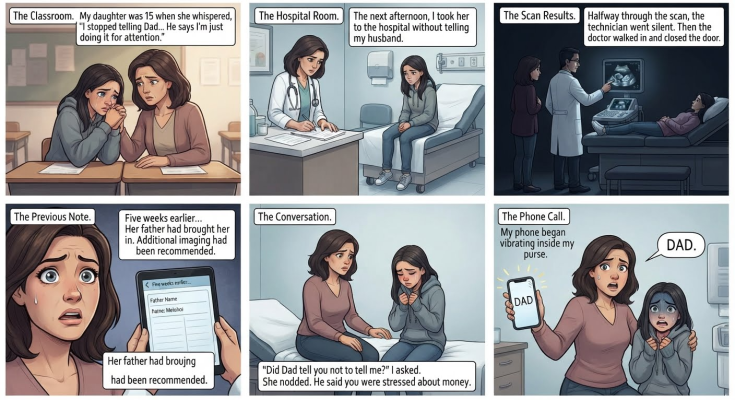
My daughter was 15 when she finally looked at me and whispered, “I stopped telling Dad when it hurts.

The spoon scraped the bottom of the ceramic bowl with a dry, repetitive sound that made my teeth ache. Grace was only pushing the gray clumps of oatmeal from one side of the dish to the other, her chin nearly touching her collarbone. A gallon of milk cost five dollars
now, and I had watched her pour half a cup of it down the drain the day before. I adjusted the drafty kitchen window, where the plastic insulation sheet had begun to pull away from the double-hung frame, letting in the damp October air.
“You need to eat before the bus comes, Grace,” I said, setting the milk carton back on the refrigerator shelf. “You have a long day.”
She did not look up, her fingers tightening around the handle of her spoon. Her voice was barely a whisper when she spoke, trailing off at the end as if she lacked the breath to finish. “I am not very hungry today, Mom…”
I reached out to touch her forehead, but she flinched slightly, shifting her weight to the left and pressing her right forearm tight against her ribs.
“Does your stomach hurt?” I asked, leaning closer to see her eyes.
She shook her head quickly, too quickly, and stared down at the cold milk. “Just tired.”
I rubbed my gold wedding ring with my thumb, feeling the worn edge where the metal had thinned over fifteen years of marriage. A cold draft rattled the plastic on the window again, making
a high, whistling noise that filled the quiet space between us.
“Your father says we have to watch the groceries this month,” I said, wiping a smudge of dried honey from the counter. “We cannot afford to waste food.”
Grace pulled her arms close to her chest, her voice dropping even lower. “I know.”
She pushed her chair back, the metal legs scraping against the linoleum. She left the bowl on the table and walked toward the hallway to get her backpack. I watched her go, noticing how she kept her right arm pinned against her waist, her shoulder dipped slightly to that side.
The heavy brass keys in the hallway rattled, and Arthur stepped into the kitchen with his coat already zipped to his chin. He was tapping his key ring against his palm, a fast, rhythmic clicking that always meant he was behind schedule.
“We need to move if we are going to beat the traffic on Route Two,” Arthur said, his words crowding each other as he reached for his travel mug.
I looked at the half-empty bowl on the table, then at the clock on the microwave, which showed exactly ten past seven.
“Grace barely touched her breakfast,” I said.
Arthur did not look at our daughter, his eyes scanning the counter for his car keys even though they were already in his hand. “She is fourteen, Clara, she will eat when she gets to school. Teenagers have moods.”
He grabbed the mug and headed for the side door, the brass keys still clicking in his hand.
The old family sedan had an exhaust rattle that shook the floorboards whenever we stopped at a red light on Main Street. Arthur kept his hands on the steering wheel, his thumbs tapping against the worn vinyl cover in time with the engine’s vibration. The heater was blowing a thin stream of lukewarm air that smelled faintly of old dust and oil, doing very little to warm the drafty cabin.
“I saw the stack of mail on the desk yesterday,” I said, leaning my head back against the cold headrest. “The eighty dollar heating bill was on top.”
Arthur cleared his throat, his eyes darting to the rearview mirror before focusing back on the wet asphalt ahead. “I paid that on Tuesday, Clara, along with the electric bill.”
“The electric bill was over one hundred,” I said, looking at the grey clouds gathering over the water tower. “And the grocery budget is already short twenty dollars.”
“It is handled, everything is handled,” he said, his voice rising in that rapid, defensive climb I had learned to ignore. “You do not need to worry about the utility bills. I have it covered.”
His cell phone vibrated in the plastic cup holder between our seats, the screen lighting up with an unlisted number from the city. He reached down quickly, flipped the phone face down against the dark plastic, and kept his hand resting on top of it.
“Who was that?” I asked.
“Just a solicitor,” he said, his fingers tapping the back of the phone. “They call three times a day trying to sell duct cleaning.”
“They usually leave a message,” I said. “And that was a local prefix.”
“I blocked them,” he said, his voice flat.
We turned onto the bypass, and the exhaust rattle grew louder as the car struggled to reach fifty miles per hour. I looked out the side window at the grey Ohio fields, wondering how many more months the muffler would hold together before we had to find another hundred and fifty dollars for the shop.
“Grace was holding her side this morning,” I said, watching a crow land on a rusted fence post. “She has been quiet all week.”
“She is just growing,” Arthur said, his hand leaving the phone to grab the steering wheel with both palms. “You always think every little ache is a medical emergency.”
“She looked pale, Arthur,” I said.
“She is fine, Clara, I promise you she is fine.”
“I think we should take her to the clinic if it keeps up,” I said.
“We do not have the money to throw away on doctor visits for a stomach ache,” he said, his brass keys jingling in his pocket as he shifted his weight. “She is fine.”
“We have the insurance card,” I said. “The co-pay is only thirty-five dollars.”
“Thirty-five dollars is thirty-five dollars,” he said, turning the car into the gravel parking lot of my office building. “We just need to manage what we have instead of running to the doctor every time someone sneezes.”
The afternoon bell had rung ten minutes ago, and the yellow school buses were already pulling out of the gravel lot in a long, noisy line. I sat in the idling sedan near the edge of the asphalt, listening to the loose metal underneath tap against the frame with every shudder of the engine. The schoolyard smelled of damp leaves and bus exhaust.
Grace walked out of the double doors of the high school alone, her heavy backpack slung over only one shoulder. She was moving with a strange, deliberate slowness, her right hand pressed flat against the denim of her jeans just below her belt line.
I opened the passenger door from the inside, letting the cold wind sweep through the front seat before she reached the car. “Over here, Grace.”
She climbed in slowly, letting her backpack slide onto the floorboards with a heavy thud that rattled the glove box. She did not lean back against the seat, keeping her body slightly curved forward as she pulled the door shut with her left hand.
“How was gym class?” I asked, shifting the car into drive and checking the mirror.
“We just ran laps,” she said, her voice trailing off at the end.
“Did you run?”
“A little,” she said, looking out the passenger window at the passing suburban ranches. “My side had a stitch in it.”
“A stitch?” I asked, turning the car onto the main road. “Like a cramp?”
“It is nothing,” she said, her hand moving away from her side and disappearing into the pocket of her jacket. “Just tired.”
We drove past the grocery store, where the sign in the window advertised milk on sale, though it was still higher than it had been in the summer. I watched Grace out of the corner of my eye, noting the small crease between her eyebrows that did not go away even when she closed her eyes.
“Did you go to the nurse today?” I asked.
She did not answer for a long moment, her breathing shallow and quiet in the warm air from the heater. “No.”
“Grace,” I said, slowing down for the turn onto our street. “Tell me the truth.”
“I did not go to the nurse, Mom,” she whispered. “I just sat on the bench for a little bit.”
“Why did you sit on the bench?”
“My side just hurt when I tried to run,” she said, her voice dropping so low I could barely hear it over the rattle of the exhaust. “But it stopped.”
“If you are sick, we need to address it,” I said, parking the car in our gravel driveway. “You cannot just sit on a bench and hide it.”
“I am not hiding anything,” she said, her voice barely audible as she reached for her backpack. “I just want to go upstairs.”
The kitchen smelled of boiled potatoes and the lemon bleach I used to scrub the laminate counters after dinner. Arthur was sitting in the living room with the television on, the blue light flickering against the hallway wall while the evening news anchor read the local weather forecast. Grace had already gone upstairs to her room, leaving her schoolbooks stacked on the bottom step.
I carried the empty plastic milk jug to the recycling bin under the sink, intending to rinse it before the morning pickup. When I pushed the lid open, a small piece of crumpled white paper caught my eye, sitting on top of an empty soup can.
It was thermal paper, the kind they print from the small register machines at the Oakhaven Community Hospital clinics.
I reached down and pulled it out, smoothing the tight creases against the edge of the kitchen counter with my palm. The blue logo of the pediatric clinic was printed at the top, followed by a date from the second week of October.
The amount printed at the bottom was thirty-five dollars, marked as a patient co-pay for an office visit.
“Arthur,” I called out, my voice sounding thin in the quiet kitchen.
The clicking of his brass key ring stopped in the living room, and the television volume dropped a notch. He appeared in the doorway a moment later, his fingers still tracing the metal ring in his pocket.
“What is it?” he asked, his eyes dropping immediately to the paper in my hand.
“What is this receipt from the clinic?” I asked, pointing to the date. “Grace was not sick in October.”
Arthur cleared his throat, his defensive tone returning before I could finish the question. “She is just having growing pains, Clara, so do not make a mountain out of a molehill.”
“This is a receipt for a pediatric co-pay,” I said, my thumb rubbing the thin gold band on my finger. “Why were you at the clinic with Grace?”
Arthur did not answer, his eyes shifting back toward the dark hallway.
I stared down at the crumpled white thermal paper receipt with the pediatric clinic logo.
The desk at the Oakhaven Lumber Yard always smelled of damp cedar and old coffee. I kept the scrap of paper tucked under my computer keyboard until ten o’clock, when the main office finally quieted down.
The lumber yard manager was out checking the inventory of yellow pine in the yard, so only the sound of the desk printers clacked through the room.
Jean, my coworker who had been there twenty years, was busy counting out manila folders for the quarterly sales reports. Her reading glasses sat on the tip of her nose as she flipped through the paper.
I waited until she stepped away to the break room to heat up her lavender tea.
My hand was cold when I picked up the receiver of the office landline.
I dialed the number for the Oakhaven Community Hospital pediatric clinic, holding the crumpled receipt in my other palm. The white thermal paper had started to yellow at the edges.
The line rang four times before a receptionist answered.
“Pediatric associates, this is Linda.”
“Hello, my name is Clara,” I said, keeping my voice low. “I’m calling about my daughter, Grace.”
“Let me pull up her chart,” Linda said. “What is her date of birth?”
“June twelfth,” I said. “I’m looking at a billing receipt from October fourteenth of last year. I was trying to match it to our family budget records, but I don’t have an appointment listed on our calendar.”
The sound of keys tapping came through the small speaker of the phone.
“Let’s see,” Linda said. “I have an entry for October fourteenth, yes.”
“What was the appointment for?” I asked.
“Well, it looks like a triage assessment was started at two o’clock,” she said. “But the file notes say the patient left before the evaluation was completed.”
“Left?” I asked. “But my husband said he took her for her checkup.”
“There’s no record of a completed checkup on that date,” Linda said. “Only the initial triage paperwork.”
“What does the triage paperwork say?”
“I’m sorry, Clara, but I can’t release clinical notes over the phone,” Linda said. “You’d have to sign a formal request in person at the front desk.”
I looked down at the receipt. The total printed at the bottom was zero, but the code for a diagnostic intake was typed in small, faded gray letters.
“Is there a balance due on that visit?” I asked.
“Not for the triage,” Linda said. “But there is a flag on the account. I can’t see the details from my screen.”
“A flag?”
“You’ll have to speak with the billing coordinator or the clinic director,” she said.
Jean walked back into the cubicle, her mug of tea steaming in her hand.
“Thank you,” I said quickly. “I’ll come by this afternoon.”
I hung up the phone and pushed the white receipt back under the edge of my keyboard.
“Is Grace still having those stomach issues?” Jean asked, setting her mug down on a cork coaster.
“She says it’s just a stitch in her side from gym class,” I said.
“My oldest had that,” Jean said, sorting her folders. “They called it growing pains. Some kids just carry their stress in their middle.”
I nodded, but my fingers went to my collarbone, feeling the cold metal of my necklace.
Arthur had told me he paid the eighty-dollar gas bill on Tuesday, but the final notice was still sitting on our dresser under his hairbrush.
We had exactly forty-two dollars left in the checking account until Friday’s deposit, and the grocery list was growing.
A gallon of milk cost five dollars now, and even the store-brand bread had gone up.
I knew Grace wasn’t a stressful child; she was too quiet for that.
The pediatric clinic was located on the second floor of the community hospital, down a long corridor that smelled of lemon bleach and floor wax.
I walked in at twenty past two, during my thirty-minute afternoon break from the lumber yard.
The double doors of the Oakhaven Community Hospital were heavy glass, letting in a draft of cold autumn air that chased me up the concrete stairs.
The lobby was empty except for an older woman reading a magazine in one of the blue vinyl chairs.
Behind the sliding glass window, Linda was typing on a black digital tablet.
“Hi,” I said, tapping the glass lightly. “I’m Clara, Grace’s mother. I called earlier about the October fourteenth record.”
Linda looked up, her expression shifting from professional boredom to mild recognition.
“Oh, yes,” she said, sliding the window open. “You wanted the printed summary.”
“Yes, please,” I said, handing her my driver’s license. “I’d like to see what was written down.”
Linda took the card and clicked her mouse several times.
“It looks like there’s an administrative hold on this file,” she said.
“An administrative hold?”
“Yes,” Linda said, her voice dropping. “Dr. Vance, our clinic director, has to review any uncompleted files before we can print them for the family.”
“But I’m her mother,” I said. “The bill came to our house. I should be able to see her file.”
“I understand that,” Linda said, adjusting a silver stethoscope that was draped over a hook on the wall behind her. “But when a patient leaves before the doctor performs the exam, we have to follow a specific protocol. Especially when there is a signed waiver.”
“What waiver?” I asked.
“I can’t show you the document until Dr. Vance releases it,” Linda said. “He’s currently in consultations with the outpatient department.”
“Can I wait for him?”
“He’s booked until four o’clock,” Linda said. “And then he has to sign off on the daily charts.”
“The copay for a specialist is two hundred dollars, and that’s before they even do the imaging,” Linda said. “If the patient left before the doctor signed off, the billing department flags the file to make sure we don’t carry the administrative loss.”
“Please,” I said. “My daughter has been having pain again. I need to know what happened in October.”
Linda looked at me for a long moment, then sighed and picked up a blue folder from a bin next to her.
“I can leave a message on his desk,” she said. “But you’ll have to come back tomorrow morning to pick up the records.”
“Can you just tell me who signed the waiver?” I asked.
“The parent who was present at the visit,” Linda said, sliding my driver’s license back across the black counter.
“Arthur,” I said.
Linda didn’t confirm the name, but she didn’t deny it either; she just slid the glass window shut.
I stood there for a second, my heart ticking like a cheap clock.
The school pickup lane was a line of idling cars, exhaust pipes rattling in the cold autumn air.
Our old family sedan let out a familiar, rusty squeak as I tapped the brakes behind a delivery truck.
The yellow gym schedule printed on yellow paper was crumpled in the cup holder of the console, reminding me that Grace had sat out of the fitness test twice already.
Grace came out of the double doors of the school, her backpack dragging against her side.
She also held a yellow school permission slip for the class trip, folding it over and over until it was a tiny square.
She walked with her head down, her steps shorter than usual.
She opened the passenger door and slid into the vinyl seat, keeping her hands buried deep in her pockets.
“Hi, Mom,” she said, her voice very quiet.
“How is your side feeling today?” I asked.
“It’s fine,” she said, looking out the window at the brick school building.
“What’s that paper in your hand?” I asked, pointing to the yellow square.
“Nothing,” she said, sliding it quickly into her pocket. “Just some school stuff we don’t need.”
I put the car in gear and pulled out onto the main road, the exhaust rattle filling the silence between us.
“Grace,” I said, keeping my eyes on the traffic ahead. “I called the clinic today.”
She didn’t move, but I saw her reflection in the side mirror, her jaw tightening.
“They told me you were there on October fourteenth,” I said. “With your dad.”
“We went for a flu shot,” she whispered.
“No,” I said. “A flu shot doesn’t require an intake assessment. They said you left before the doctor could see you.”
Grace didn’t say anything; she just stared at her lap, her thumb rubbing against the fabric of her skirt.
“Why did you leave, Grace?”
“Dad said we didn’t need to stay,” she said, her voice trailing off.
“But you were in pain,” I said. “That was the week you sat out of the soccer game.”
“It went away,” she said.
“Grace, did the nurse say something to you?”
“She just asked questions,” Grace said. “And then Dad had to sign some papers at the desk.”
“What papers?”
“I don’t know,” she whispered. “He told me to wait in the hall.”
I watched her through the rearview mirror, her small shoulders curved inward as if she were trying to disappear into her coat.
“Your father told me it was just a routine check,” I said.
“It was,” Grace said, her voice barely audible. “He told me not to worry you about the bills.”
“The bills?”
“The paper at the desk,” she said. “He said we had to go.”
I turned the car onto our street, the tires thump-thumping over the gravel driveway of our small ranch home.
The kitchen was dark when we walked in, the plastic insulation on the window pane bowing slightly from the draft.
Arthur was sitting at the table, his brass key ring tapping against his palm in a fast, rhythmic circle.
“You’re late,” he said, looking up from a stack of unopened mail.
“I had to stop by the clinic,” I said, setting my purse on the counter next to the breadbox.
The tapping stopped.
Arthur cleared his throat, his eyes scanning my face before settling on his keys.
“Why would you go there?” he asked, his voice rapid and defensive. “There’s no reason to go to the clinic.”
“I found the receipt from October,” I said. “The one from the day you took Grace.”
Arthur stood up, his chair scraping against the linoleum floor.
“Oh, that,” he said, walking to the refrigerator and opening the door. “It was just a quick stop for a routine check, nothing worth worrying you about.”
“She was in pain, Arthur,” I said. “The receptionist said you started an intake and then left.”
“They had a three-hour wait, Clara,” he said, looking at a carton of eggs. “I wasn’t going to let her sit in that waiting room with all those sick kids for a simple stomach ache that went away in ten minutes.”
“They said there’s a restriction on the file,” I said. “And a waiver.”
“They’re just trying to cover their own administrative mistakes,” Arthur said, shutting the refrigerator door with a sharp click. “You know how they are with their billing. They probably lost the insurance card and want us to pay the copay.”
“Did they call you?” I asked. “Did they leave a voicemail about a follow-up?”
“I never received a clinic voicemail,” he said, turning back to the table. “Not one. If it was important, they would have sent a letter.”
“The clinic says they recommended an imaging referral,” I said.
“They recommend everything,” Arthur said, his voice sharpening. “They want to run every test under the sun so they can charge us another hundred and fifty dollars. We don’t have that kind of money to throw away on their guesses.”
“Grace said you signed papers,” I said.
Arthur tapped his key ring against the table, his voice rising.
“I signed the standard sign-in sheet, Clara. That’s all. You’re making a mountain out of a molehill. She’s fine.”
He walked out of the kitchen, his keys jingling in his pocket as he went down the hallway toward his study.
I stood by the counter, my hand resting on my phone.
The screen lit up with a pale blue glow.
It was a text message from the Oakhaven clinic scheduling system.
The morning sun was too bright on the clinic’s linoleum floor, catching the yellowed edges of the old health awareness posters taped near the water cooler. I sat on a blue vinyl chair with a clipboard resting on my knees, trying to keep my pen steady as I filled out the new patient questionnaire.
Grace sat beside me, her knees pulled up slightly, staring at a poster of a cartoon giraffe on the opposite wall. Her school backpack rested between her sneakers on the floor, the zipper half-open to reveal a cluster of blue ballpoint pens and a crumpled lunch paper.
“Is it still sharp?” I asked, keeping my voice low.
“Only when I sit up straight,” Grace said.
Her voice trailed off at the end, barely carrying over the hum of the vending machine in the corner. She did not look at me, keeping her eyes fixed on the cartoon giraffe.
The receptionist had handed me four pages of new registration forms because our family insurance provider had changed in January. On the second page, there was a box asking for any medical clinic visits in the last six months.
I paused, my pen hovering over the blank white line. I had already confirmed the October receipt existed, but the clinic’s database had no record of a completed treatment.
“Grace,” I said, leaning closer so our shoulders touched. “When you came here in October with your dad, did they give you any medicine?”
“Just some pink liquid,” she said. “It tasted like cherry.”
She reached into her backpack, her fingers rustling through loose sheets of lined notebook paper. She pulled out a crumpled yellow sheet and tried to slide it under her thigh before I could see it.
“What is that?” I asked.
“Nothing,” she said. “Just a paper from gym.”
I reached over and gently pulled the yellow paper from under her hand, smoothing the edges against my clipboard. It was a permission slip for the county fitness physicals, requiring a twenty-five dollar equipment fee.
The deadline at the bottom of the yellow paper was printed in bold red ink, and it had passed three days ago.
“Why didn’t you show this to me?” I asked.
“I didn’t think we had the twenty-five dollars,” Grace said.
She pulled the collar of her grey knit sweater up toward her chin, her eyes dropping to the floor.
The sliding glass window at the reception desk scraped open, and Evelyn Diaz called Grace’s name.
We followed Evelyn down the beige-tiled corridor, the scent of lemon bleach rising from the floorboards. Grace walked with a slight hitch in her right hip, keeping her hand pressed against the pocket of her jeans as if she were carrying something fragile.
The exam room had the same blue vinyl chairs as the waiting area, alongside a stainless-steel sink and a paper-covered table. Evelyn took Grace’s temperature with a plastic digital thermometer that beeped twice.
“Did you tell your father we were coming here today?” I asked, watching Evelyn write the temperature on a small pad.
“He was still asleep when we left,” Grace said.
She sat on the edge of the examination table, her legs dangling over the side. The paper covering the table crinkled loudly every time she shifted her weight.
The heavy wood door opened, and Dr. Paul Vance walked in. He carried a thin black digital tablet under his arm and did not smile, though his voice was quiet and measured.
“Good morning, Clara,” he said, looking at me before turning to Grace. “Let’s see how we are doing today.”
He had Grace lie back on the paper table, instructing her to bend her knees. When his fingers pressed gently against the lower right quadrant of her abdomen, Grace caught her breath and her toes curled inward.
“Still tender right there,” Dr. Vance said.
He tapped his index finger against the edge of his black tablet, staring at the screen for several seconds. The screen cast a pale blue light across his face as he scrolled through the electronic medical record.
He did not look up when he spoke next.
“The notes from October show the exact same localized pain,” Dr. Vance said.
“The receptionist told me it was just a routine check,” I said. “For a flu shot.”
Dr. Vance stopped tapping his screen. He looked at me, his brow furrowing, then looked down at Grace, who was staring up at the ceiling tiles.
“Grace, would you mind if I spoke to your mother in the hallway for just a moment?” he asked.
Grace nodded once, her hands flat against the paper table.
The hallway was busy with nurses shifting files and a small child crying near the weighing scale. Dr. Vance closed the heavy wooden door of exam room three behind us, letting the latch click shut.
“The database shows an incomplete referral from October twelfth,” he said.
“My husband told me the doctor said she was fine,” I said. “He said it was just growing pains.”
Dr. Vance did not look angry, but his voice became even slower, each word distinct.
“Clara, we do not issue routine clearances when there is active abdominal guarding,” he said.
“What do you mean?” I asked.
I rubbed my gold wedding ring with my thumb, turning the metal around my knuckle until it pressed against the skin.
“There is something else from that visit, and I think you need to know about it,” Dr. Vance said.
He held the door open for me to return to the exam room. My hand stayed on my ring, the metal warm from my skin as I walked back inside.
Grace was sitting on the edge of the exam table again, her hands tucked under her thighs. She looked between the two of us, her eyes wide in the bright fluorescent light.
“Is something wrong?” she asked.
“We are just checking the records from your last visit, Grace,” Dr. Vance said, pulling his rolling stool closer to the small desk in the corner.
He tapped the screen of his tablet twice, then turned the device around so the screen faced us. A scanned PDF document appeared on the display, with the clinic’s official letterhead at the top.
“An urgent ultrasound was ordered on October twelfth,” Dr. Vance said. “The parent present signed a waiver declining the immediate procedure due to the two hundred dollar out of pocket cost.”
My chest felt tight, the air in the small room suddenly warm and still.
“My husband said there was no follow-up needed,” I said.
“The waiver was signed right here,” Dr. Vance said, pointing to the bottom of the digital page.
He turned the digital screen toward me, showing a scanned signature block.
The blue ink on the gray screen was unmistakable.
Arthur always wrote his capital A with a sharp, elongated loop that crossed over the rest of his name. It was the same signature he used on our joint savings account, on the mortgage papers, and on the permission slips we signed for Grace’s field trips. He always claimed his handwriting was the mark of a meticulous man who kept his affairs in order.
I leaned closer to the black digital tablet Dr. Vance held, my eyes tracking the tiny digital pixels that formed the curves of my husband’s handwriting.
“Is that definitely his signature?” I asked, though I already knew the answer.
Dr. Vance tapped the edge of his tablet twice with his index finger, keeping his gaze on the glowing screen.
“It is signed by Arthur Miller,” Dr. Vance said, his voice slow and deliberate as he read from the clinic database. “He checked the box refusing the diagnostic ultrasound because of the immediate out-of-pocket cost.”
The screen showed the date, October eleventh, printed in small black numbers next to the blue ink signature block.
“Two hundred dollars,” I said, the exact amount of the clinic copay tasting like ash in my mouth as I said it out loud.
“Yes, that was the clinic copay for the off-site specialist appointment at the time,” Dr. Vance said.
My hand automatically moved toward the gold band on my left hand, but I caught myself and dropped both hands to my lap, squeezing them together until my knuckles turned white.
“He didn’t tell me anything about this visit,” I said.
“The record shows the patient presented with acute lower right quadrant pain,” Dr. Vance said, scrolling through the digitized text. “Our triage nurse noted that the father was informed of the urgent need for imaging to rule out a localized infection or a cyst. He was given a printed referral and a list of approved clinics.”
Grace sat on the edge of the examination table, her bare heels tapping against the metal footrest with a dull, rhythmic sound that filled the small space.
She did not look up at me, keeping her eyes fixed on her worn blue canvas sneakers.
“There is a note here from Evelyn,” Dr. Vance said, scrolling down with a quick flick of his thumb against the screen. “She wrote that the patient seemed highly anxious about the home reaction to the cost of returning.”
I looked at Grace, whose head remained bowed toward her knees, her shoulders hunched forward.
“Grace,” I said, but her heels just kept tapping against the metal.
“I need to print the official transfer document from October,” Dr. Vance said, setting the tablet on the laminate counter next to the sink. “I will be back in five minutes to discuss our next step.”
The heavy wooden door clicked shut behind him, leaving us in the quiet room with the smell of lemon bleach and the cold air from the ceiling vent.
I stood up from the blue vinyl chair and moved closer to the exam table, the paper liner crinkling under my steps.
“Grace, look at me, please,” I said.
She slowly lifted her chin, but her eyes stayed fixed on the paper liner beneath her thighs, her fingers curling around the edge of the examination table.
“Why didn’t you tell me you came here in October?” I asked, keeping my voice as low and gentle as I could manage.
“Dad said it was fine,” she whispered.
“He took you to a doctor and didn’t mention it to me?”
“He picked me up early from school that Tuesday,” she said, her voice dropping even lower. “He told me we were just going to get a quick check because my side was hurting, but then the lady at the front desk told him about the two hundred dollars.”
“And he didn’t have it?” I asked.
“He told her he forgot his checkbook,” Grace said. “But when we got to the car, he said the clinic was just trying to take our money and that we couldn’t come back. He said the doctors always try to find problems that aren’t really there just to bill the insurance.”
“He told you that?”
“He said we had too many bills already, and that you were already stressed about the heating company,” she said.
Her voice was so soft I had to lean in close to her shoulder to hear the words over the hum of the clinic fan.
“But you were hurting, Grace,” I said.
She reached down and pressed her right palm against her lower right side, holding it there tightly.
“It only hurts when I run fast,” Grace said, her voice trailing off at the end. “Like during the school gym class when we have to do the three laps around the track. Sometimes I have to stop and lean against the chain-link fence until the pinching stops.”
“You told me you just had a simple stitch in your side from drinking water too fast,” I said.
“That’s what Dad told me to tell you if you asked,” she whispered. “He said if we had to go back to the hospital, you would get mad at me because of the money.”
I felt a cold knot form in my chest as I realized how many gym classes she had sat through since October, hiding the pain because she thought she was a financial burden.
“Did he really say that, Grace?”
“He said you were already sitting at the kitchen table with the calculator and all those yellow papers with the red stamps on them,” she said. “Dad said if we added another hospital bill to the pile, you would take it out on me because I caused the problem.”
“You could never cause a problem like that,” I said, the words catching in my throat as I thought of Arthur’s lies.
“He said we didn’t have the two hundred dollars,” she whispered.
She rubbed the back of her hand against her denim skirt, over and over in the same spot.
“He told me the pain would go away on its own if I just walked slower and didn’t run during gym,” she said.
“And you believed him?”
“He is my dad,” she whispered, her voice barely audible over the hum of the air unit.
“He bought me a cherry slushie at the gas station afterward,” Grace said, her fingers tracing the seam of her denim skirt. “He told me it was our little secret. He said you had enough on your plate with the electric bills and the furnace repairs, and we didn’t need to add a hospital bill to the pile.”
I stared at her, my own daughter, realizing she had spent months carrying a secret that could have ended in an emergency room, all to save her father from admitting he couldn’t pay a copay.
The silence in the small room felt heavier than the winter coats we left in the back seat of our sedan.
“Grace, I need you to promise me something right now,” I said.
“What?”
“No matter what your father says about our money, you tell me when you are sick.”
She did not answer, but she nodded her head once, her shoulders dropping a fraction of an inch.
The heavy wooden door opened again, and Dr. Vance walked back in carrying a single sheet of paper printed with the clinic logo.
“This is the referral coordinator’s schedule,” he said, handing the paper to me. “The authorization for the imaging department downstairs is only good for another seven days.”
“Seven days,” I repeated, looking at the black print and the deadline highlighted in yellow.
“If we do not get the ultrasound done before then, the insurance company will require a whole new clinical assessment,” he said, tapping his index finger on the counter.
“A pediatric cyst can cause intermittent pain when it twists,” Dr. Vance explained, his finger tracing a line on his printout. “It goes away when it untwists, which is why she only feels it during exertion like running. But if it twists completely, it cuts off the blood supply. That is a surgical emergency.”
“And we wouldn’t know until it was too late,” I said.
“Exactly,” Dr. Vance said. “Which is why we cannot wait another week.”
My phone began to buzz in my pocket, the steady vibration shaking against my thigh.
I pulled it out and looked at the small screen, my hand steady despite the heat rising in my face.
Arthur’s name was flashing in bright green letters across the front of the display.
I did not answer it, setting the phone face up on the laminate table next to the exam sink instead.
“Can we schedule the ultrasound today?” I asked Dr. Vance.
“The imaging lab has an opening at ten o’clock,” Dr. Vance said, looking at his watch. “But you will need to sign a new financial waiver first.”
The phone on the table buzzed again, sliding an inch to the left against the smooth surface.
I watched the screen light up with Arthur’s name for the second time in two minutes.
“I will sign whatever I need to sign,” I said, keeping my voice completely level.
The phone kept vibrating, the plastic casing buzzing against the hard wood of the counter.
It slid another inch toward the edge, displaying Arthur’s name.
The screen of my phone lit up again, Arthur’s name flashing against the black plastic. I did not reach for it. I let the vibration hum against the wood grain of the small side table until the screen went dark.
Dr. Vance kept his index finger pressed to the edge of his black digital tablet. He did not look at the phone, though his eyes narrowed slightly as the silence stretched between us. Grace sat on the edge of the examination table, her thin fingers tangled together in her lap.
“We need that scan,” Dr. Vance said, his voice dropping into a quiet, even register. “I can bypass the standard pre-authorization waiting period by classifying this as an urgent diagnostic request. If we do that, we can get her downstairs to imaging within the hour.”
I looked at Grace, whose eyes were fixed on the patterned linoleum floor. “Can we do that today? Without waiting for the insurance company to mail the approval?”
“We can,” Dr. Vance said, tapping the screen to finalize the order. “But the hospital billing system requires a signed financial responsibility form before they will release the contrast dye for the machine. Our scheduling window for the regional specialist expires in exactly seven days, and we cannot afford to miss that deadline.”
“I will sign whatever we need to sign,” I said.
Dr. Vance nodded, his face softening slightly as he stood up from his small rolling stool. He opened the heavy wood door of the exam room and gestured toward the hallway. “Go down to the main reception desk and ask for Evelyn Diaz. I will send the electronic bypass order down now.”
The lobby of the clinic smelled of lemon bleach and damp wool from the autumn rain outside. Evelyn Diaz was waiting behind the high laminate counter, her silver stethoscope catching the bright fluorescent light as she leaned forward.
“Dr. Vance sent the override,” Evelyn said, her voice dropping to a low, reassuring murmur. “I have the new billing waiver ready for you, Clara.”
She pulled a crisp white sheet of paper from the laser printer behind her. The paper was still warm when she slid it across the counter toward me.
“Is this the two hundred dollar copay?” I asked, keeping my voice low so Grace, who was standing a few feet away by the water cooler, would not hear.
“The urgent bypass copay is one hundred and fifty dollars,” Evelyn said, pointing to a small box near the bottom of the form. “But we can set up a ten dollar monthly plan for the remaining balance. We can make this work with small payments, so do not let the cost stop you.”
I looked at the number printed in black ink. One hundred and fifty dollars was the exact amount I had tucked into the zippered pocket of my winter coat, saved from three weeks of grocery stretching and the small cash bonuses from my typing work at the office. It was our entire emergency reserve.
“If I pay the deposit now, does it guarantee she gets the scan today?” I asked.
“Within twenty minutes,” Evelyn said, tapping her finger on the signature line. “Once this is in the system, the billing office cannot hold up the appointment.”
I walked over to the waiting area where Grace was standing by the large, bubbling fish tank. A single orange goldfish swam slow circles around a plastic castle, its tail trailing through the cloudy water.
Grace watched the fish, her hands tucked deep into her coat pockets. As I stood beside her, I noticed the tight line of her shoulders drop an inch. The sharp, guarded look she had carried since we left the house seemed to soften in the blue light of the tank.
“They are going to do the test downstairs, Grace,” I said, putting my hand on the rough wool of her shoulder. “It is already scheduled.”
“Is Dad going to be mad about the money?” she whispered, her voice barely carrying over the hum of the aquarium filter.
“You do not need to worry about the money,” I said, though my fingers tightened against the strap of my purse where my wallet lay. “That is my job. I am taking care of it.”
“He said we did not have the extra hundred dollars for the clinic,” she said, her eyes still on the orange fish. “He said if we spent it on this, we wouldn’t have enough for the oil tank.”
“The oil tank is full enough for now,” I said, keeping my voice steady. “We are getting the scan.”
Before I could return to the desk, my phone began to vibrate in my palm again. I stepped into the narrow alcove near the public restrooms, where an old metal payphone still hung on the wall, and pressed the receiver to my ear.
“Clara,” Arthur said, his voice coming through with a rapid, defensive clip. “Where are you? I called the school and they said Grace was marked absent for the afternoon.”
“We are still at the clinic, Arthur,” I said, leaning my back against the cold tile of the alcove.
“There is no reason to be sitting in a clinic all day,” he said, and I could hear the familiar clinking of his brass key ring in the background. “I told you, she just needs some rest. I will pay the utility bill today if you just bring her home. I will go down to the office myself before they close.”
“The utility bill is not the problem right now,” I said.
“I will handle the car repair too,” he added quickly, his voice rising a fraction. “I will take the sedan to the shop on Monday to fix that exhaust rattle, so you do not have to worry about it. Just bring her home, Clara. We do not need these people looking into our business.”
“They are doing an ultrasound, Arthur,” I said, my voice flat.
“An ultrasound is hundreds of dollars,” he said, his breath coming faster through the line. “We do not have that kind of money lying around. You are letting these doctors scare you into spending money we do not have.”
“I am signing the papers now,” I said.
“Clara, do not do anything rash,” he said, but I did not answer.
I pulled the phone away from my ear and pressed the red button on the screen, cutting off his voice mid-sentence.
I walked back to the reception counter where Evelyn was waiting with the pen. The blue ink felt cold against my fingers as I pressed the tip to the warm paper. I signed my own name on the financial agreement sheet.
The billing clerk took the clipboard back from my hands and capped her pen with a sharp click that echoed in the quiet lobby. She filed the white copy of the payment agreement under a plastic divider in her drawer, then handed me a yellow routing slip.
“Down the hall, past the double doors, and take the elevators to the lower level,” she said.
The elevator was small and smelled of old floor wax and damp concrete. Grace kept her hands buried deep inside her pockets, her shoulder pressing against my arm as we felt the cab drop with a heavy sigh.
The doors slid open onto a beige tiled corridor with pipes running along the ceiling. We found the outpatient imaging department at the very end of the hall, behind a set of heavy wooden doors with wire-reinforced glass.
The waiting room down here had no windows to the outside. It had three rows of orange plastic chairs and a television on a wall bracket playing a game show with the sound turned off.
“Does it hurt to sit down, Grace?” I asked.
“Only when I lean back,” she said.
She chose a chair in the corner, farthest from the television screen where a woman was spinning a giant green wheel. I sat beside her and smoothed the yellow routing slip on my lap.
I reached into my pocket and felt the corner of the school gym schedule printed on yellow paper. Grace had folded it into a tight square, and I wondered how many times she had sit on the bleachers while the other girls ran laps.
At exactly eleven o’clock, my phone gave a long double vibration against my thigh. I pulled it out, expecting a message from the school nurse or perhaps my office.
It was a text from Arthur, so long that the gray bubble filled the entire screen of my phone. I had to scroll twice to read the whole thing.
He wrote that he had already called ahead to the Woodside Grille and put our names down for a six o’clock table. He said he wanted to buy Grace the prime rib dinner she always asked for on her birthday, even though her birthday was not until February.
He added that he had already cleared his afternoon schedule at the lumber yard to make sure he was home in time to drive us there in the clean sedan. He wrote three separate sentences about how much we all deserved a nice night out after such a busy autumn.
I stared at the glowing blue letters on the black screen. There was no mention of the unpaid eighty-dollar heating bill, or the clinic copay, or the fact that Grace was currently sitting in a basement waiting room.
“Who is that, Mom?” Grace asked.
“Your father,” I said.
“Is he mad about the paper you signed?”
“No,” I said. “He is just asking about dinner.”
Before I could answer further, a woman in light blue scrubs stepped out of the double doors holding a metal clipboard.
“Grace Miller?” she called.
I stood up, but my phone began to ring in my palm, the screen flashing with Arthur’s name and his picture from our trip to the lake three years ago. I looked at Grace, then at the technician.
“Go ahead, Grace,” I said. “I will be right behind you.”
The technician gave a brief nod and guided Grace through the wooden doors. The heavy latch clicked shut behind them, leaving me alone in the corridor.
I walked twenty paces down the quiet hallway, past a vending machine that hummed in the dark, and pressed the phone to my ear.
“Clara, thank goodness,” Arthur said. “I was worried you had the ringer turned off.”
His voice was warm and breezy, the way he spoke when he was greeting clients at the yard. There was no trace of the sharp, defensive tone he had used at the kitchen table this morning.
“We are downstairs in imaging,” I said. “They just took her in for the scan.”
“Good, good,” he said. “That is exactly what we wanted. I am so glad they could fit her in today.”
“You signed a waiver in October, Arthur,” I said. “The doctor showed me your signature on the screen.”
There was a brief pause on the line, but I could hear the rapid, rhythmic tapping of his brass key ring against his palm in the background.
“I was only trying to protect you from the stress, Clara, because you do so much,” he said.
The words came out smooth, like a speech he had practiced during his drive between job sites.
“Protect me from what?” I asked. “She has been in pain for a month.”
“The clinic has all these extra charges, Clara, and their billing department is a mess,” he said. “They make mistakes all the time.”
“This was not a billing mistake,” I said.
“I was going to take care of it,” Arthur said. “In fact, I have already sorted out the heating bill today. It is completely handled.”
“How did you pay it?” I asked.
“I went by the utility office on my lunch break,” he said, his voice rising slightly. “I told you I had it under control, Clara. You don’t need to worry about the money.”
“The hospital receptionist said the October bill was sent to collections,” I said.
“They have the wrong address on file, I told you that,” he said. “They probably sent it to the old house on Maple Street. You know how these county systems are.”
I looked down at the linoleum floor, where a yellow stripe marked the path to the laboratory.
“Arthur,” I said. “Grace knew about the waiver.”
The key ring stopped tapping on his end of the line.
“She is just a kid, Clara,” he said, his voice dropping to a low, quick whisper. “She doesn’t understand how these things work. I told her not to worry about the adult stuff.”
“She thought I would be angry at her,” I said.
“Well, you get so tense when the bills come,” he said. “I didn’t want you staying up all night staring at the ledger again. I was handling it.”
“We are waiting for the scan now,” I said.
“Right,” he said, his warm tone returning instantly. “And then we are going to that dinner. I already told the owner we might be a few minutes late, and he said he would keep the fireplace booth for us.”
“I have to go back in,” I said.
I hung up before he could answer and pushed the heavy wooden doors open.
The ultrasound room was dark except for the blue glow of a large monitor next to the examination table. Grace lay on her back under a thin white sheet, her eyes fixed on the ceiling tile.
The technician was a middle-aged woman with dark hair tied back in a neat bun. She had already applied the warm gray gel to Grace’s lower right abdomen and was holding the plastic probe.
“You might feel a little bit of cold and some pressure here, Grace,” the technician said.
She moved the plastic transducer in small, slow circles across Grace’s skin. On the screen, gray and white shadows shifted like clouds, but the technician’s face remained entirely still.
I sat in a low vinyl chair by the wall, holding my purse on my lap. The silence in the room was heavy, broken only by the rhythmic hum of the machine’s cooling fan.
My phone buzzed in my hand. I looked down, keeping the screen low so the light would not disturb the examination.
It was another text from Arthur. He had sent an image of a red convertible car, followed by three smiling emojis and a thumbs-up icon.
The text below the image said he was thinking of taking our old sedan to the mechanic on Saturday to finally fix the exhaust rattle. He said we deserved a quiet ride for our trip to his sister’s house next month.
I looked from the screen of my phone to Grace’s face. Her mouth was set in a tight, thin line as the technician pressed the probe deeper into her side.
“Are you doing okay, sweetie?” I asked.
“I am fine,” Grace whispered.
The technician did not look up from her monitor. She clicked a button on her keyboard, saving an image, then moved the probe to a different spot.
My phone buzzed a third time.
Arthur had sent another message, listing the specific side dishes he was going to order for us at the Grille. He asked if Grace still wanted the baked potatoes with the extra sour cream.
The screen of the ultrasound machine flickered as the technician zoomed in on a dark circular shape near the bottom of the display. She tapped two points on the screen, measuring the width of the dark spot.
“Is that her appendix?” I asked.
“The doctor will review all the images and talk to you upstairs,” the technician said.
She wiped the remaining gel from Grace’s skin with a paper towel and handed her a fresh sheet to cover herself.
“We are all done in here,” she said. “You can head back up to the waiting area.”
The elevator took us back to the main floor in silence. Grace walked with her head down, her hands tucked into her pockets again, her pace slow and deliberate.
We sat in the same blue vinyl chairs near the front desk of the pediatric clinic. The lobby was emptier now, the morning rush of appointments having cleared out.
I set my phone on the small laminate table between our chairs. The screen lit up almost immediately with a fresh notification.
Arthur had sent a link to the Woodside Grille menu, along with a note saying he had already reserved the booth by the fireplace.
I stared at the glowing blue text. All my life, when things got difficult, Arthur would find a way to make a grand gesture, a sudden plan that made us feel like a normal, prosperous family.
But the heating bill was still sitting on our kitchen counter, unpaid.
I remembered the way he had tapped his brass key ring on the phone, the hurried speed of his explanations, the ease with which he shifted the blame to the clinic’s billing database.
He was not trying to protect me from the stress. He was trying to build a wall of noise so I would not ask the clinic receptionist any more questions about what happened in October.
“Mom?” Grace said.
“Yes, sweetie?”
“Do we have to go to dinner tonight?” she asked.
I looked at her pale face, the dark circles under her eyes, and the quiet way she sat.
“No,” I said. “We do not.”
I picked up the phone. I opened the messaging app, selected Arthur’s long paragraph about the prime rib and the fireplace booth, and pressed the small trash can icon.
The screen went gray, then blank. I slid the phone deep into my coat pocket and took Grace’s hand.
Evelyn laid a blue cardboard folder on the high laminate counter of the reception desk. “We keep paper backups for everything from that quarter because the digital transition crashed twice in November,” Evelyn said.
She flipped through three sheets of white paper. The lemon bleach smell from the floor wax was strong. “The clinic coordinator made three attempts to reach your home phone after the October visit,” Evelyn said, her voice quiet as she tapped her finger against the page.
“We only have one number,” I said. “And Arthur said he checked the machine every evening.” Evelyn adjusted her silver stethoscope around her neck, its metal cold against her uniform. She did not look up from the folder.
“I see the automatic dialer logs, but there is also a handwritten entry from a manual callback,” she said. She turned the blue folder sixty degrees so the page faced me. “Let me get the plastic magnifying sheet from the drawer,” Evelyn said.
She slid her hand into the drawer under the counter. “Grace is still sitting by the fish tank,” I said. “She is fine there for a moment,” Evelyn said.
She pulled out a magnifying sheet and laid it over the paper. “Here is the log for October twelfth,” Evelyn said. “October twelfth was a Monday,” I said.
“Yes,” Evelyn said. “At twelve forty-two.” My phone buzzed in my pocket. I did not pull it out.
“Does the log show if anyone answered?” I asked. “It does,” Evelyn said. “The notation has a checkmark next to the word spoke.”
“Who did they speak to?” I asked. Evelyn did not look up from the page. “The name of the person who answered is written in the notes,” she said.
“Let me see,” I said. Evelyn studied the handwriting through the plastic. “The handwriting is quite tight,” she said.
She traced the line with the tip of her index finger but did not read it aloud yet. Grace walked over from the fish tank. She stood close to me.
“Is there a problem with the insurance?” Grace asked. “No, honey,” I said. “We are looking at the old schedule.”
“The school gym teacher asked me for the yellow paper yesterday,” Grace said. “Which yellow paper?” I asked.
“The one about the physical education waiver,” Grace said. “She said I cannot sit out anymore without a signature.” “We will get that signed before we leave today,” Evelyn said.
Evelyn turned back to the paper. “The staff member who called on October twelfth was Nurse Higgins,” Evelyn said. “She was very nice,” Grace said.
“She wrote down the exact time she finished the call,” Evelyn said. “And she wrote down who she spoke to?” I asked. “She did,” Evelyn said.
“Was it our house number?” I asked. “It was the primary number listed on the intake form,” Evelyn said. “The seven-digit one ending in four-four-eight-two.” “That is our landline,” I said. “The phone on the kitchen wall.”
“The log says the call lasted three minutes,” Evelyn said. Grace looked at the blue folder, then up at me.
“I remember that day,” Grace said. “I was home from school because my side felt hot.” “You were home?” I asked. “I thought you went to class.”
“Dad stayed home with me in the morning because you had the early shift at the clinic in town,” Grace said. “I remember,” I said. “I left the driveway at six.”
“The phone rang while Dad was making toast,” Grace said. “Did he answer it?” I asked.
“He went into the hallway to talk,” Grace said. “He closed the door.” “Did he tell you who it was?” I asked. “He said it was a wrong number,” Grace said.
She looked down at her shoes, her voice trailing off. “He told me to go upstairs and lie down,” Grace said.
Evelyn tapped her index finger on the edge of the desk. “The notation here is very clear about what was said during those three minutes,” Evelyn said. “Read it to me, please,” I said.
Evelyn looked at Grace, then back at me. She slid the blue folder slightly closer to her side of the desk.
“Grace, would you mind picking out a sticker from the box by the scale?” Evelyn asked. “We have some new ones.” “I am fourteen,” Grace said, her voice trailing off.
“I know,” Evelyn said. “But we have the holographic ones with the solar system. I think they are in the deep bottom drawer.” Grace walked back toward the scale, her steps slow on the shiny yellow tile.
Evelyn waited until Grace was out of earshot before she turned the folder back toward herself. “The record says the father answered and stated the child was completely fine,” Evelyn said.
The words sat on the counter between us like cold grease. “He said she was fine?” I asked.
“The exact note from Nurse Higgins says, father reports pain has fully resolved,” Evelyn said. “No further symptoms. Family requests cancellation of the ultrasound referral.”
“He cancelled the referral,” I said. “That is what is written here,” Evelyn said. “He told her the pain was just a mild digestive issue from some bad milk she drank.”
“But Grace was still hurting,” I said. “She has been hurting all autumn.” “We have to go by what the parent tells us on the phone,” Evelyn said. “If a parent says the symptom is gone, we cannot force them to bring the child back to the clinic.”
“Of course,” I said. “He also stated that the family was switching to a different pediatric practice closer to his office in Canton,” Evelyn said. “We have never been to Canton,” I said. “And we have never seen another doctor.”
“I figured as much when I saw your active insurance file today,” Evelyn said. She picked up a black marker and wrote a small note on a yellow sticky pad.
“We need to get this scanned into the current digital chart before Dr. Vance comes back from lunch,” Evelyn said. “Can I have a copy of that page?” I asked.
“I can print the communication log for you,” Evelyn said. “But the billing department will need to sign off on releasing the full file.” “Just the log,” I said. “The part about the phone call on October twelfth.”
“I will run it through the copier,” Evelyn said. She lifted the blue folder and walked toward the staff room behind the desk.
The office was very quiet now that the morning rush of toddlers had cleared out for the afternoon. The only sound was the low hum of the copy machine behind the drywall, followed by the slide of the paper catcher.
I walked over to the small consultation nook in the far corner of the pediatric lobby. Two blue vinyl chairs sat under a framed print of a sleeping puppy. Grace was already sitting in the left chair, holding a silver foil sticker with a picture of Saturn on it.
“Did they find the paper?” Grace asked. “Evelyn is printing it now,” I said. I sat in the right chair. The vinyl was cold through my trousers.
“Did Dad really tell them I was okay?” Grace asked. “He told them the pain went away,” I said.
“I told him it still hurt on the Tuesday after that,” Grace said. “But he said we had to wait for the new insurance cards to come in the mail.” “The cards did not change,” I said.
“He said they did,” Grace said. “He told me the old cards were expired because the company changed their bank.” “Our company did not change banks,” I said.
“He told me not to tell you because you had enough to worry about with the heating bill and the groceries,” Grace said. “I see,” I said.
“Is Dad going to be mad at me?” Grace asked. “No,” I said. “He is not going to be mad at you.”
“He was very loud when the clinic called the second time,” Grace said. “He was standing by the kitchen door.” “There was a second call?” I asked.
“I think so,” Grace said. “He told them to stop calling our house during dinner.” I kept my hands flat on my knees, pressing my fingers into the fabric of my trousers to keep them still.
“We are going to get the ultrasound done today, Grace,” I said. “Evelyn said it costs two hundred dollars,” Grace said. “I have the money,” I said.
“Is that the money for the winter tires?” Grace asked. “We do not need tires today,” I said. “We need this.”
Evelyn came out of the staff room holding a single sheet of white paper. The ink was still warm when she handed it to me. “Here is the photocopy of the manual call sheet,” Evelyn said.
“Thank you,” I said. “Dr. Vance is in exam room three now,” Evelyn said. “He wants to see you both before you go down to imaging.”
“We will be right there,” I said. Evelyn walked back to her desk, her soft-soled shoes making no sound at all. Grace stood up and waited by the entrance to the corridor.
I stayed in the blue vinyl chair for five seconds, looking at the black and white photocopied grid on the page. Near the bottom, under the section marked Representative Signature, Nurse Higgins had written Arthur’s name in a neat, rounded hand.
Under that, in the section for Call Notes, the blue ink of the original pen had been copied into a deep, solid black. “Spoke with Mr. Vance,” the note said. “Father states patient pain resolved. Refuses scheduling.”
The word refuses had been underlined twice with a dark pen. I stared at the photocopied call log with Arthur’s name written in blue ink.
I folded the photocopied page, pressing my thumb along the crease until the thermal paper was thin and flat. The blue ink of Arthur’s signature was still bright, a sharp reminder of what had been hidden from me. I slipped the document into the front pocket of my plastic binder, sliding it behind the clean white insurance forms I had filled out earlier.
Grace remained in her blue vinyl chair, her head tilted down toward a scuff mark on the rubber baseboard. The quietness between us was heavy, filling the small alcove like a draft from an unsealed window. She kept her hands tucked deep inside her pockets, her small frame curled inward as if she could make herself disappear.
My phone vibrated against my thigh, the screen lighting up with Arthur’s name in grey letters. The vibration sent a small, persistent hum through the plastic chair and into the floor.
I pressed the button and held the receiver to my ear as I stood up, taking two steps toward the arched doorway of the nook. I did not want my voice to carry across the hallway to where the reception desk sat.
“Clara, what is taking so long?” he asked, his voice coming through with a sharp, tight edge. “The clinic should have finished that appointment an hour ago.”
“We are still waiting for the technician, Arthur,” I said, keeping my voice low. “The schedule is backed up.”
“There is no reason to wait,” he said, his words coming in a rapid, defensive rush. “I told you it was just a simple check, and you are letting them stretch this out to charge us another copay.”
“The doctor wants an ultrasound,” I said, looking down at the linoleum floor. “They are doing it today, downstairs.”
“We cannot afford to let them run random tests because of some administrative error,” he said, his breath whistling slightly through the small speaker. “They are trying to cover their own mistakes on our dime, Clara, and you are letting them do it.”
“It was not an error, Arthur,” I said, my voice steady.
“I am coming inside,” he said, and I could hear the rapid, rhythmic tapping of his brass key ring against his palm through the line.
“No,” I said, “stay by the car, and I will walk down to the lobby.”
I walked toward the front vestibule, my flat shoes making a hollow, rhythmic sound against the clean tile. The hallway was quiet, save for the distant hum of an elevator down the hall and the soft murmur of nurses talking behind the main desk.
The air near the glass entrance doors was cold, carrying the faint, sharp scent of damp Ohio asphalt from the parking lot outside. A delivery driver in a yellow uniform was carrying a stack of cardboard boxes toward the reception desk, his boots squeaking on the wax.
Through the double glass doors, I saw our small family sedan idling near the yellow curb of the drop-off lane. Its rusted tailpipe shook slightly against the bumper, releasing a thin plume of grey exhaust into the autumn air. Arthur was sitting in the driver’s seat, his silhouette dark and rigid against the grey light.
I held the phone closer to my ear, leaning my shoulder against the cold metal frame of the outer door.
“Clara, listen to me,” Arthur said. “You are wasting our resources on things we do not need.”
“Our daughter has been in pain for weeks,” I said. “This is not a waste.”
“Kids get aches all the time,” he said, his voice rising. “You are turning this into a crisis because you want to prove some point about the household budget.”
“I have the call log from October twelfth, Arthur,” I said, my voice dropping to a whisper as a medical assistant walked past the vestibule. “The clinic logged the call.”
The sound of his breathing was the only thing on the line for several seconds, heavy and uneven against the receiver.
“That log does not pay our heating bill,” he said, his voice rising. “The gas company doesn’t care about clinic paperwork.”
“You told the nurse she was fine,” I said. “You told them the pain had resolved.”
“If you sign for any more specialized tests today, I am calling the insurance company to take your name off the auto policy,” he said.
I leaned my forehead against the glass pane of the door, the cold surface chilling my skin.
“You would leave me without car insurance?” I asked.
“You can pay the hundred and twenty dollars a month yourself if you want to make these choices,” he said. “I am protecting our family from ruin.”
A woman carrying a diaper bag passed through the automatic doors, the cold wind rustling her coat and bringing in the smell of wet leaves. The glass doors slid closed with a soft, heavy sigh.
“You signed the waiver to avoid the copay,” I said, looking out at the hood of our car.
“I did what I had to do to keep us afloat,” he said, his voice cracking slightly before he pulled it back. “You think you are the only one who cares, but I am the one managing the bills.”
“You lied to the pediatric clinic, Arthur,” I said.
“You are trying to make me look like a bad father,” he said, his voice rising in pitch. “You want to set me up so the doctors look at me like I am some kind of monster.”
“I just want our daughter to get checked,” I said.
“You cannot make these medical decisions without me, Clara, not on my income,” he said.
The words felt hard and heavy, settling between us like wet cement.
“We have to think about the long-term cost of these referrals,” he added, his voice dropping back to its rapid, defensive tone.
“And what about Grace?” I asked.
“Grace is fine,” he said. “She would have complained more if it was real.”
I ended the call, the screen going dark in my hand. I stood by the glass door for a moment, watching the thin plume of exhaust rise from our car.
I walked back down the long corridor toward the consultation nook, the lemon-scented air feeling colder now.
Grace was sitting with her chin tilted down, her hands tucked deep into her pockets. Her shoulders were curved forward, making her look much smaller than fourteen.
The yellow school gym schedule was sticking out from the side pocket of her school bag on the floor, its edges frayed.
I sat back down in the blue chair opposite her, leaning forward so my knees almost touched hers.
“Grace,” I said gently. “Your gym teacher, Mrs. Gable, called the house last week.”
Grace did not look up, but her shoulders tightened, and her fingers moved inside her pockets.
“She said you had to sit out of class three times because of your side,” I said. “She was worried about your participation grade.”
“My side was burning,” Grace whispered, her voice trailing off. “I told her I just had a cramp from running the laps around the blacktop.”
“Why didn’t you tell me about the pain?” I asked.
“Dad said we were already behind on the electric bill,” she said, her voice dropping even lower.
She kept her eyes on her sneakers, her fingers catching on the canvas seams.
“He said if we had to pay another hospital bill, we would lose the car,” she said. “He said you were already stressed about the money.”
I looked at her small, pale face, realizing she had carried this burden for weeks just to protect the peace in our kitchen. She had sat on the hard gym benches, holding her side, because she thought her pain would break our family.
The phone in my palm began to vibrate again, Arthur’s name flashing across the screen.
I pressed the button to answer, holding the phone to my ear without moving away from Grace.
“Clara, do not walk away from this conversation,” Arthur said, his voice sharp and demanding.
“I am not walking away,” I said.
“I am the one who works fifty hours a week to keep this family together, and you are treating me like an enemy,” he said.
I looked at Grace, who was watching me with her quiet, steady eyes.
“We are getting the ultrasound today, Arthur,” I said.
“If you do this, I will not sign for the payment plan, and you will have to find a way to pay the clinic yourself,” he said.
I hung up the phone mid-sentence, placing it face down on the table.
I walked out of the quiet alcove and stopped at the high laminate counter where Evelyn was updating a chart on her computer. The blue carpet beneath my shoes felt thin, worn down by thousands of worried steps before mine.
“Evelyn,” I said, keeping my voice low so it would not carry to the waiting room.
She looked up, her fingers pausing over the keyboard, and adjusted the silver stethoscope resting against her blue scrubs.
“I need a complete copy of Grace’s file from October,” I said. “Every page, including the triage notes, the phone logs, and the waiver form. I need them certified.”
Evelyn did not ask why, and she did not look surprised. She clicked a few times on her mouse, the rhythmic tapping sounding like a clock in the quiet office.
“I can print the full electronic record right here,” she said, her voice dropping to a gentle murmur. “But for the official certification stamp, I have to retrieve the signed paper waiver from our physical archives downstairs and have our department manager sign off on the cover sheet.”
“How long will that take?” I asked.
“About twenty minutes,” she said. “The physical files are in the basement records room. I can go down myself so we do not have to wait on the courier.”
“Thank you,” I said. “I want to make sure we have everything in writing before we leave this building.”
Evelyn stood up and took a heavy keyring from her desk drawer, the metal clinking in the small space.
“I will go down right now,” she said. “Go sit back down with Grace in the nook. It is quieter there.”
I watched her walk down the beige tiled corridor toward the staff elevator, her soft rubber-soled shoes making no sound at all.
I walked back to the small alcove tucked between the exam rooms, where Grace sat on a low bench under a framed print of a lighthouse. She had her knees pulled up toward her chest, her chin resting on her denim-covered shins.
“What did they say?” Grace asked, her voice barely louder than the hum of the nearby vending machine.
“Evelyn is getting the papers,” I said, sitting down beside her on the vinyl cushion. “She is going down to the basement to get the original waiver your father signed, and she is going to stamp them so they are official.”
Grace looked down at her shoes, her fingers tracing the faded seam of her jeans.
“Is Dad going to be mad?” she asked.
“Your father does not know we are getting them,” I said. “And right now, that does not matter. What matters is making sure we know exactly what happened so the doctors can help you.”
The hallway clock clicked as the minute hand jumped forward to a quarter of two.
Grace turned her head to look at me, her brown eyes steady in a way I had not seen in months.
“I want my own copy of the papers, Mom, so I can see what they wrote,” she said.
I looked at her, surprised by the sudden firmness in her soft voice.
“Are you sure?” I asked. “Some of it might be hard to read.”
“I am fourteen,” she said, her chin lifting slightly. “I was the one who was sick. I should have my own set.”
“We will ask Evelyn as soon as she gets back up,” I said.
Grace reached into her school bag and pulled out her books to make room, and I caught a glimpse of the yellow school gym schedule tucked into the front pocket. The yellow paper was crumpled at the edges, representing another thing she had tried to hide to keep the peace.
“I did not want to cause trouble,” Grace whispered, her thumb brushing the yellow paper. “Dad said we were already behind on the electric bill.”
“You did not cause any of this,” I said, my voice steady despite the tightness in my throat. “We are going to fix it.”
Evelyn returned five minutes later carrying a thick, legal-sized folder with a bright orange tab. She had two printed packets in her other hand, each bound with a heavy silver staple.
“Here is the certified file,” Evelyn said, placing the orange-tabbed folder on the small wooden table between us. “The manager signed the certification page, and I have attached the photocopy of the original signed waiver and the telephone log from October twelfth.”
“Thank you, Evelyn,” I said, reaching for the folder.
“Wait,” Grace said, leaning forward. “Can I have my own copy too? Just for me?”
Evelyn paused, looking from Grace to me, her hand resting on the printed packets.
“Because Grace is fourteen, she has the right to request her own medical records under state law,” Evelyn said, her tone professional but warm. “But to do that, we need to file an adolescent release form.”
She pulled a light green sheet of paper from the back of the folder and laid it on the table in front of Grace.
“This form states that you are requesting a personal copy of your clinical records and that you understand you have the right to keep them private,” Evelyn explained, pointing to a line at the bottom. “You need to sign here, Grace, and your mother can sign as the witness.”
Grace took the black ballpoint pen Evelyn offered. Her fingers were steady as she pressed the pen to the paper, writing her name in her neat, school-taught cursive.
I watched her sign, realizing this was the first time she had ever put her signature on a legal document.
I signed my own name on the witness line below hers, the ink looking dark and final against the green paper.
Evelyn took the green sheet, scanned it into the small desktop unit behind the partition, and then handed Grace one of the thick printed packets.
“This one is yours, Grace,” Evelyn said. “Keep it in a safe place.”
Grace took the papers and slipped them into her backpack, right next to the yellow gym schedule, pulling the zipper closed with a decisive click.
“Now,” Evelyn said, looking at me. “Your husband is waiting in the main corridor by the elevators. Dr. Vance asked me to let you know he is ready to see all of you in the conference room whenever you are ready to walk out.”
“We are ready,” I said, picking up the certified folder.
We walked out of the quiet pediatric wing and into the wide, fluorescent-lit corridor that led to the central elevator bank. The floor smelled of lemon bleach, a clean, sterile scent that did nothing to ease the tightness in my chest.
At the far end of the hallway, Arthur was standing near the double elevator doors.
He was wearing his heavy work jacket, his shoulders hunched forward as he leaned against the handrail.
As we got closer, I could see his brass key ring in his right hand, though he was holding it still, his knuckles white against the metal.
His face looked gray under the harsh ceiling lights, his eyes darting from me to Grace, then down to the thick orange-tabbed folder in my hand.
He took a step toward us, his mouth opening as if to speak, but he stopped when he saw the expression on my face.
I held the manila folder tightly against my chest, my fingers locking over the edge of the cardboard.
We stood five feet apart in the middle of the hallway, the elevator bell chiming behind him as a light flickered above the door.
“Clara,” he said, his voice low and strained. “What is that?”
I did not answer him, and I did not step aside.
I simply held the folder closer, my arm pressing against the heavy paper that contained every choice he had made in October.
Arthur looked at Grace, but she did not look down this time; she stood right beside me, her backpack slung over her shoulder, her gaze fixed on his face.
Evelyn stood a few paces behind us, her silver stethoscope catching the overhead light as she waited to guide us to the private room.
The elevator doors slid open with a soft hiss, but none of us moved toward them.
I took a deep breath, the cold air from the ventilation duct hitting my face as I prepared for the next thirty yards of the corridor.
Clara grasped the thick manila envelope tightly as they walked toward the elevator.
Arthur was standing by the silver elevator doors, his key ring silent in his pocket, his coat unbuttoned. He took three fast steps toward us and reached out to grasp Grace’s arm, but I stepped directly into his path.
“Do not touch her, Arthur,” I said.
He stopped, his hand hanging in the air between us before he dropped it to his side. His eyes went from my face to the thick manila envelope under my arm, then back again.
“We need to go home, Clara,” he said, his voice rising just enough to make a passing technician turn to look. “This is a public hallway. We are not doing this here.”
Evelyn Diaz was standing ten feet away by the reception desk, her silver stethoscope catching the fluorescent light. I caught her eye and gestured toward the envelope.
“Is there a quiet office we can use for five minutes?” I asked.
Evelyn looked at Arthur, then at Grace, who was standing perfectly still behind me. She nod-ded once and reached for a clipboard on her counter.
“We have the small family consultation room just past the triage desk,” Evelyn said. “But before we go in, Clara, I need you to sign the sole guarantor paperwork we discussed.”
I walked to the desk, leaving Arthur standing by the elevators. I took the blue pen from the counter and signed my name on the bottom line of the single-sheet form, taking full financial responsibility for Grace’s past and future care.
Arthur walked over, his boots squeaking on the linoleum. “You cannot sign legal documents without my co-signature, Clara, not on my household account.”
“It is done,” I said, handing the pen back to Evelyn.
“This is completely unnecessary,” Arthur said, his voice dropping to a harsh whisper. “I told you they did not find anything, Clara, you are misinterpreting this.”
Evelyn led us down a short, beige tiled corridor to a small room with four blue vinyl chairs and a low wood-grained coffee table. She opened the door and waited for us to enter, then she stepped inside and shut the door behind her.
I sat in the chair closest to the door, placing the manila envelope flat on the table. Grace sat next to me, her boots barely touching the floor, while Arthur remained standing near the wall.
I unclasped the metal prongs of the envelope and pulled out the photocopied sheets from the October file. Alongside them, I pulled out the bright pink utility bill I had taken from the back drawer of Arthur’s oak roll-top desk before leaving the house.
“The electric bill was eighty dollars,” I said, placing the pink slip on top of the medical files. “The notice says the service will be disconnected on Friday.”
Arthur stared at the pink paper, his mouth opening slightly before he smoothed his coat lapels. “That was a billing dispute, Clara. I told you I handled it on Tuesday.”
“You did not handle it,” I said.
I slid the utility bill aside and laid out the two clinic documents. On the left was the October waiver form with the two hundred dollar copay box checked, and on the right was the communication log.
“Evelyn, would you read the entry from October twelfth?” I asked.
Evelyn looked at Arthur, then bent slightly to read the typed line on the log. “The notation says the contact number was dialed at two fifteen. The father answered and stated the child was completely fine, and that the pain had resolved.”
Arthur took a step toward the table, his fingers twitching toward his pocket where his brass key ring lay. “The pain had stopped that day. Grace told me herself she felt better, so there was no reason to waste two hundred dollars on a test we did not need.”
“I never said it stopped, Dad,” Grace whispered.
Arthur turned his head toward her quickly, his eyes narrowing. “You said you wanted to go home, Grace. You said you did not want to stay in that room anymore.”
“Because you told me we could not afford it,” Grace said.
Arthur looked back at the table, his gaze landing on the black ink of his own signature at the bottom of the October waiver sheet, his hand shaking.
The door clicked, and Dr. Vance walked into the room carrying his black digital tablet.
He looked at Arthur, then at me, before he pulled a rolling stool toward Grace.
“We have the results of the scan,” Dr. Vance said, tapping his finger on the plastic edge of the screen.
Grace leaned back against the blue vinyl cushion, her hand resting flat against her lower right side.
“Is it something that requires immediate surgery?” I asked.
Dr. Vance shook his head, his face relaxing into a reassuring expression.
“It is a fluid-filled cyst on her right ovary,” he said. “It is five centimeters, which is why it has been causing such sharp, intermittent pain.”
“But she is going to be fine?” I asked.
“Yes, Clara, she is,” Dr. Vance said. “It is entirely treatable with a course of medication to help it shrink, along with regular monitoring.”
Arthur stepped forward, his keys rattling against his thigh.
“What are the specific dimensions of the fluid volume?” Arthur asked, his voice rising in pitch.
“The ultrasound shows it is fifty-two milliliters,” Dr. Vance said, keeping his eyes on the digital tablet.
“And the exact recurrence rate for a patient of her age?” Arthur asked, leaning over the back of Grace’s chair. “We need to know the statistical probability of a secondary occurrence before we authorize any medication.”
Dr. Vance did not look up at Arthur. He turned the screen toward me instead.
“We will start her on a low-dose hormone therapy today,” Dr. Vance said to me. “I want to see her back here in four weeks for another ultrasound.”
“Will the pharmacy have this ready this afternoon?” I asked.
“I am sending the prescription to the drugstore on Elm Street right now,” Dr. Vance said.
Arthur shifted his weight, his leather shoes squeaking on the white linoleum floor.
“I can call our insurance representative to verify the tier coverage for that specific brand,” Arthur said, reaching for his shirt pocket. “There is no need to rush into a prescription until we determine the copay level.”
“The medication costs twelve dollars, Arthur,” I said.
He stopped with his hand inside his pocket, his fingers frozen against his wallet.
“We must follow the proper administrative steps, Clara,” Arthur said, his words coming faster now. “I am only trying to ensure we do not incur unnecessary out-of-pocket expenses when a generic alternative might be fully covered.”
“We are getting the medicine today,” I said.
Dr. Vance stood up and set a printed summary page on the small table next to my chair.
“The nurse will bring in the dosage instructions in a moment,” Dr. Vance said, nodding to Grace.
As the doctor walked out, the room fell quiet except for the low hum of the ceiling vent.
Arthur stood by the window, his hand gripping the plastic adjustment rod for the blinds.
“I only wanted to make sure we were not being overcharged,” Arthur said to the glass. “The clinic has a history of billing errors, and someone has to keep track of the ledger.”
Grace looked down at her lap, where her school backpack sat with the zipper half-open.
A bright yellow piece of paper was sticking out from the front pocket.
I reached over and pulled the yellow gym schedule permission slip out of the bag.
At the bottom of the page, the school had printed a fee of forty-five dollars for the mandatory physical education uniform and insurance.
“Why didn’t you show me this, Grace?” I asked.
Grace looked at her father, then back at the floor.
“Dad said we couldn’t afford any more school fees this semester,” Grace said, her voice dropping to a whisper. “He said the school was just trying to squeeze money out of families.”
I took my checkbook out of my pocket, placed it on my knee, and wrote a check for forty-five dollars to the school district.
I folded the check, slid it inside the yellow gym slip, and tucked it securely back into the front pocket of Grace’s backpack.
“The school fee is paid,” I said.
Arthur turned around, his face pale in the harsh fluorescent light of the exam room.
“That was not a priority, Clara,” Arthur said. “We have the quarterly heating bill arriving next week, and the sedan needs a new exhaust bracket.”
“Our daughter is the priority,” I said.
Grace sat up straight in her chair, her shoulders square for the first time all afternoon.
“I stopped telling you when it hurt because I thought you would be mad,” Grace said, looking directly at Arthur.
Arthur blinked, his mouth opening slightly as he looked at her.
“I was never mad at you, Grace,” Arthur said, his rapid tone vanishing. “I was only trying to manage our household budget so we didn’t end up in debt.”
“You made me feel like I was a bill,” Grace said.
The silence that followed her words was different from the silence we had lived with for months.
It was the sound of a wall finally cracking open.
Arthur reached down to touch his brass key ring, but his hand stopped before he reached his pocket.
“I signed the waiver because they wanted two hundred dollars right then,” Arthur said, his voice flat and thin. “I didn’t have the two hundred dollars, Clara.”
“You should have told me,” I said.
“I am the husband,” Arthur said. “I am supposed to have the money.”
The door opened again, and Evelyn Diaz stepped in holding a white paper bag with the pharmacy label stapled to the top.
“We had the prescription filled at our internal pharmacy to save you a trip,” Evelyn said, handing the bag to me. “The total was twelve dollars, and I have noted on the chart that the co-signature requirement has been fully satisfied.”...
PART 2-My daughter was 15 when she finally looked at me and whispered, “I stopped telling Dad when it hurts.
Thank you, Evelyn,” I said, putting the medicine in my purse.
I stood up and picked up Grace’s backpack, sliding the straps over my shoulder.
“Are we going home now?” Grace asked.
“Yes,” I said. “We are going home.”
Arthur moved toward the door, reaching for the handle as if to open it for us.
“I will follow you in the sedan,” Arthur said. “We can stop at the grocery store on the way and get the ingredients for that chicken dinner.”
“No,” I said. “You take your car, Arthur.”
He looked at me, his hand still resting on the polished metal door handle.
“What do you mean?” Arthur asked.
“Grace and I are going to ride together,” I said. “We need some time to talk.”
“I can drive us all,” Arthur said. “It makes no sense to waste the gasoline on two separate trips when we are going to the same house.”
“I am driving,” I said.
We walked out of the consultation room and down the beige tiled corridor of the pediatric clinic.
Evelyn Diaz stood by the reception desk, her silver stethoscope catching the light as she watched us pass.
We took the elevator down to the ground level without speaking a single word.
In the parking lot, the autumn wind was blowing dry brown leaves across the asphalt.
Arthur walked to his car, his steps slow and heavy as he searched his pockets for his keys.
I unlocked the passenger side of the small family sedan for Grace, then walked around to the driver’s seat.
The engine started with its familiar, low exhaust rattle.
I put the car in gear and backed out of the space, leaving Arthur standing beside his own vehicle.
He was still looking down at his keys when we turned onto the main road.
The heater in the sedan kicked on, blowing warm air against our hands.
I turned the wheel toward the highway that led back to our small ranch home in Oakhaven.
“Does your side still hurt right now?” I asked.
“Just a little bit,” Grace said. “But it feels different now.”
“The medicine will start working tonight,” I said.
Grace rested her head against the car window, watching the autumn trees pass.
The exhaust rattle vibrated through the floorboards as I pulled our old sedan into the driveway.
Arthur’s car was not in its usual spot by the garage.
I turned off the ignition, and the sudden quiet of the afternoon settled over the front seat.
Grace remained still for a second, her hand resting on the door handle before she pushed it open.
Inside the kitchen, the air was cool and smelled of the lemon bleach I had used on the counters the night before.
I set the heavy manila envelope containing the certified medical records on the small telephone shelf by the door.
“Let us get something warm in you,” I said.
Grace sat at the table, her movements slow but without the tense hesitation that had governed her all morning.
I took a carton of chicken broth from the pantry and poured it into a small saucepan on the stove.
The blue flame flickered under the metal, casting a thin circle of light against the white plaster wall.
“Are you hungry at all?” I asked.
“A little,” Grace said.
Her voice did not trail off this time, and she kept her hands flat on the clean wood of the table.
I sliced two pieces of white bread and dropped them into the toaster, the spring-loaded lever resisting slightly before it clicked into place.
The heat from the burner began to rise, carrying the salty scent of the broth into the corners of the drafty room.
I watched the steam start to curl from the edge of the pan, thinking of the local motel down on Route Two where Arthur had said he would stay.
He had called from the road, his voice flat and defensive, asking if I wanted him to return for his winter coat.
I had told him I would leave it on the porch, and he had hung up without another word.
I ladled the broth into a blue ceramic bowl and carried it to the table along with the dry toast.
Grace took the spoon, dipping it slowly into the liquid, her shoulders relaxed in her oversized knit sweater.
“The doctor said the medicine should start working by tomorrow morning,” I said.
She nodded, swallowed a small sip of the broth, and looked up at me.
“What happens to the bills now?” she asked.
“I am taking care of them,” I said.
“Is Dad coming back tonight?”
“No,” I said. “He is staying at the motel for a while.”
She did not look down or pull her sleeves over her hands; she simply chewed her toast and watched the light fade outside the window.
At eight o clock, after the dishes were washed and dried, I sat across from Grace at the laminate table.
I reached into my purse and pulled out the yellow school gym schedule that had been sitting at the bottom of my bag for weeks.
The fee printed at the bottom was twenty-five dollars, a small sum that had somehow seemed like an mountain when Arthur was managing the ledger.
I took my checkbook from the drawer, filled out the slip in steady black ink, and signed my name on the bottom line.
“Give this to your teacher tomorrow morning,” I said, sliding the yellow paper across the table.
Grace looked at the check, then at the signature block.
“Are you sure we have enough?” she asked.
“We have exactly enough,” I said.
The school fee was paid, and the one hundred and fifty dollar hospital copay was scheduled on the ten dollar monthly plan Evelyn had helped me set up.
There was a quiet strength in knowing the exact numbers, even if they were small, rather than guessing at secrets hidden in Arthur’s locked desk.
I stood up and walked to the window, looking out at the gravel driveway.
The exhaust on the sedan would cost ninety dollars to patch at the local garage on Elm Street, according to the estimate I had requested over the phone while Grace was resting.
Arthur had promised to look at it three times since September, but tomorrow morning at nine o clock, I was driving it to the mechanic myself.
I would walk the four blocks back home in the cold, and the bill would be paid with the remainder of my grocery cash.
“Go on up to bed, Grace,” I said. “You need the rest.”
She stood up, leaving the yellow slip on the table where I could see it, and walked toward the stairs.
“Goodnight, Mom,” she said.
“Goodnight, sweetheart.”
Her footsteps on the wooden stairs were light, lacking the heavy, cautious pause she had used when she was trying to disappear into the background.
The house grew very still after that.
I did not open Arthur’s desk again, nor did I look at the pile of unpaid utility notices that still sat inside the blue folder on the counter.
I spent an hour folding the laundry, smelling the clean detergent, placing each towel in precise square stacks.
I left the back door locked, the porch light shining onto the empty gravel drive where Arthur’s car usually dripped oil.
I lay down on the bed at ten o clock, the sheets cool against my skin, and listened to the wind brush against the plastic insulation on the kitchen window.
The draft was still there, but the plastic kept the worst of the cold from reaching the hallway.
I woke at six-thirty the next morning before the sun had cleared the tree line.
The kitchen was cold, the grey light of dawn barely reaching the tiled floor as I filled the kettle.
I sat at the table with a mug of black tea, listening to the hum of the refrigerator and the distant whistle of the early train on the northern tracks.
For fifteen years, the morning had begun with the sound of Arthur’s brass key ring tapping against his palm, a restless rhythm that signaled the start of another day of managed explanations.
Now, there was only the quiet rise of steam from my mug and the soft creak of the floorboards upstairs.
I did not feel anger toward him as I sat there in the grey light.
The certified medical file remained on the shelf by the door, its thick manila edge visible against the white paint.
My sister-in-law had called at midnight, her voice trembling as she asked if I was going to use the records to expose Arthur’s lies to his brothers.
I had told her no.
The truth was in the kitchen cabinet, safe and documented, and its only purpose was to ensure Grace received her medicine on time.
There was no need to carry the weight of his public shame along with the bills.
At seven o clock, the stairs creaked again, more quickly this time.
Grace came down the steps wearing her school clothes, her hair brushed back into a neat ponytail.
She did not look at the floor as she entered the room, and her hands were free of her sleeves.
She walked straight to the table and sat in the chair opposite mine, her face clear in the growing light of the morning sun.
“Can I tell you something whenever it hurts?” she asked.
I set my mug down on the wooden surface, the ceramic making a soft click against the table.
“Yes,” I said. “Every single time.”
Grace leaned forward, her shoulders straight, and looked directly into my eyes without any of the old fear.
“My side hurts again,” she said.
I did not feel the cold panic that had gripped me in the clinic hallway, nor did I reach for my gold wedding ring.
I simply smiled, reaching across the table to hold her hand as the morning sun filled the kitchen.
WEBSITE PART 3 — THE PAIN SHE WAS FINALLY BRAVE ENOUGH TO TELL ME ABOUT
Chapter 1: The Morning Everything Changed Again
“My side hurts again,” Grace said.
For one suspended moment, the kitchen seemed to stop breathing.
The kettle whispered behind me.
The old refrigerator hummed against the wall.
Outside, the first school bus of the morning rumbled along our street, its yellow body passing through the pale October sunlight.
But all I could hear were the five words my daughter had finally learned she was allowed to say.
My side hurts again.
I looked at her face.
She was not crying.
She was not apologizing.
She was not trying to explain why she had interrupted my breakfast or why another doctor’s appointment might cost money.
She was simply telling me the truth.
And that was something I had spent months trying to give back to her.
“Thank you for telling me,” I said.
Grace blinked.
“Are you upset?”
“No, sweetheart.”
“Even though I took the medicine?”
“Even though you took the medicine.”
She studied my expression, searching for the irritation she had learned to expect from her father.
I kept my voice calm.
“Tell me exactly what you’re feeling.”
She touched the lower right side of her abdomen.
“It started when I woke up.”
“Is it the same as before?”
She hesitated.
“Not exactly.”
Something about her answer made me put down my tea.
“What is different?”
“Before, it was like somebody was pinching me.”
“And now?”
She swallowed.
“Now it feels like somebody is pulling something inside.”
I stood up.
“We’re calling the doctor.”
Her eyes widened.
“Right now?”
“Right now.”
“But you have work.”
“I can call work.”
“And the car is supposed to go to the mechanic.”
“The mechanic can wait.”
She looked toward the yellow gym permission slip lying beside her schoolbooks.
“What about school?”
I moved around the table and knelt beside her chair.
“Grace, look at me.”
She did.
“School can wait.”
Her lips parted slightly.
“The car can wait.”
I squeezed her hand.
“The bills can wait.”
A tear rolled down her cheek.
“But you cannot.”
For the first time that morning, she leaned forward and wrapped her arms around my shoulders.
I held her carefully, feeling how thin she had become beneath her sweater.
And as I pressed my cheek against her hair, I realized something that frightened me more than the possibility of another medical emergency.
My daughter had needed permission to be sick.
Not permission from a doctor.
Not permission from a teacher.
Permission from the people who were supposed to protect her.
I had given it to her.
Now I had to make certain she never lost it again.
Chapter 2: The Call That Changed Our Plans
Dr. Vance’s office answered on the third ring.
Evelyn Diaz recognized my voice immediately.
“Clara?”
“Good morning, Evelyn.”
“Is everything all right with Grace?”
“She says the pain has returned.”
There was a brief silence.
“Is it in the same location?”
“Yes.”
“Has she been sick to her stomach?”
“Not that she’s told me.”
“Does she have a fever?”
“I haven’t checked yet.”
Evelyn’s voice became firmer.
“Clara, given her recent findings and treatment, she needs to be assessed promptly.”
“I can bring her in.”
“I want you to speak with Dr. Vance first.”
I heard the clicking of a keyboard.
Then footsteps.
Then the distant sound of a door opening.
When Dr. Vance came onto the line, he did not waste time with small talk.
“Clara, tell me what happened.”
I repeated Grace’s description as precisely as I could.
He asked several questions about the pain, her medication, her appetite, and whether she could walk comfortably.
Then he said something that made my fingers tighten around the telephone.
“I don’t want you waiting for an ordinary clinic appointment.”
My mouth went dry.
“Why?”
“Because returning or changing abdominal pain after treatment needs a fresh evaluation.”
“Does that mean something has gone wrong?”
“Not necessarily, but I cannot safely tell you what it means over the telephone.”
I looked across the kitchen.
Grace was sitting perfectly still.
Her hands rested on her knees.
She was watching me with an expression I recognized.
She was listening for bad news.
“Where should I take her?” I asked.
“Bring her to the emergency department now.”
I closed my eyes briefly.
“All right.”
“And Clara?”
“Yes?”
“Do not let the financial paperwork delay you.”
I looked at the stack of envelopes beside the breadbox.
The hospital payment plan.
The heating bill.
The estimate for the car.
The school permission slip.
All those pieces of paper that had once seemed powerful enough to decide what happened to our family.
“I won’t,” I said.
When I hung up, Grace asked the question I had been expecting.
“Is it bad?”
“I don’t know yet.”
“Did the doctor sound worried?”
“He wants someone to examine you.”
She nodded slowly.
Then she whispered something that made my heart ache.
“I’m glad I told you.”
I helped her put on her coat.
“So am I.”
Chapter 3: The Empty Passenger Seat
The old sedan started on the second attempt.
The exhaust rattled beneath the floorboards as I backed out of the driveway.
I had intended to take it to the garage that morning.
Instead, I turned toward Oakhaven Community Hospital.
Grace sat beside me with her backpack at her feet.
She had insisted on bringing it.
“Why do you need your schoolbooks?” I asked as we stopped at a traffic light.
She looked down.
“I thought maybe I could finish my homework while we wait.”
I almost told her she didn’t need to worry about homework.
But then I understood.
The backpack was familiar.
The pencils, notebooks, and little blue calculator were things she could control.
Everything else in her life had changed so quickly.
Her father was living in a motel.
Her mother had begun opening bank statements she had never been allowed to examine.
The kitchen no longer filled with Arthur’s impatient voice every morning.
And now she was going back to the hospital.
“That’s fine,” I said.
She glanced at me.
“You’re not going to tell me I’m being silly?”
“No.”
“Dad always said I worried about things that didn’t matter.”
I tightened my grip on the steering wheel.
“Your schoolwork matters to you.”
She nodded.
“And your health matters to me.”
For several miles, neither of us spoke.
The road passed between fields of fading corn.
A thin mist hovered above the drainage ditches.
The radio played quietly, but I could not have named a single song.
Then Grace reached into her backpack.
“Mom?”
“Yes?”
“There’s something I didn’t tell you yesterday.”
I felt my stomach tighten.
“What is it?”
She pulled out a folded piece of notebook paper.
It had been creased so many times that the corners were beginning to tear.
“I wrote this when Dad was still living at home.”
She handed it to me when we stopped at another red light.
Across the top, in her careful handwriting, were four words.
THINGS I SHOULD NOT SAY.
I stared at the page.
Below the heading was a list.
My side hurts.
I feel sick.
I need to sit down.
Can we call the doctor?
I don’t want to run today.
I am scared.
And at the bottom, written in smaller letters, was one final sentence.
Please don’t be mad at me.
I could barely breathe.
“Grace,” I whispered.
She looked through the windshield.
“I used to practice not saying those things.”
The light turned green.
A car behind us sounded its horn.
I folded the paper carefully and placed it in the cup holder.
Then I drove.
I could not trust myself to speak until we reached the hospital parking lot.
Chapter 4: The Question No One Had Asked
The emergency department was busy.
A young father carried a sleeping toddler against his chest.
An elderly woman sat beside a walker, staring at the television above the reception desk.
A nurse moved quickly between the examination rooms.
We checked in, and Grace was assessed by the triage team.
When the nurse asked her to rate her pain, Grace looked at me first.
I shook my head gently.
“Tell her what you feel, sweetheart.”
Grace took a breath.
“Six.”
The nurse nodded and continued asking questions.
She listened without interrupting.
She did not roll her eyes.
She did not mention the cost of medical care.
She did not tell Grace she was exaggerating.
After the examination, she said, “Thank you for explaining that so clearly.”
Grace stared at her.
“Really?”
“Really.”
I watched my daughter’s face change.
It was such a small moment.
But sometimes the smallest kindness reveals how long someone has gone without hearing it.
We were taken to a room where another clinician reviewed her recent imaging and treatment records.
More testing followed.
Blood was drawn.
The medical team discussed whether further imaging was needed.
We waited while the doctors worked to understand why the pain had returned.
During that time, Grace grew quieter.
Finally, she asked, “Mom, can I tell you something without you telling Dad?”
I pulled my chair closer.
“Yes.”
“Even if it’s about him?”
“Yes.”
She stared at the edge of her blanket.
“He didn’t only tell me not to talk about my stomach.”
My heart began beating harder.
“What else did he tell you?”
She took a long breath.
“He told me you were going to leave us.”
I felt as though the floor had shifted beneath my chair.
“What?”
“He said you were tired of taking care of everybody.”
I stared at her.
“He said that?”
She nodded.
“He said every time you looked at the bills, you wished you didn’t have a family.”
My throat tightened.
“Grace, that isn’t true.”
“I know that now.”
I leaned closer.
“When did he tell you this?”
She twisted the edge of the blanket.
“After the first hospital visit.”
I remembered that week.
The heating bill had arrived with a red final notice.
The car had needed repairs.
I had worked overtime at the lumber yard.
And Arthur had told me Grace was becoming moody because she was growing up.
“He said you might leave if I made things too difficult,” she continued.
I pressed my fingers against my lips.
“He said the best thing I could do was be easy.”
“Easy?”
“Not ask for things.”
She looked at me.
“Not need things.”
I reached for her hand.
“Oh, sweetheart.”
“He said if I loved you, I would help keep the family together.”
A terrible understanding settled over me.
Arthur had not simply hidden a medical referral.
He had made our daughter believe that her ordinary needs could destroy our family.
And she had spent months trying to become a child who needed nothing.
Chapter 5: The Letter in the Backpack
“There’s more,” Grace whispered.
I did not want there to be more.
But I had promised her that she could tell me anything.
So I nodded.
She opened the front pocket of her backpack.
From beneath a pencil case, she removed a white envelope.
My name was written across it.
CLARA.
The handwriting belonged to Arthur.
“Where did you get this?” I asked.
“Dad gave it to me before he went to the motel.”
“When?”
“The night he packed his clothes.”
I remembered that evening.
Arthur had stood in the hallway holding his brown suitcase.
He had refused to look at me.
He had complained about the humiliation of being forced out of his own home.
Then he had gone upstairs to say goodbye to Grace.
I had waited in the kitchen.
Now I wondered what else had happened behind her bedroom door.
“He told me to give it to you when you stopped being angry,” Grace said.
I stared at the envelope.
“Did he say what was inside?”
“No.”
“Did he ask you to keep it secret?”
She nodded.
“He said you wouldn’t understand yet.”
I held the envelope without opening it.
The paper felt strangely heavy.
For years, Arthur had controlled the timing of every difficult conversation.
He decided when a bill was important.
He decided when a doctor was necessary.
He decided what I needed to know.
And now, even from a motel room, he was trying to decide when I would be allowed to hear his explanation.
I placed the envelope in my purse.
“You don’t have to carry messages between us anymore,” I told Grace.
She looked relieved.
“Not even if Dad asks?”
“Not even then.”
“What if he gets mad?”
“That is something he will have to manage himself.”
She considered that.
Then she leaned back against her pillow.
“Okay.”
It was the first time I had heard her say that word without sounding frightened.
Chapter 6: The Second Scan
By early afternoon, the medical team had reviewed Grace’s results.
Dr. Vance came to the emergency department to speak with the treating physician.
When they entered the room together, I stood immediately.
“What’s wrong?”
The emergency physician pulled a chair beside Grace’s bed.
“We have a clearer picture now.”
I sat down.
Grace reached for my hand.
The doctor explained that the earlier imaging had identified a cyst near her right ovary.
The new evaluation suggested that the cyst was still present and required specialist assessment.
Her symptoms raised concern for intermittent twisting of the ovary, a condition that could affect its blood supply.
The doctors were not willing to dismiss her pain simply because it sometimes improved.
“Does she need surgery?” I asked.
“The pediatric surgical team is evaluating her now,” the doctor said.
Grace looked terrified.
“Am I going to lose something?”
The physician turned toward her.
“We are doing everything we can to understand the problem and protect your health.”
She swallowed.
“Did I make it worse by waiting?”
I saw the doctor pause.
“No, Grace.”
He spoke gently.
“You did the right thing by telling your mother when the pain returned.”
“But it started months ago.”
“I know.”
“Dad said it wasn’t important.”
The physician’s expression softened.
“Pain that keeps returning deserves attention.”
Grace looked down.
“I thought I was being dramatic.”
He shook his head.
“You weren’t.”
I watched her absorb those words.
For months, she had lived inside the story her father had written for her.
A story in which pain was attention-seeking.
A story in which doctors were greedy.
A story in which money mattered more than discomfort.
And now, slowly, other adults were helping her understand that none of those things had been true.
Chapter 7: The Man in the Hospital Corridor
Arthur arrived at four seventeen.
I knew the exact time because I had been watching the clock above the nurses’ station.
I had called him after the doctors explained that Grace might need a procedure.
I had told him where we were.
I had not asked him to come.
He came anyway.
I heard his brass keys before I saw him.
That familiar metallic clicking moved down the corridor like a sound from another life.
Then he appeared outside the room.
His coat was wrinkled.
His face looked tired.
He carried a paper bag from the Woodside Grille.
For a moment, I simply stared at it.
“Clara,” he said.
I stepped into the hallway and pulled the door partly closed behind me.
“Why are you carrying restaurant food?”
He glanced at the bag.
“I thought Grace might be hungry.”
“She may need surgery, Arthur.”
His expression changed.
“Surgery?”
“Yes.”
“For a stomach ache?”
I felt something inside me go still.
“Don’t call it that.”
He blinked.
“Clara, I’m only trying to understand.”
“No.”
I kept my voice quiet.
“You have had months to understand.”
He shifted the bag to his other hand.
“I made a mistake.”
“A mistake?”
“I should have followed up with the clinic.”
“You signed a refusal.”
“I know.”
“You told them her pain had disappeared.”
“I know.”
“You told our daughter that I might abandon her if she cost us too much money.”
His face drained.
For the first time since I had known him, Arthur had no immediate explanation.
He looked toward the hospital room.
“She told you that?”
“Yes.”
He closed his eyes.
“Clara, I was under enormous pressure.”
I stared at him.
“Grace was under enormous pressure.”
He opened his mouth.
I continued before he could speak.
“She was afraid to eat.”
“She was afraid to run.”
“She was afraid to tell us when she was hurting.”
“And she was afraid that being sick would make her mother stop loving her.”
Arthur’s shoulders sagged.
“I never wanted that.”
“Then why did you tell her those things?”
He looked away.
“I thought if she understood how difficult things were, she would stop worrying you.”
“You made her responsible for our marriage.”
He did not answer.
“You made a child responsible for protecting you from the consequences of your own decisions.”
The paper bag crinkled in his hand.
“I was trying to keep the family together.”
I shook my head.
“No, Arthur.”
I looked directly at him.
“You were trying to keep everyone quiet.”
Chapter 8: The Truth Behind the Locked Desk
Arthur sat down on a plastic chair outside the room.
For several minutes, he said nothing.
Then he rubbed his face.
“There are things you don’t know.”
I almost laughed.
After everything that had happened, the words sounded painfully familiar.
“What things?”
He looked toward the elevator.
“The money was worse than I told you.”
“How much worse?”
He swallowed.
“I lost the savings.”
I stared at him.
“What savings?”
“Our emergency account.”
I felt cold.
“That account had nearly six thousand dollars.”
He nodded.
“Where did it go?”
He pressed his hands together.
“I made some investments.”
“What investments?”
He looked at the floor.
“Online trading.”
For a moment, I could only hear the distant beeping of hospital equipment.
“When?”
“Last spring.”
I thought about the spring.
Grace had been playing soccer.
I had been working extra shifts.
Arthur had told me we were finally getting ahead.
“How much did you lose?”
“All of it.”
I stared at him.
“Every dollar?”
He nodded.
“And then I borrowed money trying to recover it.”
My voice became very quiet.
“How much?”
He hesitated.
“Arthur.”
“Four thousand.”
I sat down opposite him.
The corridor seemed to stretch endlessly in both directions.
“Four thousand dollars?”
He nodded.
“On a credit card.”
“Which credit card?”
He didn’t answer.
“Arthur, whose name is on the card?”
He looked up.
“Yours.”
For several seconds, neither of us spoke.
Then I stood.
“I need you to leave.”
“Clara—”
“Not forever from Grace’s life.”
I took a breath.
“But from this hallway, right now.”
He rose halfway from his chair.
“I can explain.”
“You can explain it to the appropriate people after our daughter is safe.”
His eyes filled.
“I never meant for any of this to happen.”
I looked at the restaurant bag.
At the expensive food he had brought to a hospital where our daughter was waiting for a surgical consultation.
At the keys trembling in his hand.
At the man who had spent years telling me he had everything under control.
And I finally understood something.
Arthur was not frightened of poverty.
He was frightened of being seen as a man who had failed.
And to avoid that feeling, he had allowed his daughter to suffer.
“Go home, Arthur,” I said.
He looked at me helplessly.
“You told me I don’t have a home anymore.”
I swallowed.
“Then go back to the motel.”
He stood still for a moment.
Then he turned and walked toward the elevators.
The brass keys jingled softly with every step.
I watched until he disappeared.
Chapter 9: A Mother’s Longest Night
The pediatric surgical team recommended an urgent procedure after assessing Grace’s symptoms and imaging.
The surgeon explained the plan carefully.
They needed to examine the affected area directly and treat whatever they found.
The priority was protecting Grace’s health and preserving normal function wherever possible.
I signed the consent forms with hands that would not stop trembling.
Grace watched me.
“Mom?”
“Yes?”
“Are you scared?”
I considered lying.
I wanted to tell her I was perfectly calm.
That everything would be easy.
That nothing bad could happen.
But our family had already suffered enough from adults pretending to know things they did not.
“Yes,” I said.
She looked surprised.
“You are?”
“Of course.”
“Then how are you being so brave?”
I brushed her hair away from her forehead.
“Being brave doesn’t mean you aren’t scared.”
“What does it mean?”
“It means you do the important thing even when you’re frightened.”
She thought about that.
Then she gave me the smallest smile.
“Like telling you my side hurt?”
I felt tears gather in my eyes.
“Exactly like that.”
A nurse came to prepare her for the operating room.
Grace squeezed my hand.
“Will you be here when I wake up?”
“Yes.”
“Promise?”
“I promise.”
She held on for another moment.
Then the nurse began moving her bed toward the doors.
I walked beside her as far as they would allow.
At the entrance to the operating area, Grace looked back.
“Mom?”
“Yes, sweetheart?”
“I’m glad you believed me.”
The doors closed.
And I stood alone in the hallway.
For the first time in fifteen years of marriage, there was no husband beside me.
No one telling me I was overreacting.
No one promising to handle everything.
No one explaining why we couldn’t afford to be afraid.
There was only me.
And the terrible silence of waiting.
Chapter 10: The Woman Who Sat Beside Me
I do not know how long I had been sitting in the waiting room when Jean arrived.
My coworker from the lumber yard stood in the doorway holding two paper cups of coffee.
Her gray hair was escaping from the clip at the back of her head.
She looked exhausted.
“I told Mr. Henderson you weren’t coming in,” she said.
I stared at her.
“How did you know where I was?”
“You called the office this morning.”
“I only told them Grace was sick.”
Jean sat beside me.
“Then I called your sister.”
I looked down.
My sister, Margaret, lived two counties away.
We had spoken only briefly during the previous week.
“She told me enough,” Jean said.
I rubbed my face.
“I don’t know what I’m going to do.”
Jean handed me a cup.
“You’re going to wait for the doctor.”
“And after that?”
“We’ll figure it out.”
I shook my head.
“The bank account is almost empty.”
“Then we’ll look at the numbers.”
“Arthur borrowed money in my name.”
Jean became still.
“Did you authorize it?”
“No.”
“Then you need to find out exactly what happened.”
“I don’t even know where to start.”
She placed her hand over mine.
“One thing at a time.”
I stared at the coffee.
“Everyone keeps saying that.”
“Because it’s true.”
She leaned closer.
“Clara, I’ve watched you keep that lumber yard running through three managers, two computer failures, and a winter when half the staff was out sick.”
I gave a weak laugh.
“That isn’t the same thing.”
“No.”
She squeezed my hand.
“This is harder.”
Then she said something I would remember for the rest of my life.
“But being frightened doesn’t mean you’re incapable.”
I began to cry.
Not loudly.
Not dramatically.
Just a quiet, exhausted crying that seemed to come from somewhere deep inside my chest.
Jean put her arm around me.
And for the first time in months, I allowed someone else to help carry the weight.
Chapter 11: The Doctor’s Answer
The surgeon came into the waiting room shortly after nine.
I stood so quickly that my coffee spilled onto the floor.
“Grace?”
“She is stable,” the surgeon said.
My knees nearly gave way.
Jean caught my elbow.
The surgeon explained that the operation had found intermittent twisting involving the right ovary and an associated cyst.
The team had corrected the twisting and treated the cyst.
Most importantly, the ovary had been preserved.
Grace would need monitoring, follow-up appointments, and time to recover.
But the immediate danger had been addressed.
I covered my mouth.
“She’s going to be okay?”
“We’re pleased with how the procedure went,” the surgeon said.
I nodded repeatedly.
“Thank you.”
The surgeon looked at me.
“Your daughter did something very important.”
“What?”
“She spoke up when the pain returned.”
I looked toward the doors.
“Yes,” I whispered.
“She did.”
When I was finally allowed to see her, Grace was sleepy.
Her hair lay tangled against the pillow.
Her face looked smaller than I remembered.
I sat beside her bed and took her hand.
After several minutes, her eyes opened.
“Mom?”
“I’m here.”
“Did they fix it?”
“They treated the problem, sweetheart.”
She blinked slowly.
“Am I in trouble?”
My heart broke all over again.
“No.”
She looked at me through heavy eyelids.
“Did it cost a lot?”
I leaned forward.
“Grace.”
She waited.
“I want you to listen very carefully.”
She nodded.
“Your job is to heal.”
I kissed her forehead.
“My job is to take care of everything else.”
Her eyes filled.
Then she whispered, “Okay.”
And she fell asleep holding my hand.
Chapter 12: The Envelope Arthur Wanted Me to Open
Two days later, Grace came home.
She was tired.
She moved carefully.
But the constant guarded expression had begun to disappear from her face.
Margaret drove down to stay with us for the weekend.
Jean brought soup.
Mr. Henderson from the lumber yard arranged my shifts so I could attend the follow-up appointments.
And the mechanic on Elm Street agreed to keep the sedan another day when I explained that my daughter had just come home from the hospital.
The world had not suddenly become easy.
The heating bill still existed.
The credit card still needed investigating.
The mortgage payment was approaching.
But I was no longer alone with those problems.
On Saturday evening, while Grace slept upstairs, I finally opened Arthur’s envelope.
Inside was a three-page letter.
The first page was an apology.
The second was an explanation.
The third was a request.
He wrote about the pressure of being a provider.
About the humiliation of losing money.
About the shame he felt when he couldn’t afford the ultrasound.
He wrote that he had been terrified I would stop respecting him if I learned the truth.
Then, near the bottom of the final page, he wrote:
If you can find it in your heart to forgive me, please tell Grace that I was only trying to protect her.
I read that sentence three times.
Then I folded the letter.
Because I finally understood the difference between forgiveness and dishonesty.
I might someday forgive Arthur for the fear and confusion he had caused.
But I would not teach Grace that what happened to her had been protection.
I would not ask her to rewrite her memories to make her father feel better.
And I would not tell her that love meant accepting silence.
I placed the letter in a folder with the financial records.
Then I took out a clean sheet of paper.
And I began writing my own.
Chapter 13: The Letter I Never Sent
Arthur,
I have read your letter.
I believe you when you say you were frightened.
I believe you when you say you were ashamed.
I believe that losing the savings made you feel as though you had failed us.
But I need you to understand something.
Your feelings did not give you the right to make our daughter afraid of her own pain.
You were allowed to tell me the truth.
You were allowed to say we needed help.
You were allowed to admit that you had made a financial mistake.
You were not allowed to tell Grace that her illness might destroy our marriage.
You were not allowed to make her responsible for my happiness.
And you were not allowed to hide a medical recommendation because you feared the cost.
I cannot repair our marriage by pretending those things did not happen.
I cannot protect Grace by teaching her to doubt what she remembers.
If you want to become a trustworthy father again, you will need to do more than apologize.
You will need to accept responsibility without blaming money, doctors, stress, or me.
You will need to respect Grace’s boundaries.
You will need to tell the truth even when it embarrasses you.
And you will need to understand that she is not responsible for making you feel forgiven.
I hope you choose to do those things.
But whether you do or not, Grace will be safe.
Clara.
I read the letter twice.
Then I put it in the drawer.
I never mailed it.
Not because I changed my mind.
But because I realized Arthur did not need another carefully written explanation.
He already knew what he had done.
What mattered now was what he chose to do next.
Chapter 14: The First Sunday Without Fear
Three weeks later, Grace and I made pancakes.
It was a Sunday morning.
The first snow of the season had fallen during the night, leaving a thin white covering on the grass.
The kitchen smelled of butter and warm syrup.
Grace stood beside the counter wearing fuzzy blue slippers.
Her doctor had cleared her for gentle activity while she continued recovering.
She was still tired sometimes.
She still had appointments ahead.
But she was beginning to smile without looking over her shoulder.
“Can I flip one?” she asked.
I handed her the spatula.
“Go ahead.”
She slid it beneath the pancake.
Lifted.
Turned.
And watched in horror as half the batter folded onto itself.
“Oh, no.”
I laughed.
She stared at the crooked pancake.
“It’s ruined.”
“It’s breakfast.”
“It looks terrible.”
“It’ll taste fine.”
She looked at me.
Then she started laughing too.
It was the kind of laughter I had not heard from her in months.
Open.
Uncontrolled.
Completely unafraid.
We sat down at the kitchen table with our uneven pancakes and two mugs of warm milk.
For a while, we ate in comfortable silence.
Then Grace asked, “Do you think Dad will ever change?”
I put down my fork.
“I don’t know.”
“Do you want him to?”
“Yes.”
She looked surprised.
“Even after everything?”
“I want him to become a better person.”
I took a breath.
“But wanting that doesn’t mean we have to wait for it.”
Grace considered my answer.
“Can I love him and still be mad?”
“Yes.”
“Can I miss him and not want him to come home?”
“Yes.”
“Can I forgive him someday and still remember what happened?”
I reached across the table.
“Absolutely.”
She looked down at her plate.
“I think I miss the dad I thought I had.”
The words struck me with a quiet force.
I squeezed her hand.
“I understand.”
And I did.
Because I missed the husband I had thought I married.
But missing someone did not mean I had to return to the life that had hurt us.
Chapter 15: The Meeting at the School
By December, Grace had returned to school on a modified schedule.
Her teachers had been patient.
Her gym instructor had received updated medical guidance.
And for the first time, Grace no longer needed to invent excuses when she couldn’t participate in an activity.
One afternoon, the school counselor asked to meet with us.
Her name was Mrs. Bennett.
She had worked at Oakhaven High School for nearly twenty years.
Her office was filled with books, colorful posters, and a small bowl of wrapped peppermint candies.
Grace sat beside me.
Mrs. Bennett opened a notebook.
“I wanted to talk about how Grace is doing emotionally.”
Grace looked nervous.
“Did I do something wrong?”
Mrs. Bennett smiled.
“No.”
She leaned forward.
“Actually, one of your teachers told me something wonderful.”
Grace blinked.
“What?”
“Last week, another student felt sick during gym.”
Grace nodded.
“She was dizzy.”
“And what did you do?”
“I told the teacher.”
Mrs. Bennett smiled.
“You stayed with her until the nurse came.”
Grace shrugged.
“I didn’t want her to feel embarrassed.”
“Why would she feel embarrassed?”
Grace looked at her hands.
“Sometimes people think you’re just trying to get out of things.”
Mrs. Bennett waited.
Then Grace added, “But being sick isn’t something you should have to prove.”
I felt tears rise behind my eyes.
Mrs. Bennett nodded.
“That’s exactly right.”
She turned toward me.
“Clara, I think Grace is beginning to understand something important.”
“What?”
“That asking for help is not the same as being helpless.”
I looked at my daughter.
She was sitting upright.
Her hands rested openly in her lap.
She was not hiding inside her sleeves.
And I realized that recovery was happening in places no ultrasound could measure.
Chapter 16: The Day Arthur Finally Stopped Explaining
Arthur asked to meet me in January.
Not at the house.
Not at the hospital.
At a small café near the courthouse.
I agreed after speaking with my attorney.
By then, I had obtained copies of the financial statements.
The unauthorized credit account was under formal review.
I had opened an individual checking account.
And the legal process of separating our finances and marriage had begun.
Arthur arrived ten minutes early.
For once, his keys were not clicking in his hand.
He sat across from me and ordered black coffee.
He looked older.
Not dramatically older.
Just tired in a way I had never noticed before.
“Thank you for coming,” he said.
I nodded.
He stared at his cup.
“I’ve been seeing a counselor.”
“I’m glad.”
“She asked me something last week.”
I waited.
“She asked why I kept calling everything a misunderstanding.”
I looked at him.
“And what did you tell her?”
He swallowed.
“I told her I didn’t know.”
He rubbed his forehead.
“Then she asked me what I would call it if somebody else had done the same things to Grace.”
The café grew quiet around us.
Arthur looked up.
“I didn’t have an answer.”
For the first time, he was not blaming the clinic.
He was not blaming the insurance company.
He was not blaming my work schedule.
He was not blaming the price of groceries.
He was simply sitting with the truth.
“I was wrong,” he said.
I watched him carefully.
“I knew she was hurting.”
He swallowed.
“I knew the doctors wanted more testing.”
His voice cracked.
“And I chose not to do it.”
I said nothing.
“I lied to you.”
He looked down.
“And I frightened her into lying too.”
For several minutes, we sat in silence.
Then he asked, “Do you think she’ll ever trust me again?”
I looked through the window at the snow piled along the curb.
“I don’t know.”
He nodded slowly.
“Is there anything I can do?”
“Yes.”
He looked up.
“Keep telling the truth.”
His eyes filled.
“Even if it doesn’t bring us back together?”
“Especially then.”
Chapter 17: The Birthday She Almost Didn’t Celebrate
Grace turned fifteen in February.
For weeks, she insisted she didn’t want a party.
“It’s too expensive,” she said.
I recognized the words.
They belonged to the old house.
The old fear.
The old belief that happiness was something we had to justify financially.
So I did not plan anything elaborate.
I invited Margaret.
Jean.
Two of Grace’s closest friends.
And Mrs. Bennett, who stopped by briefly with a small gift.
We decorated the kitchen with blue and silver streamers.
I baked a chocolate cake.
The frosting was uneven.
The candles leaned slightly to one side.
But when Grace walked into the room, she stopped in the doorway.
Everyone shouted, “Happy birthday!”
She covered her mouth.
Then she laughed.
Then she cried.
And then she laughed again.
After we ate, her friends went into the living room to play music.
Grace stayed beside me in the kitchen.
“Mom?”
“Yes?”
“Can I ask you something?”
“Anything.”
“Were you ever angry that I didn’t tell you sooner?”
I turned toward her.
“No.”
“Not even a little?”
I shook my head.
“I was sad that you felt you couldn’t.”
She looked down.
“I thought if I told you, everything would fall apart.”
I brushed a strand of hair away from her face.
“Some things did change.”
She nodded.
“But the important things stayed.”
“What important things?”
I smiled.
“You and me.”
Her eyes filled.
“And the fact that you deserve to be safe.”
She wrapped her arms around me.
For a long time, we stood beside the kitchen counter holding each other.
Behind us, her friends were laughing.
The cake sat half-eaten on the table.
And the house was filled with a kind of noise I had almost forgotten.
Happy noise.
Chapter 18: The Last Piece of Paper
In March, I cleaned out the drawer beside the kitchen sink.
It was full of old receipts.
Expired coupons.
Instruction manuals for appliances we no longer owned.
And dozens of folded papers Arthur had insisted on keeping because they might be important someday.
Near the bottom, I found the original yellow school permission slip.
The one Grace had been afraid to show me.
The one with the twenty-five-dollar fee.
I unfolded it carefully.
The paper was soft along the creases.
At the bottom was my signature.
Clara Miller.
Written in steady black ink.
I stared at it for a long time.
It seemed impossible that such a small piece of paper could remind me of so much.
The first hospital visit.
The hidden waiver.
The phone calls.
The second scan.
The surgery.
The nights Grace had spent believing she was a burden.
And the morning she finally told me the truth.
I could have thrown the paper away.
Instead, I placed it in a small wooden box with her childhood photographs.
Not because I wanted to remember the fear.
But because I wanted to remember what happened when we stopped allowing fear to make our decisions.
That evening, Grace came downstairs carrying a stack of schoolbooks.
She was preparing for her spring exams.
Her hair was tied in a loose ponytail.
She had grown taller over the winter.
She looked stronger.
“Mom, can you help me with algebra?”
I laughed.
“I can try.”
She sat across from me.
For twenty minutes, we worked through equations.
She made mistakes.
I made mistakes.
We erased numbers and started again.
At one point, she threw her pencil onto the table.
“This is impossible.”
I smiled.
“It’s not impossible.”
“It feels impossible.”
“Then we’ll do it one step at a time.”
She picked up the pencil again.
And suddenly I realized how much those words had come to mean in our house.
One step at a time.
One honest conversation.
One appointment.
One paid bill.
One difficult decision.
One ordinary morning when a frightened girl chose to tell her mother the truth.
Chapter 19: A Year Later
The following October, I woke before sunrise.
The kitchen was warm.
The window had finally been repaired.
There was no plastic insulation fluttering against the glass.
The sedan had been replaced with a modest used car that started reliably and no longer rattled beneath our feet.
The household budget was still careful.
We did not have much money left over at the end of the month.
But I knew where every dollar went.
And there were no locked desks.
No secret accounts I had agreed to ignore.
No unopened medical letters hidden beneath a hairbrush.
Grace came downstairs at seven.
She was wearing jeans and a blue sweater.
Her backpack hung from both shoulders.
She had joined the school art club.
She was planning to apply for a summer program at the community college.
And she had recently told me she wanted to become a nurse.
“Why nursing?” I had asked.
She had smiled.
“Because I want people to know somebody is listening.”
That morning, she poured herself a bowl of cereal.
Then she looked at me.
“Mom?”
“Yes?”
“I have a headache.”
I set down my tea.
“Okay.”
She waited.
I asked how she felt and whether she had any other symptoms.
We talked about what she needed.
Nothing dramatic happened.
No one became angry.
No one mentioned the grocery budget.
No one accused her of wanting attention.
It was an ordinary conversation between a mother and daughter.
And that was what made it extraordinary.
After breakfast, she picked up her backpack.
“Love you, Mom.”
“Love you too.”
She walked toward the door.
Then stopped.
“Mom?”
I looked up.
“Yes?”
She smiled.
“Thanks for believing me.”
I felt the familiar tightness in my throat.
“Always.”
She stepped outside into the cool autumn morning.
I watched her walk toward the school bus.
Her shoulders were straight.
Her steps were confident.
She was no longer moving carefully to hide her pain.
She was simply walking.
Living.
Growing.
Becoming the person she was always meant to be.
And I stood at the kitchen window, watching until the bus disappeared around the corner.
Chapter 20: The Truth That Finally Set Us Free
There are moments in life that divide everything into before and after.
Sometimes they are enormous.
A wedding.
A birth.
A death.
A diagnosis.
But sometimes they are almost invisible.
A quiet sentence at a kitchen table.
A folded piece of paper.
A frightened child finally deciding that the truth is worth telling.
For me, that moment came when Grace looked into my eyes and said her side hurt again.
I had spent years believing that keeping a family together meant preventing conflict.
I thought a good wife made sacrifices quietly.
I thought a good mother kept the household running no matter how exhausted she became.
I thought love meant finding a way to survive every difficulty without letting anyone see how frightened I was.
But I had misunderstood something important.
A peaceful home is not a home where nobody complains.
It is a home where people can speak without fear.
A strong family is not one where every problem stays hidden.
It is one where problems can be faced together.
And a child does not become strong by learning to need nothing.
A child becomes strong by knowing that needing help will not make love disappear.
Arthur and I did not reconcile.
Over time, we established arrangements that respected Grace’s needs and her right to rebuild trust at her own pace.
He continued counseling.
He began addressing the financial consequences of his decisions.
I hoped he would keep changing.
But I no longer made my happiness dependent on whether he did.
Grace had her own healing to do.
Some days were easy.
Other days were not.
There were still moments when she apologized for things that required no apology.
There were still times when she hesitated before asking for something.
But every time she spoke up, I listened.
And slowly, the hesitation grew smaller.
One evening, long after her fifteenth birthday, I found her sitting on the living room floor looking through an old family photo album.
She held a picture of herself at six years old.
In it, she was standing in the backyard wearing a bright yellow raincoat.
Her hair was tangled.
Her boots were muddy.
She was laughing with her whole face.
“Mom,” she said.
“Yes?”
“Do you remember this day?”
I sat beside her.
“Of course.”
“You let me jump in all the puddles.”
I smiled.
“You were absolutely determined to get soaked.”
She laughed.
Then she looked at the photograph again.
“I want to be like that again.”
I studied her face.
“Like what?”
PART 3-My daughter was 15 when she finally looked at me and whispered, “I stopped telling Dad when it hurts.
She touched the little girl in the yellow raincoat.
“Not scared of making a mess.”
I put my arm around her.
“You can be.”
She looked at me.
“Really?”
“Really.”
She rested her head against my shoulder.
For a while, we sat quietly, turning the pages of the album.
There were photographs of birthdays.
Christmas mornings.
School plays.
Trips to the lake.
Ordinary moments from a life that had been both beautiful and complicated.
Then Grace closed the album.
“Mom?”
“Yes, sweetheart?”
“I don’t think I want to be exactly like that little girl.”
I looked at her.
“Why not?”
She smiled.
“Because she didn’t know how strong she was yet.”
I felt tears rise in my eyes.
“And now?”
Grace stood up.
She stretched her arms above her head.
Then she looked at me with a confidence I had once feared she would never recover.
“Now I do.”
I watched her walk toward the stairs.
At the bottom step, she turned around.
“And Mom?”
“Yes?”
“If something hurts tomorrow, I’ll tell you.”
I smiled.
“I know you will.”
She disappeared upstairs.
The house settled into its familiar evening quiet.
I turned off the living room lamp and walked into the kitchen.
On the table sat the blue ceramic bowl Grace had used for breakfast.
Beside it was her school schedule.
A pencil.
And a small handwritten note.
I picked it up.
The handwriting was unmistakably hers.
There were only seven words.
I don’t have to be afraid anymore.
I stood there holding the paper.
And I finally understood that the greatest thing I had given my daughter was not the money for an ultrasound.
It was not the hospital bills I had paid.
It was not the home I had fought to keep.
It was something much simpler.
I had given her back her voice.
And she had taught me how to use mine.
WEBSITE PART 3 — THE STORY CONTINUES
Chapter 21: The Letter That Arrived One Year Too Late
The morning after Grace left that little note on the kitchen table, I found another envelope waiting in our mailbox.
It was white, with a blue return address printed in the upper left corner.
Oakhaven Community Hospital.
For a moment, I simply stood on the porch holding it.
The autumn wind moved through the trees, scattering yellow leaves across the driveway.
A year earlier, an envelope from the hospital would have made my stomach tighten with fear.
I would have wondered how much money we owed.
I would have wondered whether Arthur had already seen it.
And I might have hidden it beneath a stack of grocery coupons until I found the courage to open it.
But that morning, I carried it inside.
I placed my coffee on the kitchen counter.
Then I opened the envelope.
Inside was a letter from the hospital’s patient services department.
It concerned the review of Grace’s earlier medical records.
I had requested that review months before, after discovering the signed refusal and the canceled imaging referral.
At first, I had wanted answers.
Then I had wanted accountability.
Eventually, as Grace recovered, I had almost forgotten that the investigation was still underway.
The letter began with a formal acknowledgment of my complaint.
It explained that the hospital had reviewed the documentation from the original appointment, the follow-up calls, and the communication surrounding the canceled referral.
Then came a sentence that made me sit down.
The hospital had identified an additional handwritten note that had not appeared in the electronic summary I originally received.
I read the sentence twice.
An additional handwritten note.
I turned the page.
There, beneath a photocopied clinic form, was a message written by Nurse Higgins.
It had been recorded on the afternoon of Grace’s first visit.
The note said that Grace had become tearful when her father declined the recommended imaging.
But that was not the part that stopped me.
The final line read:
Patient quietly asked whether she could return without her father because she was afraid the pain would continue.
I covered my mouth.
My daughter had tried to ask for help.
Even then.
Even before the weeks of silence.
Before the school gym excuses.
Before the pain became impossible to ignore.
She had known something was wrong.
And she had tried to find a way back to the doctor.
I looked toward the staircase.
Grace was upstairs getting ready for school.
I could hear her moving around her bedroom.
The ordinary sounds of a fifteen-year-old preparing for another day.
A drawer closing.
Music playing quietly.
Footsteps across the floor.
I pressed the letter against my chest.
Then I heard her call from upstairs.
“Mom, have you seen my blue sweater?”
I closed my eyes.
For a moment, I wanted to run upstairs and hold her.
But I knew that what she needed now was not another morning filled with my fear.
She needed the ordinary life we had worked so hard to rebuild.
“It’s in the laundry basket,” I called.
“Thanks!”
I folded the letter.
Placed it in the blue folder containing the hospital records.
And made a decision.
I would not hide the truth from Grace.
But I would choose a time when she felt safe enough to hear it.
Because there was one lesson I had learned from everything that happened.
The truth belongs to the person whose life it changed, but it should never be used to frighten them.
Chapter 22: The Girl Who Remembered Everything
That evening, Grace found me sitting at the kitchen table.
She had finished her homework.
Her hair was pulled into a loose ponytail.
She carried a mug of hot chocolate with both hands.
“Mom?”
“Yes, sweetheart?”
“Are you okay?”
I looked up.
“Why do you ask?”
“You’ve been quiet today.”
I smiled faintly.
“Just thinking.”
She pulled out the chair opposite me.
“About Dad?”
I hesitated.
“Partly.”
She nodded as though she had expected that answer.
Then she placed her mug on the table.
“I talked to him yesterday.”
I felt my stomach tighten.
“You did?”
“He called after school.”
“Did he upset you?”
“No.”
She looked at her hands.
“Not exactly.”
I waited.
Grace had become much better at speaking when something bothered her.
But she still needed time.
And I had learned not to rush her.
“He asked if I remembered the good things.”
I frowned.
“What good things?”
She shrugged.
“The lake trips.”
“The Christmas mornings.”
“When he taught me to ride my bike.”
I nodded slowly.
“And what did you say?”
“I told him I remembered.”
She traced a finger around the rim of her mug.
“Then he said he hoped I wouldn’t let one bad year erase all the good ones.”
I felt a familiar anger rise inside me.
Not because Arthur wanted his daughter to remember happy moments.
But because he was still trying to guide how she interpreted the painful ones.
“What did you tell him?”
Grace looked up.
“I told him the good memories don’t erase the bad ones either.”
I stared at her.
Then I smiled.
“That was a thoughtful answer.”
She nodded.
“He got quiet.”
“Did he argue?”
“No.”
“He just said he was sorry.”
Grace took a small sip of hot chocolate.
Then she asked, “Mom, can I tell you something strange?”
“Of course.”
“Sometimes I remember being happy with Dad.”
I nodded.
“And then I feel guilty.”
“Why?”
“Because I think I shouldn’t miss somebody who hurt me.”
I reached across the table.
“Grace, you don’t have to choose between remembering the good moments and acknowledging the bad ones.”
She studied my face.
“You mean I can have both?”
“Yes.”
She looked relieved.
Then she said something that stayed with me long after she went to bed.
“I think the hardest part is that I don’t know which version of him was real.”
I squeezed her hand.
“Maybe both were real.”
She frowned.
“How can that be?”
“People can do loving things and harmful things.”
I took a breath.
“What matters is whether they accept responsibility for the harm and change their behavior.”
Grace was quiet for a moment.
Then she whispered, “I wish he had just told us the truth.”
I looked toward the blue folder beside my chair.
“So do I.”
Chapter 23: The Appointment Arthur Didn’t Know About
Two weeks later, Grace had a routine follow-up appointment.
Her recovery had continued well.
She had returned to most of her normal activities.
And the specialist was pleased with her progress.
But before we left the hospital, Grace asked if she could speak privately with someone.
I was surprised.
“Of course.”
She looked at the nurse.
“Is there somebody I can ask about what happened last year?”
The nurse nodded.
“We can arrange that.”
I sat in the waiting room while Grace met with a patient advocate.
Twenty minutes passed.
Then thirty.
I watched families move through the corridor.
A little boy walked past holding a stuffed dinosaur.
A mother pushed a stroller toward the elevators.
An elderly man stood beside a vending machine trying to straighten a folded dollar bill.
Everything seemed ordinary.
Yet I knew that behind the closed door, my daughter was doing something extraordinary.
She was asking questions that adults had once made her afraid to ask.
When Grace finally came out, she looked tired.
But not frightened.
“Ready to go?” I asked.
She nodded.
We walked toward the elevator.
Then she stopped.
“Mom?”
“Yes?”
“I asked them if they remembered me.”
I turned toward her.
“What did they say?”
“They said the records showed what happened, but they couldn’t speak for every person who was there.”
I nodded.
“That makes sense.”
Grace looked at the floor.
“I asked whether it was my fault that Dad signed the paper.”
My chest tightened.
“Oh, Grace.”
She looked up.
“They said no.”
I swallowed.
“They were right.”
She nodded slowly.
“I know.”
Then she added, “I think I needed to hear it from somebody who was there.”
We stepped into the elevator.
The doors closed.
As we descended, Grace leaned against my shoulder.
“Mom?”
“Yes?”
“I don’t want to be scared of hospitals anymore.”
I put my arm around her.
“Then we’ll keep working on that.”
She smiled faintly.
“Maybe someday I’ll work in one.”
I smiled back.
“Maybe you will.”
Chapter 24: The Phone Call From Margaret
Three days before Thanksgiving, my sister Margaret called.
I was standing at the stove stirring a pot of soup.
Grace was upstairs studying.
The house smelled of onions, carrots, and warm bread.
“Clara,” Margaret said, “I need to tell you something.”
Her voice sounded unusually serious.
I turned down the heat.
“What happened?”
“Arthur called me.”
I closed my eyes.
“When?”
“Yesterday.”
“What did he want?”
Margaret hesitated.
“He asked whether you were planning to sell the house.”
I stared at the stove.
“Why would he ask that?”
“He said he was worried about the mortgage.”
I set down the spoon.
“Did he tell you something else?”
There was a pause.
“Clara, he said he’s been offered a job in another state.”
I leaned against the counter.
“Where?”
“Pennsylvania.”
I stared through the kitchen window.
A thin layer of frost covered the backyard grass.
“He’s moving?”
“He says he’s considering it.”
I was silent.
Margaret continued.
“He wanted to know whether Grace would be willing to visit during school holidays.”
I rubbed my forehead.
“He hasn’t mentioned any of this to me.”
“I thought you should know.”
“Thank you.”
Margaret hesitated again.
“Clara?”
“Yes?”
“There’s something else.”
I closed my eyes.
“What?”
“He said he wants to start over.”
I looked toward the staircase.
Upstairs, Grace was humming softly while she studied.
I thought about all the work she had done.
The counseling sessions.
The medical appointments.
The difficult conversations.
The small steps toward feeling safe again.
Then I looked down at the soup simmering on the stove.
“Margaret,” I said quietly, “Arthur can start over wherever he wants.”
My sister waited.
“But he doesn’t get to decide that Grace’s healing has to start over with him.”
Chapter 25: Thanksgiving at the Blue Table
Thanksgiving morning arrived with gray skies and cold wind.
Margaret came early.
Jean brought a pumpkin pie.
Mr. Henderson dropped off a small basket of apples from his orchard.
Grace insisted on decorating the dining table herself.
She chose blue napkins.
White candles.
And a little glass vase filled with dried flowers.
When I asked why she wanted blue, she smiled.
“Because everything used to be brown in this house.”
I laughed.
She wasn’t wrong.
Arthur had preferred dark furniture.
Dark curtains.
Dark rugs.
He said bright colors looked childish.
Now the kitchen curtains were pale yellow.
The living room had a soft green rug.
And Grace had helped me paint the dining room a warm cream color.
The house looked different.
But more importantly, it felt different.
We sat down to eat shortly after two.
Margaret said a few words about gratitude.
Jean thanked everyone for welcoming her.
Grace looked around the table.
Then she cleared her throat.
“Can I say something?”
Everyone turned toward her.
She looked nervous for a moment.
Then she smiled.
“Last year, I thought Thanksgiving was supposed to be about pretending everything was okay.”
My throat tightened.
Grace continued.
“But this year, I think it’s about being thankful for the people who help when things aren’t okay.”
Jean reached for a tissue.
Margaret smiled through tears.
Grace looked at me.
“And I’m thankful that Mom listened.”
I couldn’t speak.
She continued.
“And I’m thankful that Aunt Margaret came when we needed her.”
Margaret reached across the table and squeezed her hand.
“And Jean brought food when Mom was too tired to cook.”
Jean laughed softly.
“That’s what friends do.”
Grace smiled.
Then she looked around the table again.
“I think this is my favorite Thanksgiving.”
I wiped my eyes.
“Mine too, sweetheart.”
We ate.
We laughed.
We told stories.
Nobody counted how much each serving cost.
Nobody complained about the heating bill.
Nobody made Grace feel guilty for taking another piece of pie.
And when the evening ended, she helped me carry the dishes into the kitchen.
“Mom?”
“Yes?”
“Can we do this again next year?”
I smiled.
“Absolutely.”
Chapter 26: The Visit That Changed Everything
Two weeks after Thanksgiving, Arthur asked to see Grace.
He had accepted the job in Pennsylvania.
He planned to move shortly after Christmas.
He wanted to speak with her before leaving.
I discussed the request with Grace and the professionals helping us manage the family changes.
She agreed to a short meeting in a familiar public place, with me nearby.
We chose the café near the library.
Arthur arrived wearing a navy coat.
He looked thinner.
His hair had more gray than I remembered.
But the most noticeable change was that he no longer carried his keys in his hand.
He placed them quietly on the table.
Grace sat across from him.
I remained at another table within sight.
For several minutes, they spoke about school.
Her art projects.
Her grades.
The upcoming winter holiday.
Then Arthur leaned forward.
“Grace, I want to tell you something.”
She looked at him.
“Okay.”
“I’ve spent a lot of time thinking about what happened.”
She nodded.
“I know.”
He swallowed.
“I used to believe that being a good father meant having all the answers.”
Grace said nothing.
“And when I didn’t have the answers, I pretended I did.”
He looked down.
“That was wrong.”
Grace watched him carefully.
Arthur continued.
“I was ashamed about the money.”
He took a breath.
“But that shame belonged to me.”
His voice cracked.
“It never belonged to you.”
Grace’s eyes filled.
He continued.
“I should never have made you afraid to tell us when you were hurting.”
She wiped her cheek.
“I thought you were going to hate me.”
Arthur closed his eyes.
When he opened them, there were tears on his face.
“I know.”
Grace looked down.
“And I thought Mom would leave.”
He nodded.
“I know.”
For a long moment, neither spoke.
Then Grace asked the question I had wondered whether she would ever ask.
“Dad, why didn’t you just say you were scared?”
Arthur stared at her.
He opened his mouth.
Closed it.
Then finally whispered, “Because I didn’t know how.”
Grace looked at him for a long time.
Then she said, “You could have learned.”
Arthur began to cry.
Not loudly.
Not dramatically.
Just quietly, with his hands folded on the table.
Grace did not rush to comfort him.
She did not apologize.
She did not tell him everything was fine.
She simply waited.
And I realized that my daughter had learned something I had struggled to understand for most of my marriage.
You can care about someone’s pain without becoming responsible for fixing it.
Chapter 27: The Promise He Could Finally Make
When their meeting was almost over, Arthur reached into his coat pocket.
He removed a small envelope.
Grace’s shoulders stiffened.
I saw it from across the room.
Arthur noticed too.
He paused.
Then he placed the envelope back in his pocket.
“Actually,” he said, “I don’t think I should give you this.”
Grace looked confused.
“What is it?”
“A letter.”
She glanced toward me.
Arthur shook his head gently.
“You don’t need another letter from me telling you how to feel.”
He took a breath.
“I’ll just say what I need to say.”
Grace waited.
“I love you.”
Her eyes filled.
“And I’m sorry.”
He swallowed.
“I know saying that doesn’t make everything better.”
She nodded.
“I know it doesn’t mean you have to forgive me today.”
Another nod.
“And I know I have to keep showing you that I’m changing.”
Grace looked at him.
“Even if I don’t want to visit you?”
Arthur’s face tightened.
But he nodded.
“Even then.”
She wiped her cheek.
“Even if I’m still mad?”
“Yes.”
“Even if I need more time?”
He took a breath.
“As much time as you need.”
Grace sat quietly.
Then she whispered, “Thank you.”
Arthur looked at her.
“For what?”
“For not making me promise anything.”
I looked away.
Because that was the moment I knew something important had changed.
Not everything.
Not enough to erase the past.
But something.
For the first time, Arthur had offered his daughter love without attaching a condition.
And Grace had been allowed to accept it without giving anything in return.
Chapter 28: Christmas Morning Without the Old Fear
Christmas arrived beneath a blanket of snow.
The little tree in our living room stood beside the window.
It was not expensive.
The ornaments did not match.
Some were homemade.
Some were old.
Some had been purchased from the discount shelf at the grocery store.
But Grace loved it.
She had placed a handmade paper star at the top.
On Christmas Eve, we baked cookies.
We watched an old holiday movie.
We wrapped gifts in brown paper decorated with colored pencils.
And before bed, Grace handed me a small package.
“Open it tomorrow,” she said.
I smiled.
“Of course.”
The next morning, I woke to the smell of cinnamon.
Grace was already downstairs.
She had made toast.
Hot chocolate.
And a plate of slightly burned pancakes.
I laughed when I saw them.
“Are those for me?”
She grinned.
“Don’t judge the shape.”
I sat beside the tree.
She handed me the package.
Inside was a small wooden picture frame.
In the center was a photograph of the two of us standing outside the hospital several months after her surgery.
We were smiling.
Not perfectly.
Not like people posing for a magazine.
Just two people who had been through something difficult and were beginning to find their way forward.
Below the photograph, Grace had written:
HOME IS WHERE I CAN TELL THE TRUTH.
I stared at the words.
Then I looked at my daughter.
“Grace.”
She smiled nervously.
“Do you like it?”
I pulled her into my arms.
“I love it.”
She hugged me tightly.
And for a long moment, neither of us spoke.
Outside, snow fell quietly against the windows.
The house was warm.
The kitchen smelled of cinnamon.
And for the first time in years, Christmas morning did not feel like a performance.
It felt like peace.
Chapter 29: The Secret in the Blue Folder
That night, after Grace had gone upstairs, I took out the blue folder one final time.
Inside were the hospital records.
The photocopied telephone log.
The original signed waiver.
The financial statements.
The letter Arthur had given Grace.
And the handwritten note from Nurse Higgins.
I spread them across the kitchen table.
For a moment, I considered throwing everything away.
I wanted to stop looking backward.
I wanted to close that chapter forever.
But then I noticed something.
Tucked behind the hospital letter was a small envelope I had forgotten.
It had been given to me by the patient advocate months earlier.
On the front were the words:
FOR GRACE, WHEN SHE IS READY.
I stared at it.
I remembered the advocate explaining that Grace had written something during one of their conversations.
She had asked that it be kept until she decided whether she wanted to share it.
I had respected that request.
And in the rush of appointments, paperwork, and family changes, I had forgotten it was there.
I did not open it.
It was not mine to read.
Instead, I placed it on the kitchen counter.
The next morning, I showed it to Grace.
She looked surprised.
“I forgot about that.”
“Do you want it?”
She nodded.
I handed it to her.
She turned it over in her hands.
Then she smiled faintly.
“I remember what I wrote.”
I waited.
She looked at me.
“Can I read it to you?”
“Only if you want to.”
She opened the envelope.
Inside was a single sheet of lined paper.
Her handwriting was smaller than it was now.
The letters leaned unevenly across the page.
She took a breath.
Then she began reading.
Chapter 30: The Words She Had Been Waiting to Say
“Dear Future Me,” Grace read.
Her voice trembled slightly.
“I hope you’re not scared anymore.”
She paused.
I sat quietly.
“I hope you can go to school without worrying about your stomach.”
Another pause.
“I hope you can eat breakfast without feeling guilty.”
Her eyes filled.
“I hope you can tell Mom when something is wrong.”
She wiped her cheek.
“I hope Dad learns that being sick isn’t the same as being bad.”
I felt tears sliding down my face.
Grace continued.
“I hope you stop saying sorry all the time.”
She took a breath.
“And I hope you remember that you deserve help, even when helping you costs money.”
She lowered the paper.
For several seconds, the kitchen was silent.
Then she looked at me.
“I think she would be happy.”
I swallowed.
“Who?”
“The girl who wrote this.”
I smiled through tears.
“I think she would.”
Grace looked down at the letter.
Then she folded it carefully.
“Mom?”
“Yes?”
“Can we put this in the picture frame?”
I nodded.
“Of course.”
She smiled.
“Because I want to remember how far I came.”
I stood and wrapped my arms around her.
And as I held my daughter in the warm morning light, I realized that the ending of our story had never been about punishing Arthur.
It had never been about winning an argument.
It had never been about proving who was right.
It had been about a frightened girl learning that her voice mattered.
And a mother learning that love without honesty could never make a home safe.
Chapter 31: The Spring That Brought Us Back to Life
By the following spring, the backyard was filled with flowers.
Grace had planted tulips along the fence.
I had started growing tomatoes in wooden boxes beside the kitchen window.
Every Saturday morning, we worked outside together.
Sometimes we talked.
Sometimes we listened to music.
Sometimes we simply enjoyed the quiet.
One afternoon, Grace came running through the back door.
“Mom!”
I looked up from the kitchen sink.
“What happened?”
She was holding a letter.
Her face was bright with excitement.
“I got accepted!”
I dried my hands.
“Accepted where?”
“The summer health sciences program!”
I stared at her.
“The one at the community college?”
She nodded so quickly that her ponytail bounced.
“Yes!”
I laughed and pulled her into a hug.
“Oh, Grace!”
She was laughing too.
“I didn’t think they’d choose me.”
“Why not?”
“Because there were so many applicants.”
I held her at arm’s length.
“Well, they chose you.”
She looked down at the letter.
Then she whispered, “I want to help kids who are scared.”
My smile softened.
“I know.”
She looked at me.
“Maybe someday I can be the person who listens when nobody else does.”
I felt tears rise again.
“You already are that person.”
She shook her head.
“Not yet.”
I smiled.
“Then you’re on your way.”
That evening, we celebrated with homemade pizza.
We sat on the porch afterward, watching the sunset turn the sky pink and gold.
Grace leaned against my shoulder.
“Mom?”
“Yes?”
“Do you ever wish none of it happened?”
I looked out at the garden.
The flowers.
The warm light.
The quiet house.
“Yes,” I said.
She looked surprised.
“Really?”
“I wish you had never been frightened.”
I took her hand.
“I wish you had received the medical care you needed right away.”
I paused.
“And I wish our family had learned to tell the truth without going through so much pain.”
Grace nodded.
Then she asked, “But would we be the same people?”
I considered that.
“No.”
She smiled faintly.
“Maybe that’s okay.”
I looked at her.
She was growing into a thoughtful, compassionate young woman.
Not because suffering had been necessary.
Not because what happened had been good.
But because she had been given the support and freedom to recover.
I squeezed her hand.
“Maybe it is.”
Chapter 32: The Day She Stopped Apologizing
The final change came on an ordinary Tuesday.
There were no doctors.
No lawyers.
No hospital letters.
No dramatic confrontations.
Grace came home from school and dropped her backpack beside the kitchen table.
She looked frustrated.
“What’s wrong?” I asked.
She sighed.
“I had an argument with a girl in my class.”
I turned toward her.
“What happened?”
“She kept borrowing my notes and never giving them back.”
I nodded.
“So what did you do?”
“I told her I couldn’t lend them anymore.”
“And?”
“She got mad.”
I waited.
Grace folded her arms.
“She said I was selfish.”
I watched her carefully.
A year earlier, those words would have devastated her.
She would have apologized.
She would have offered the notes again.
She would have done almost anything to avoid someone being upset with her.
But now she stood in the kitchen with her shoulders straight.
“What did you say?” I asked.
Grace looked at me.
“I told her she was allowed to be disappointed.”
I smiled.
“And then?”
“And then I went to class.”
I laughed softly.
She looked confused.
“What’s funny?”
“Nothing.”
I shook my head.
“I’m proud of you.”
She smiled.
“Thanks.”
Then she reached for an apple.
And that was it.
No guilt.
No apology.
No long explanation.
She had set a boundary.
Someone had disliked it.
And the world had continued turning.
I watched her walk upstairs.
Then I sat down at the kitchen table.
Because I realized something I had not understood before.
Healing does not always announce itself with a grand moment.
Sometimes it looks like a child asking for help.
Sometimes it looks like a mother opening a bill without fear.
And sometimes it looks like a fifteen-year-old girl saying no without apologizing.
Chapter 33: The Home We Chose to Build
That summer, Grace and I painted the front door blue.
It was her idea.
She said the old brown paint made the house look sad.
I laughed and told her the door had looked that way since before she was born.
“Then it’s time for something new,” she said.
We spent an entire Saturday sanding, cleaning, and painting.
By late afternoon, both of us had blue paint on our hands.
Grace had a streak across her cheek.
I had somehow managed to get paint in my hair.
When we finally stepped back to admire our work, the door shone brightly in the sunlight.
Grace grinned.
“It looks like a different house.”
I studied it.
The walls were the same.
The windows were the same.
The little porch still creaked beneath our feet.
But she was right.
It did look different.
Because it belonged to a different chapter of our lives.
A chapter where medical appointments were not secrets.
Where bills were discussed honestly.
Where difficult feelings could be spoken aloud.
Where love was not measured by how little trouble someone caused.
And where a child could say she was hurting without being made to feel ashamed.
That evening, Grace brought out two glasses of lemonade.
We sat on the porch steps.
The blue door stood behind us.
The garden smelled of warm earth.
Somewhere down the street, children were laughing.
Grace leaned her head against my shoulder.
“Mom?”
“Yes?”
“Do you think we’ll be okay?”
I looked at her.
At the bright blue paint on her fingers.
At the confidence in her eyes.
At the young woman who had learned to speak for herself.
And I smiled.
“Yes, sweetheart.”
I wrapped my arm around her.
“I think we’re already finding our way.”
She smiled.
Then she looked toward the road.
A car passed slowly beneath the trees.
The evening sunlight glimmered on its windows.
For a moment, neither of us spoke.
Then Grace said, “I like our house now.”
I kissed the top of her head.
“So do I.”
And behind us, the blue front door stood open.
Not because we had forgotten what happened.
Not because every problem had disappeared.
But because we no longer needed fear to decide who was allowed inside our lives.
Our home was finally a place where the truth could enter freely.
And this time, we intended to keep it that way.…
PART 4-My daughter was 15 when she finally looked at me and whispered, “I stopped telling Dad when it hurts.
WEBSITE PART 3 — THE STORY CONTINUES
Chapter 34: The Stranger Who Knocked on Our Blue Door
The first knock came at exactly seven seventeen on a rainy Thursday evening.
Grace was upstairs finishing an assignment for her summer health sciences program.
I was standing in the kitchen, drying the last of the dinner plates, when three deliberate knocks echoed through the house.
I looked toward the hallway.
We weren’t expecting anyone.
The rain had been falling since noon, turning the front yard into a patchwork of muddy puddles.
Through the frosted glass of our newly painted blue door, I could see the outline of a woman holding an umbrella.
She knocked again.
I dried my hands on a dish towel and walked toward the entrance.
When I opened the door, a woman in her late fifties stood on the porch.
She wore a dark green raincoat.
Her silver hair was tucked beneath a knitted scarf.
In one hand, she held a large brown envelope.
In the other, she carried a faded leather handbag.
“Can I help you?” I asked.
The woman studied my face.
“Are you Clara Miller?”
“Yes.”
She seemed relieved.
“My name is Helen Brooks.”
I waited.
She glanced over her shoulder toward the street.
“I worked at Oakhaven Community Hospital for twenty-six years.”
My stomach tightened.
“Were you a nurse?”
“An administrative coordinator.”
She looked down at the envelope.
“I retired last spring.”
I nodded politely.
“Is this about Grace?”
Her expression changed.
“Yes.”
I gripped the edge of the door.
“Is something wrong?”
“No, not with her health.”
She hesitated.
“At least, that’s not why I’m here.”
The rain grew heavier, tapping against the porch roof.
I stepped aside.
“Would you like to come in?”
Helen looked relieved.
“Thank you.”
She followed me into the living room.
I offered her a towel and a cup of tea.
She accepted both.
But she did not remove her raincoat.
Instead, she sat on the edge of the sofa with the brown envelope resting across her knees.
For several seconds, she said nothing.
Then she looked directly at me.
“Mrs. Miller, I believe there’s something about your daughter’s first hospital visit that you still don’t know.”
I felt the familiar cold sensation return to my chest.
I had spent more than a year trying to put those days behind us.
I had read the records.
I had spoken with doctors.
I had confronted Arthur.
I had watched Grace recover.
What could possibly remain?
“What are you talking about?” I asked.
Helen placed the envelope on the coffee table.
“Before I explain, I need to tell you why it took me so long to come.”
I sat opposite her.
She took a deep breath.
“Because I was afraid I had made a mistake.”
Chapter 35: The Name on the Second Form
Helen opened her handbag and removed a folded sheet of paper.
It was not a medical record.
It was a letter addressed to the hospital’s records department.
“I sent this through the proper channels last month,” she explained.
“I’ve come because I wanted to make sure someone followed up with you.”
I looked at the letter.
It referred to an administrative review of Grace’s original visit.
Helen continued.
“During the transition from paper records to the new computer system, our department discovered that some intake documents had been attached to the wrong visit dates.”
I nodded slowly.
“The hospital already told me there were problems with the records.”
“Yes.”
She looked uncomfortable.
“But your daughter’s case had another complication.”
“What complication?”
“There were two separate forms concerning the imaging referral.”
I stared at her.
“Two?”
She nodded.
“The first was the refusal your husband signed.”
“I know about that.”
“The second was a request to reconsider the referral.”
I sat forward.
“What?”
Helen looked at me.
“Someone contacted the clinic after the original refusal and asked whether the imaging could still be arranged.”
My heart began pounding.
“Who?”
She shook her head.
“I don’t want to give you a name from memory when the official records need to be verified.”
I stared at her.
“Was it Arthur?”
“I can’t confirm that.”
“Was it Grace?”
Helen’s expression softened.
“That’s one of the questions the hospital is reviewing.”
I leaned back.
For a moment, I could not speak.
I remembered the handwritten note Nurse Higgins had written.
Grace had asked whether she could return without her father.
Had someone heard her?
Had someone tried to help?
Helen folded her hands.
“Mrs. Miller, I don’t want to give you false hope or suggest that something happened when the records don’t establish it.”
I nodded.
“But I thought you deserved to know that the review wasn’t finished.”
I looked toward the staircase.
Grace’s bedroom door was closed.
Her music played quietly upstairs.
I turned back to Helen.
“Why come to my house?”
She looked down.
“Because I remember your daughter.”
My throat tightened.
“You met her?”
“Only briefly.”
Helen’s eyes filled.
“She was sitting in the waiting room holding a yellow school paper.”
I stared at her.
The yellow permission slip.
The one Grace had folded into a tiny square.
Helen continued.
“She kept asking whether the doctor would be angry if she came back.”
I covered my mouth.
“And I told her doctors weren’t there to be angry with children.”
Helen wiped her cheek.
“She thanked me.”
The room became very quiet.
Then Helen whispered, “I’ve thought about that little girl for a long time.”
Chapter 36: The Conversation Upstairs
After Helen left, I sat alone in the living room.
The rain continued against the windows.
The brown envelope remained on the coffee table.
I had not opened the supporting documents.
Helen had made it clear that the hospital needed to verify the records before reaching any conclusions.
I understood that.
But understanding did not make the waiting easier.
I thought about calling Margaret.
Then Jean.
Then the hospital.
Instead, I heard Grace coming downstairs.
“Mom?”
I looked up.
She stood at the bottom step wearing gray sweatpants and an oversized blue sweater.
“Who was here?”
“A woman who used to work at the hospital.”
Grace’s expression changed.
“About me?”
“Yes.”
She came into the living room.
“Am I okay?”
I stood immediately.
“Your doctors haven’t told us anything new about your health.”
She relaxed slightly.
“Then why did she come?”
I considered my answer carefully.
For so long, Arthur had decided that frightening information should be hidden.
I had promised myself I would not repeat that pattern.
But I also knew that honesty did not require overwhelming Grace with unverified details.
“The hospital is still reviewing some paperwork from your first visit,” I said.
She looked toward the envelope.
“Did they find something?”
“They may have found another record about the referral.”
Grace sat down.
For several seconds, she stared at her hands.
Then she said, “I remember trying to call them.”
I froze.
“What?”
She looked up.
“I tried to call the clinic.”
“When?”
“After Dad said we couldn’t go back.”
I sat beside her.
“Grace, you never told me that.”
She nodded.
“I know.”
“Can you tell me what happened?”
She took a deep breath.
“I used the phone in the school office.”
I stared at her.
“You called from school?”
“Yes.”
“Did someone answer?”
She nodded.
“I told them my side still hurt.”
I felt tears rise.
“What did they say?”
Grace looked down.
“They asked if my mom or dad could call.”
“And what did you tell them?”
She twisted the cuff of her sweater.
“I said I didn’t know if I was allowed to ask.”
My chest tightened.
“Oh, sweetheart.”
She looked at me.
“I was scared they would tell Dad.”
I reached for her hand.
“Did they?”
“I don’t know.”
She paused.
“But the lady said I could always tell the school nurse if I was hurting.”
I closed my eyes.
Grace continued.
“I thought about going to the nurse.”
“Why didn’t you?”
“Because I thought Dad would find out.”
I pulled her gently into my arms.
She rested her head against my shoulder.
For a long time, neither of us spoke.
Then she whispered, “Mom, I really did try.”
I held her tighter.
“I know.”
“I wasn’t just sitting there doing nothing.”
I pulled back enough to look at her.
“Grace, even if you hadn’t made that call, none of this would have been your fault.”
Her eyes filled.
“But I tried.”
I nodded.
“Yes, sweetheart.”
I kissed her forehead.
“You did.”
Chapter 37: The School Secretary’s Memory
The next morning, I called Mrs. Bennett.
I explained what Grace had remembered.
Mrs. Bennett listened carefully.
Then she said, “Clara, I think we should speak with our school nurse.”
I agreed.
Later that afternoon, Grace and I returned to Oakhaven High School.
The summer building was quieter than usual.
Most classrooms were empty.
A custodian pushed a cleaning cart down the corridor.
The smell of floor polish reminded me of the hospital.
Mrs. Bennett met us outside the main office.
Beside her stood a woman with short brown hair and kind eyes.
“This is Nurse Patricia Collins,” Mrs. Bennett said.
Patricia smiled at Grace.
“Hello, sweetheart.”
Grace smiled nervously.
“Hi.”
We sat in a small meeting room.
Patricia opened a notebook.
“Grace, your counselor told me you remember calling the hospital from school.”
Grace nodded.
“Do you remember approximately when?”
“After the first appointment.”
“Were you in pain that day?”
“Yes.”
Patricia listened without interrupting.
Grace described sitting in the school office during lunch.
She remembered asking the secretary whether she could use the telephone.
She remembered dialing the number printed on the clinic’s appointment card.
And she remembered becoming frightened when the receptionist asked for a parent’s name.
Patricia nodded.
“Thank you for telling us.”
Then she looked at me.
“I can’t confirm the details of that telephone call without checking the school’s records and speaking with the people involved.”
“I understand,” I said.
“But I do remember that Grace came to the health office several times that term.”
Grace looked surprised.
“You do?”
Patricia smiled gently.
“You were very quiet.”
She paused.
“You always said you just needed to sit down.”
Grace lowered her eyes.
“I didn’t want to cause trouble.”
Patricia leaned forward.
“Coming to the nurse is never causing trouble.”
Grace nodded.
“I know that now.”
Patricia’s eyes softened.
“I’m glad.”
As we prepared to leave, Mrs. Bennett asked Grace whether she wanted a few minutes alone with her.
Grace agreed.
I waited in the hallway.
Through the window, I could see them talking.
Grace sat with her hands resting on the table.
Her shoulders were straight.
She was not hiding her face.
And I realized that even now, long after the surgery, she was still discovering how many people had wanted to help her.
Chapter 38: Arthur’s Unexpected Confession
Arthur called on Sunday evening.
He had been living in Pennsylvania for several months.
Our conversations were limited and practical.
Usually, we discussed Grace’s school schedule or arrangements for their occasional telephone calls.
But that evening, his voice sounded different.
“Clara, I need to ask you something.”
“What is it?”
“Did someone from Oakhaven Hospital contact you?”
I went still.
“Why?”
He hesitated.
“I received a letter.”
“What kind of letter?”
“From the hospital’s records department.”
I looked toward the blue folder on the kitchen table.
“What did it say?”
“They’re reviewing the October visit again.”
“Yes.”
There was a long silence.
Then Arthur said, “I think I know what they’re looking for.”
My heart began beating faster.
“What do you mean?”
He exhaled.
“After I refused the ultrasound, I called the clinic again.”
I closed my eyes.
“When?”
“A few days later.”
“Why?”
“Because Grace was still hurting.”
I gripped the telephone.
“And?”
“I asked whether the referral was still available.”
I stared at the wall.
“Arthur, why didn’t you tell me?”
He did not answer immediately.
“Because they said she needed to come back.”
“And?”
“I told them I’d think about it.”
I felt the old anger rising.
“You knew she still needed help.”
“Yes.”
“You called the hospital because you were worried.”
“Yes.”
“And then you did nothing?”
His voice broke.
“I kept telling myself I’d take her the next week.”
I pressed my hand against my forehead.
“Arthur.”
“I know.”
He sounded exhausted.
“I know how terrible that sounds.”
I looked toward the staircase.
Grace was upstairs painting a picture of the garden.
She had spent the afternoon laughing with a friend.
And now I was listening to the man who had once made her afraid of being sick explain another missed opportunity to help her.
“Why are you telling me this now?” I asked.
He swallowed.
“Because my counselor told me that admitting only the parts you think someone already knows isn’t the same as telling the truth.”
I closed my eyes.
For a long moment, neither of us spoke.
Then I said, “You need to give the hospital an accurate account of everything that happened.”
“I will.”
“And Arthur?”
“Yes?”
“Don’t ask Grace to make you feel better about this.”
His voice was quiet.
“I won’t.”
I ended the call.
Then I sat in the kitchen for a long time.
Because the truth was becoming clearer.
There had been more than one opportunity to help Grace.
And the people who had tried to reach her had not all known what was happening at home.
Chapter 39: The Girl Who Asked the Hardest Question
A week later, the hospital contacted me through its patient services department.
The review had established that there had been an additional inquiry about the imaging referral.
Arthur’s account of his follow-up call was consistent with the available documentation.
The hospital also confirmed that a school-day telephone inquiry had been recorded, although the surviving note did not conclusively identify the caller.
I thanked the representative.
I requested copies of the records I was entitled to receive.
And I asked that the review’s conclusions be documented clearly.
When the call ended, I sat at the kitchen table.
Grace came downstairs a few minutes later.
“Was that the hospital?”
“Yes.”
She sat opposite me.
“Did they find out?”
“Some of it.”
I explained what had been confirmed.
I did not speculate about the missing details.
I did not exaggerate.
I did not tell her anything that the records couldn’t support.
Grace listened quietly.
Then she asked, “Did Dad really call them again?”
“Yes.”
Her expression changed.
“So he knew I was still hurting.”
I nodded.
“Yes.”
She looked down.
For several seconds, she said nothing.
Then she whispered, “Why wasn’t that enough?”
I felt my throat tighten.
I wanted to give her an answer that would make sense.
I wanted to explain fear.
Shame.
Money.
Denial.
All the things Arthur had used to justify his choices.
But none of them could answer the question she was really asking.
Why hadn’t her pain mattered enough?
I reached across the table.
“Grace, I can’t give you a reason that makes his decision right.”
She nodded slowly.
“I know.”
“But I can tell you this.”
She looked up.
“You were worth helping every single time you asked.”
Her eyes filled.
“Even when Dad said we couldn’t afford it?”
“Yes.”
“Even when I was scared?”
“Yes.”
“Even when I didn’t know how to explain what was wrong?”
I squeezed her hand.
“Especially then.”
Grace began to cry.
I moved beside her.
She leaned into my arms.
And for a long time, we sat together.
Not trying to erase what happened.
Not trying to find an explanation that made everything acceptable.
Simply allowing the truth to exist.
Chapter 40: The Summer Ceremony
At the end of August, Grace’s health sciences program held a small graduation ceremony.
The auditorium at the community college was filled with folding chairs.
Parents held cameras.
Students whispered excitedly to one another.
A banner hung across the stage.
FUTURE HEALTHCARE LEADERS.
I sat in the third row beside Margaret and Jean.
Grace wore a white blouse and navy trousers.
Her hair was neatly braided.
She looked nervous as she waited with the other students.
When her name was called, I stood and applauded.
She walked across the stage.
Accepted her certificate.
And smiled for the photograph.
Then the program director stepped toward the microphone.
“We have one additional recognition this year.”
The room grew quiet.
“This award is given to a student who demonstrated unusual compassion, maturity, and commitment to patient advocacy.”
I looked toward Grace.
She was listening politely.
The director continued.
“This student consistently reminded her classmates that a patient’s concerns deserve attention, even when the patient struggles to explain them.”
My eyes filled.
“Grace Miller.”
For a moment, Grace did not move.
Then the student beside her nudged her gently.
She looked stunned.
The auditorium filled with applause.
I covered my mouth.
Margaret squeezed my arm.
Jean was already crying.
Grace walked back onto the stage.
She accepted a small framed certificate.
Then the director handed her the microphone.
“Would you like to say a few words?”
Grace looked terrified.
I saw her fingers tighten around the frame.
For one terrible second, I thought she might refuse.
Then she looked out into the audience.
Her eyes found mine.
I smiled.
She took a breath.
And she began to speak.
Chapter 41: The Speech That Made the Room Go Silent
“A year ago,” Grace said, “I didn’t think I was very brave.”
Her voice trembled.
She paused.
Then continued.
“I thought brave people were the ones who didn’t complain.”
The room grew quiet.
“I thought being strong meant not needing help.”
She looked down at her certificate.
“But I learned something different.”
I felt tears sliding down my face.
Grace lifted her chin.
“Sometimes being brave means telling someone you’re hurting.”
She paused.
“Sometimes it means asking a question even when you’re afraid of the answer.”
Another pause.
“And sometimes it means believing someone when they tell you something is wrong.”
The director stood quietly beside her.
Grace looked toward the audience.
“I want to work in healthcare someday because I know how important it is to feel heard.”
Her voice grew steadier.
“I want people to know they don’t have to be perfect at explaining their pain.”
She swallowed.
“They just have to be able to tell the truth.”
I pressed my hand against my chest.
Grace smiled faintly.
“And I want to thank my mom.”
My breath caught.
“She taught me that asking for help doesn’t make you a problem.”
Her eyes met mine.
“She taught me that being loved means you don’t have to be afraid to speak.”
The auditorium remained silent for one heartbeat.
Then the applause began.
It grew louder.
People stood.
Margaret was crying openly.
Jean was clapping so hard that her hands turned red.
And I stood in the third row watching my daughter.
The same girl who had once practiced a list of things she should never say.
The same girl who had hidden her pain because she feared the cost.
The same girl who had believed her illness might destroy her family.
Now stood on a stage telling an entire room that every person deserved to be heard.
I had never been prouder of anyone in my life.
Chapter 42: The Photograph on the Mantel
That evening, we returned home with flowers, certificates, and a dozen photographs.
Grace placed her award on the mantel beside the framed picture she had given me for Christmas.
HOME IS WHERE I CAN TELL THE TRUTH.
She stepped back to admire them.
“Mom?”
“Yes?”
“Do you think I’m really going to become a nurse?”
I smiled.
“If that’s what you want, I think you can work toward it.”
She laughed.
“You always say that.”
“Because it’s true.”
She looked at the certificate.
Then she turned toward me.
“Can I ask you something?”
“Anything.”
“Do you ever think about what would have happened if I hadn’t told you?”
I felt my smile fade.
Sometimes, late at night, I did think about it.
I thought about the first appointment.
The canceled referral.
The school office telephone call.
The mornings Grace had sat at the breakfast table too frightened to eat.
I thought about how close we had come to missing another warning.
But I did not want my daughter to spend the rest of her life living inside that possibility.
“Yes,” I said.
She looked at me.
“Does it scare you?”
“Sometimes.”
She nodded.
“Me too.”
I walked toward her.
“But sweetheart, we don’t have to live in the things that might have happened.”
She considered that.
“We can remember what did happen.”
“What happened?”
I smiled.
“You told me.”
She nodded.
“I listened.”
Another nod.
“And we got you help.”
Grace smiled faintly.
“Then we kept going.”
I pulled her into my arms.
“Yes.”
I kissed her forehead.
“We kept going.”
Chapter 43: The Unexpected Message From Pennsylvania
Two months after the ceremony, Arthur sent Grace a letter.
It arrived in a plain white envelope.
There was no money inside.
No expensive gift.
No restaurant invitation.
Just a handwritten note.
Grace brought it to me after school.
“Dad wrote.”
I nodded.
“Do you want to read it?”
She hesitated.
“Can you sit with me?”
“Of course.”
We sat on the living room sofa.
She opened the envelope.
Arthur wrote that he had seen the photograph of her receiving the student award.
He congratulated her.
He said he was proud of her dedication and kindness.
Then, near the end, he wrote something that made Grace stop reading.
I know I cannot change the past, and I will not ask you to pretend it was different.
She stared at the words.
Then she continued.
I hope you keep speaking up for yourself and for other people.
Her eyes filled.
You deserved to be listened to long before you learned how to demand it.
Grace lowered the letter.
For several minutes, she said nothing.
Then she looked at me.
“Mom?”
“Yes?”
“I think Dad is finally starting to understand.”
I nodded.
“Maybe he is.”
She folded the paper carefully.
“I’m not ready to forget.”
“You don’t have to.”
“I’m not even sure I’m ready to forgive everything.”
“That’s okay.”
She looked relieved.
“But I’m glad he wrote this.”
I smiled.
“Then you’re allowed to be glad.”
She placed the letter beside her certificate.
Not because it erased what happened.
Not because it restored the family we once had.
But because it represented something she had never been given before.
An apology that did not demand a reward.
Chapter 44: The Last Time I Looked Back
On the anniversary of Grace’s surgery, I woke before dawn.
The house was quiet.
The air smelled of rain.
I made tea and sat at the kitchen table.
For a while, I watched the sky brighten beyond the window.
Then I opened the wooden box where I kept the papers from that difficult year.
The yellow permission slip.
The first hospital letter.
The handwritten note.
The photograph from Christmas.
And the little list Grace had once made.
THINGS I SHOULD NOT SAY.
I unfolded it carefully.
My side hurts.
I feel sick.
I need to sit down.
Can we call the doctor?
I don’t want to run today.
I am scared.
Please don’t be mad at me.
I stared at the words.
Then I took out a clean sheet of paper.
I wrote a new heading.
THINGS YOU ARE ALWAYS ALLOWED TO SAY.
Below it, I copied every sentence.
My side hurts.
I feel sick.
I need to sit down.
Can we call the doctor?
I don’t want to run today.
I am scared.
Then I added more.
I need help.
I don’t understand.
I disagree.
I need time.
I am not comfortable.
I deserve to be heard.
And at the bottom, I wrote one final sentence.
I do not have to earn love by staying silent.
I placed the two pages side by side.
For a long time, I looked at them.
Then I heard footsteps on the stairs.
Grace appeared in the doorway.
“Morning, Mom.”
I smiled.
“Good morning.”
She looked at the papers.
“What are you doing?”
I hesitated.
“Just remembering.”
She walked closer.
Then she saw the old list.
Her expression softened.
“I remember writing that.”
I nodded.
She picked up the new page.
Read it.
Then smiled.
“Can I keep this one?”
“Of course.”
She folded it carefully.
Placed it in her backpack.
And kissed my cheek.
“Thanks, Mom.”
She started toward the refrigerator.
Then stopped.
“Actually, can I add something?”
I handed her a pen.
She returned to the table.
Beneath the final sentence, she wrote:
I am allowed to have a future bigger than what happened to me.
I read the words.
Then looked at my daughter.
She smiled.
And I knew she was right.
Chapter 45: The Life Waiting Beyond the Blue Door
That afternoon, Grace and I went for a walk.
The autumn leaves were turning gold.
The air was cool.
The sidewalks were scattered with tiny branches from the previous night’s storm.
We walked past the school.
The grocery store.
The library.
And the small park where I had pushed Grace on the swings when she was little.
She stopped beside the old playground.
“Mom, do you remember when I was scared to go down that slide?”
I laughed.
“You made me stand at the bottom for twenty minutes.”
She smiled.
“And then I finally did it.”
“You did.”
She looked toward the slide.
“I think life is kind of like that.”
I raised an eyebrow.
“How?”
She thought for a moment.
“Sometimes you have to know someone will be there if you fall.”
I felt my throat tighten.
“And then?”
She smiled.
“Then you can try.”
We continued walking.
The sun dipped lower.
The houses along the street glowed warmly behind their windows.
When we reached our driveway, Grace stopped.
She looked at the blue front door.
The paint had faded slightly after a year of weather.
There were a few scratches near the handle.
A small chip along the bottom edge.
But it was still beautiful.
“Mom?”
“Yes?”
“Do you think we should repaint it next summer?”
I smiled.
“Maybe.”
She looked thoughtful.
“Or maybe we should leave it.”
“Why?”
She touched one of the little scratches.
“Because it doesn’t have to be perfect.”
I looked at her.
She smiled.
“It just has to be ours.”
We stepped inside.
The house smelled of dinner cooking.
Her schoolbooks waited on the table.
The framed photograph stood on the mantel.
And beyond the kitchen window, the last light of the afternoon settled over the garden.
There were still challenges ahead.
College applications.
Work.
Money.
Relationships.
Choices neither of us could predict.
But I was no longer afraid of the future simply because I couldn’t control it.
And Grace was no longer afraid of the truth simply because someone might dislike hearing it.
We had learned that safety was not the absence of difficulty.
It was the presence of honesty, care, and people willing to help.
That evening, Grace came downstairs carrying her notebook.
She sat beside me on the sofa.
“Mom?”
“Yes, sweetheart?”
“I started writing something.”
“What kind of thing?”
“A story.”
I smiled.
“What’s it about?”
She looked down at the notebook.
“A girl who thought she had to be quiet to keep everybody happy.”
I felt tears rise.
“And what happens to her?”
Grace smiled.
“She finds her voice.”
I reached for her hand.
“That sounds like a wonderful story.”
She nodded.
“I haven’t figured out the ending yet.”
I looked at her.
Then I smiled.
“That’s okay.”
She looked surprised.
“It is?”
“Of course.”
I squeezed her hand.
“Some of the best stories take a lifetime to finish.”
Grace smiled.
Then she opened her notebook.
And began to write…
PART 5-My daughter was 15 when she finally looked at me and whispered, “I stopped telling Dad when it hurts.
WEBSITE PART 3 — THE STORY CONTINUES
Chapter 46: The Notebook My Daughter Didn’t Want Me to Read
Three weeks after Grace began writing her story, I found her sitting on the bedroom floor surrounded by crumpled sheets of paper.
It was nearly eleven at night.
The house was quiet except for the rain tapping against the upstairs windows.
I had come to remind her that she needed sleep before school.
But when I reached her doorway, I stopped.
Grace was crying.
Not loudly.
Not the desperate crying I remembered from the hospital.
These were quiet tears.
The kind someone tries to hide because they don’t want anyone to know how deeply something has affected them.
“Sweetheart?”
She looked up quickly.
“Mom.”
I stepped into the room.
“What’s wrong?”
She wiped her face with her sleeve.
“Nothing.”
I waited.
She looked down at the notebook resting on her knees.
“It’s just my story.”
I sat beside her.
“Is it making you sad?”
She nodded.
“A little.”
“Do you want to talk about it?”
She hesitated.
Then she pushed the notebook toward me.
“I wrote something, but I don’t know if it’s too much.”
I looked at the cover.
It was blue, with little silver stars scattered across the front.
On the first page, she had written a title.
THE GIRL WHO LEARNED TO DISAPPEAR.
My throat tightened.
“That’s a powerful title.”
Grace shrugged.
“I thought about calling it The Quiet Girl.”
“Why did you change it?”
She picked at the corner of a piece of paper.
“Because being quiet wasn’t really what happened.”
I looked at her.
“What do you mean?”
She took a deep breath.
“I wasn’t always quiet, Mom.”
I remembered.
When Grace was little, she had been fearless.
She asked questions constantly.
She sang in the grocery store.
She talked to strangers about her favorite books.
She once spent an entire afternoon explaining to our elderly neighbor why butterflies needed flowers.
“I remember,” I said.
She looked at me.
“I used to talk all the time.”
“Yes.”
“And then I stopped.”
I swallowed.
“Do you know when?”
She nodded.
“Not exactly one day.”
She looked toward the window.
“It happened little by little.”
I waited.
“First, Dad got annoyed when I asked too many questions.”
She rubbed her palms together.
“Then he started saying I was too sensitive.”
Another pause.
“Then he said I made everything complicated.”
I felt my chest tighten.
“And eventually,” she whispered, “I started trying to figure out what everybody wanted me to be before I said anything.”
I reached for her hand.
Grace looked down at her notebook.
“That’s why I called it disappearing.”
I could not speak.
She continued.
“Because I was still there.”
Her voice trembled.
“But I didn’t feel like anybody could see me.”
Chapter 47: The Memory She Had Never Shared
Grace turned to a page near the middle of her notebook.
“Can I read you something?”
“Of course.”
She cleared her throat.
Then she began.
“When I was eleven, I broke a blue glass bowl in the kitchen.”
I remembered that bowl.
It had belonged to Arthur’s mother.
He kept it on the highest shelf of the dining room cabinet.
One afternoon, Grace had tried to help me put away the dishes.
The bowl slipped.
It shattered against the floor.
I remembered hearing the crash.
I remembered running into the kitchen.
And I remembered Arthur’s angry voice.
But Grace remembered something else.
She continued reading.
“Dad told me I was careless.”
“He said the bowl had been in his family for forty years.”
“He told me some things couldn’t be replaced.”
She paused.
Then she looked at me.
“Do you remember what happened afterward?”
I searched my memory.
“I remember cleaning up the glass.”
She nodded.
“But do you remember what Dad said when you went outside to put the trash away?”
I shook my head.
Grace looked down.
“He told me that if I kept making mistakes, you would get tired of defending me.”
My stomach tightened.
“He said that?”
She nodded.
“He told me I should learn to be less trouble.”
I stared at her.
“Grace, why didn’t you tell me?”
She gave me a sad little smile.
“Because I thought he was right.”
I closed my eyes.
She continued.
“After that, whenever I broke something or forgot something, I tried to fix it before anybody noticed.”
She looked around her bedroom.
“I used to keep glue in my desk.”
“Glue?”
She nodded.
“For things I accidentally broke.”
I felt tears rise.
“Sweetheart.”
“And I used to practice what I was going to say before asking you for anything.”
I shook my head slowly.
“I had no idea.”
“I know.”
She leaned against my shoulder.
“That’s why I’m writing it.”
I wrapped my arm around her.
“Because you want people to understand?”
She nodded.
“And because I want to understand myself.”
We sat together for a long time.
Then Grace whispered something that made me realize how much healing she still had ahead of her.
“Mom, do you think I can become the girl I was before?”
I brushed her hair away from her face.
“You don’t have to become exactly who you were.”
She looked at me.
“Why not?”
“Because you’ve grown.”
I smiled gently.
“You can become someone new.”
She thought about that.
Then she nodded.
“Someone who doesn’t disappear.”
I kissed her forehead.
“Exactly.”
Chapter 48: The School Competition
In November, Mrs. Bennett announced a student writing competition.
The theme was simple.
A MOMENT THAT CHANGED MY LIFE.
Students could submit essays, short stories, or personal reflections.
The winning entry would be published in the school literary magazine.
Grace came home carrying the announcement.
She placed it on the kitchen table.
Then she stood beside it for several minutes.
I noticed her expression.
“What’s that?”
“A writing competition.”
I picked up the paper.
“That sounds interesting.”
She nodded.
“I was thinking about entering.”
I smiled.
“You should.”
She looked nervous.
“With my story.”
I paused.
“The one you’ve been writing?”
She nodded.
“Maybe just part of it.”
I sat down.
“Grace, that’s a big decision.”
“I know.”
“Are you comfortable sharing something so personal?”
She looked at the announcement.
“I don’t know.”
I waited.
She pulled out the chair opposite me.
“Part of me wants people to read it.”
“And the other part?”
“Is scared they’ll think I’m being dramatic.”
The old words.
The old fear.
I reached across the table.
“Your story matters whether anybody else reads it or not.”
She nodded.
“And you don’t have to share private details to prove what happened.”
She looked thoughtful.
“So I can change some things?”
“Of course.”
“Like names?”
“Yes.”
“And places?”
“Yes.”
She smiled faintly.
“Then maybe I could write it as fiction.”
I nodded.
“That might give you some space.”
Grace looked relieved.
Then she asked, “Will you read it before I submit it?”
“If you’d like me to.”
She smiled.
“I would.”
Chapter 49: The Story Within the Story
For the next two weeks, Grace wrote every evening.
Sometimes she sat at the kitchen table.
Sometimes she curled up on the living room sofa.
Sometimes she took her notebook into the backyard and wrote beneath the old maple tree.
I watched her work.
She crossed out sentences.
Rearranged paragraphs.
Started entire pages again.
She grew frustrated.
Then excited.
Then frustrated again.
One evening, she came downstairs carrying a printed manuscript.
“Mom?”
I looked up from my book.
“Finished?”
She nodded.
“I think so.”
She handed it to me.
The title was printed in large black letters.
THE HOUSE WHERE NOBODY LISTENED.
I began reading.
The story was about a girl named Lily.
Lily lived in a house where everyone believed that problems disappeared if nobody talked about them.
When the roof leaked, her father placed a bucket beneath the water and told everyone not to worry.
When the furnace stopped working, he handed out blankets and said the house was warm enough.
When Lily became sick, he told her to stop thinking about it.
At first, Lily believed him.
She learned to ignore the cold.
She learned to step around the buckets.
She learned to smile even when she was frightened.
But one night, a terrible storm arrived.
Rain poured through the roof.
Water spread across the floor.
The furnace stopped completely.
And Lily finally realized that pretending a problem did not exist could not make it disappear.
So she opened the front door.
She stepped into the storm.
And she asked for help.
I turned the final page.
The last sentence made me stop.
The house had not been destroyed by the storm, but by all the years everyone pretended the roof wasn’t leaking.
I sat very still.
Grace watched my face.
“Is it bad?”
I looked up.
“No.”
She swallowed.
“Is it too obvious?”
I shook my head.
“It’s honest.”
She looked down.
“Do you think people will understand?”
I placed the pages on my lap.
“I think some people will.”
“And the others?”
I smiled gently.
“They may understand something different.”
Grace considered that.
Then she nodded.
“That’s okay.”
I reached for her hand.
“Are you proud of it?”
She looked at the manuscript.
Then she smiled.
“Yes.”
“Then that’s what matters most.”
Chapter 50: The Teacher’s Unexpected Request
Three days after Grace submitted her story, Mrs. Bennett called.
I was at work.
The lumber yard office smelled of sawdust and fresh coffee.
Jean was sorting invoices beside the printer.
When I saw the school number on my phone, my heart jumped automatically.
Even after all that time, calls from the school still made me nervous.
“Hello?”
“Clara, this is Mrs. Bennett.”
“Is Grace all right?”
“She’s perfectly fine.”
I exhaled.
“Thank goodness.”
Mrs. Bennett laughed softly.
“I’m calling about her writing submission.”
I sat down.
“Did something happen?”
“Yes.”
She paused.
“In a very good way.”
I smiled.
“What do you mean?”
“Her story has been selected as one of the finalists.”
I covered my mouth.
“Oh, my goodness.”
“But there’s something else.”
I waited.
“The English department would like to ask Grace whether she’d be comfortable reading an excerpt at the winter literary evening.”
My smile faded slightly.
“In front of people?”
“Yes.”
“How many?”
“Perhaps a hundred students and parents.”
I thought about my daughter.
The girl who once whispered that she was afraid to tell her father when she hurt.
The girl who practiced not asking for help.
The girl who had slowly learned to speak again.
“Mrs. Bennett,” I said carefully, “I don’t want her to feel pressured.”
“Neither do we.”
Her voice was warm.
“We’ve made it clear that she can decline.”
I nodded.
“Then I’ll talk with her.”
“Thank you.”
Before hanging up, Mrs. Bennett added something.
“Clara?”
“Yes?”
“I’ve taught a lot of students over the years.”
I waited.
“Your daughter has a remarkable understanding of what silence can do to a person.”
My eyes filled.
“Thank you.”
“And I think she’s beginning to understand what her voice can do too.”
Chapter 51: The Question at Dinner
That evening, Grace sat across from me eating spaghetti.
I waited until she finished telling me about her day.
Then I mentioned Mrs. Bennett’s call.
Grace nearly dropped her fork.
“They want me to read it?”
I smiled.
“An excerpt.”
“In front of everybody?”
“Only if you want to.”
She stared at her plate.
“I don’t know.”
“That’s okay.”
She twisted a strand of spaghetti around her fork.
“What if I cry?”
“Then you cry.”
“What if my voice shakes?”
“Then your voice shakes.”
“What if somebody laughs?”
I leaned forward.
“Then that tells you something about their behavior, not the value of your words.”
Grace looked at me.
She thought for a long moment.
Then she asked, “Do you think I should do it?”
I considered my answer.
A year earlier, I might have told her yes immediately.
I would have wanted her to prove how far she had come.
But I had learned that healing was not a performance.
It was not something she owed an audience.
“I think you should decide what feels right for you,” I said.
She nodded.
“And if I say no?”
“I’ll be proud of you.”
“And if I say yes?”
“I’ll be proud of you.”
She smiled.
“That’s not very helpful.”
I laughed.
“Maybe not.”
Then I reached across the table.
“But it’s true.”
Chapter 52: The Night She Found Her Voice Again
The literary evening arrived on a cold Friday in December.
Snow had begun falling shortly before sunset.
The school auditorium glowed with warm yellow lights.
Families filled the seats.
Students stood near the stage holding folders and printed pages.
Grace wore a simple navy dress.
Her hair was braided over one shoulder.
She carried her manuscript in both hands.
I sat beside Margaret and Jean.
Arthur had not been invited to the event by Grace, and he respected that decision.
For once, the evening belonged entirely to her.
The first student read a poem about friendship.
The second shared a funny story about a family vacation.
The third read an essay about moving to a new town.
Then the teacher approached the microphone.
“Our next student has written a story about courage, truth, and the importance of being heard.”
I felt my heart begin to race.
“Please welcome Grace Miller.”
The audience applauded.
Grace walked onto the stage.
She stood behind the microphone.
For a moment, she looked very small beneath the bright lights.
Her fingers trembled as she unfolded the pages.
I held my breath.
She looked down.
Then she began.
“There was once a girl who lived in a house where nobody liked bad news.”
Her voice was quiet.
But clear.
“When the roof leaked, her father placed a bucket beneath the water.”
A few people smiled.
“When the windows rattled, he told her the wind was harmless.”
Grace took a breath.
“And when the girl said she was hurting, he told her that if she stopped talking about it, the pain would disappear.”
The auditorium grew silent.
I felt Margaret reach for my hand.
Grace continued.
“For a long time, the girl believed that being good meant being easy to love.”
Her voice grew stronger.
“She thought love was something people gave you when you were quiet, helpful, and never made mistakes.”
She paused.
“But one day, she learned that silence could not repair a broken roof.”
Another pause.
“And pretending not to hurt could not make her well.”
I felt tears sliding down my face.
Grace looked up from the manuscript.
For one moment, her eyes found mine.
Then she read the final lines.
“The girl opened the door and asked for help.”
“She discovered that the world outside was not free of storms.”
“But there were people who would stand beside her while the rain fell.”
Grace lowered the pages.
Then she spoke one sentence that was not in the original manuscript.
“And sometimes the bravest thing a person can do is stop apologizing for needing someone.”
The room remained silent.
Then the applause began.
It rose slowly.
Then grew louder.
People stood.
Jean was crying.
Margaret was smiling through tears.
And I stood in the middle of the auditorium, applauding my daughter.
Not because she had won a competition.
Not because she had impressed her teachers.
But because she had stood before a room full of people and spoken words she once would have been too frightened even to whisper.
Chapter 53: The Woman Waiting in the Hallway
After the event, Grace was surrounded by classmates.
Several teachers congratulated her.
Mrs. Bennett hugged her.
Jean insisted on taking photographs.
Margaret kept telling everyone how proud she was.
I stepped into the hallway to get some water.
That was when I noticed a woman standing near the exit.
She appeared to be in her early forties.
She wore a dark coat and held a small black handbag.
Her eyes were red.
At first, I thought she was waiting for one of the students.
Then she approached me.
“Excuse me.”
I turned.
“Yes?”
“Are you Grace’s mother?”
I nodded.
“Yes.”
She swallowed.
“My name is Rebecca Lawson.”
I smiled politely.
“Nice to meet you.”
She glanced toward the auditorium.
“I wanted to tell you something.”
I waited.
“My daughter heard Grace’s story tonight.”
I nodded.
“I’m glad she came.”
Rebecca’s eyes filled.
“She cried through most of it.”
My smile faded.
“I’m sorry.”
“No.”
Rebecca shook her head quickly.
“Please don’t apologize.”
She took a breath.
“My daughter has been having a difficult year.”
I listened.
“She hasn’t been telling me much.”
Rebecca looked down.
“I thought she was just being a teenager.”
My chest tightened.
“Then tonight, after Grace finished reading, my daughter leaned over and whispered something to me.”
I waited.
Rebecca’s voice broke.
“She said, ‘Mom, I think I live in that house too.’”
For a moment, neither of us spoke.
Then Rebecca began to cry.
“I don’t know exactly what she meant yet.”
She wiped her cheek.
“But I told her I wanted to listen.”
I reached for her hand.
“That’s a good place to start.”
Rebecca nodded.
“She asked if we could talk when we got home.”
I smiled through tears.
“Then I hope you have a good conversation.”
She squeezed my hand.
“Please tell Grace that her story mattered.”
I nodded.
“I will.”
Rebecca walked away.
I stood alone in the hallway for several moments.
Then I turned toward the auditorium.
Inside, Grace was laughing with her friends.
She had no idea that her words had already reached someone who needed them.
Chapter 54: The Message That Arrived at Midnight
We returned home shortly after ten.
Grace was exhausted.
She placed her manuscript on the kitchen table.
Then she changed into pajamas and curled up on the sofa.
I made hot chocolate.
Margaret and Jean stayed for another hour.
We talked about the evening.
We looked through photographs.
We laughed about how nervous Grace had been before going onstage.
Eventually, everyone went home.
Grace kissed me goodnight and went upstairs.
I cleaned the kitchen.
Turned off the lights.
And prepared to go to bed.
Then my phone vibrated.
It was almost midnight.
The message came from Mrs. Bennett.
Clara, I’m sorry to contact you so late.
I wanted you to know that several parents have reached out after tonight’s event.
Grace’s story opened some important conversations.
I sat down.
Another message appeared.
One parent asked whether Grace would consider allowing her story to be included in a student anthology.
I smiled faintly.
Then a third message arrived.
Please don’t feel any pressure to answer tonight.
I simply wanted you both to know that her writing made a difference.
I looked toward the staircase.
Grace was asleep.
Her manuscript lay on the table.
The pages were slightly bent from being held so tightly beneath the stage lights.
I picked them up.
I read the final paragraph again.
Then I placed the manuscript beside the framed photograph on the mantel.
HOME IS WHERE I CAN TELL THE TRUTH.
For a long time, I stood looking at those words.
And I realized that our story was becoming something neither of us had expected.
It was no longer only about what happened to Grace.
It was becoming about what she chose to do with the voice she had found.
Chapter 55: The Decision That Frightened Me
The following morning, Grace came downstairs wearing fuzzy socks and an oversized sweatshirt.
She looked sleepy.
But happy.
“Morning, Mom.”
I smiled.
“Good morning, famous author.”
She groaned.
“Mom.”
I laughed.
“Sorry.”
She poured herself a bowl of cereal.
Then she noticed the manuscript on the mantel.
“You put it there?”
“Yes.”
She smiled.
“Why?”
“Because I’m proud of it.”
She looked down.
“Mrs. Bennett said some people wanted copies.”
I nodded.
“She messaged me.”
Grace sat at the table.
For a moment, she looked thoughtful.
Then she said, “I think I want to let them publish it.”
I felt my stomach tighten.
“Are you sure?”
She nodded.
“I think so.”
I sat opposite her.
“Grace, once people read something, you can’t always control how they respond.”
“I know.”
“Some people may misunderstand.”
“I know.”
“Some may ask questions you’re not comfortable answering.”
She looked at me.
“Then I don’t have to answer.”
I smiled faintly.
“No, you don’t.”
She took a breath.
“Mom, I spent so long being scared of what people would think.”
I nodded.
“I don’t want to let that decide everything anymore.”
I looked at my daughter.
The girl who once hid her pain.
The girl who once feared asking for a doctor.
The girl who once believed that needing help could make her family disappear.
Now sat across from me asking permission to share her words with the world.
I reached for her hand.
“Then we’ll make sure you understand the choices and the privacy involved.”
She smiled.
“And then?”
“And then the decision is yours.”
Grace squeezed my hand.
“Thank you.”
Chapter 56: The One Person Who Didn’t Applaud
Two weeks later, the school literary magazine published its winter edition.
Grace’s story appeared near the center.
Her name was printed beneath the title.
She brought home three copies.
One for herself.
One for me.
And one for Margaret.
I placed mine on the living room bookshelf.
For several days, everything seemed wonderful.
Teachers congratulated her.
Classmates complimented her writing.
Mrs. Bennett encouraged her to keep working on her longer manuscript.
Then, on a Thursday afternoon, Grace came home unusually quiet.
I noticed immediately.
She placed her backpack beside the table.
Took off her coat.
And walked toward the stairs without saying hello.
“Grace?”
She stopped.
“Yes?”
“Is everything okay?”
She hesitated.
Then turned around.
“Dad called.”
I felt my stomach tighten.
“When?”
“During lunch.”
I sat down.
“What did he say?”
She looked at the floor.
“He read my story.”
I waited.
“He said it was well written.”
“That sounds nice.”
Grace shook her head.
“Then he asked if it was about him.”
I closed my eyes briefly.
“What did you tell him?”
“I said it was fiction based on things I understood.”
She nodded toward her backpack.
“He said people might think badly of him.”
I felt anger rise.
But I kept my voice calm.
“What happened next?”
Grace looked up.
“He asked if I could tell people it wasn’t about our family.”
I stared at her.
“Did he ask you to say something that wasn’t true?”
She nodded.
“He said it would help him move on.”
I took a slow breath.
“And what did you say?”
Grace’s eyes filled.
“I told him I wasn’t going to lie.”
I stood.
She began to cry.
“He got quiet.”
I walked toward her.
“Sweetheart.”
“He said he thought we were finally getting past everything.”
I pulled her into my arms.
She cried against my shoulder.
“I wasn’t trying to hurt him, Mom.”
“I know.”
“I just wanted to write.”
“I know.”
She pulled back.
“Did I do something wrong?”
I looked directly into her eyes.
“No.”
She wiped her cheeks.
“Then why do I feel so bad?”
I brushed her hair away from her face.
“Because you care about him.”
She nodded.
“And because you spent a long time believing that his feelings were your responsibility.”
Her eyes filled again.
I squeezed her hands.
“But they aren’t.”
She looked at me.
“Even now?”
“Even now.”
Chapter 57: The Call I Had to Make
That evening, I called Arthur.
He answered on the second ring.
“Clara.”
“We need to talk about Grace.”
He sighed.
“I thought we were doing better.”
“We were.”
“Then why is she upset?”
I closed my eyes.
“Because you asked her to change the meaning of her story to protect your reputation.”
There was silence.
Then he said, “I didn’t mean it that way.”
“Arthur.”
He stopped.
I took a breath.
“She wrote a story about learning to speak.”
“I know.”
“And your response was to ask her to say something she didn’t believe.”
He said nothing.
“Do you understand what that felt like to her?”
He exhaled.
“I was embarrassed.”
I leaned against the kitchen counter.
“I understand that.”
He sounded surprised.
“You do?”
“Yes.”
I paused.
“But embarrassment is not an emergency that Grace has to solve.”
There was a long silence.
Then Arthur whispered, “You’re right.”
I waited.
“I read the story and recognized myself.”
His voice trembled.
“I hated seeing what I’d done from her point of view.”
I looked toward the stairs.
“Then sit with that feeling.”
He swallowed.
“Don’t ask her to make it easier.”
Arthur was quiet.
Then he said, “I think I owe her another apology.”
I nodded.
“Maybe.”
He hesitated.
“What do you mean, maybe?”
“Because an apology only helps if you’re ready to respect what she says afterward.”
He exhaled.
“I understand.”
“Then give her time.”
He was silent for several seconds.
Then he whispered, “I will.”
Chapter 58: The Apology That Didn’t Ask for Forgiveness
Three days later, Grace received a short message from Arthur.
She showed it to me after dinner.
It read:
Grace, I read your story again.
I was wrong to ask you to protect my feelings.
You have every right to write about what you’ve learned and experienced.
I’m sorry I made you feel responsible for my embarrassment.
You don’t need to respond.
Grace read the message twice.
Then she placed her phone on the table.
“Mom?”
“Yes?”
“I think that’s the first time Dad apologized without explaining why he did it.”
I nodded.
“Maybe it is.”
She looked thoughtful.
“I’m not going to answer yet.”
“That’s okay.”
She smiled faintly.
“But I’m glad he sent it.”
I squeezed her hand.
“So am I.”
She picked up her notebook.
Then she looked at me.
“Can I tell you something?”
“Of course.”
“I think I know what my next story is going to be about.”
I smiled.
“What?”
She looked down at the blank page.
“A girl who learns that somebody can love her and still be wrong.”
I felt tears rise.
“That sounds important.”
She nodded.
“And she doesn’t have to stop loving them to tell the truth.”
I smiled.
“No, she doesn’t.”
Grace began writing.
And I sat beside her, listening to the gentle scratching of her pencil against the paper.
Chapter 59: The Invitation From the Library
In January, the Oakhaven Public Library contacted Mrs. Bennett.
They were organizing a youth writing evening.
Several students from local schools had been invited to share their work.
Grace was among them.
When she heard the news, she was excited.
Then nervous.
Then excited again.
“Mom, what if nobody comes?”
I laughed.
“Then we’ll be there.”
“What if a hundred people come?”
“Then we’ll be there too.”
She smiled.
“You always say that.”
“Because it’s true.”
The library event was scheduled for a Saturday afternoon.
Grace spent the week preparing.
She practiced reading aloud.
She adjusted the pacing of her story.
She changed a few sentences.
And she decided to add a short introduction.
On the morning of the event, she stood in front of her bedroom mirror.
I heard her practicing through the door.
“My name is Grace Miller.”
A pause.
“I write stories about people who learn to speak for themselves.”
Another pause.
“Sometimes the hardest part of telling a story is believing you have the right to tell it.”
I stood quietly in the hallway.
I did not interrupt.
Because I understood that this was her moment.
Not mine.
Not Arthur’s.
Not the hospital’s.
Hers.
Chapter 60: The Question From the Back Row
The library meeting room was filled with families.
Bookshelves lined the walls.
A large window overlooked the snowy town square.
Grace sat beside the other young writers.
She looked nervous but determined.
When her turn came, she walked to the front.
She introduced herself.
Then she read an excerpt from her story.
The audience listened quietly.
When she finished, the librarian invited questions.
Several people raised their hands.
One asked how she developed her characters.
Another asked whether she preferred writing by hand or typing.
Grace answered with growing confidence.
Then a woman in the back row raised her hand.
She appeared to be in her seventies.
Her gray hair was pinned neatly behind her head.
She wore a purple cardigan and held a small notebook.
The librarian nodded toward her.
“Yes, ma’am?”
The woman stood.
“My name is Eleanor.”
She smiled gently at Grace.
“I wanted to ask you something.”
Grace nodded.
“Okay.”
Eleanor took a breath.
“Your story is about a girl who learns to speak after years of being afraid.”
“Yes.”
The woman looked down at her notebook.
“What would you say to someone who is much older and still hasn’t learned how?”
The room became silent.
I felt my chest tighten.
Grace looked at Eleanor.
For several seconds, she said nothing.
Then she stepped closer to the microphone.
“I think I’d tell them it’s not too late.”
Eleanor’s eyes filled.
Grace continued.
“I think sometimes people believe that if they’ve been quiet for a long time, they have to stay that way.”
She paused.
“But I don’t think that’s true.”
The woman wiped her cheek.
Grace smiled gently.
“You can start with one sentence.”
Eleanor looked at her.
“What sentence?”
Grace thought for a moment.
Then she said, “Maybe just, ‘I need help.’”
The woman covered her mouth.
Grace continued.
“Or, ‘That hurt me.’”
Another pause.
“Or even, ‘I don’t know what to do.’”
The room remained silent.
Then Grace smiled.
“You don’t have to tell your whole story at once.”
Eleanor nodded through tears.
“Thank you, dear.”
Grace smiled back.
“You’re welcome.”
And I sat in the audience realizing that my daughter was no longer only learning to use her voice.
She was helping other people find theirs.
Chapter 61: The Woman Who Returned
After the event, Eleanor approached us.
She held her notebook against her chest.
“Grace?”
My daughter turned.
“Yes?”
“I wanted to thank you.”
Grace smiled.
“I’m glad you came.”
Eleanor looked at me.
“Are you her mother?”
I nodded.
“Yes.”
She smiled warmly.
“You must be very proud.”
“I am.”
Eleanor looked back at Grace.
“I’ve spent most of my life believing that keeping the peace meant keeping quiet.”
Grace listened.
“My husband passed away several years ago.”
Eleanor paused.
“And I’ve been trying to learn who I am when I’m not arranging my life around someone else’s expectations.”
I felt my throat tighten.
Grace nodded slowly.
“That sounds hard.”
“It is.”
Eleanor smiled.
“But listening to you today helped.”
She reached into her handbag and removed a small folded paper.
“I wrote something while you were speaking.”
She handed it to Grace.
My daughter unfolded it.
There was one sentence.
I AM ALLOWED TO BEGIN AGAIN.
Grace smiled.
“That’s beautiful.”
Eleanor nodded.
“I think I’m going to put it on my refrigerator.”
Grace laughed softly.
“I think you should.”
They hugged.
Then Eleanor walked toward the library entrance.
I watched her go.
And I realized something.
Healing did not belong to one age.
It did not have an expiration date.
A fifteen-year-old girl could learn to speak.
A seventy-year-old woman could learn to begin again.
And a mother in her forties could learn that love did not require silence.
Chapter 62: The Evening I Finally Understood
That night, Grace and I returned home beneath a sky full of stars.
The roads were quiet.
Snow glimmered along the sidewalks.
When we reached the house, the blue front door looked almost purple beneath the porch light.
Grace carried her notebook inside.
I followed with our coats.
We made tea.
Then sat together in the living room.
For a long time, neither of us spoke.
Finally, Grace looked at me.
“Mom?”
“Yes?”
“Do you think people can really change?”
I considered the question.
“Yes.”
She nodded.
“Even Dad?”
“Possibly.”
She looked thoughtful.
“Even me?”
I smiled.
“Especially you.”
She laughed.
“Why especially me?”
“Because you’re already changing.”
She looked down at her notebook.
“I used to think changing meant becoming somebody completely different.”
I nodded.
“And now?”
She smiled.
“Now I think it means becoming more yourself.”
I felt tears rise.
“That’s a beautiful way to put it.”
Grace leaned against my shoulder.
Then she whispered, “Mom, I’m happy.”
I looked at her.
“Really?”
She nodded.
“Not all the time.”
I smiled.
“Nobody is happy all the time.”
“I know.”
She looked toward the mantel.
At the framed photograph.
At her writing certificate.
At the little handwritten note.
HOME IS WHERE I CAN TELL THE TRUTH.
Then she said, “But I’m happy more often than I’m scared.”
I closed my eyes.
For a moment, I could not speak.
Because that was all I had wanted.
Not perfection.
Not a life without problems.
Not a daughter who never cried.
Just a daughter who felt safe enough to live.
I wrapped my arm around her.
And together, we sat in the warm living room while the winter wind moved softly against the windows.
Chapter 63: The Final Page of the Blue Notebook
Several months later, Grace finished her manuscript.
It had grown from a short story into a collection of connected chapters.
She wrote about fear.
Silence.
Friendship.
Trust.
And the complicated process of learning to feel safe again.
On the final page, she wrote a passage that she asked me to read.
I sat at the kitchen table.
She stood beside the window.
Outside, the garden was beginning to bloom.
I opened the notebook.
And read.
The girl once believed that the world was divided into two kinds of people.
The ones who needed help.
And the ones who were strong.
She spent years trying to belong to the second group.
Then she learned that strength was not the absence of need.
It was the courage to admit that nobody could carry everything alone.
I paused.
My eyes filled.
Then I continued.
She did not become fearless.
She still worried sometimes.
She still remembered the things that hurt.
But she stopped believing those memories had the right to decide her future.
I looked up at Grace.
She smiled.
“Keep reading.”
I looked down.
And when the girl finally opened the blue door, she discovered something wonderful.
The world was bigger than the house where she had learned to be silent.
There were people who listened.
There were places where she could grow.
There were stories she had not yet lived.
And there was a future waiting for her that did not require her to apologize for being alive.
I reached the final sentence.
Then I stopped.
Because it was the most beautiful thing my daughter had ever written.
She had spent years learning how to disappear, but the rest of her life would be about learning how to be seen.
I closed the notebook.
Grace watched me.
“Well?”
I stood.
Walked toward her.
And wrapped my arms around her shoulders.
“It’s wonderful.”
She laughed softly.
“You’re crying.”
“I know.”
“Good crying?”
I nodded.
“The best kind.”
She hugged me tightly.
And for a long time, we stood together beside the kitchen window.
Outside, the flowers moved gently in the spring breeze.
The blue front door stood open.
And somewhere beyond our little street, an entire future waited.
A future neither of us could predict.
But one we were no longer afraid to meet.
PART 6-My daughter was 15 when she finally looked at me and whispered, “I stopped telling Dad when it hurts.
WEBSITE PART 3 — THE STORY CONTINUES
Chapter 64: The Envelope That Changed Our Plans
The letter arrived on a Wednesday afternoon, just as the first roses began blooming along our backyard fence.
Grace was at school.
I had taken the afternoon off to catch up on housework, and the washing machine was humming in the laundry room when I heard the mail truck pull away.
There were three envelopes in the mailbox.
An electricity bill.
A grocery advertisement.
And a thick cream-colored envelope addressed to Grace Miller.
The return address belonged to the Ohio Young Writers Foundation.
I stared at it.
Three months earlier, Mrs. Bennett had encouraged Grace to submit her manuscript to a statewide writing program.
Grace had spent weeks polishing the chapters.
She had removed details she wanted to keep private, changed some characters, and rewritten the ending twice.
Then she had mailed it.
Afterward, she had insisted that we stop talking about it.
“I don’t want to spend every day waiting,” she’d told me.
And I had respected that.
Now the envelope was sitting in my hand.
I wanted to open it.
Of course I did.
But I placed it on the kitchen table.
Because it belonged to Grace.
When she came home that afternoon, she immediately noticed it.
“Mom?”
I looked up from the sink.
“Yes?”
“What’s that?”
“Something for you.”
She walked closer.
Then she saw the return address.
Her face went pale.
“Oh.”
I smiled.
“Do you want to open it?”
She shook her head.
Then nodded.
Then shook her head again.
I laughed softly.
“Take your time.”
She sat down.
Turned the envelope over.
And ran her thumb beneath the flap.
For several seconds, she simply stared at the folded letter inside.
Then she began reading.
I watched her expression.
First confusion.
Then disbelief.
Then something I hadn’t seen on her face in a very long time.
Pure, unguarded joy.
“Mom.”
Her voice was barely a whisper.
“What is it?”
She looked up.
“I won.”
I stared at her.
“What?”
She began laughing.
“I won!”
She jumped out of the chair.
“Mom, they picked my story!”
I rushed toward her.
She threw her arms around me.
We laughed and cried at the same time.
Then she pulled back and pointed at the letter.
“There’s more.”
I wiped my cheeks.
“What?”
She looked down.
“They want me to attend a summer writing conference in Columbus.”
I smiled.
“That’s wonderful.”
She nodded.
“And they want me to give a speech.”
I froze.
“A speech?”
She looked at me.
“About why I wrote the story.”
The room suddenly felt very quiet.
Grace stared at the letter.
Then she whispered, “Mom, I don’t know if I can do that.”
I took her hand.
“You don’t have to decide today.”
She nodded.
But I could already see the old fear beginning to creep into her eyes.
And I knew that the next chapter of our lives would not be about whether Grace could write.
It would be about whether she believed she deserved to be heard by people who had never met her.
Chapter 65: The Night Fear Came Back
That evening, Grace barely touched her dinner.
She pushed her potatoes around her plate.
She asked twice what time it was.
And when I mentioned the conference, she changed the subject.
Finally, I put down my fork.
“Sweetheart, what’s worrying you?”
She looked up.
“Nothing.”
I raised an eyebrow.
She sighed.
“Okay.”
She placed her fork beside her plate.
“Everything.”
I smiled gently.
“Tell me.”
She stared at her hands.
“What if they ask me questions about Dad?”
I nodded.
“That’s possible.”
“What if they want to know which parts are true?”
“You can decide what you’re comfortable sharing.”
She looked at me.
“What if somebody thinks I’m lying?”
I felt my chest tighten.
“Grace.”
She shook her head.
“I know what you’re going to say.”
“What?”
“That I don’t have to prove anything.”
I smiled faintly.
“It’s still true.”
She looked away.
“But what if I get up there and freeze?”
“Then you pause.”
“What if I cry?”
“Then you cry.”
“What if everybody stares at me?”
I reached across the table.
“Then you’ll remember that you’re allowed to take up space.”
Her eyes filled.
She whispered, “I don’t know why I’m scared again.”
I squeezed her hand.
“Because doing something new can be frightening.”
She shook her head.
“But I thought I was better.”
“You are.”
“Then why does it feel like I’m back where I started?”
I took a slow breath.
“Because healing doesn’t mean fear never returns.”
She looked at me.
“It means you have more ways to handle it when it does.”
Grace sat quietly.
Then she asked, “Will you come with me?”
I smiled.
“Of course.”
She nodded.
“Even if I change my mind?”
“Even then.”
She looked down at the letter.
And for the first time that evening, she smiled.
Chapter 66: Arthur’s Request
Two days later, Arthur called.
He had received news of Grace’s award through the school newsletter.
His voice sounded genuinely excited.
“Clara, I heard about the writing competition.”
“Yes.”
“That’s incredible.”
“She worked very hard.”
“I know.”
He hesitated.
“I’d like to congratulate her.”
“You can send her a message.”
“I already did.”
I waited.
Then he said, “I was wondering if I could come to Columbus.”
My stomach tightened.
“The conference?”
“Yes.”
I leaned against the kitchen counter.
“Arthur, that’s something Grace needs to decide.”
“I understand.”
There was a pause.
“I don’t want to make her uncomfortable.”
I thought about his previous reactions to her writing.
The questions about whether the story was about him.
The request that she protect his reputation.
The apology that followed.
“Then don’t put pressure on her,” I said.
“I won’t.”
“I’ll tell her you asked.”
“Thank you.”
He hesitated again.
“Clara?”
“Yes?”
“I read her manuscript.”
I went still.
“The full version?”
“The one she sent me last month.”
I hadn’t known she had sent it.
“What did you think?”
He was silent for a long moment.
Then he whispered, “I didn’t realize how many little things she remembered.”
I closed my eyes.
“Children remember more than we think.”
“I know that now.”
He exhaled.
“There’s a chapter about a father who keeps telling his daughter not to worry.”
I nodded.
“And?”
“He thinks he’s protecting her.”
Arthur’s voice trembled.
“But he’s really teaching her that she can’t trust what she feels.”
I stared out the window.
“That sounds familiar.”
He swallowed.
“I know.”
For several seconds, neither of us spoke.
Then he said, “I wish I could go back.”
I looked toward the blue front door.
“You can’t.”
“I know.”
“But you can decide what kind of father you want to be now.”
His voice was quiet.
“I’m trying.”
I nodded.
“Then keep trying.”
Chapter 67: The Choice Grace Made
When I told Grace about Arthur’s request, she was sitting on the living room floor organizing her conference materials.
She looked up.
“Dad wants to come?”
“Yes.”
She was quiet.
Then she asked, “Did you tell him yes?”
“No.”
Her shoulders relaxed.
“I told him it was your decision.”
She nodded.
For a long moment, she looked at the papers scattered around her.
Then she asked, “Do you think he’ll be upset if I say no?”
“Maybe.”
She looked down.
I continued.
“But he can manage his disappointment.”
Grace nodded slowly.
She picked up a pencil.
Put it down.
Then said, “I don’t want him there.”
I waited.
“Not because I hate him.”
“I know.”
“And not because I want to hurt him.”
“I know.”
She looked at me.
“I just don’t want to spend the whole day wondering what he’s thinking.”
I felt tears rise.
“That makes sense.”
She nodded.
“I want to enjoy it.”
I smiled.
“Then that’s what we’ll focus on.”
She took a deep breath.
“Can I tell him myself?”
“Of course.”
She picked up her phone.
Typed a message.
Read it twice.
Then showed it to me.
Dad, thank you for wanting to come.
I’m not comfortable having you at the conference this year.
I want to focus on my writing and enjoy the experience.
I hope you understand.
I smiled.
“That’s clear and respectful.”
She nodded.
Then she pressed send.
For several seconds, she stared at the screen.
Finally, she put the phone down.
And whispered, “I did it.”
I smiled.
“Yes, you did.”
Chapter 68: The Reply That Surprised Us
Arthur responded the next morning.
Grace was eating breakfast when her phone vibrated.
She looked at the message.
Then blinked.
“Mom?”
I turned.
“Yes?”
“Dad answered.”
I sat beside her.
“Do you want to tell me what he said?”
She nodded.
“He said he understands.”
I smiled.
“That’s good.”
She continued reading.
“He said he’s proud of me.”
Another pause.
“And he said I don’t have to worry about his feelings.”
I felt my throat tighten.
Grace looked up.
“He actually said that.”
I nodded.
“I heard.”
She smiled faintly.
Then she read the final sentence.
I hope Columbus is wonderful, and I hope you enjoy every minute.
Grace placed her phone on the table.
For a long moment, she sat quietly.
Then she whispered, “I think he meant it.”
I smiled gently.
“Maybe he did.”
She nodded.
“And I’m still glad I said no.”
I laughed softly.
“Both things can be true.”
She smiled.
“I know.”
Chapter 69: The Road to Columbus
The morning we left for Columbus, Grace woke before her alarm.
By six thirty, she was standing in the kitchen with her suitcase.
She had packed three outfits.
Two notebooks.
A folder of printed speeches.
And a small photograph of us standing beside the blue front door.
I noticed the photograph when she opened her bag.
“Taking that with you?”
She nodded.
“For luck.”
I smiled.
“You don’t need luck.”
She laughed.
“Mom, everybody needs a little luck.”
We loaded the car.
Margaret arrived with breakfast sandwiches.
Jean sent a message wishing Grace well.
And shortly after seven, we pulled out of the driveway.
The morning sunlight spread across the rooftops.
Grace sat beside me, watching the familiar streets pass.
For a while, she was quiet.
Then she asked, “Mom?”
“Yes?”
“Do you remember the first time we drove to the hospital?”
My hands tightened slightly around the steering wheel.
“Yes.”
She looked out the window.
“I was so scared.”
“I know.”
She nodded.
“I thought everything was going to change.”
I glanced at her.
“A lot did change.”
She smiled faintly.
“Yeah.”
Then she turned toward me.
“But not everything changed the way I thought it would.”
I felt my throat tighten.
“What do you mean?”
She looked down at her hands.
“I thought telling you the truth would make our family fall apart.”
I waited.
“But I think pretending everything was fine was what was hurting us.”
I nodded slowly.
“That’s a wise observation.”
She smiled.
“Mrs. Bennett says I overthink everything.”
I laughed.
“She might be right.”
Grace laughed too.
Then she leaned back in her seat.
And for the next hour, we listened to music as the highway stretched ahead.
Chapter 70: The Hotel Room With Two Beds
We arrived in Columbus shortly after noon.
The conference hotel stood near a busy intersection.
Its lobby was filled with students, parents, and teachers carrying folders and luggage.
Grace looked overwhelmed.
“Mom.”
“Yes?”
“There are so many people.”
I smiled.
“That’s because a lot of young writers are here.”
She looked around.
“Do you think they’re all better than me?”
I laughed softly.
“Grace.”
“I know.”
She shook her head.
“I know what you’re going to say.”
“Then I won’t say it.”
She grinned.
“Thank you.”
We checked into a small room on the sixth floor.
Two beds stood beside a window overlooking the city.
Grace immediately placed her suitcase on the bed nearest the window.
Then she pulled out her manuscript.
I watched her arrange the pages carefully.
“Are you going to practice?”
She nodded.
“Just once.”
I smiled.
“Take your time.”
She stood beside the window.
Cleared her throat.
And began.
“My name is Grace Miller.”
Her voice shook.
She stopped.
Closed her eyes.
Then started again.
“My name is Grace Miller.”
This time, her voice was steadier.
“I used to believe that courage meant never being afraid.”
She paused.
“But I learned that courage can begin with a single sentence.”
She looked up.
I smiled.
She continued.
“Sometimes that sentence is, ‘I need help.’”
I felt tears rise.
“And sometimes,” she said, “it’s simply, ‘Please listen to me.’”
When she finished, the room was quiet.
Then I applauded.
Grace laughed.
“Mom, it’s just practice.”
I smiled.
“I know.”
She looked down at the pages.
“Was it okay?”
I stood.
Walked toward her.
And hugged her.
“It was more than okay.”
Chapter 71: The Girl From Cincinnati
That evening, the conference hosted a welcome reception.
Grace was nervous about attending.
She stood beside me near the refreshments table, holding a paper cup of lemonade.
Then another girl approached.
She had curly brown hair and wore a yellow cardigan.
“Hi.”
Grace looked up.
“Hi.”
“Are you Grace Miller?”
Grace blinked.
“Yes.”
The girl smiled.
“I’m Olivia.”
She held out her hand.
“I read your story.”
Grace looked surprised.
“You did?”
Olivia nodded.
“It was one of the finalists they sent us.”
Grace smiled nervously.
“Oh.”
Olivia hesitated.
“Can I tell you something?”
“Sure.”
“I cried.”
Grace looked startled.
“I’m sorry.”
Olivia laughed softly.
“No, I mean it was good.”
She took a breath.
“My parents divorced last year.”
Grace nodded.
“And for a long time, I thought it was because I wasn’t good enough.”
Grace’s expression softened.
Olivia continued.
“Your story made me realize I wasn’t responsible for keeping everybody happy.”
Grace stared at her.
Then she smiled.
“I’m glad.”
Olivia nodded.
“Do you want to sit with me?”
Grace glanced at me.
I smiled.
“Go ahead.”
She followed Olivia toward a table near the window.
I watched them begin talking.
At first, Grace looked nervous.
Then she laughed.
Then she leaned forward, listening.
And I realized that something wonderful was happening.
My daughter was making a friend who knew her through the words she had chosen to share.
Not through her pain.
Not through her medical records.
Not through Arthur.
Through her writing.
Chapter 72: The Question Nobody Expected
The next afternoon, Grace attended a panel discussion with several other young writers.
Parents sat near the back of the room.
A moderator asked questions about inspiration, revision, and storytelling.
Grace answered thoughtfully.
Then the moderator asked something unexpected.
“Grace, your story deals with a child who learns that silence can be harmful.”
Grace nodded.
“Yes.”
“Do you think adults sometimes misunderstand what children need?”
The room grew quiet.
I sat very still.
Grace considered the question.
Then she leaned toward the microphone.
“Yes.”
The moderator smiled.
“Can you explain?”
Grace took a breath.
“I think adults sometimes believe that protecting children means keeping difficult things from them.”
She paused.
“But children can usually tell when something is wrong.”
I felt my throat tighten.
“And when nobody explains what’s happening, they sometimes blame themselves.”
The moderator nodded.
“So what should adults do differently?”
Grace thought for a moment.
Then she said, “They should tell the truth in a way children can understand.”
Another pause.
“And they should listen when children say something doesn’t feel right.”
The room remained silent.
Then Grace added something that made my heart ache.
“Because a child shouldn’t have to become seriously ill before somebody believes they’re hurting.”
I closed my eyes.
For a moment, I could not breathe.
When I opened them, the audience was applauding.
Grace looked surprised.
Then she smiled.
Chapter 73: The Woman in the Gray Suit
After the panel, a woman approached Grace and me in the hallway.
She wore a gray suit and carried a leather folder.
Her hair was pulled into a neat bun.
“Excuse me.”
I turned.
“Yes?”
“Are you Grace Miller?”
Grace nodded.
“Yes.”
The woman smiled.
“My name is Dr. Naomi Ellis.”
She offered her hand.
“I work with a nonprofit organization that supports young patients and families navigating medical decisions.”
Grace shook her hand.
“Nice to meet you.”
Dr. Ellis smiled.
“I heard your panel discussion.”
Grace looked nervous.
“Oh.”
“I thought your comments were thoughtful.”
“Thank you.”
Dr. Ellis looked at me.
“Would it be all right if I explained why I wanted to speak with you?”
I nodded.
“Of course.”
She turned back to Grace.
“Our organization develops educational materials to help young people understand how to communicate with healthcare professionals.”
Grace listened carefully.
“We’ve been looking for young writers who can help us make those materials more understandable.”
My heart began pounding.
Dr. Ellis continued.
“I wondered whether you might be interested in learning about a youth advisory program.”
Grace stared at her.
“Me?”
Dr. Ellis smiled.
“Yes.”
Grace looked at me.
Then back at Dr. Ellis.
“What would I have to do?”
“First, you would receive information about the program.”
Dr. Ellis opened her folder.
“Then you and your parent could decide whether you wanted to apply.”
Grace nodded.
“And if I did?”
“You might help review educational stories, suggest clearer language, and share ideas about what makes young patients feel comfortable asking questions.”
Grace’s eyes brightened.
“That sounds amazing.”
Dr. Ellis smiled.
“I thought you might like it.”
She handed us a brochure.
“There’s no need to decide now.”
I thanked her.
Then Grace and I walked toward the elevators.
My daughter stared at the brochure.
“Mom.”
“Yes?”
“Did that really just happen?”
I laughed.
“Yes.”
She looked down again.
“Somebody wants me to help kids?”
I smiled.
“Yes, sweetheart.”
She shook her head in disbelief.
Then whispered, “I used to be one of those kids.”
I put my arm around her.
“I know.”
Chapter 74: The Speech That Almost Didn’t Happen
On the final morning of the conference, Grace was scheduled to give her speech.
She woke at six.
By seven, she was pacing the hotel room.
At eight, she said she felt sick.
I looked at her carefully.
“Is it nerves, or are you having physical symptoms that need attention?”
She paused.
Then smiled faintly.
“Mostly nerves.”
I nodded.
“Okay.”
She sat on the bed.
“I don’t think I can do it.”
I sat beside her.
“You don’t have to.”
She looked at me.
“But everybody expects me to.”
“Expectations don’t take away your right to choose.”
She stared at her hands.
“I worked so hard.”
“I know.”
“And I want to do it.”
I waited.
“But I’m scared.”
I reached for her hand.
“Then maybe the question isn’t whether you’re scared.”
She looked up.
“What’s the question?”
“Whether you still want to try.”
Grace was quiet.
Then she nodded.
“Yes.”
I smiled.
“Then we’ll take it one step at a time.”
She took a deep breath.
“Can you walk with me to the auditorium?”
“Of course.”
“Can you sit where I can see you?”
“Yes.”
“And if I forget my speech?”
“You have your pages.”
She smiled.
“And if I cry?”
I laughed softly.
“Then I’ll probably cry too.”
Grace laughed.
Then she stood.
Straightened her dress.
Picked up her manuscript.
And said, “Okay.”
I smiled.
“Okay.”
Chapter 75: The Words That Changed the Room
The auditorium was filled with students, teachers, parents, and conference organizers.
Grace stood backstage with the other award recipients.
I sat in the third row.
The same row where I had watched her receive her first health sciences certificate.
My hands trembled.
Not from fear.
But from the overwhelming realization of how far she had come.
Then the announcer stepped to the microphone.
“Our next speaker is Grace Miller, whose story explores the importance of listening, honesty, and finding the courage to ask for help.”
The audience applauded.
Grace walked onto the stage.
She looked small beneath the bright lights.
For one moment, she stared at the audience.
Then she found me.
I smiled.
She took a breath.
And began.
“When I was younger, I thought the best thing I could do for the people I loved was never need anything.”
The room grew quiet.
“I thought being strong meant hiding my fear.”
She paused.
“I thought being good meant never making anybody uncomfortable.”
Her voice grew steadier.
“But I learned that silence doesn’t make problems disappear.”
She looked toward the audience.
“Sometimes silence makes them harder to see.”
Another pause.
“And sometimes, by the time somebody finally notices, a person has been hurting for a very long time.”
I felt tears slide down my face.
Grace continued.
“I wrote my story because I wanted people to understand that children don’t always know how to explain what they’re feeling.”
She swallowed.
“They may be scared.”
“They may feel guilty.”
“They may believe their problems are too expensive, too complicated, or too inconvenient.”
Her voice trembled.
“But they still deserve to be heard.”
The room was completely silent.
Then Grace lifted her chin.
“I used to think my story was about a girl who learned to stop being afraid.”
She smiled faintly.
“Now I think it’s about a girl who learned that being afraid didn’t mean she had to be silent.”
I covered my mouth.
Grace looked toward me.
Then she delivered the final lines.
“Every child deserves someone who listens.”
“Every person deserves to ask for help.”
“And nobody should have to earn love by pretending they don’t hurt.”
For a heartbeat, there was silence.
Then the audience stood.
Applause filled the auditorium.
Grace looked stunned.
Then she smiled.
And I stood in the third row, crying openly as my daughter bowed her head.
Chapter 76: The Conversation in the Parking Garage
After the ceremony, Grace and I walked toward the parking garage.
She carried flowers, certificates, and a folder filled with conference materials.
Her face glowed with excitement.
“Mom.”
“Yes?”
“I can’t believe I did that.”
I laughed.
“You did.”
She shook her head.
“I thought I was going to faint.”
“You looked calm.”
“I was not calm.”
We both laughed.
Then she stopped walking.
“Mom?”
I turned.
“Yes?”
“Can I tell you something?”
“Always.”
She looked down at the flowers.
“When I was onstage, I remembered the hospital.”
My smile softened.
She continued.
“I remembered sitting in the waiting room.”
“I remembered being scared.”
“I remembered thinking nobody would believe me.”
I reached for her hand.
Grace looked up.
“But then I looked at all those people listening.”
Her eyes filled.
“And I realized I wasn’t that little girl anymore.”
I smiled through tears.
“No.”
She nodded.
“I still remember her.”
“Of course.”
“And I still feel sad for her sometimes.”
I squeezed her hand.
“That’s understandable.”
Grace smiled faintly.
“But I don’t feel trapped there anymore.”
I pulled her into my arms.
And beneath the fluorescent lights of the parking garage, surrounded by strangers loading luggage into cars, I held my daughter as tightly as I had held her outside the hospital.
Only this time, neither of us was frightened.
Chapter 77: The Message We Never Expected
That evening, as we prepared to drive home, Grace’s phone vibrated.
She glanced at the screen.
Then frowned.
“Mom?”
I looked up.
“What is it?”
“It’s from Dad.”
I nodded.
“Okay.”
She read the message.
Her expression changed.
“What did he say?”
She looked at me.
“He watched the speech.”
I blinked.
“What?”
She turned the phone toward me.
The conference had shared a recording with families of the participants.
Arthur had apparently received the link through the public event page.
His message was short.
Grace, I watched your speech.
I cried.
Not because you embarrassed me.
Because I finally understood how much courage it took for you to tell the truth.
I’m proud of you.
You don’t have to answer.
Grace stared at the screen.
For a long moment, she said nothing.
Then she whispered, “Mom?”
“Yes?”
“I think he really is changing.”
I smiled gently.
“I hope so.”
She nodded.
Then she typed a reply.
Thank you, Dad.
I had a really good day.
She showed it to me.
I smiled.
“That’s lovely.”
She pressed send.
Then placed the phone in her bag.
And for the first time in a long time, she did not spend the next hour wondering whether she had said enough.
Chapter 78: The Road Home
We left Columbus just before sunset.
The sky was streaked with orange and pink.
Grace sat beside me, holding her award certificate.
For a while, she was quiet.
Then she turned toward me.
“Mom?”
“Yes?”
“Do you think this is the best day of my life?”
I laughed softly.
“Maybe so far.”
She smiled.
“So far?”
I nodded.
“There are a lot of days ahead.”
She looked out the window.
“That’s kind of exciting.”
I smiled.
“It is.”
She leaned back.
Then she whispered, “I used to be scared of growing up.”
I glanced at her.
“Why?”
“Because I thought being an adult meant worrying all the time.”
I felt my chest tighten.
She continued.
“Bills.”
“Money.”
“Making mistakes.”
“Disappointing people.”
I nodded slowly.
“And now?”
She smiled.
“Now I think it also means getting to choose.”
I looked at her.
“Choose what?”
“Who you want to be.”
“Who you trust.”
“What you do when something is wrong.”
She paused.
“And whether you keep living in a house where nobody listens.”
I felt tears rise.
I reached across the console and squeezed her hand.
“You’re right.”
She smiled.
Then she looked out at the highway.
“Mom?”
“Yes?”
“I think I’m ready for whatever comes next.”
I smiled.
“So am I.”
Chapter 79: The Letter From the Foundation
Three weeks after the conference, another envelope arrived.
This time, it was addressed to both of us.
Inside was a letter from the Ohio Young Writers Foundation.
The director thanked Grace for her participation.
She praised her speech.
Then she explained that the foundation wanted to include an excerpt from Grace’s story in its annual youth writing collection.
Grace read the letter carefully.
Then she looked at me.
“Mom, they want to publish it.”
I smiled.
“Yes.”
She stared at the page.
“Like a real book?”
“A collection of stories.”
She laughed.
“That’s still a book.”
I laughed too.
“Yes, it is.”
She looked down again.
Then she whispered, “Can you imagine?”
I smiled.
“What?”
“A girl who used to be afraid to say her stomach hurt.”
She looked up.
“And now people want to read what she writes.”
I felt my eyes fill.
“I can imagine.”
She shook her head.
“I can’t.”
Then she began laughing.
And I laughed with her.
Chapter 80: The Evening the Blue Door Opened Again
That night, we celebrated with dinner on the porch.
The air was warm.
The garden was blooming.
The blue front door stood open behind us.
Grace had placed her conference certificate beside the little vase of flowers on the table.
She looked at it several times while we ate.
Finally, she turned toward me.
“Mom?”
“Yes?”
“Do you think I should write another book?”
I smiled.
“If you want to.”
She nodded.
“I think I do.”
“What’s it going to be about?”
She looked toward the street.
For a long moment, she thought.
Then she smiled.
“A girl who discovers that her life doesn’t end when something bad happens.”
I felt my throat tighten.
“And what happens to her?”
Grace looked at me.
“She keeps going.”
I nodded.
“And then?”
She smiled.
“She finds people who love her.”
“And then?”
“She learns to love herself.”
I smiled.
“And then?”
Grace laughed.
“Mom, you’re making me write the whole thing right now.”
I laughed too.
“Sorry.”
She shook her head.
Then her expression softened.
“Actually, I think I know how it ends.”
I leaned forward.
“Tell me.”
Grace looked at the blue front door.
Then at the flowers.
Then at me.
“She realizes that the bad thing was part of her story.”
I nodded.
“But it wasn’t the whole story.”
I felt tears rise.
Grace smiled.
“And then she starts writing the rest.”
For a long moment, I could not speak.
Because I understood exactly what she meant.
We had spent so much time trying to survive the worst chapter of our lives.
We had forgotten that there would be chapters afterward.
Ordinary chapters.
Beautiful chapters.
Difficult chapters.
Unexpected chapters.
Chapters filled with mistakes and laughter and second chances.
And perhaps that was the most important thing we had learned.
The worst thing that happens to you does not get to write every page that follows.
Grace reached for her notebook.
She opened it to a blank page.
Then she wrote a title.
THE LIFE AFTER THE STORM.
I watched her smile.
Outside, the evening wind moved through the flowers.
The house glowed warmly behind us.
And the blue door remained open…
PART 7-My daughter was 15 when she finally looked at me and whispered, “I stopped telling Dad when it hurts.
WEBSITE PART 3 — THE LIFE AFTER THE STORM
Chapter 81: The Letter That Wasn’t Addressed to Grace
The morning after Grace wrote the title of her new book, I found a letter beneath our blue front door.
It was not in the mailbox.
It had been pushed through the narrow gap between the door and the floor.
The envelope was pale yellow.
There was no stamp.
No return address.
Only my name, written in careful blue ink.
Clara Miller.
I stood in the hallway staring at it.
Outside, the neighborhood was still waking up.
A delivery truck rumbled along the street.
Somewhere nearby, a dog barked.
The smell of freshly cut grass drifted through the open kitchen window.
Everything seemed ordinary.
But something about that envelope made me hesitate.
I picked it up.
The paper felt thick.
There was something inside besides a letter.
I carried it to the kitchen table.
Then I opened it.
A small photograph slipped out.
It landed faceup beside my coffee cup.
I stared at the picture.
It showed Arthur standing outside a brick building.
Beside him was a woman I had never seen before.
She appeared to be in her early forties.
Her dark hair fell just below her shoulders.
She wore a gray coat and held a folder against her chest.
The photograph had been taken from across the street.
On the back, someone had written a date.
Three months before Grace’s first hospital appointment.
My hands went cold.
I unfolded the accompanying letter.
There were only four sentences.
Mrs. Miller, I apologize for contacting you this way.
My name is Diane Mercer, and I believe your former husband has information about a financial account that concerns you.
I tried to reach you through the contact information I was given, but my messages were never returned.
Please contact me through the enclosed office number if you wish to discuss the documents.
I read it twice.
Then a third time.
My first instinct was to call Arthur.
But I stopped myself.
I had spent years reacting to his explanations before gathering the facts.
I would not do that again.
I examined the letter.
The woman had included the name of an accounting office in Dayton.
I looked up the office through its publicly listed contact information and confirmed that Diane Mercer worked there.
Only then did I call.
A receptionist answered.
I explained that I had received a letter.
A few minutes later, Diane came on the line.
“Mrs. Miller?”
“Yes.”
There was a pause.
“Thank you for calling.”
I gripped the telephone.
“What is this about?”
Diane took a breath.
“It’s about an account that may have been opened using your information.”
I closed my eyes.
And suddenly, the peaceful morning felt very far away.
Chapter 82: The Account I Had Never Opened
Diane spoke carefully.
She explained that she had worked with a financial services firm that handled some of Arthur’s former business records.
During a review of archived documents, an account had been flagged because the contact information and signatures did not appear consistent.
My name was associated with it.
So was Arthur’s.
I stared at the kitchen wall.
“What kind of account?”
“A small investment account.”
I swallowed.
“How much money?”
“I can’t confirm the current balance or any activity until we complete identity verification and establish what information we’re authorized to share.”
I appreciated her caution.
But my hands were trembling.
“Was this account opened before Grace got sick?”
“Yes.”
“How long before?”
“Approximately eight months.”
I closed my eyes.
Eight months.
Eight months before Arthur refused the ultrasound.
Eight months before he told our daughter we could not afford to take her back to the doctor.
Eight months before I discovered that our family finances were far worse than he had admitted.
I remembered the hidden credit-card debt.
The online trading losses.
The bills he had concealed.
I had believed we had uncovered everything.
Apparently, we had not.
Diane continued.
“Mrs. Miller, I don’t want you to assume that a crime occurred simply because your name appears in the records.”
I nodded, although she couldn’t see me.
“But there are discrepancies that deserve investigation.”
“What should I do?”
“I recommend obtaining the account documents through the firm’s official process and reviewing them with an independent professional.”
I wrote down the steps.
Then I asked one final question.
“Why did you come to my house?”
Diane hesitated.
“I didn’t come to your house.”
I froze.
“What?”
“I sent a letter to the address on file several weeks ago.”
I stared at the pale yellow envelope.
“Then who delivered this?”
There was silence.
Finally, Diane said, “I don’t know.”
I looked toward the blue front door.
For the first time in a long while, I felt the old instinct to be afraid.
But this time, I did not hide the envelope.
I placed it in a folder.
Then I called Margaret.
Chapter 83: Margaret’s Warning
Margaret arrived an hour later.
She brought two coffees and a paper bag of blueberry muffins.
She found me sitting at the kitchen table with the letter spread before me.
“Clara.”
I looked up.
“Thank you for coming.”
She sat opposite me.
I explained everything.
The photograph.
The financial account.
The discrepancy in the documents.
And the strange way the envelope had appeared at our door.
Margaret listened without interrupting.
When I finished, she picked up the photograph.
“Do you know this woman?”
“No.”
She turned it over.
“Are you sure Arthur didn’t mention her?”
I shook my head.
“Not once.”
Margaret examined the date.
Then she looked at me.
“Clara, don’t jump to conclusions.”
I sighed.
“I know.”
“But don’t ignore it either.”
I nodded.
She placed the photograph on the table.
“Have you called your attorney?”
“Not yet.”
“Then that’s your next step.”
I looked toward the staircase.
Grace was still at school.
“I don’t want her dragged into another mess.”
Margaret’s expression softened.
“Then we keep the adult financial issues with the adults.”
I nodded.
She reached for my hand.
“But that doesn’t mean you have to handle them alone.”
I looked down.
For years, I had believed that asking for help made me weak.
Arthur had encouraged that belief.
He preferred problems to stay inside the house.
He said outsiders would judge us.
He said family matters belonged to the family.
But I had learned what secrecy could cost.
So I picked up my phone.
And called my attorney.
Chapter 84: The Question Arthur Couldn’t Answer
Three days later, I spoke with Arthur.
I had already begun the formal process of requesting the financial documents.
My attorney had advised me not to make accusations until we knew what the records showed.
I followed that advice.
But I wanted to hear Arthur’s explanation.
He answered from his apartment in Pennsylvania.
“Clara?”
“Arthur, I need to ask you about an investment account.”
There was a pause.
“What account?”
“One associated with a financial services firm in Dayton.”
Silence.
I waited.
Then he said, “Where did you hear about that?”
I felt my stomach tighten.
“Does it exist?”
He exhaled.
“Yes.”
I closed my eyes.
“Is my name on it?”
Another pause.
“Yes.”
“Did I authorize it?”
He said nothing.
I stared at the wall.
“Arthur.”
His voice was low.
“I thought we had already settled the financial issues.”
“That isn’t what I asked.”
He sighed.
“Clara, it was years ago.”
I gripped the telephone.
“That isn’t what I asked either.”
There was a long silence.
Then he whispered, “I used some of your information when I opened it.”
I felt the room tilt.
“Without asking me?”
“Yes.”
I closed my eyes.
For a moment, I could hear nothing except the refrigerator humming.
Then I asked, “Why?”
Arthur’s breathing sounded uneven.
“I thought I could make the money back.”
“What money?”
“The money I’d lost.”
I stared at the kitchen table.
“You opened another account because you were trying to recover your losses?”
“Yes.”
“And you used my name?”
He swallowed.
“Yes.”
I felt anger rise.
But beneath it was something colder.
Recognition.
Arthur had not simply been afraid of money.
He had made decisions for other people because he believed his fear gave him the right.
He had decided which bills I could see.
Which accounts I could know about.
Which medical care Grace could receive.
And which truths our family was allowed to discuss.
I took a slow breath.
“Arthur, I’m going to let the formal review determine what happened with that account.”
He was quiet.
“I understand.”
“And I need you to cooperate fully.”
“I will.”
I paused.
“Please don’t contact Grace about this.”
His voice broke.
“I won’t.”
I ended the call.
Then I sat very still.
Because for the first time, I understood that the greatest damage Arthur had done was not one hidden account or one canceled appointment.
It was the belief that other people’s lives were his to manage.
Chapter 85: The Secret Grace Was Keeping
That evening, Grace came home carrying a stack of books.
She was excited about a new writing workshop.
She talked all through dinner about a character she had created.
A young woman who inherited an old bookstore.
A mysterious collection of letters.
A town where everyone seemed to know a secret.
I smiled and listened.
For a while, the financial account faded into the background.
Then Grace became quiet.
She pushed her plate away.
“Mom?”
“Yes?”
“Can I tell you something?”
“Always.”
She looked down.
“I got an email.”
I felt my stomach tighten.
“From whom?”
“The foundation.”
I smiled.
“About your story?”
She nodded.
“They want to know if I’d be interested in applying for a longer summer program.”
“That sounds wonderful.”
She didn’t smile.
I studied her face.
“What’s wrong?”
She took a breath.
“It’s in another state.”
I waited.
“And it lasts three weeks.”
I nodded.
“That sounds like a big opportunity.”
She looked at me.
“It’s expensive.”
I felt something inside me tighten.
There it was again.
Money.
The word that had once silenced our entire family.
Grace continued.
“I looked at the travel costs.”
I waited.
“And I thought maybe I shouldn’t even ask.”
My heart broke a little.
“Grace.”
She shook her head.
“I know.”
She looked embarrassed.
“I know I’m supposed to tell you.”
I reached across the table.
“You don’t have to apologize for wanting an opportunity.”
She nodded.
“But what if we can’t afford it?”
“Then we’ll look at the options.”
She looked up.
“Really?”
“Yes.”
“Scholarships?”
“Possibly.”
“Financial aid?”
“We can ask.”
“And if it doesn’t work?”
“Then we’ll be disappointed, and we’ll find another path.”
Grace stared at me.
Then she smiled faintly.
“You make it sound so simple.”
I laughed softly.
“It isn’t always simple.”
I squeezed her hand.
“But we can be honest about it.”
Her eyes filled.
Then she whispered, “I almost didn’t tell you.”
I pulled her into my arms.
“I’m glad you did.”
Chapter 86: The Scholarship Nobody Expected
The next week, Grace and I attended an online information session about the summer writing program.
The program director explained the schedule.
Morning workshops.
Afternoon discussions.
Evening readings.
Students would work with experienced authors and editors.
Grace listened with shining eyes.
Then came the discussion about costs.
I saw her shoulders tense.
The director explained that several scholarships were available.
Some covered tuition.
Others covered lodging.
A few covered both.
Grace looked at me.
I smiled.
She raised her hand.
The director called on her.
“Yes, Grace?”
My daughter took a breath.
“I wanted to ask whether students can apply for more than one kind of scholarship.”
The director smiled.
“Absolutely.”
Grace nodded.
“Thank you.”
I watched her lower her hand.
It was such a small moment.
A simple question.
But I remembered a time when she had been afraid to ask whether she could see a doctor.
Now she was asking strangers about financial assistance without shame.
When the session ended, Grace turned toward me.
“Mom.”
“Yes?”
“I asked.”
I smiled.
“You did.”
“And nobody got mad.”
I laughed softly.
“No.”
She looked thoughtful.
“That’s still kind of amazing.”
I reached for her hand.
“Keep asking questions, sweetheart.”
She smiled.
“I will.”
Chapter 87: The Visit From Diane Mercer
Two weeks later, Diane contacted me again.
The account review had progressed.
She asked whether I would be willing to meet with a representative from the financial firm and my attorney.
I agreed.
We met in a small conference room in Dayton.
Margaret accompanied me.
Diane was there, along with a compliance officer.
The meeting lasted nearly two hours.
We reviewed copies of documents.
Account-opening forms.
Signature records.
Transaction summaries.
And correspondence associated with the account.
Some records were incomplete.
Others required further verification.
But one thing was clear.
Arthur had used my personal information in connection with financial activity I had not authorized.
My attorney explained the steps available to me.
The firm would continue its investigation.
I could dispute the account’s association with my name and take appropriate steps to protect my credit.
I listened carefully.
Asked questions.
And took notes.
When the meeting ended, Diane walked us toward the exit.
“Mrs. Miller?”
I turned.
“Yes?”
“I wanted to apologize for how confusing the first letter was.”
I smiled faintly.
“Thank you.”
She hesitated.
“I also wanted to tell you something.”
I waited.
“When I first saw the records, I almost assumed there had been a simple administrative mistake.”
She looked down.
“But then I remembered something my mother used to say.”
I raised an eyebrow.
“What?”
Diane smiled sadly.
“People deserve to know what is being done in their name.”
I felt my throat tighten.
“Yes,” I whispered.
“They do.”
Chapter 88: The Evening I Stopped Being Afraid of Paperwork
That night, I returned home exhausted.
Grace was at Margaret’s house.
The kitchen was quiet.
I placed the financial documents on the table.
For a long time, I simply stared at them.
There had been a time when paperwork frightened me.
Bills.
Statements.
Medical forms.
Anything involving numbers or signatures.
Arthur had always handled those things.
He told me I worried too much.
He said I didn’t understand finances.
He said it was easier if I left everything to him.
And for years, I believed him.
Now I looked at the documents spread across the table.
They were complicated.
Some were confusing.
Some were upsetting.
But they were not impossible.
I could ask questions.
I could request explanations.
I could seek professional advice.
I could learn.
I picked up a pen.
Made a list of the remaining steps.
Then I opened my laptop.
And began organizing the records.
By the time Grace came home, I had filled three pages with notes.
She stopped in the doorway.
“Mom?”
I looked up.
“Yes?”
“What are you doing?”
“Sorting out some financial paperwork.”
She glanced at the table.
“Is everything okay?”
I considered my answer.
“There are some problems I need to resolve.”
She looked concerned.
“Are we in trouble?”
I stood and walked toward her.
“I’m taking care of the adult financial issues with professional help.”
She nodded.
“Do I need to do anything?”
“No.”
Her shoulders relaxed.
Then she smiled.
“Okay.”
She started upstairs.
But halfway up, she turned around.
“Mom?”
“Yes?”
“I’m glad you don’t hide the bills anymore.”
I felt my throat tighten.
“Me too, sweetheart.”
Chapter 89: The Email That Made Grace Cry
On a bright Monday afternoon, Grace received an email from the summer writing program.
She was sitting at the kitchen table when she opened it.
I was preparing dinner.
Suddenly, she gasped.
I turned.
“Grace?”
She stared at the screen.
Then covered her mouth.
“Mom.”
I rushed toward her.
“What happened?”
She looked up.
Tears filled her eyes.
“I got the scholarship.”
I froze.
“What?”
She turned the laptop toward me.
The email explained that she had been selected for a scholarship covering tuition and housing for the three-week program.
We would still need to plan for travel and incidental expenses.
But the largest costs were covered.
I read the message twice.
Then looked at my daughter.
“Grace.”
She began laughing through tears.
“I got it.”
I pulled her into my arms.
She hugged me tightly.
For a long time, we stood in the kitchen crying and laughing.
Then she pulled back.
“Mom?”
“Yes?”
“Do you know what the best part is?”
I smiled.
“What?”
“I almost didn’t apply.”
I nodded.
“But you did.”
She smiled.
“Because I asked.”
I squeezed her hands.
“Yes.”
She looked toward the blue front door.
Then whispered, “I think I’m finally starting to understand.”
“What?”
“That asking for something doesn’t mean I deserve it automatically.”
I nodded.
“But it means I give myself a chance.”
I smiled through tears.
“Exactly.”
Chapter 90: The Goodbye at the Bus Station
The summer program began in June.
Grace had never spent three weeks away from home.
Neither of us knew exactly how we would feel about it.
We packed carefully.
Clothes.
Toiletries.
Notebooks.
Books.
A small first-aid kit.
And the photograph of us beside the blue front door.
On the morning of her departure, Margaret drove us to the bus station.
Grace carried her suitcase with one hand and her backpack with the other.
She looked excited.
Then nervous.
Then excited again.
As the departure time approached, she became quiet.
“Mom?”
“Yes?”
“What if I get homesick?”
“Then you call me.”
“What if I don’t make friends?”
“Give yourself time.”
“What if I don’t like it?”
“Then we talk about what to do.”
She nodded.
Then she whispered, “What if I need help?”
I smiled.
“Then you ask.”
Her eyes filled.
I hugged her.
She held me tightly.
For a moment, I remembered the little girl who had once been afraid to tell me her side hurt.
The girl who thought needing something made her a burden.
Now she was preparing to travel to another state to pursue something she loved.
I kissed her forehead.
“I’m proud of you.”
She smiled through tears.
“I know.”
Then she laughed.
“You tell me every day.”
I laughed too.
“Get used to it.”
The boarding announcement sounded.
Grace picked up her suitcase.
She took three steps.
Then turned around.
“Mom!”
“Yes?”
“I love you!”
I smiled.
“I love you too!”
She waved.
Then climbed aboard.
I stood beside Margaret as the bus pulled away.
And for the first time, watching my daughter leave did not feel like losing her.
It felt like watching her grow.
Chapter 91: The House That Felt Too Quiet
The first evening without Grace was harder than I expected.
I made dinner for one.
Set one plate on the table.
And sat in the kitchen listening to the refrigerator hum.
Her chair was empty.
Her notebook was gone.
Her laughter was missing from the hallway.
I looked toward the staircase.
For a moment, I almost called her.
Then I stopped.
She had promised to message when she arrived.
She had done exactly that.
She was safe.
She was excited.
And she deserved the chance to experience something without me checking on her every hour.
I finished dinner.
Washed the dishes.
Then went outside.
The garden needed watering.
The roses were blooming.
The tomatoes were growing.
The blue front door stood open behind me.
I picked up the watering can.
And began moving from plant to plant.
As I worked, I realized something.
For so long, my entire life had revolved around protecting Grace.
First from illness.
Then from fear.
Then from the consequences of Arthur’s decisions.
I had been so focused on helping her find her future that I had barely thought about my own.
What did I want?
What did I enjoy?
Who was Clara Miller when she wasn’t worrying about someone else?
The question surprised me.
I stood beside the rosebush for a long time.
Then I smiled faintly.
Perhaps Grace wasn’t the only person who needed a new chapter.
Chapter 92: Jean’s Proposal
The following Saturday, Jean invited me to lunch.
We met at a small café near the town square.
She ordered soup.
I ordered a sandwich.
For a while, we talked about work.
Then Jean leaned forward.
“Clara, I want to ask you something.”
I smiled.
“That sounds serious.”
She laughed.
“Maybe a little.”
I waited.
“You’ve been handling more responsibility at the office lately.”
I nodded.
“And you’ve gotten very good at organizing the financial records.”
I laughed softly.
“I’ve had plenty of practice.”
Jean smiled.
“Exactly.”
She took a breath.
“The owner is thinking about creating a new office manager position.”
I stared at her.
“What?”
“He wants someone who understands the business and can help oversee billing, scheduling, and administrative procedures.”
I blinked.
“Jean.”
She smiled.
“I recommended you.”
I stared at her.
“Me?”
“Yes.”
I shook my head.
“I don’t know if I’m qualified.”
Jean raised an eyebrow.
“Clara.”
I looked at her.
“You’ve worked there for years.”
“I know.”
“You understand the customers.”
“Yes.”
“You’ve been learning the accounting software.”
“Yes.”
“And you’ve helped fix more administrative problems than anyone wants to admit.”
I laughed nervously.
Jean leaned forward.
“So why shouldn’t you apply?”
I opened my mouth.
Then closed it.
Because the answer that came to mind was painfully familiar.
Arthur used to say I wasn’t good with money.
Arthur used to say I couldn’t handle complicated decisions.
Arthur used to say I worried too much.
I looked down at my hands.
Then I realized something.
Arthur was no longer sitting at my kitchen table telling me what I couldn’t do.
But his voice was still echoing inside my head.
I took a breath.
“Jean?”
“Yes?”
“I think I’d like to apply.”
She grinned.
“Good.”
Chapter 93: The Interview That Made My Hands Shake
The interview took place the following Wednesday.
I wore a navy blouse.
Black trousers.
And the small silver necklace Margaret had given me for my birthday.
I arrived fifteen minutes early.
My hands were trembling.
The owner, Mr. Whitaker, greeted me warmly.
“Clara, come in.”
I sat across from him.
He reviewed my experience.
Asked about scheduling.
Inventory records.
Customer accounts.
And staff coordination.
I answered carefully.
At first, my voice shook.
Then I began talking about the systems I had helped improve.
The invoice tracking process.
The filing system.
The customer follow-up schedule.
Mr. Whitaker listened.
Then he smiled.
“Clara, do you know why we’re considering you?”
I hesitated.
“Because I’ve been here a long time?”
He shook his head.
“That’s part of it.”
He leaned forward.
“But the bigger reason is that when something goes wrong, you don’t pretend it isn’t happening.”
I felt my throat tighten.
He continued.
“You ask questions.”
“You find the problem.”
“And you work on fixing it.”
I stared at him.
For a moment, I could barely speak.
Because those were the very things Arthur had once criticized.
Asking questions.
Not accepting vague answers.
Wanting to understand what was happening.
Mr. Whitaker smiled.
“I think you’d be excellent in the role.”
I swallowed.
“Thank you.”
Then he asked, “Do you have any questions for me?”
I almost said no.
The old habit.
The old instinct to be agreeable.
Then I remembered Grace.
Standing at a conference microphone.
Asking about scholarships.
Telling an auditorium that nobody should have to apologize for needing help.
I sat a little straighter.
“Yes,” I said.
“I have several.”
Chapter 94: The Call From Grace
That evening, Grace called from the writing program.
Her face appeared on my phone screen.
She was sitting beneath a tree.
Students were walking behind her.
“Mom!”
I smiled.
“Hi, sweetheart.”
She grinned.
“Guess what?”
“What?”
“I made friends.”
I laughed.
“That’s wonderful.”
“And we had a workshop today.”
“How was it?”
“Amazing.”
She began telling me about the instructor.
The writing exercises.
The stories her classmates were creating.
Then she stopped.
“Mom?”
“Yes?”
“How was your interview?”
I smiled.
“I think it went well.”
Her eyes widened.
“Really?”
“Yes.”
She grinned.
“I knew it!”
I laughed.
“You don’t even know if I got the job.”
“I know.”
She leaned closer to the camera.
“But you tried.”
I felt my throat tighten.
She smiled.
“That’s what you always tell me.”
I nodded.
“Yes.”
Grace looked thoughtful.
“Mom, I think we’re both getting braver.”
I laughed softly.
“Maybe we are.”
She grinned.
“Good.”
Then she looked over her shoulder.
“I have to go.”
“Okay.”
“I love you.”
“I love you too.”
She paused.
“And Mom?”
“Yes?”
“Don’t forget to do things for yourself while I’m gone.”
I stared at the screen.
She smiled.
“Promise?”
I swallowed.
“I promise.”
Chapter 95: The Offer I Almost Refused
Two days later, Mr. Whitaker called me into his office.
I sat down.
He smiled.
“Clara, we’d like to offer you the office manager position.”
For a moment, I couldn’t speak.
Then I laughed nervously.
“Really?”
He nodded.
“Really.”
He explained the responsibilities.
The salary increase.
The training period.
And the support available during the transition.
I listened carefully.
Then I asked questions.
About the schedule.
The expectations.
The reporting structure.
And the salary review process.
Mr. Whitaker answered each one.
When the meeting ended, I walked back to my desk holding the offer letter.
Jean looked up.
“Well?”
I stared at her.
Then smiled.
“I got it.”
She jumped out of her chair.
“I knew it!”
She hugged me.
I laughed.
Then I looked down at the letter.
For years, I had believed that my greatest responsibility was keeping everyone else comfortable.
Now someone was offering me a role because I was capable.
Because I had learned.
Because I had worked.
Because I had stopped being afraid to ask questions.
I accepted the position after reviewing the terms.
Then I went home.
And placed the offer letter beside Grace’s writing award.
Two different achievements.
One shared lesson.
Neither of us had needed permission from fear to grow.
Chapter 96: The Truth About Starting Over
When Grace returned home three weeks later, she was different.
Not dramatically.
Not in a way that made her seem like a stranger.
But she carried herself with a new confidence.
She had stories about friends.
Teachers.
Workshops.
Late-night conversations.
And the excitement of being surrounded by people who loved writing as much as she did.
I met her at the bus station.
She stepped off carrying her suitcase.
Then spotted me.
“Mom!”
She ran toward me.
I wrapped my arms around her.
For a moment, I held her tightly.
Then she pulled back.
“You look different.”
I laughed.
“Do I?”
She nodded.
“Happy.”
I smiled.
“I am.”
She looked at me.
“Did you get the job?”
I grinned.
“Yes.”
She screamed.
People turned.
I laughed.
Grace threw her arms around me again.
“Mom!”
I hugged her.
Then she whispered, “I’m so proud of you.”
My eyes filled.
“Thank you.”
She pulled back.
“See?”
“What?”
“You can have new chapters too.”
I laughed through tears.
“Yes, sweetheart.”
“I think I can.”
Chapter 97: The Dinner That Changed Everything
That evening, Margaret and Jean came over for dinner.
We celebrated Grace’s summer program.
My new position.
And the simple fact that life had begun to feel hopeful again.
The table was filled with food.
Roasted chicken.
Potatoes.
Salad.
Warm bread.
And a chocolate cake Jean had brought from the bakery.
Grace told stories from the program.
Margaret asked questions.
Jean laughed at every funny detail.
Then, halfway through dessert, Grace became quiet.
I noticed immediately.
“Sweetheart?”
She looked up.
“Yes?”
“Everything okay?”
She nodded.
Then hesitated.
“Actually, there’s something I want to tell everybody.”
The room grew quiet.
Grace placed her fork down.
“I’ve been thinking about what I want to do after high school.”
I smiled.
“Okay.”
She took a breath.
“I still want to work in healthcare.”
I nodded.
“But I also want to keep writing.”
Jean smiled.
“You can do both.”
Grace nodded.
“That’s what I was thinking.”
She looked at me.
“I don’t want to choose one just because I’m scared I won’t be good enough at the other.”
I felt tears rise.
Margaret smiled.
“That’s a wonderful way to think about your future.”
Grace looked relieved.
Then she laughed softly.
“I know I don’t have everything figured out.”
I reached for her hand.
“You don’t have to.”
She smiled.
“Good.”
Then she picked up her fork.
“Because I still have a lot of cake to figure out.”
Everyone laughed.
Chapter 98: The Photograph We Took That Night
After dinner, Jean insisted on taking a photograph.
We stood on the porch.
The blue door behind us.
Margaret on one side.
Jean on the other.
Grace beside me.
The evening sunlight turned the sky gold.
Jean set the camera timer.
Then hurried into position.
“Everybody smile!”
We laughed.
The camera clicked.
Later, when I looked at the photograph, I noticed something.
Nobody looked perfect.
Margaret’s hair was blowing across her face.
Jean had her eyes half closed.
Grace was laughing.
And I was looking at my daughter instead of the camera.
But it was the most beautiful photograph I had ever seen.
Because nobody was pretending.
Nobody was hiding.
Nobody was afraid of making a mistake.
We were simply together.
And that was enough.
Chapter 99: The Last Page of the Old Story
A week later, I sat alone at the kitchen table.
Grace was upstairs writing.
The house was quiet.
I opened the blue folder one final time.
Inside were the records from the hospital.
The financial documents.
The old letters.
And the handwritten list Grace had once made.
THINGS I SHOULD NOT SAY.
I unfolded it carefully.
Then I looked toward the staircase.
I could hear the faint scratching of her pencil.
I smiled.
I no longer needed the papers to remind me what happened.
I would never forget.
But I did not need to keep returning to them to prove that our pain had been real.
I placed the documents into a storage box.
Labeled it.
And put it on the highest shelf of the closet.
Not because the past no longer mattered.
But because it no longer needed to occupy the center of our home.
Then I returned to the kitchen.
Opened the window.
And let the summer air fill the room.
Chapter 100: The Future Beyond the Blue Door
That evening, Grace came downstairs carrying her notebook.
“Mom?”
I looked up.
“Yes?”
“I finished the first chapter of my new book.”
I smiled.
“Already?”
She laughed.
“I’ve been working on it for weeks.”
She sat beside me.
“Want to hear the opening?”
“Of course.”
She opened the notebook.
Cleared her throat.
And began.
There was once a girl who believed that every storm meant the end of the world.
She had seen walls crack.
She had watched people leave.
She had learned how quickly ordinary life could change.
But one morning, after the rain stopped, she opened her front door.
And discovered that the world was still there.
Grace paused.
Then continued.
The trees were still growing.
The birds were still singing.
The sun was still rising.
And somewhere beyond the horizon, there were places she had never seen and people she had never met.
She looked up.
I smiled.
“Keep going.”
Grace nodded.
For the first time, the girl understood that surviving a storm did not mean she had to spend the rest of her life watching the sky.
She could plant flowers.
She could make friends.
She could fall in love.
She could make mistakes.
She could begin again.
Grace closed the notebook.
Then looked at me.
“Well?”
I felt tears rise.
“It’s beautiful.”
She smiled.
“Do you know what I’m going to call it?”
I shook my head.
“What?”
She turned the notebook around.
On the cover, in large careful letters, she had written:
BEYOND THE BLUE DOOR.
I stared at the title.
Then looked at my daughter.
She smiled.
“Because that’s where everything starts.”
I reached for her hand.
Outside, the evening wind moved gently through the garden.
The flowers swayed.
The porch light glowed.
And our blue front door stood open to the warm summer air.
For so long, I had believed our story was about everything we had lost.
The trust.
The marriage.
The years spent afraid.
But now I understood.
It was also about everything we had found.
Courage.
Honesty.
Friendship.
Independence.
And the freedom to build a future that belonged to us.
Grace leaned against my shoulder.
“Mom?”
“Yes, sweetheart?”
“Do you think our story has a happy ending?”
I looked toward the open door.
Then I smiled.
“I think it has a happy beginning.”
She laughed softly.
“That’s not the same thing.”
“No,” I said.
I wrapped my arm around her.
“It isn’t.”
Then I kissed the top of her head.
“It’s even better.”
Because endings close a story.
But beginnings leave room for everything that comes next.
And for the first time in our lives, neither of us was afraid to turn the page…
PART 8-My daughter was 15 when she finally looked at me and whispered, “I stopped telling Dad when it hurts.
WEBSITE PART 3 — BEYOND THE BLUE DOOR
Chapter 101: The Morning Everything Changed Again
The first sign that something was wrong came on a Tuesday morning in September.
Grace had already left for school.
I was standing in the kitchen, drinking my second cup of coffee and reviewing the weekly schedule for my new office manager position.
The house was peaceful.
Sunlight streamed through the curtains.
A cool breeze moved through the open window.
And the blue front door stood slightly ajar, just as Grace had left it when she hurried outside.
Then my phone rang.
I glanced at the screen.
Arthur.
I hesitated.
We had spoken only occasionally over the past several months.
Our conversations were usually brief and concerned Grace.
He had respected her boundaries more consistently.
He had continued attending counseling.
And although I still did not trust him with every part of our lives, I no longer felt the same immediate fear whenever his name appeared on my phone.
I answered.
“Hello, Arthur.”
“Clara.”
His voice sounded strange.
I straightened.
“What’s wrong?”
He was silent for several seconds.
Then he said, “I need to tell you something before you hear it from somebody else.”
My stomach tightened.
“What happened?”
He took a shaky breath.
“I’m leaving Pennsylvania.”
I frowned.
“Why?”
“I lost my job.”
I closed my eyes.
“I’m sorry to hear that.”
He gave a bitter little laugh.
“That’s not the worst part.”
I gripped the edge of the counter.
“Arthur, what are you talking about?”
He hesitated.
Then whispered, “The financial investigation isn’t finished.”
I stared at the wall.
“I know.”
“They found another account.”
My heart began pounding.
“What account?”
“One I never told you about.”
For a moment, I couldn’t speak.
Arthur continued.
“It wasn’t in your name.”
I exhaled slightly.
“But it involved money I took from our joint savings years ago.”
I closed my eyes.
“Arthur.”
“I know.”
His voice broke.
“I know what you’re thinking.”
I stared through the kitchen window.
“No,” I said quietly.
“You don’t.”
He fell silent.
Then I asked the question that mattered most.
“Does this create any new financial responsibility for me or Grace?”
“I don’t think so.”
“That isn’t an answer.”
He swallowed.
“My attorney says the accounts need to be reviewed.”
I took a slow breath.
“Then you need to cooperate with that review.”
“I will.”
“And Arthur?”
“Yes?”
“Don’t involve Grace in your financial problems.”
His voice trembled.
“I wasn’t going to.”
I looked toward the blue door.
“Good.”
Then I ended the call.
For several minutes, I stood alone in the kitchen.
The coffee had gone cold.
The schedule on my laptop remained unfinished.
And I realized that although our lives had changed, Arthur was still struggling to face the consequences of decisions he had made years earlier.
But this time, I knew something important.
His crisis did not have to become ours.
Chapter 102: The Woman I Used to Be
I sat down at the kitchen table.
For a moment, I remembered the woman I had been two years earlier.
The woman who would have rushed to Arthur’s rescue.
The woman who would have emptied her savings to fix a problem she hadn’t created.
The woman who would have hidden the truth from Grace because she believed that protecting her family meant keeping everyone comfortable.
I could almost hear that woman’s thoughts.
What if Arthur can’t pay his bills?
What if he loses his apartment?
What if people judge him?
What if Grace blames me for not helping?
But then another voice rose inside me.
A quieter voice.
A steadier one.
The voice I had spent two years learning to trust.
Arthur is responsible for his choices.
Grace is responsible for being a teenager.
And I am responsible for protecting the peaceful life we have built.
I looked around the kitchen.
The yellow curtains.
The flowers on the windowsill.
The framed photograph beside the refrigerator.
The little handwritten note Grace had taped above the table.
WE CAN TELL THE TRUTH HERE.
I smiled faintly.
Then I picked up my coffee cup.
Poured the cold coffee into the sink.
And made a fresh one.
Because the day was still beginning.
And I had work to do.
Chapter 103: The Unexpected Visitor at the Lumber Yard
At eleven thirty that morning, Jean appeared in my office doorway.
She looked uncomfortable.
“Clara?”
I glanced up from the computer.
“Yes?”
“There’s someone here asking for you.”
I smiled.
“Customer?”
She shook her head.
“No.”
I frowned.
“Who?”
Jean hesitated.
“A woman.”
I waited.
“She says her name is Rebecca Lawson.”
I blinked.
Rebecca Lawson.
The mother I had met after Grace’s school reading.
The woman whose daughter had whispered that she recognized herself in Grace’s story.
I stood immediately.
“Is everything okay?”
Jean shrugged.
“She seems nervous.”
I walked toward the front office.
Rebecca stood beside the counter holding a large handbag.
Her hair was pulled back.
She wore a pale blue blouse and dark trousers.
When she saw me, her expression softened.
“Clara.”
I smiled.
“Rebecca.”
She stepped forward.
“I’m sorry to come to your workplace.”
“That’s all right.”
I glanced toward the small meeting room.
“Would you like to sit down?”
She nodded.
“Please.”
We entered the room.
I closed the door.
Rebecca sat across from me.
For a moment, she looked at her hands.
Then she said, “I wanted to thank you.”
I blinked.
“For what?”
“For what Grace’s story did for my daughter.”
My throat tightened.
“How is she?”
Rebecca smiled faintly.
“Better.”
I felt relief wash over me.
“I’m glad.”
She nodded.
“We’ve been talking.”
She paused.
“Really talking.”
I smiled.
“That’s wonderful.”
Rebecca looked down.
“It’s been difficult.”
I waited.
“There were things I didn’t know.”
Her voice trembled.
“Things she was afraid to tell me.”
I reached across the table.
“I’m sorry.”
Rebecca shook her head.
“We’re getting help.”
She smiled through tears.
“And she’s starting to trust me again.”
I squeezed her hand.
“That’s what matters.”
Rebecca took a breath.
“Clara, I didn’t come only to say thank you.”
I sat back.
“What else?”
She opened her handbag.
And removed a folded newspaper.
Chapter 104: The Article That Started a Conversation
Rebecca placed the newspaper on the table.
It was a local weekly publication.
The headline caught my attention immediately.
YOUNG WRITER INSPIRES CONVERSATIONS ABOUT LISTENING TO CHILDREN.
Beneath it was a photograph of Grace standing at the library microphone.
I stared at the picture.
Rebecca smiled.
“Have you seen this?”
I shook my head.
“No.”
She pushed it toward me.
“The reporter interviewed several parents who attended the library event.”
I began reading.
The article discussed the importance of listening when young people express concerns.
It described Grace’s fictional story.
It included comments from educators about creating environments where children feel comfortable asking for help.
And near the end, it mentioned that several families had begun new conversations after hearing her work.
I felt tears rise.
Rebecca watched me.
“Your daughter has no idea how many people she’s helped.”
I smiled faintly.
“She knows her writing has reached some people.”
Rebecca nodded.
“But I think it’s bigger than she realizes.”
I looked down at the newspaper.
Then Rebecca said something that made me pause.
“Clara, our community center is organizing a family communication workshop.”
I looked up.
“They asked me to help.”
I smiled.
“That’s wonderful.”
She hesitated.
“And I wondered whether Grace might be interested in contributing something.”
I sat very still.
“What kind of contribution?”
“Maybe a short written piece.”
Rebecca smiled.
“Nothing she isn’t comfortable with.”
I nodded.
“I can ask her.”
Rebecca looked relieved.
“Thank you.”
Then she added, “And Clara?”
“Yes?”
“I wondered whether you might be willing to speak too.”
I stared at her.
“Me?”
She nodded.
“About what you learned as a parent.”
I laughed nervously.
“Rebecca, I’m not a speaker.”
She smiled.
“Neither was Grace.”
I looked at the newspaper.
At my daughter’s photograph.
At the confident expression on her face.
Then I laughed softly.
“You have a point.”
Chapter 105: The Invitation I Didn’t Know How to Accept
That evening, Grace sat at the kitchen table reading the newspaper article.
She was grinning.
“Mom, they used the picture where I look nervous.”
I laughed.
“You look wonderful.”
She shook her head.
“I look like I’m trying to remember how to breathe.”
I smiled.
“You were nervous.”
“Very.”
She read another paragraph.
Then looked up.
“Rebecca wants us to help with a workshop?”
“Yes.”
Grace looked interested.
“What kind?”
“A community discussion about helping families communicate.”
She nodded.
“That sounds important.”
“I think so too.”
She smiled.
“Are you going to do it?”
I hesitated.
“I haven’t decided.”
Grace raised an eyebrow.
“Why?”
I laughed softly.
“Because speaking in front of people makes me nervous.”
She stared at me.
Then began smiling.
“Oh.”
I narrowed my eyes.
“What?”
“Nothing.”
“Grace.”
She laughed.
“It’s just funny.”
“What is?”
She leaned forward.
“You’ve spent two years telling me that being scared doesn’t mean I can’t try.”
I closed my eyes.
She grinned.
“And now you’re scared.”
I sighed dramatically.
“I raised a very inconveniently observant daughter.”
Grace burst out laughing.
Then she reached across the table.
“Mom.”
“Yes?”
“You don’t have to do it.”
I nodded.
“I know.”
“But if you want to try, I’ll sit in the front row.”
My throat tightened.
She smiled.
“Where you can see me.”
I stared at her.
Then laughed through tears.
“That sounds familiar.”
She squeezed my hand.
“That’s because you taught me.”
Chapter 106: The First Time I Told My Story
The community workshop took place on a Saturday afternoon.
The meeting room was smaller than I expected.
Perhaps thirty people attended.
Parents.
Grandparents.
Teachers.
A few teenagers.
Rebecca introduced the event.
Then she invited Grace to read a short excerpt from her writing.
Grace stood confidently.
She spoke clearly.
She smiled.
And when she finished, the audience applauded warmly.
Then Rebecca turned toward me.
“Clara, would you like to share a few words?”
My heart began pounding.
I stood slowly.
Grace smiled at me from the front row.
I walked toward the microphone.
For a moment, I stared at the people seated before me.
I could feel my hands trembling.
Then I looked at Grace.
And I began.
“My name is Clara Miller.”
My voice shook.
I paused.
“I used to believe that being a good mother meant making sure my daughter never had to worry.”
The room grew quiet.
“I thought protecting her meant solving every problem before she knew it existed.”
I swallowed.
“But I learned that children don’t need us to pretend everything is perfect.”
I looked toward Grace.
“They need to know that when something is wrong, we will listen.”
A woman in the second row nodded.
I continued.
“They need to know that asking for help won’t make them a burden.”
My voice grew steadier.
“And they need to know that adults can make mistakes and still take responsibility for changing.”
I paused.
“For a long time, I thought strength meant handling everything alone.”
I smiled faintly.
“Now I think strength also means knowing when to ask for support.”
I looked around the room.
“And perhaps the most important thing I’ve learned is that listening isn’t just waiting for someone to finish speaking.”
I took a breath.
“It’s being willing to let what they say change what you do.”
For several seconds, the room remained silent.
Then people began applauding.
I stepped away from the microphone.
Grace stood.
She was smiling through tears.
When I reached her, she hugged me.
“Mom.”
I laughed nervously.
“What?”
“You did it.”
I smiled.
“Yes.”
She hugged me tighter.
“I’m so proud of you.”
Chapter 107: The Conversation in the Parking Lot
After the workshop, Grace and I walked toward the car.
The afternoon sun was warm.
A breeze moved through the trees.
She carried a small folder of handouts.
I carried my notes.
For a while, we walked quietly.
Then Grace looked at me.
“Mom?”
“Yes?”
“Do you know what I liked most about your speech?”
I smiled.
“What?”
“You didn’t pretend you always knew what to do.”
I laughed softly.
“Because I didn’t.”
She nodded.
“I think adults forget that kids can tell when they’re pretending.”
I looked at her.
“You’re probably right.”
She smiled.
“And I liked when you said listening means changing what you do.”
I nodded.
“That’s something I had to learn.”
She was quiet for a moment.
Then she asked, “Do you think Dad has learned it?”
I considered my answer.
“I think he’s trying.”
She nodded.
“Sometimes I think so too.”
We reached the car.
Grace stopped beside the passenger door.
“Mom?”
“Yes?”
“I don’t want to spend my whole life being angry at him.”
I felt my throat tighten.
“You don’t have to.”
She looked down.
“But I also don’t want to pretend everything was okay.”
“You don’t have to do that either.”
She smiled faintly.
“It’s complicated.”
I laughed softly.
“Most important things are.”
She nodded.
Then she looked up.
“I think I’m learning how to hold both feelings.”
I reached for her hand.
“I think you are.”
Chapter 108: The Decision Arthur Had to Make Alone
The financial investigation continued through the autumn.
My attorney kept me informed about matters directly affecting me.
Arthur cooperated with requests for records.
He acknowledged using information without permission.
And he began working through the consequences with his own legal and financial advisers.
I did not rescue him.
I did not lend him money.
I did not make excuses.
And I did not ask Grace to comfort him.
For the first time in our marriage and separation, Arthur had to face a difficult problem without making the rest of us responsible for solving it.
One evening, he called.
“Clara?”
“Yes?”
“I wanted to tell you that I’m working with a financial counselor.”
I nodded.
“That’s good.”
“And I’ve started a repayment plan for some of the obligations I owe.”
“I hope it helps.”
He hesitated.
“I know you don’t trust me.”
I was silent.
Then I said, “Trust takes time.”
“I know.”
“And it takes consistent actions.”
He exhaled.
“I understand.”
There was a pause.
Then he whispered, “I think I’m finally learning that being sorry isn’t the same as making things right.”
I looked toward the kitchen window.
The garden was quiet.
The roses had faded.
The first autumn leaves were falling.
“No,” I said.
“It isn’t.”
He was silent.
Then he said, “Thank you for telling me the truth.”
I closed my eyes.
For years, those words were all I had wanted to hear.
But now, they did not make me want to return to the life we had shared.
They simply made me hope that Arthur might someday become someone who could live honestly with himself.
Chapter 109: The Day Grace Asked About Forgiveness
A week before Thanksgiving, Grace came home carrying a small package.
She placed it on the kitchen table.
“Mom?”
I looked up.
“Yes?”
“I bought something for Dad.”
I blinked.
“Oh?”
She nodded.
“Just a book.”
I smiled.
“What kind?”
“A book about rebuilding trust.”
I looked at her.
She shrugged.
“I saw it at the bookstore.”
I nodded.
“That’s thoughtful.”
She looked nervous.
“Is it weird?”
“No.”
She sat down.
“I don’t know if I forgive him.”
I waited.
“But I think I want him to keep getting better.”
I smiled gently.
“Those feelings can exist together.”
She nodded.
“Do you think forgiveness means forgetting?”
“No.”
“Does it mean trusting someone again?”
“Not necessarily.”
She looked thoughtful.
“Then what does it mean?”
I considered the question.
“I think different people understand forgiveness differently.”
She nodded.
“For me, it may mean deciding that I don’t want anger to control the rest of my life.”
She looked at me.
“But that doesn’t mean I have to allow someone to hurt me again.”
Grace smiled faintly.
“I like that.”
I reached for her hand.
“You get to decide what forgiveness means to you.”
She nodded.
Then she looked at the book.
“I think I’ll send it.”
I smiled.
“Okay.”
She picked up a pen.
Wrote a short note.
Then placed it inside the cover.
I didn’t ask to read it.
Because it was hers.
Chapter 110: Thanksgiving With an Empty Chair
Thanksgiving arrived beneath a pale gray sky.
Margaret came early.
Jean brought her famous pumpkin pie.
Rebecca and her daughter joined us for dessert.
The house was filled with conversation.
Laughter.
Warm food.
And the smell of cinnamon.
Grace had decorated the table with blue napkins again.
She said it was becoming a tradition.
We sat down shortly after two.
For a while, everything felt perfect.
Then Grace looked toward the empty chair at the end of the table.
Arthur’s old chair.
I noticed her expression.
“Sweetheart?”
She looked up.
“Yes?”
“Are you okay?”
She nodded.
Then hesitated.
“I was just thinking.”
I waited.
“About Dad.”
I reached for her hand.
She smiled faintly.
“I know he can’t be here.”
I nodded.
“But sometimes I still miss the good Thanksgivings.”
My throat tightened.
“I know.”
She looked around the table.
Then smiled.
“But I like this one too.”
Margaret reached across and squeezed her hand.
“You’re allowed to miss people.”
Jean nodded.
“And you’re allowed to enjoy the people who are here.”
Grace smiled.
“Thanks.”
Then she picked up her fork.
And began eating.
There was no dramatic moment.
No speech.
No sudden revelation.
Just a young woman learning that love and loss could sit at the same table without destroying her peace.
Chapter 111: The Letter From the Publisher
Three days after Thanksgiving, Grace received another email.
She was upstairs when she opened it.
I heard a scream.
My heart jumped.
“Grace!”
Footsteps thundered down the stairs.
She appeared in the kitchen doorway.
Her face was bright red.
Her eyes were wide.
“Mom!”
I stood.
“What happened?”
She held out her phone.
“The anthology!”
I blinked.
“What about it?”
She was laughing.
“They’re sending us copies!”
I smiled.
“That’s wonderful.”
She shook her head.
“No, Mom.”
She pointed at the screen.
“They want me to write an introduction for the next edition.”
I stared at her.
“What?”
She nodded.
“They said my speech was one of the most memorable parts of the conference.”
I felt tears rise.
Grace began laughing again.
“Mom, they want me to write about why stories matter.”
I pulled her into my arms.
“Oh, sweetheart.”
She hugged me tightly.
Then she whispered, “I think I know what I’m going to say.”
I smiled.
“What?”
She pulled back.
“That stories help people feel less alone.”
My throat tightened.
“Yes.”
She smiled.
“And sometimes they help people say things they didn’t know how to say.”
I nodded.
“That’s beautiful.”
Grace looked down at her phone.
Then whispered, “I can’t believe this is happening.”
I smiled.
“Believe it.”
Chapter 112: The Introduction She Wrote
For the next two weeks, Grace worked on her introduction.
She wrote at the kitchen table.
In the library.
At school.
And sometimes on the porch, wrapped in a blanket.
She asked me to read several drafts.
I offered suggestions when she requested them.
But the words were hers.
One evening, she handed me the final version.
“Mom?”
I looked up.
“Finished?”
She nodded.
“I think so.”
I took the pages.
And began reading.
Stories are not always about extraordinary people doing extraordinary things.
Sometimes they are about ordinary people finding the courage to do something small.
To ask a question.
To tell the truth.
To say no.
To say yes.
To ask for help.
To begin again.
I paused.
Then continued.
For a long time, I believed that my voice was only important when it made other people happy.
Now I know that a voice matters because it belongs to a person.
And every person deserves to be heard.
I looked up.
Grace was watching me.
“Keep going,” she whispered.
I smiled.
I read the final paragraph.
If you are holding this book and wondering whether your story matters, I hope you remember something.
You do not have to be famous.
You do not have to be fearless.
You do not have to have all the answers.
You only have to begin.
Because somewhere, someone may be waiting for the words only you can write.
I lowered the pages.
My eyes filled.
Grace smiled nervously.
“Well?”
I stood.
Walked toward her.
And hugged her.
“It’s wonderful.”
She laughed softly.
“Good.”
Then she whispered, “I think I finally know why I write.”
I smiled.
“Why?”
She looked at me.
“Because I don’t want anybody to feel invisible.”
Chapter 113: The Night the Lights Went Out
Two weeks before Christmas, a winter storm swept through Oakhaven.
Snow fell heavily.
The wind shook the windows.
And shortly after eight in the evening, the electricity went out.
The house became dark.
Grace was sitting on the sofa reading.
I was in the kitchen preparing tea.
For a moment, neither of us moved.
Then Grace called, “Mom?”
“I’m here.”
She laughed nervously.
“Okay.”
I found the flashlight in the kitchen drawer.
Then brought candles into the living room.
We lit them carefully.
The warm glow filled the room.
Outside, the wind howled.
Grace wrapped herself in a blanket.
“Mom?”
“Yes?”
“Do you remember when the power went out when I was little?”
I smiled faintly.
“Yes.”
She looked toward the window.
“Dad got so angry.”
I remembered.
He had complained about the utility company.
The cost of spoiled food.
The inconvenience.
He had spent the evening pacing through the house.
Grace had been frightened.
I nodded.
“I remember.”
She looked at me.
“It’s different now.”
I smiled.
“How?”
She looked around the candlelit room.
“It’s just a power outage.”
I laughed softly.
“Yes.”
She smiled.
“We don’t have to make it into something bigger.”
I sat beside her.
“No.”
We wrapped ourselves in blankets.
Ate crackers and cheese.
And played a card game by candlelight.
The electricity returned two hours later.
But neither of us rushed to turn on the television.
We were enjoying the quiet too much.
Chapter 114: The Christmas Gift I Never Expected
On Christmas morning, Grace handed me a small wrapped box.
It was decorated with blue ribbon.
I smiled.
“What’s this?”
“Your present.”
I laughed.
“You didn’t have to get me anything.”
She raised an eyebrow.
“Mom.”
I grinned.
“Okay.”
I opened the box.
Inside was a small silver keychain.
It was shaped like a door.
On one side, the words were engraved:
BEYOND THE BLUE DOOR.
On the other side:
EVERY NEW DAY IS ANOTHER CHANCE.
I stared at it.
Then looked at Grace.
She smiled.
“I had it made.”
My eyes filled.
“Sweetheart.”
She shrugged.
“I thought you could put it on your office keys.”
I laughed through tears.
“That’s perfect.”
She hugged me.
Then whispered, “Mom?”
“Yes?”
“Thank you for opening the door.”
I closed my eyes.
For a moment, I couldn’t speak.
Then I kissed her forehead.
“Thank you for teaching me how.”
Chapter 115: The New Year’s Promise
On New Year’s Eve, Grace and I sat on the porch wrapped in blankets.
The air was cold.
The neighborhood was quiet.
A few distant fireworks lit the sky.
We each held a mug of hot chocolate.
Grace looked toward the stars.
“Mom?”
“Yes?”
“Do you believe in New Year’s resolutions?”
I smiled.
“Sometimes.”
She nodded.
“I made one.”
“What is it?”
She looked at me.
“I want to keep doing things that scare me.”
I laughed softly.
“That sounds exhausting.”
She grinned.
“Not dangerous things.”
“I should hope not.”
She smiled.
“Just things I really want to do but feel nervous about.”
I nodded.
“That sounds like a good goal.”
She looked at me.
“What about you?”
I thought for a moment.
Then smiled.
“I want to stop measuring my life by what went wrong.”
Grace looked thoughtful.
“What do you mean?”
“I spent so many years thinking about mistakes.”
I looked toward the blue front door.
“Mine.”
“Arthur’s.”
“The things I didn’t notice.”
“The things I wish I’d done differently.”
I paused.
“But I want to spend more time noticing what I’m building now.”
Grace smiled.
“I like that.”
I squeezed her hand.
Then she whispered, “Mom?”
“Yes?”
“I think we’re going to have a good year.”
I looked toward the dark sky.
Then smiled.
“I think we have a good chance.”
Chapter 116: The Letter I Finally Wrote to Myself
The next morning, I sat at the kitchen table with a blank sheet of paper.
Grace was still asleep.
The house was quiet.
Sunlight streamed through the window.
I picked up a pen.
And began writing.
Dear Clara,
You spent years believing that keeping everyone happy was your responsibility.
You thought that if you worked hard enough, worried enough, and sacrificed enough, you could prevent every problem.
You were wrong.
I paused.
Then continued.
But being wrong does not mean you failed at everything.
You loved your daughter.
You learned to listen.
You asked for help.
You faced truths you once feared.
And when the life you knew changed, you found the courage to build another.
My eyes filled.
I kept writing.
You are allowed to be proud of yourself.
You are allowed to rest.
You are allowed to make plans that belong to you.
You are allowed to be happy without apologizing.
I stopped.
Then wrote one final sentence.
You do not have to spend the rest of your life proving that you deserved a better one.
I placed the pen down.
For a long moment, I stared at the page.
Then I folded it carefully.
And placed it inside the drawer beside my bed.
Not because I wanted to hide it.
But because it was a promise I intended to keep.
Chapter 117: The Girl at the Kitchen Table
Later that morning, Grace came downstairs carrying her notebook.
Her hair was messy.
She wore fuzzy socks.
And she looked half asleep.
“Morning, Mom.”
I smiled.
“Good morning.”
She poured herself a glass of orange juice.
Then sat opposite me.
“Writing?”
I nodded.
“A little.”
She smiled.
“What about?”
I laughed softly.
“Myself.”
She looked surprised.
“Really?”
“Yes.”
She grinned.
“Good.”
I raised an eyebrow.
“Good?”
She nodded.
“You always tell me to write what matters.”
I smiled.
“That’s true.”
She opened her notebook.
Then looked up.
“Mom?”
“Yes?”
“Do you think someday we’ll look back at all this and it won’t hurt anymore?”
I considered the question.
“Maybe some parts will always feel sad.”
She nodded.
“But I think the sadness can become smaller compared with everything else in our lives.”
She looked thoughtful.
“Like a chapter in a really long book?”
I smiled.
“Exactly.”
Grace grinned.
“Then we need to write a lot more chapters.”
I laughed.
“Yes.”
“We do.”
Chapter 118: The Future We Couldn’t Predict
Spring arrived early that year.
The garden began blooming before March ended.
The blue front door needed another coat of paint.
Grace was busy with school, writing, and planning her next summer.
I was settling into my office manager position.
Margaret had started volunteering at the library.
Jean was planning a long-awaited vacation.
Rebecca and her daughter were doing well.
And Arthur continued working through the consequences of his financial decisions.
Our lives were not perfect.
There were still difficult days.
Unexpected bills.
Arguments.
Disappointments.
Moments when old fears returned.
But something fundamental had changed.
We no longer treated problems as proof that our lives were falling apart.
We treated them as problems.
Things to discuss.
Things to understand.
Things to address.
And sometimes, things we needed help solving.
One afternoon, Grace came home with a disappointing grade on an assignment.
She looked frustrated.
I asked what happened.
She explained.
We talked about it.
She decided to ask her teacher for feedback.
Then she went upstairs to study.
That was all.
No shame.
No panic.
No fear that one mistake would make her unworthy of love.
I stood in the kitchen afterward, smiling to myself.
Because ordinary moments like that were the greatest evidence of how far we had come.
Chapter 119: The Book on the Shelf
In May, a package arrived from the Ohio Young Writers Foundation.
Grace was at school.
I placed it on the kitchen table.
When she came home, she opened it immediately.
Inside were two copies of the annual youth writing anthology.
The cover was deep blue.
Silver letters shimmered across the front.
Grace stared at it.
Then slowly opened the book.
She turned the pages.
Past poems.
Essays.
Short stories.
And illustrations.
Then she found her name.
Grace Miller.
Beneath it was her introduction.
The one she had written at our kitchen table.
The one about stories helping people feel less alone.
She touched the printed words with her fingertips.
For several seconds, she said nothing.
Then she looked at me.
“Mom.”
I smiled.
“Yes?”
“It’s real.”
I laughed softly.
“Yes.”
She held the book against her chest.
Then whispered, “I think this is the first time I’ve ever seen something I made become something other people can hold.”
My eyes filled.
I hugged her.
And for a long time, we stood together in the kitchen.
The blue book between us.
The sunlight streaming through the windows.
The future waiting beyond the door.
Chapter 120: The Beginning We Chose
That evening, Grace placed the anthology on the living room shelf.
Beside it stood her writing certificate.
Her health sciences award.
The framed photograph.
And the little note she had written so long ago.
HOME IS WHERE I CAN TELL THE TRUTH.
She stepped back.
Then smiled.
“Mom?”
“Yes?”
“Do you think we should add another shelf?”
I laughed.
“Already?”
She grinned.
“I plan to write a lot more books.”
I smiled.
“Then I suppose we’d better make room.”
She looked toward the blue front door.
The evening sunlight glowed against the paint.
A gentle breeze moved through the curtains.
For a moment, she was quiet.
Then she said, “Mom, I used to think our story started when I got sick.”
I looked at her.
“And now?”
She smiled.
“I think it started when we finally told the truth.”
I felt tears rise.
She continued.
“And I don’t think it’s finished.”
I smiled.
“No.”
She reached for my hand.
“Not even close.”
We stood together in the living room.
Two people who had once been frightened of what the truth might destroy.
Now surrounded by the life honesty had helped us rebuild.
There would be more chapters.
More changes.
More challenges.
More opportunities.
And perhaps more storms.
But we had learned something that no storm could take away.
A home is not made safe by pretending nothing is wrong.
It becomes safe when the people inside know they can speak, be heard, and face difficult things together.
Grace squeezed my hand.
Then she smiled.
“Come on, Mom.”
I laughed.
“Where are we going?”
She opened the blue front door.
“Outside.”
I followed her onto the porch.
The evening air was warm.
The garden was blooming.
And the world stretched beyond our little street, full of possibilities neither of us had imagined.
For the first time, I did not wonder what we might lose.
I wondered what we might discover.
And as Grace stepped into the sunlight, I realized that was the greatest change of all.…
LAST PART 9-My daughter was 15 when she finally looked at me and whispered, “I stopped telling Dad when it hurts.(END)
WEBSITE PART 3 — THE FINAL CHAPTERS
BEYOND THE BLUE DOOR: THE END OF OUR STORY
Chapter 121: The Letter That Arrived Seven Years Later
Seven years passed before I understood what it truly meant to let go of the past.
Not seven years without remembering.
Not seven years without sadness.
But seven years of birthdays, graduations, unexpected opportunities, ordinary Tuesdays, and quiet evenings when the house felt so peaceful that I sometimes stopped what I was doing just to appreciate it.
Grace was twenty-three now.
She had graduated from college with a degree in nursing.
She had continued writing throughout her studies, filling notebooks with stories about families, courage, grief, and the complicated ways people learned to love one another.
Her first published collection had sold modestly, but the letters she received from readers meant more to her than any sales figure.
Some were from teenagers.
Some were from parents.
And some were from people old enough to be her grandparents.
They all seemed to say the same thing in different ways.
I thought I was the only one.
Grace kept those letters in a wooden box beside her desk.
She told me that whenever she doubted whether her writing mattered, she opened the box and read one.
By then, I was fifty-three.
My hair had begun turning silver around my temples.
I still worked as an office manager, although I had reduced my hours to make more room for gardening, traveling, and the life I had once believed I wasn’t allowed to have.
Our blue front door had been repainted twice.
The roses along the fence had grown taller.
The maple tree in the backyard had lost a branch during a winter storm.
And the little house in Oakhaven had become something I never expected.
A place where people came when they needed to talk.
Grace’s friends.
Margaret.
Jean.
Rebecca and her daughter.
Sometimes even strangers who had met Grace at a community event and wanted to thank her for something she’d written.
But on one particular Tuesday morning, a letter arrived that made me sit down before opening it.
The return address was from Pennsylvania.
The handwriting belonged to Arthur.
I hadn’t heard from him in nearly four months.
Our divorce had been finalized years earlier.
The financial investigation had eventually resulted in documented corrections to the accounts associated with my name and a repayment arrangement for Arthur’s obligations.
It had taken time, legal assistance, and more paperwork than I ever wanted to see again.
But that chapter had finally closed.
Arthur had continued working, attending counseling, and rebuilding a quieter life.
His relationship with Grace remained cautious.
They exchanged birthday messages.
They spoke occasionally.
Sometimes they met for lunch.
But he no longer demanded closeness simply because he was her father.
That was one of the most important changes he had made.
I opened the letter.
Inside was a single handwritten page.
Clara,
I know you have built a life that no longer includes me in the way it once did.
I respect that.
I’m writing because there is something I should have said years ago.
You were never weak.
You were never incapable.
And you were never responsible for protecting me from the consequences of my decisions.
I spent much of our marriage making you doubt yourself because I was afraid you would eventually realize how little control I had over my own life.
You deserved honesty.
Grace deserved safety.
And I failed both of you.
I stopped reading.
My eyes filled.
For a moment, I could hear his old voice again.
The criticism.
The impatience.
The endless explanations about why I was worrying too much.
I looked down at the letter.
I am not asking you to forgive me.
I am not asking for another chance.
I simply wanted to acknowledge the truth without asking you to carry my shame.
I hope the life you’ve built continues to bring you happiness.
Arthur.
I folded the paper carefully.
Then I sat by the window.
For years, I had imagined what it would feel like to hear Arthur admit everything without excuses.
I had expected triumph.
Relief.
Perhaps even anger.
Instead, I felt something quieter.
Peace.
Because I no longer needed his acknowledgment to believe my own experience.
And that was how I knew I had finally moved on.
Chapter 122: The Phone Call From the Hospital
Three days later, Grace called me during my lunch break.
Her voice sounded unusually serious.
“Mom?”
I straightened in my chair.
“Yes, sweetheart?”
“Are you busy?”
“Not too busy.”
She hesitated.
“Something happened at work.”
Grace had recently begun working at a children’s hospital in Columbus.
She loved nursing.
She loved the challenge of learning new skills.
And she loved the moments when a frightened child finally relaxed because someone had taken the time to explain what was happening.
But some days were difficult.
She had already learned that compassion could be exhausting.
That medical professionals sometimes carried stories home with them.
And that caring deeply required learning when to rest.
“What happened?” I asked.
Grace was quiet.
Then she said, “I met a little girl today.”
I waited.
“She was eleven.”
My heart tightened.
“She came in with her grandmother.”
Grace took a breath.
“She was very quiet.”
I listened.
“And when the doctor asked whether anything hurt, she kept saying she was fine.”
Grace paused.
“But I could tell she was frightened.”
I closed my eyes.
“What did you do?”
“I asked whether she’d like to talk for a minute.”
“And?”
“She nodded.”
Grace’s voice trembled.
“I told her she didn’t have to answer everything at once.”
I smiled sadly.
“That sounds like you.”
She continued.
“Then I asked whether she wanted her grandmother to stay.”
The little girl had requested a private conversation with the appropriate clinical staff.
Grace helped arrange it according to the hospital’s procedures.
She listened.
She made sure the physician received the information the child wanted to share.
And the care team followed up on the child’s symptoms.
Grace did not tell me the child’s private medical details.
She understood the importance of confidentiality.
But she told me one thing.
“Mom, before she left, she asked me a question.”
“What question?”
Grace swallowed.
“She asked whether I thought she had been brave.”
My eyes filled.
“What did you say?”
“I told her she had done something important by speaking up.”
There was a long silence.
Then Grace whispered, “Mom, I remembered being fifteen.”
I pressed my hand against my chest.
“I know.”
“I remembered being scared.”
“I know, sweetheart.”
“And I remembered how much I needed somebody to listen.”
Her voice broke.
“So I listened.”
I closed my eyes.
For a moment, I couldn’t speak.
Then I whispered, “I’m so proud of you.”
Grace laughed softly through tears.
“I know.”
“You tell me every time.”
I smiled.
“And I always will.”
Chapter 123: The Invitation That Brought Us Back to Oakhaven Hospital
That autumn, Grace received an invitation from Oakhaven Community Hospital.
The hospital had developed a new educational program about communication between young patients, families, and healthcare professionals.
They wanted Grace to participate in a public discussion about patient advocacy.
The invitation was thoughtful.
Professional.
And carefully worded.
They did not ask her to describe private medical details.
They did not ask her to revisit painful memories.
They invited her to speak about what helped young patients feel safe enough to ask questions.
Grace called me the evening she received it.
“Mom, I don’t know how I feel.”
I sat on the sofa.
“About the invitation?”
“Yes.”
I waited.
“Part of me wants to go.”
“And the other part?”
“Doesn’t want to walk through those doors again.”
I understood.
Oakhaven Community Hospital was where Grace had received the surgery that saved her from further harm.
It was also connected to some of the most frightening days of our lives.
Both truths existed together.
“You don’t have to accept,” I said.
“I know.”
She was quiet.
Then she whispered, “But I think I want to.”
I smiled gently.
“Then I’ll support you.”
“Will you come?”
“Of course.”
She exhaled.
“Okay.”
Then she laughed nervously.
“Mom, I think this might be the hardest speech I’ve ever given.”
I looked toward the framed photograph on the mantel.
HOME IS WHERE I CAN TELL THE TRUTH.
“Maybe,” I said.
“But you don’t have to prove anything by giving it.”
She was quiet.
Then she answered, “I know.”
“And that’s why I think I’m ready.”
Chapter 124: The Corridor I Never Forgot
The morning of the hospital event, Grace and I arrived together.
She wore navy trousers and a cream blouse.
Her hair was pulled into a neat bun.
A small silver necklace rested against her collarbone.
She looked every bit the young professional she had become.
But as we entered the hospital, I saw her expression change.
She slowed.
Looked toward the reception desk.
Then toward the long corridor leading to the imaging department.
I recognized it immediately.
The same corridor.
The same pale walls.
The same overhead lights.
For a moment, I was back in that terrible year.
I remembered Grace sitting beside me.
Her hands folded in her lap.
Her face pale.
Her voice barely audible.
I remembered wondering whether we had waited too long.
I remembered the surgeon explaining the procedure.
And the overwhelming relief of learning that her ovary had been preserved.
Grace stopped walking.
“Mom?”
I turned.
“Yes?”
“Can we stand here for a minute?”
“Of course.”
We moved beside a window.
Outside, autumn leaves drifted across the hospital courtyard.
Grace stared through the glass.
Then whispered, “I remember being afraid I’d never feel normal again.”
My throat tightened.
“I know.”
She looked at me.
“Do you remember what you told me before surgery?”
I smiled sadly.
“I told you I’d be there when you woke up.”
She nodded.
“You were.”
I reached for her hand.
“Of course I was.”
She looked toward the corridor.
Then smiled faintly.
“I’m glad we came.”
I nodded.
“Me too.”
We stood together for another moment.
Then Grace straightened her shoulders.
“Okay.”
I smiled.
“Ready?”
She took a breath.
“Yes.”
And together, we walked forward.
Chapter 125: The Nurse Who Remembered
The event coordinator met us outside the conference room.
She introduced herself and explained the schedule.
Then she said something unexpected.
“Grace, there’s someone here who hoped she might get a chance to see you.”
Grace looked surprised.
“Who?”
The coordinator smiled.
“Nurse Higgins.”
I froze.
Grace turned toward me.
For a moment, neither of us spoke.
Then a familiar woman appeared at the end of the hallway.
Her hair had turned almost completely silver.
She wore a pale blue cardigan over her uniform.
And when she saw Grace, she stopped.
Her eyes filled.
“Oh, my goodness.”
Grace smiled nervously.
“Hello.”
Nurse Higgins approached slowly.
“Grace Miller.”
My daughter nodded.
“Yes.”
The nurse looked at her.
Then at me.
“I remember you both.”
My throat tightened.
“We remember you too.”
Nurse Higgins smiled through tears.
“Look at you.”
Grace laughed softly.
“I’m a nurse now.”
The older woman covered her mouth.
“Oh, sweetheart.”
She shook her head in disbelief.
“That’s wonderful.”
Grace stepped forward.
“Can I hug you?”
Nurse Higgins opened her arms.
“Of course.”
They embraced.
I stood beside them, crying quietly.
Then Grace pulled back.
“I wanted to thank you.”
Nurse Higgins shook her head.
“You don’t have to.”
Grace smiled.
“Yes, I do.”
She took a breath.
“You listened when I was scared.”
The older nurse’s eyes filled.
“And I remember that.”
For a long moment, neither of them spoke.
Then Nurse Higgins whispered, “I’m glad you’re doing well.”
Grace smiled.
“I am.”
And hearing those two simple words made me realize just how far we had traveled.
Chapter 126: The Speech That Closed the Circle
The hospital conference room was filled with healthcare professionals, patient advocates, educators, and families.
Grace sat beside me near the front.
She had prepared notes.
But when her name was called, she left them on her chair.
I looked at her in surprise.
She smiled faintly.
Then walked toward the microphone.
“My name is Grace Miller.”
Her voice was calm.
“I’m a registered nurse, and I’m also someone who remembers what it feels like to be a frightened young patient.”
The room grew quiet.
She looked toward the audience.
“When I was younger, I believed that asking for help could make me a burden.”
She paused.
“I worried about money.”
“I worried about upsetting people.”
“And sometimes I worried more about other people’s reactions than about what was happening in my own body.”
I felt tears rise.
Grace continued.
“I was fortunate to receive the medical care I needed.”
She looked toward Nurse Higgins.
“And I was fortunate that there were people who took my concerns seriously.”
The older nurse lowered her head.
Grace took a breath.
“But I also learned something important.”
She paused.
“Children do not always communicate fear in the ways adults expect.”
A physician in the front row nodded.
“Sometimes they say they’re fine.”
“Sometimes they smile.”
“Sometimes they apologize.”
“And sometimes they become very quiet.”
Grace looked around the room.
“That doesn’t mean they have nothing to say.”
The room remained silent.
“It may mean they’re waiting to learn whether it’s safe to speak.”
I covered my mouth.
Grace continued.
“As healthcare professionals, we cannot control every circumstance in a patient’s life.”
“But we can explain.”
“We can listen.”
“We can ask thoughtful questions.”
“And we can remember that the person in front of us may be carrying fears we cannot see.”
She paused.
Then smiled.
“I became a nurse because someone once made me feel that my voice mattered.”
Her eyes met mine.
“And now I hope to spend my career helping other people feel the same way.”
For a moment, the room was silent.
Then the applause began.
I stood.
Nurse Higgins stood beside me.
And together, we applauded the young woman who had once been too frightened to tell us how badly she hurt.
Chapter 127: The Conversation Arthur Asked For
Two months later, Arthur called Grace.
He told her he had been diagnosed with a chronic health condition that required ongoing treatment and monitoring.
It was manageable, his doctors had explained, but he needed to take his health seriously.
Grace listened.
She asked a few questions.
Then she encouraged him to follow his care plan and keep his appointments.
Arthur was quiet.
Finally, he said, “Grace, there’s something strange about being on the other side.”
She frowned.
“What do you mean?”
He hesitated.
“Being the one who needs help.”
Grace sat quietly.
Arthur continued.
“I used to think needing a doctor meant something had gone wrong with me as a person.”
She closed her eyes.
“I know.”
“I thought being strong meant pretending I was fine.”
Grace was silent.
Then he whispered, “I taught you that.”
She took a breath.
“Yes, Dad.”
He did not argue.
He did not defend himself.
He simply said, “I’m sorry.”
Grace looked out the window.
For a long moment, she watched the leaves moving in the breeze.
Then she said, “Dad, I hope you take care of yourself.”
His voice broke.
“Thank you.”
“And I hope you let people help you.”
He was quiet.
Then he whispered, “I’m trying.”
Grace nodded.
“Good.”
After the call, she came downstairs.
I was preparing dinner.
“Mom?”
I turned.
“Yes?”
“Dad told me about his health.”
I nodded.
“Are you okay?”
She thought for a moment.
“I think so.”
Then she smiled faintly.
“I’m worried about him.”
“That’s understandable.”
“But I don’t feel like I have to fix everything.”
I reached for her hand.
“That’s important.”
She nodded.
“I can care about him without becoming responsible for his whole life.”
I smiled.
“Yes.”
Grace looked relieved.
Then she picked up a carrot from the cutting board.
“Can I help with dinner?”
I laughed.
“Absolutely.”
Chapter 128: The Day I Finally Forgave Myself
The following spring, I turned fifty-four.
Grace came home for the weekend.
Margaret and Jean organized a small birthday dinner.
Rebecca brought flowers.
And Grace baked a chocolate cake that leaned slightly to one side.
We laughed about it all evening.
After everyone left, Grace and I sat on the porch.
The night was warm.
Crickets chirped in the garden.
The blue door glowed beneath the porch light.
Grace looked at me.
“Mom?”
“Yes?”
“Can I ask you something personal?”
I smiled.
“Of course.”
She hesitated.
“Do you still blame yourself for what happened when I was fifteen?”
The question caught me off guard.
For years, I had carried that guilt.
The missed signs.
The delayed appointment.
The fear I hadn’t recognized.
The moments when I believed Arthur’s explanations because I wanted our family to be okay.
I looked toward the garden.
“Sometimes,” I admitted.
Grace nodded.
Then she reached for my hand.
“Mom, I need you to hear something.”
I turned toward her.
She looked directly into my eyes.
“You listened when I finally told you.”
My throat tightened.
“You got me help.”
I nodded slowly.
“You stayed with me.”
Tears filled my eyes.
“And you changed things so I could feel safe.”
I looked down.
Grace squeezed my hand.
“You weren’t perfect.”
I laughed through tears.
“No.”
“But you didn’t have to be perfect to be a good mom.”
I covered my mouth.
She continued.
“I don’t want you to spend the rest of your life punishing yourself for things you wish you’d known sooner.”
I began crying.
Grace moved closer.
She wrapped her arms around me.
And for a long time, I held my daughter beneath the warm spring sky.
Then I whispered something I had never quite managed to say before.
“I think I’m ready to forgive myself.”
Grace hugged me tighter.
“Good.”
Chapter 129: The Proposal Beneath the Maple Tree
Three years later, Grace called me on a Sunday afternoon.
She was twenty-six.
She had become a confident pediatric nurse and continued writing whenever her schedule allowed.
She had also fallen in love.
His name was Daniel.
He was a high school science teacher with gentle brown eyes, a quiet sense of humor, and an extraordinary ability to make Grace laugh when she was exhausted.
They had met at a community literacy event.
Daniel had volunteered to help students with a science writing project.
Grace had been invited to speak about storytelling.
He accidentally spilled lemonade on his own shoes while introducing himself.
Grace had laughed.
He had blushed.
And something beautiful had begun.
I liked Daniel from the first time I met him.
Not because he was perfect.
But because he listened.
When Grace spoke, he paid attention.
When she disagreed, he didn’t punish her with silence.
When she was tired, he didn’t accuse her of being difficult.
And when she told him about the painful years of her childhood, he did not try to turn himself into the hero of her story.
He simply listened.
Then he asked what she needed from him.
One Sunday, Daniel invited Grace to the little park near our house.
The same park where I had pushed her on the swings when she was small.
They walked beneath the maple trees.
The leaves were turning gold.
And beside the old playground, Daniel stopped.
Grace looked at him.
“What’s wrong?”
He smiled nervously.
“Nothing.”
She raised an eyebrow.
“Daniel.”
He laughed.
“Okay.”
Then he took her hands.
“Grace, there’s something I want to ask you.”
Her eyes widened.
He knelt on one knee.
And pulled a small ring box from his pocket.
Grace covered her mouth.
“Daniel.”
He smiled through tears.
“You taught me that love isn’t about controlling someone’s life.”
He paused.
“It’s about being someone they can trust while they live it.”
Grace began crying.
“I want to spend my life listening to you.”
“Laughing with you.”
“Learning with you.”
“And standing beside you when life gets difficult.”
He opened the box.
“Grace Miller, will you marry me?”
She laughed through tears.
“Yes.”
Then she said it again.
Louder.
“Yes!”
He stood.
She threw her arms around him.
And beneath the golden leaves, they kissed.
When Grace called me afterward, she could barely speak.
“Mom!”
I laughed.
“What happened?”
She held her hand toward the camera.
The ring sparkled.
I gasped.
Then began crying.
“Oh, sweetheart.”
She laughed.
“He asked!”
I smiled through tears.
“And?”
She grinned.
“I said yes!”
Chapter 130: The Wedding Dress and the Memory
Wedding planning began the following spring.
Grace wanted something simple.
A garden ceremony.
Close friends.
Family.
Warm lights.
Flowers.
And music she loved.
She did not want an enormous ballroom.
She did not want an expensive spectacle.
She wanted a day that felt like her.
One afternoon, we visited a bridal boutique.
Grace tried on several dresses.
Some were beautiful but uncomfortable.
Others were elegant but too elaborate.
Then the consultant brought out a simple ivory gown.
It had delicate lace sleeves and a flowing skirt.
Grace stepped into the dressing room.
A few minutes later, she emerged.
I looked up.
And stopped breathing.
There she stood.
My daughter.
The little girl who once hid beneath her blanket when she was frightened.
The teenager who had endured surgery.
The young woman who had found her voice.
Now standing before me in a wedding dress.
Grace smiled nervously.
“Well?”
I covered my mouth.
Tears filled my eyes.
“Oh, sweetheart.”
She laughed.
“Mom, don’t cry yet.”
I shook my head.
“I can’t help it.”
She looked in the mirror.
Then her expression softened.
“Mom?”
“Yes?”
“Do you remember when I thought nobody would ever want to be with someone who had so many problems?”
My heart tightened.
“I remember.”
She looked at herself.
“I used to think I had to become perfect before anybody could love me.”
I stood.
Walked toward her.
And placed my hands on her shoulders.
“You never had to be perfect.”
She smiled.
“I know that now.”
Then she looked at the dress.
And whispered, “I think this is the one.”
I smiled through tears.
“So do I.”
Chapter 131: The Invitation Arthur Didn’t Expect
Grace spent several weeks deciding whether to invite Arthur to the wedding.
She wanted him there.
But she also wanted to feel completely comfortable on her wedding day.
Their relationship had improved over the years.
Arthur had become more reliable.
He respected her boundaries.
He no longer tried to make her responsible for his emotions.
Still, the past could not simply be erased.
One evening, Grace called him.
“Dad?”
“Hi, sweetheart.”
She smiled.
“Hi.”
They talked for a few minutes.
Then she took a breath.
“I wanted to ask you something.”
“Of course.”
“Would you like to come to my wedding?”
Arthur was silent.
Then his voice broke.
“Grace.”
She waited.
“Are you sure?”
She smiled faintly.
“Yes.”
He exhaled shakily.
“I would be honored.”
Grace nodded.
“But there’s something I need you to understand.”
“Anything.”
She took a breath.
“Mom is walking me down the aisle.”
There was silence.
Arthur did not answer immediately.
Grace waited.
Then he whispered, “I understand.”
She closed her eyes.
“Are you upset?”
His voice trembled.
“A little sad.”
Grace nodded.
“But I understand why.”
She felt tears rise.
Arthur continued.
“Your mother was the person who helped you rebuild your life.”
He paused.
“And she deserves that place beside you.”
Grace covered her mouth.
For a long moment, neither of them spoke.
Then Arthur said, “Thank you for inviting me.”
Grace smiled through tears.
“Thank you for understanding.”
Chapter 132: The Morning of the Wedding
The wedding took place on a beautiful Saturday in June.
The garden behind a small countryside venue was filled with white flowers.
Soft lights hung between the trees.
A wooden arch stood at the end of a stone pathway.
The air smelled of roses and fresh grass.
Grace’s friends arrived early.
Margaret supervised the flowers.
Jean kept checking the cake.
Rebecca helped arrange the guest book.
Daniel stood near the ceremony area with his best friend, looking so nervous that everyone kept laughing at him.
I was upstairs with Grace.
She stood before a mirror in her ivory dress.
Her hair was pinned softly behind her head.
A small silver necklace rested against her collarbone.
The same necklace she had worn during her hospital advocacy speech years earlier.
I adjusted the lace at her shoulder.
Then stepped back.
Grace looked at me.
“Mom?”
“Yes?”
“Are you crying?”
I laughed.
“Not yet.”
She raised an eyebrow.
“Liar.”
We both laughed.
Then she became quiet.
“Mom, can I tell you something?”
“Anything.”
She looked toward the window.
“I used to be afraid of marriage.”
My throat tightened.
“I know.”
She continued.
“I thought it meant one person making all the decisions.”
I nodded.
“Or somebody always having to give in.”
She looked at me.
“But Daniel doesn’t make me feel small.”
I smiled.
“He shouldn’t.”
She nodded.
“He makes me feel like I can be more myself.”
I reached for her hand.
“That’s what a healthy partnership should help make possible.”
Grace smiled.
Then she whispered, “I wish you could have had that.”
I felt tears rise.
I squeezed her hand.
“Sweetheart, I have a good life now.”
She nodded.
“And I have something even better than the marriage I once imagined.”
“What?”
I smiled.
“A daughter who knows she deserves respect.”
Grace began crying.
I pulled her into my arms.
And for a long moment, we held each other.
Chapter 133: The Walk Down the Aisle
When the music began, Grace took my arm.
We stood behind the garden doors.
Beyond them, I could hear guests settling into their seats.
My heart pounded.
Grace looked at me.
“Mom?”
“Yes?”
“Ready?”
I smiled through tears.
“I think so.”
She laughed softly.
“Me too.”
The doors opened.
Sunlight poured across the pathway.
And together, we stepped into the garden.
I saw Margaret crying in the front row.
Jean held a handkerchief against her face.
Rebecca smiled warmly.
Arthur sat quietly near the front.
When he saw Grace, he stood with the other guests.
His eyes filled.
But he smiled.
And at the end of the pathway stood Daniel.
Waiting.
Not impatiently.
Not possessively.
Just smiling at the woman he loved.
Grace squeezed my arm.
I looked at her.
She was crying.
But she was smiling too.
We reached the arch.
Daniel stepped forward.
I kissed Grace’s cheek.
Then whispered, “You don’t have to be afraid to be yourself.”
She smiled through tears.
“I know, Mom.”
I placed her hand in Daniel’s.
Then stepped aside.
And as I took my seat, I realized something.
I was not giving my daughter away.
She had never belonged to me.
I had simply been fortunate enough to walk beside her for part of her journey.
Now she was choosing someone to walk beside her through the next part.
And that was beautiful.
Chapter 134: The Vows That Made Everyone Cry
Daniel spoke first.
His hands trembled slightly.
“Grace, when I met you, I thought you were the most interesting person in the room.”
The guests laughed softly.
He smiled.
“Then I got to know you.”
He looked into her eyes.
“And I realized that your kindness was not something you gave because life had always been easy.”
His voice trembled.
“It was something you chose, even after life had been difficult.”
Grace began crying.
Daniel continued.
“I promise to listen when you speak.”
“To ask when I don’t understand.”
“To apologize when I’m wrong.”
“And to remember that loving you does not give me the right to decide who you should become.”
I covered my mouth.
He smiled through tears.
“I promise to be your partner.”
“Your friend.”
“And your safe place when the world feels overwhelming.”
Then Grace took a breath.
She unfolded a small piece of paper.
“Daniel.”
Her voice shook.
“When I was younger, I thought love meant never disappointing anybody.”
She paused.
“I thought being loved meant being easy.”
A tear slipped down her cheek.
“Then I learned that real love leaves room for honesty.”
She looked into his eyes.
“You have never asked me to become smaller so you could feel bigger.”
Daniel’s eyes filled.
“You have never made me afraid of my own feelings.”
She smiled.
“And you have never treated my past as something you needed to rescue me from.”
She took a breath.
“You simply loved the person standing in front of you.”
Her voice grew stronger.
“So I promise to do the same.”
“To listen.”
“To speak honestly.”
“To respect your dreams.”
“And to remember that even when life is difficult, we are on the same side.”
The officiant smiled.
The guests wiped their eyes.
And when Daniel and Grace exchanged rings, I felt a peace so deep that I could hardly explain it.
Because my daughter was not repeating the life I had once lived.
She was building something different.
Chapter 135: Arthur’s Quiet Goodbye
Later that evening, after dinner and dancing, Arthur approached me near the garden.
He looked older.
His hair had thinned.
There were deeper lines around his eyes.
But his expression was calm.
“Clara.”
I turned.
“Arthur.”
He smiled faintly.
“Beautiful wedding.”
I nodded.
“It was.”
He looked toward the dance floor.
Grace was laughing with Daniel.
For a long moment, Arthur watched them.
Then he whispered, “She’s happy.”
I smiled.
“Yes.”
He nodded.
“That’s all I wanted for her.”
I looked at him.
For years, I might have challenged those words.
I might have reminded him of everything he had done.
But tonight was not about settling old arguments.
It was about celebrating Grace.
So I simply said, “She’s worked hard to build that happiness.”
Arthur nodded.
“I know.”
He was quiet.
Then he looked at me.
“Clara, thank you.”
I frowned slightly.
“For what?”
“For being there when I wasn’t the father she needed.”
My throat tightened.
I looked toward the garden.
Then back at him.
“I did what I could.”
He shook his head.
“You did more than that.”
I was silent.
Arthur took a breath.
“I know I can’t undo the past.”
“No.”
“But I’m grateful she still let me be here today.”
I nodded.
“Then honor that trust.”
He smiled sadly.
“I will.”
We stood quietly for a moment.
Then Arthur offered his hand.
I looked at it.
And shook it.
There was no reconciliation.
No promise to begin again.
No sudden return to the marriage we had lost.
Only two people acknowledging that the past had happened and that the future no longer needed to repeat it.
Then Arthur walked away.
And I turned back toward the dance floor.
Chapter 136: The Dance I Had Waited a Lifetime For
Near the end of the reception, Grace approached me.
She was barefoot.
Her wedding dress brushed the grass.
Her hair had begun falling loose around her face.
“Mom?”
I smiled.
“Yes?”
“Can I have this dance?”
I laughed.
“Of course.”
She took my hand.
The music changed.
A soft piano melody filled the garden.
We stepped onto the dance floor.
Grace placed her arms around me.
I held her gently.
For a moment, neither of us spoke.
Then she whispered, “Do you remember the night I came home from the hospital?”
My throat tightened.
“Yes.”
She smiled faintly.
“I was so scared.”
“I know.”
“And you sat beside my bed all night.”
I nodded.
“I remember.”
She looked at me.
“You kept telling me I was safe.”
Tears filled my eyes.
“I wanted you to believe it.”
She smiled.
“I do now.”
I closed my eyes.
Grace hugged me tighter.
Then she whispered, “Mom, thank you for giving me a home where I could become myself.”
I began crying.
I kissed her forehead.
“Thank you for teaching me that home could be that kind of place.”
We danced slowly beneath the lights.
Around us, people laughed and talked.
But for those few minutes, the world seemed to grow quiet.
I remembered holding Grace as a baby.
Teaching her to tie her shoes.
Watching her learn to ride a bicycle.
Sitting beside her hospital bed.
Helping her write her first school speech.
Watching her leave for college.
Seeing her graduate.
And now watching her begin a marriage built on the things she had once been afraid to ask for.
Honesty.
Respect.
Patience.
And love that did not require silence.
When the song ended, Grace kissed my cheek.
“I love you, Mom.”
I smiled through tears.
“I love you more than words.”
She laughed softly.
“That’s funny.”
“Why?”
“Because you taught me that words matter.”
I laughed too.
“Then I’ll keep trying to find enough of them.”
Chapter 137: The House After the Wedding
The following morning, I returned to Oakhaven.
The house was quiet.
Grace and Daniel had left for a short honeymoon.
Margaret had gone home.
Jean was recovering from the celebration.
And I stood alone on the porch looking at the blue front door.
The paint was beginning to fade again.
There were scratches near the handle.
A small mark where Grace had once bumped her bicycle against it.
And a tiny dent from the year a delivery man dropped a heavy package.
I ran my fingers across the wood.
For a moment, I remembered the day we painted it.
Grace had been fifteen.
We had chosen blue because she said it felt peaceful.
We had laughed when she accidentally painted a streak across my cheek.
We had stood back afterward, admiring our work.
And I had believed that changing the color of a door might help us mark the beginning of a different life.
I hadn’t known how much that small decision would come to mean.
I opened the door.
Stepped inside.
And looked around.
The living room was filled with memories.
Grace’s first writing award.
The anthology.
Photographs from college.
Her nursing graduation certificate.
A picture of us at the hospital advocacy event.
And now, a framed wedding photograph.
I sat on the sofa.
For a moment, the quiet felt strange.
Then I smiled.
Because it was not the silence of fear.
It was the silence of a house that had done its job.
It had sheltered us.
Held our tears.
Heard our laughter.
And given Grace a place to grow strong enough to leave.
I looked toward the staircase.
Her old bedroom door was open.
The room was still there.
But she no longer needed to live inside it to know she had a home.
And I no longer needed her presence every day to know that I was loved.
Chapter 138: The Last Letter in the Blue Folder
A month after the wedding, I decided to sort through the storage closet.
I found boxes of photographs.
Old school projects.
Holiday decorations.
And the blue folder.
The same folder that had once held Grace’s medical records and the letters from the hospital.
I sat on the floor.
Opened it.
And slowly examined the contents.
The original referral paperwork.
The letters.
The notes.
The old list Grace had written.
THINGS I SHOULD NOT SAY.
I unfolded it.
The paper had yellowed.
The pencil marks were faint.
But I could still read every word.
My side hurts.
I feel sick.
I need to sit down.
Can we call the doctor?
I don’t want to run today.
I am scared.
Please don’t be mad at me.
I stared at the list.
For a moment, I felt the familiar sadness.
But it no longer swallowed me.
Instead, I thought about the woman Grace had become.
A nurse who listened to frightened children.
A writer who helped strangers find words for their feelings.
A wife who understood that love and respect belonged together.
A daughter who could disagree with me without fear.
I placed the list beside the newer page we had written years earlier.
THINGS YOU ARE ALWAYS ALLOWED TO SAY.
I read the sentences.
Then I smiled.
Because the difference between those two pages was the story of our lives.
I found a clean envelope.
Placed both lists inside.
And wrote on the front:
FOR GRACE, WHENEVER SHE WANTS TO REMEMBER HOW FAR SHE HAS COME.
Then I put the envelope in a small wooden box.
I did not throw the past away.
I simply gave it a place where it could rest.
Chapter 139: The Surprise on My Sixtieth Birthday
Six years later, I turned sixty.
Grace was thirty-two.
She and Daniel had built a warm, busy life together.
They lived less than two hours away.
Grace continued working in pediatric nursing, mentoring newer nurses and writing in the evenings.
Daniel still taught science.
And two years earlier, they had welcomed a daughter named Lily.
My granddaughter.
A little girl with dark curls, bright eyes, and an endless supply of questions.
The first time I held her, I cried so hard that Grace began laughing.
“Mom, you’re going to scare her.”
I shook my head.
“I can’t help it.”
Grace smiled.
Then whispered, “She’s lucky to have you.”
I looked at the tiny baby in my arms.
And thought about how much I wanted her to know.
That questions were welcome.
That mistakes could be repaired.
That feelings were not something to be ashamed of.
And that love should never require her to disappear.
On my sixtieth birthday, Grace invited me to her house.
She said she was planning a small family dinner.
I expected cake.
A few gifts.
Perhaps some photographs.
But when I arrived, the living room was filled with people.
Margaret.
Jean.
Rebecca.
Olivia, Grace’s old writing friend.
Several colleagues.
And even Nurse Higgins, now retired.
They all shouted, “Surprise!”
I covered my mouth.
Grace laughed.
“Happy birthday, Mom!”
I began crying immediately.
Then Lily came running toward me.
“Grandma!”
I knelt.
She threw her arms around my neck.
I hugged her tightly.
“Oh, sweetheart.”
She pulled back.
“Mommy said we have a special present.”
I smiled.
“Oh?”
She nodded enthusiastically.
“It’s a book!”
I looked up.
Grace was standing beside Daniel holding a wrapped package.
Her eyes were shining.
“Mom, this one is from me.”
I opened it carefully.
Inside was a hardcover book.
The cover was deep blue.
A small illustration showed a house with a blue front door.
Above it, in elegant silver lettering, were the words:
BEYOND THE BLUE DOOR
A Story of Finding Our Voices
By Grace Miller
I stared at the cover.
My hands began trembling.
“Grace.”
She smiled through tears.
“It’s my new book.”
I opened it.
On the first page was a dedication.
For my mother, Clara.
Who taught me that home is not the place where nothing bad ever happens.
Home is the place where I can tell the truth and know I will not have to face it alone.
I covered my mouth.
Tears blurred the words.
Grace knelt beside me.
“Mom?”
I looked at her.
She smiled.
“I wanted you to have the first copy.”
I pulled her into my arms.
And for a long time, I couldn’t speak.
Chapter 140: The Little Girl Who Asked Why
Later that evening, after the birthday dinner, Lily climbed onto my lap.
She was four years old.
Her curls bounced as she settled against me.
She pointed toward Grace’s book.
“Grandma?”
“Yes, sweetheart?”
“Why is the door blue?”
I smiled.
“Because your mommy and I painted it that color a long time ago.”
Lily looked thoughtful.
“Why?”
I laughed softly.
“Because we wanted our house to feel peaceful.”
She nodded.
Then asked, “Was it sad before?”
I looked toward Grace.
She was standing near the kitchen, talking with Daniel.
For a moment, I considered how to answer.
Then I looked at Lily.
“Sometimes.”
Her eyes widened.
“Why?”
“Because families sometimes have difficult times.”
She nodded seriously.
“Like when I fell off my bicycle?”
I smiled.
“A little like that.”
She considered my answer.
“Did you get better?”
I looked at my daughter.
At her smile.
At the life she had built.
At the people gathered around us.
Then I looked back at Lily.
“Yes, sweetheart.”
I kissed her forehead.
“We got better.”
She smiled.
“Good.”
Then she climbed down and ran toward her mother.
I watched her go.
And I realized something.
The little girl running across the room would never need to inherit every fear her mother and grandmother had carried.
She could learn from our stories without being trapped inside them.
That was the future we had worked toward.
Not a world without pain.
But a family where pain did not have to be hidden.
Chapter 141: The Day We Painted the Door One Last Time
The following summer, Grace came to Oakhaven with Daniel and Lily.
The blue front door needed repainting again.
I had planned to hire someone.
But Grace insisted we do it ourselves.
“Mom, it’s tradition.”
I laughed.
“You said that last time.”
She grinned.
“And I was right.”
Daniel brought the supplies.
Grace bought the paint.
Lily insisted on wearing an apron.
We spread newspapers across the porch.
Opened the paint can.
And began.
Grace painted the upper panels.
Daniel worked along the edges.
I handled the center.
And Lily, with careful supervision, painted a tiny section near the bottom.
She got more paint on her apron than on the door.
But she was delighted.
“Grandma!”
I turned.
“Look!”
I smiled.
“Beautiful.”
Grace laughed.
“She definitely takes after me.”
I looked at the blue paint on her sleeve.
“Yes.”
“She certainly does.”
We worked for hours.
Taking breaks.
Drinking lemonade.
Laughing about old memories.
At one point, Grace stepped back and looked at the door.
“Mom?”
“Yes?”
“Do you remember the first time we did this?”
I smiled.
“Of course.”
She looked thoughtful.
“I was fifteen.”
“Yes.”
“And I thought painting the door would make everything feel new.”
I nodded.
“Did it?”
She smiled.
“A little.”
Then she looked at Lily.
“But I think the real change was what happened inside the house.”
I felt my throat tighten.
“Yes.”
Grace reached for my hand.
“We learned to listen.”
I nodded.
“We did.”
Lily looked up from her little paintbrush.
“Mommy?”
Grace smiled.
“Yes, sweetheart?”
“Can I paint another part?”
Grace laughed.
“Of course.”
And I watched my granddaughter add another careful stroke of blue.
Three generations.
One door.
And a history that no longer frightened us.
Chapter 142: The Final Conversation
That evening, after Daniel and Lily had gone inside to wash their hands, Grace and I sat on the porch.
The freshly painted door gleamed behind us.
The sun was beginning to set.
The garden smelled of roses.
For a long time, we sat quietly.
Then Grace turned toward me.
“Mom?”
“Yes?”
“Do you ever wish our lives had been different?”
I considered the question.
There were things I would always wish had never happened.
I wished Grace had never been afraid to ask for help.
I wished Arthur had never concealed the truth.
I wished I had recognized the warning signs sooner.
I wished my daughter had never needed to learn courage through suffering.
But I also knew that I could not rewrite the past.
“I wish some things had been different,” I said.
Grace nodded.
“Me too.”
I looked at her.
“But I don’t wish away the person you’ve become.”
She smiled faintly.
“Sometimes I wonder who I would have been.”
I nodded.
“That’s natural.”
She looked toward the garden.
“Maybe I would still have become a nurse.”
“Maybe.”
“Maybe I would still have written books.”
“Maybe.”
She smiled.
“But I think I would have been different.”
I reached for her hand.
“Probably.”
She looked at me.
“Does that make you sad?”
I thought for a moment.
“A little.”
She nodded.
“Me too.”
Then she squeezed my hand.
“But I’m happy with my life.”
I smiled.
“So am I.”
She leaned against my shoulder.
For a long time, we watched the sunset.
Then she whispered, “Mom, I think I finally understand something.”
“What?”
She looked toward the blue door.
“The past explains some things about us.”
I nodded.
“But it doesn’t get to decide everything.”
I smiled.
“No.”
She took a breath.
“We do.”
I squeezed her hand.
“Yes, sweetheart.”
“We do.”
Chapter 143: The Last Page
Years later, when I thought about our lives, I rarely remembered the worst moments first.
I remembered Grace laughing in the kitchen.
I remembered the day she received her first writing award.
I remembered the summer she left for college.
The night she called to tell me she had passed her nursing exams.
The afternoon she introduced me to Daniel.
The wedding beneath the maple trees.
The first time I held Lily.
And the day three generations painted our front door blue.
The painful memories remained.
But they no longer stood alone.
They were surrounded by thousands of ordinary, beautiful moments.
Moments that proved our lives had continued.
That we had grown.
That we had loved.
That we had learned.
And that we had found happiness without pretending the past had been perfect.
One quiet evening, I sat at my kitchen table and opened a notebook.
The same kitchen.
The same window.
The same little house.
Outside, the roses were blooming.
The blue front door stood open.
I picked up a pen.
And began writing the story I had carried inside me for so many years.
I wrote about a mother who believed she had to hold her family together at any cost.
I wrote about a daughter who believed she had to stay quiet to be loved.
I wrote about fear.
Money.
Mistakes.
And the terrible damage that could happen when adults confused control with protection.
But I also wrote about kindness.
Doctors who listened.
Friends who showed up.
A sister who refused to let me face everything alone.
A daughter who found her voice.
And a home that became safe because the people inside finally learned to tell the truth.
I wrote until the sun disappeared.
Then I reached the final page.
For a long time, I stared at the blank paper.
I thought about how I wanted the story to end.
Not with Arthur’s mistakes.
Not with the hospital.
Not with the financial investigations.
Not even with Grace’s wedding or the publication of her book.
Those were important chapters.
But they were not the ending.
The ending was something smaller.
Something quieter.
Something I had once believed was impossible.
Peace.
I looked toward the open doorway.
Then I wrote the final words.
Once, I believed that love meant keeping everyone happy.
I believed that silence could protect a family.
I believed that if I worked hard enough, I could prevent every storm.
I was wrong.
Love is not silence.
Love is not fear.
And love is not the demand that someone become smaller so another person can feel safe.
Love is listening.
Love is honesty.
Love is taking responsibility.
Love is knowing when to hold on and when to let someone grow.
And sometimes, love is simply opening the door when someone finally finds the courage to ask for help.
I paused.
Then continued.
My daughter once believed she had to disappear to be loved.
Now she lives a life where her voice matters.
She has a family of her own.
She helps frightened children.
She writes stories that remind people they are not alone.
And she teaches her daughter something I wish every child could know from the beginning.
You never have to earn love by hiding your pain.
I wiped my eyes.
Then wrote the final paragraph.
Our lives were not perfect.
They never would be.
But we had learned that happiness did not require perfection.
It required honesty, courage, and the willingness to begin again.
And after everything we had survived, I finally understood that the greatest gift I could give my daughter was not a life without storms.
It was the knowledge that she deserved shelter, kindness, and help whenever storms came.
I placed the pen down.
Closed the notebook.
And smiled.
Because the story was finished.
Not because our lives were over.
But because the fear that had once defined them no longer did.
Epilogue: The Blue Door Will Always Be Open
One Sunday afternoon, Grace arrived with Daniel and Lily.
I heard their car pull into the driveway.
Then footsteps on the porch.
Then three familiar knocks.
I smiled.
“Come in!”
The door opened.
Lily ran inside.
“Grandma!”
I laughed and knelt to hug her.
She threw her arms around my neck.
Grace followed, carrying a basket of fresh bread.
Daniel came behind her with flowers.
The house filled with voices.
Laughter.
The smell of lunch.
And the comfortable noise of people who knew they belonged.
Later, while Daniel prepared lemonade and Lily played in the garden, Grace found me standing beside the blue door.
She smiled.
“Mom?”
“Yes?”
“Why are you standing here?”
I looked at the door.
Then at her.
“Just remembering.”
She smiled softly.
“The first time we painted it?”
I nodded.
“Yes.”
Grace stepped beside me.
For a moment, we looked at the familiar blue wood.
Then she reached for my hand.
“Mom, do you remember what I said that day?”
I smiled.
“You said you wanted our home to be a place where the truth could enter freely.”
She nodded.
“And you said we’d keep it that way.”
I looked at her.
“Yes.”
She squeezed my hand.
“We did.”
My eyes filled.
I nodded.
“We did.”
From the garden, Lily called out.
“Mommy!”
Grace turned.
“Yes, sweetheart?”
“Come see!”
Grace laughed.
“Coming!”
She kissed my cheek.
Then hurried outside.
I stood in the doorway watching her.
My daughter.
My beautiful, brave daughter.
No longer the frightened girl who believed she had to stay silent.
No longer the teenager who thought asking for help might destroy her family.
Now a woman who knew her worth.
A mother who listened.
A nurse who cared.
A writer who understood the power of words.
And a person who had learned that the past could be remembered without being allowed to rule the future.
Lily ran toward Grace holding a small blue flower.
Grace knelt.
Listened carefully.
Then smiled.
Daniel joined them.
The three of them laughed together beneath the afternoon sun.
I watched from the porch.
And for one beautiful moment, I felt no regret.
No fear.
No need to return to the past.
Only gratitude.
For the daughter who taught me how to listen.
For the friends who helped us rebuild.
For the life we had made.
And for the little blue door that had stood through every season.
I stepped outside.
The breeze moved through the roses.
The sunlight warmed my face.
And somewhere behind me, the door remained open.
Because after all those years, I finally knew what home meant.
It wasn’t the walls.
It wasn’t the furniture.
It wasn’t the photographs or the awards or the books on the shelf.
It was the simple certainty that when someone said, “I’m hurting,” another person would listen.
When someone said, “I’m afraid,” they would not be shamed.
When someone said, “I need help,” they would not be treated as a burden.
And when someone said, “I want to become something more,” the people who loved them would make room for them to grow.
I looked toward Grace.
She smiled and waved.
“Mom!”
I waved back.
Then she called, “Are you coming?”
I smiled.
“Yes, sweetheart.”
And I walked toward my family.
Not toward another crisis.
Not toward another secret.
Not toward another chapter filled with fear.
But toward an ordinary afternoon.
A warm garden.
A laughing child.
And the beautiful life we had once been afraid we would never have.
The girl who had learned to disappear had finally learned to be seen.
The mother who had learned to stay silent had finally learned to speak.
And the house that had once held so much fear had become a home where love never required anyone to hide.
That was our ending.
And it was enough.
THE END.