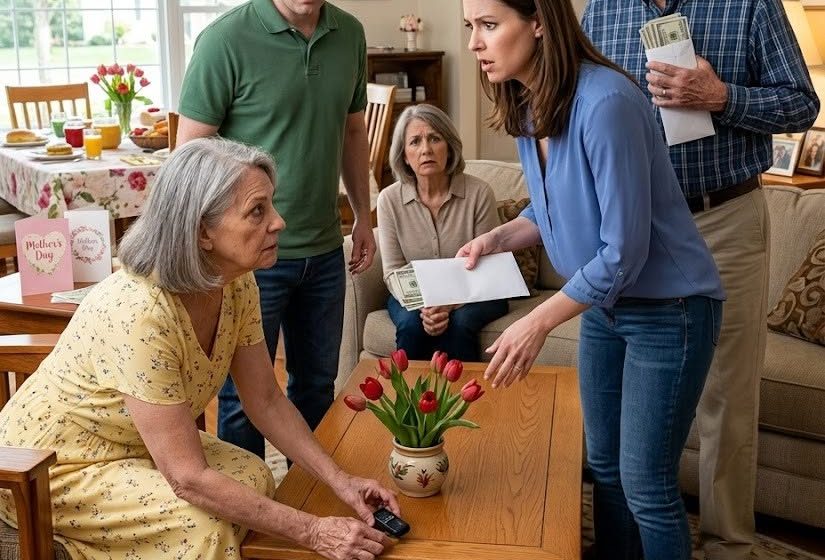

Daniel looked at Mark.
“What exactly did Vanessa tell you?”
Mark glanced at his daughter.
“Nothing. Forget it.”
“No,” Daniel said. “You just said she told you I’d understand. Understand what?”

Vanessa stepped toward him.
“He’s confused.”
Mark’s expression hardened.
“I’m not confused.”
Diane whispered his name, but he kept going.
“You told us Daniel had been putting money aside. You said after lunch you were finally going to straighten out where it should go.”
Vanessa’s mouth opened.
Nothing came out.
Daniel turned toward her slowly.
“You knew about the money?”
“Of course I knew you were saving.”
“For Mom?”
She hesitated.
That hesitation answered him.
He crossed the room, took the envelope from Mark’s hands, gathered the loose bills from the carpet, and placed everything back in my lap.
Then he looked at Vanessa.
“This was never yours to redirect.”
She folded her arms.
“So that’s it? Your mother hides a recorder in our house, humiliates me, and I’m the villain?”
Daniel glanced at the tiny recorder in my hand.
Then at the money.
“I don’t need a recording to know you ripped an envelope out of my mother’s hands.”
Vanessa’s eyes filled.
“You’re choosing her.”
Daniel shook his head.
“I’ve spent three years letting you turn every disagreement into that question.”
He walked to the front door and opened it.
“Mark. Diane. Go home.”
Then he looked at Vanessa.
“You can stay and talk to me without blaming my mother for what you just did.”
She grabbed her purse.
Ten seconds later, she walked out behind her parents.
The front door closed.
And for the first time all day, Daniel and I were alone.
Neither of us spoke.
The takeout food Vanessa had arranged on serving plates was still sitting on the dining table, half eaten and going cold.
One of the hundred-dollar bills Daniel had missed rested beside the leg of my chair.
He noticed it before I did.
He bent down, picked it up, smoothed the corner with his thumb, and tucked it back inside the white envelope.
Then he handed the envelope to me again.
“Mom.”
I stared at it.
Twenty-five thousand dollars suddenly seemed heavier than it had twenty minutes earlier.
“Daniel, I don’t want this if it costs you your marriage.”
He closed his eyes.
“Don’t do that.”
“Do what?”
“Make what she did smaller so I don’t have to deal with it.”
I had no answer ready.
For years, I had become very good at making unpleasant things smaller.
A rude comment became stress.
A forgotten birthday became bad timing.
A holiday invitation that arrived after everyone else’s became an innocent mistake.
You can survive a surprising amount if you keep renaming it.
Daniel sat in the chair across from me.
He looked exhausted.
Not angry.
Exhausted.
That frightened me more.
Anger burns hot enough to make people act before they understand what they’re doing.
Exhaustion usually means they’ve been understanding for a long time.
He looked at the recorder in my hand.
“How long have you been doing that?”
“This is the first time.”
“You brought it because of Vanessa?”
“Yes.”
He looked hurt.
I hated that.
“I didn’t come here expecting her to take money from me,” I said. “I didn’t even know there would be money.”
“Then why record lunch?”
“Because she keeps telling you I say things I didn’t say.”
He leaned back.
I continued before I lost my nerve.
“Three weeks ago, you called me after you two had an argument.”
His eyes shifted toward me.
“You said Vanessa told you I’d criticized your house and said she wasn’t keeping it clean enough.”
He remembered.
“I never said that.”
Daniel rubbed both hands over his face.
“I asked whether your dishwasher had finally been fixed.”
He gave a tired laugh with no humor in it.
“I know.”
“Do you?”
He lowered his hands.
“I don’t know what I know anymore.”
That sentence hurt.
Not because I blamed him.
Because I finally understood what the last three years had done to him.
Vanessa hadn’t simply convinced him that I was difficult.
She had turned every relationship into a loyalty test.
If Daniel defended me, he was failing his wife.
If he agreed with Vanessa, he was finally “protecting his marriage.”
If he asked for time to think, that itself became proof he was emotionally controlled by his mother.
There was no neutral position.
And slowly, my son had stopped speaking freely because every sentence carried a consequence.
I placed the recorder on the coffee table.
“You want to hear the rest?”
Daniel looked at it.
Then he shook his head.
“No.”
I was surprised.
He stared toward the front door Vanessa had just walked through.
“I heard enough with my own ears.”
For a moment, neither of us said anything.
Then he looked at the envelope again.
“Please take the money.”
“Why?”
His eyebrows drew together.
“Because it’s yours.”
“That isn’t what I asked.”
Daniel had always hated when I did that.
Even as a boy, he would give me an answer and I’d wait until he found the answer underneath it.
He looked at the carpet.
“I started saving after Christmas.”
I waited.
He continued.
“I realized I’d spent years buying things I didn’t need while you were still talking about whether you should replace your old furnace or try to get one more winter out of it.”
“That furnace works.”
“Mom.”
“It does.”
He almost smiled.
Then the expression faded.
“I wanted to do one thing for you that didn’t feel like paying you back.”
“You don’t owe me.”
“I know.”
“Do you?”
He looked at me.
This time, he smiled for real.
A little.
“You really enjoy that question, don’t you?”
“Only when you’re avoiding mine.”
His smile disappeared again.
“I wanted you to have something that wasn’t for a bill.”
The words took me back thirty years.
Daniel was nine.
He had wanted new basketball shoes because the boys at school had started making fun of the pair he wore.
I had looked at the price tag and known immediately that I couldn’t afford them.
So I cleaned two additional floors at an office building for almost a month.
I bought the shoes.
The next morning, I found a folded sheet of notebook paper beside my coffee mug.
It said, in his crooked handwriting, I WILL BUY YOU SOMETHING WHEN I GET RICH.
I had kept it for years.
Not because I expected repayment.
Because nine-year-old Daniel had believed love was a debt he needed to settle.
I had tried to teach him otherwise.
Apparently some lessons take longer than either person expects.
I put the envelope on the coffee table.
“I’ll accept it.”
His shoulders dropped.
“But not because you owe me.”
“Okay.”
“And not because Vanessa tried to take it.”
“Okay.”
“And you’re not making a decision about your marriage tonight because of me.”
His expression tightened.
“Mom—”
“No.”
I leaned forward.
“Whatever you decide about Vanessa has to be about what you can live with in your own house.”
“It is.”
“Then let it be.”
He stared at me.
I could see the boy he used to be and the tired man sitting in front of me at the same time.
“I should have stopped this years ago,” he said.
“You should have noticed it years ago.”
He flinched.
I hated that too.
But kindness and dishonesty are not the same thing.
“I didn’t need you to choose me over her,” I said. “I needed you to stop letting her tell you what I meant.”
He nodded once.
That was the first apology he gave me.
Not with words.
With understanding.
His phone buzzed.
Vanessa.
He stared at the screen.
Then another message came.
Then another.
He turned the phone face down.
“You should probably talk to her,” I said.
“I will.”
“Not while you’re furious.”
“I’m not furious.”
That worried me more.
“What are you?”
Daniel looked toward the dining room.
“I think I’m embarrassed.”
“Why?”
“Because Mark wasn’t surprised when she handed him the money.”
I hadn’t wanted to be the one to say it.
He said it himself.
“He expected it.”
“Yes.”
“And Diane laughed.”
“Yes.”
Daniel’s jaw tightened.
“So this wasn’t just Vanessa getting angry.”
“No.”
He rubbed his thumb over a scratch in the arm of his chair.
“What was I supposed to do eventually? Come home and find out the money was gone?”
I didn’t answer.
There was no answer I could give that would help.
Daniel’s phone buzzed again.
This time, he read the message.
His expression changed.
“What?”
He held the phone out.
I didn’t take it.
“Read it.”
He hesitated.
Then he did.
Vanessa had written that he had humiliated her parents, embarrassed her in front of me, and allowed me to “stage an ambush” inside their house.
There was no mention of the envelope.
No mention of taking the money.
No mention of calling me a cleaning woman who smelled like bleach.
Daniel scrolled.
Another message.
She said if he wanted to “repair this,” he needed to bring the $25,000 to her parents’ house and apologize.
I almost laughed again.
Daniel didn’t.
He typed something.
“What did you say?”
He turned the screen toward me.
I read one sentence.
The money was never theirs.
Vanessa replied almost immediately.
Then another message.
And another.
Daniel put the phone down without opening them.
“You know what the strangest part is?” he asked.
“What?”
“She isn’t asking whether she hurt you.”
I said nothing.
He looked at me.
“She’s asking why I didn’t let her finish.”
That was the moment I knew Mother’s Day hadn’t broken their marriage.
Whatever happened next, the crack had already been there.
The envelope had simply made it visible.
I left about an hour later.
Daniel carried my handbag to the car even though I told him I was perfectly capable of carrying it.
He tucked the white envelope inside and zipped the bag himself.
At the curb, he stood with one hand on my open car door.
“Mom?”
“Yes?”
“I’m sorry.”
There were probably fifty things he meant.
I didn’t ask which one.
“I know.”
He looked disappointed.
“You’re supposed to say it’s okay.”
“No, I’m not.”
That surprised a laugh out of him.
“It isn’t okay yet,” I said. “Maybe someday it will be.”
He nodded.
I drove home with the yellow dress wrinkled around my knees and $25,000 sitting beside an old lipstick and folded handkerchief.
The recorder stayed in my pocket.
For the first ten minutes, I felt triumphant.
Then I felt ashamed of feeling triumphant.
Then I decided I was too old to police every emotion before I was allowed to have it.
Vanessa had spent years making me question whether I was allowed to be hurt.
I wasn’t going to continue the job for her.
Daniel did not call the next morning.
Or the morning after that.
I resisted the urge to call him.
That was harder than I expected.
Every mother says she wants her grown child to make his own decisions until she has to watch him make one slowly.
On the third evening, he called.
“She’s staying with her parents.”
I sat down at my kitchen table.
“Okay.”
“She says she won’t come home unless I apologize to them.”
“Are you going to?”
“No.”
“Then I suppose you have your answer for tonight.”
He was quiet.
“She says you planned everything.”
“I planned to record lunch.”
“I know.”
“I did not plan the money.”
“I know.”
“I didn’t plan Mark’s comment either.”
“I know, Mom.”
Something in his voice told me he finally did.
That mattered.
Over the next two weeks, Vanessa and Daniel spoke several times.
I know because he told me, but I refused to ask for details.
I didn’t want to become the third person in their marriage in the very way Vanessa had accused me of being.
The decision had to belong to them.
What I learned came from Daniel voluntarily.
Vanessa apologized for “how the lunch got out of hand.”
She did not apologize for the insult.
She said taking the envelope had been an emotional reaction.
She did not explain why Mark had expected money.
She said her father had simply misunderstood something she’d said.
Mark, apparently, had a different memory.
Daniel asked one question repeatedly.
Had she intended, before Mother’s Day, for the money he’d saved to go to her parents?
For several conversations, Vanessa would not give him a direct answer.
She said marriage meant shared resources.
She said my needs were smaller.
She said her parents had helped them more recently.
She said twenty-five thousand dollars was too much to give an elderly woman who “already had enough.”
Eventually Daniel stopped debating all the side arguments.
He asked again.
Did you intend to give my Mother’s Day money to your parents?
Vanessa finally said yes.
She said it as though admitting it would end the argument.
It did.
Just not in the way she expected.
Daniel told her they could not continue living together until they agreed on something basic: neither of them got to secretly redirect money the other had deliberately set aside for a personal gift and then call the other disloyal for objecting.
Vanessa replied that the real issue was me.
Daniel told her the real issue was that she still believed that.
They remained apart.
There was no dramatic scene where he threw her belongings onto a lawn.
No one changed the locks while the other person was at work.
No police arrived.
No secret bank account suddenly appeared.
Real endings are usually slower than the ones people imagine when they’re angry.
Daniel and Vanessa met with a counselor.
He didn’t tell me what was said there.
I didn’t ask.
After several weeks, he told me something simple.
“Mom, I don’t think she understands the difference between compromise and permission.”
I understood immediately.
Vanessa believed that if something affected both spouses, she deserved a vote.
That part was reasonable.
But somewhere along the way, a vote had turned into ownership.
And disagreement had turned into betrayal.
Daniel also admitted his share.
He had avoided arguments until avoiding them became a habit.
He had let Vanessa interpret my words because correcting her meant a long fight afterward.
He had stopped inviting me over as often because keeping the peace felt easier.
Each individual decision had seemed small.
Together, they had created three years of distance.
“I’m angry at her,” he told me, “but I’m angrier at myself.”
“Don’t stay there too long.”
“Why?”
“Because guilt can be just another way of staring at yourself instead of fixing anything.”
He was quiet.
Then he laughed.
“You could’ve been a lawyer.”
“I cleaned up after lawyers for forty years.”
“That explains it.”
The joke surprised me.
So did how good it felt.
For the first time in years, we were talking without Vanessa existing invisibly between every sentence.
That didn’t mean I wanted their marriage to fail.
I meant what I’d told him.
I didn’t want to win Daniel back as if he were property.
He was a grown man.
He had loved Vanessa.
Part of him probably still did.
Whatever happened needed to be the result of what they could or could not repair.
A month after Mother’s Day, Vanessa called me.
I almost didn’t answer.
Then I did.
“Claire.”
Her voice sounded different.
No perfume through the phone.
No audience.
No Daniel sitting nearby.
Just the two of us.
“I think we should talk.”
“Go ahead.”
She breathed out.
“I shouldn’t have said what I said.”
“Which part?”
Silence.
I didn’t ask the question to torment her.
I needed to know what she actually regretted.
“The comment about you cleaning.”
“You mean the comment about me smelling like bleach.”
“Yes.”
“And taking the money?”
Another pause.
“I shouldn’t have grabbed it.”
“And giving it to your father?”
“It was complicated.”
There it was.
An apology until responsibility became expensive.
I looked through my kitchen window.
A grocery bag was sitting on the counter beside me because I’d come home ten minutes earlier and hadn’t put anything away.
Ordinary life was waiting.
I didn’t want to spend an hour arguing about a lunch that had already happened.
“Vanessa, I don’t need you to like me.”
“I never said I didn’t.”
“I don’t need you to explain that either.”
She went quiet.
“I need you to understand one thing.”
“What?”
“If you and Daniel repair your marriage, I will respect that.”
She said nothing.
“I will not ask him to leave you.”
Still nothing.
“But I will not come back to that house and pretend what happened was normal.”
Her voice hardened slightly.
“So you’re giving him an ultimatum.”
“No.”
I almost smiled.
“That is exactly the kind of sentence I’m done defending myself against.”
She inhaled.
I continued.
“Daniel is responsible for his relationship with me. You’re responsible for yours.”
“What do you want from me?”
It was the first useful question she’d asked.
“Nothing right now.”
She seemed surprised.
“You don’t want an apology?”
“I want any apology you give me to belong to you.”
Vanessa didn’t answer.
We ended the call politely.
Not warmly.
Politely was enough.
Two months passed.
Daniel and Vanessa remained separated.
Then three.
Eventually, Daniel told me they had decided not to move back in together.
There was no single conversation that ended it.
According to him, the counselor kept returning to one issue: could each of them describe what had happened on Mother’s Day without assigning motive to everyone else?
Daniel could.
Vanessa couldn’t.
In her version, my recorder caused the fight.
My presence caused the tension.
Daniel’s gift caused the financial conflict.
Mark’s comment caused the misunderstanding.
Daniel opening the door caused the separation.
Everyone had caused something except Vanessa.
That was the part he said he couldn’t live with anymore.
They began the process of ending the marriage.
I was sad for him.
Truly sad.
There had been good years before the bad ones.
People like simple villains because villains make endings easy.
Vanessa wasn’t cruel every minute of every day.
She had made Daniel laugh.
She had sat beside him during difficult periods at work.
She remembered the foods he hated and the way he took his coffee.
She could be generous when generosity didn’t threaten her sense of control.
That complexity did not erase Mother’s Day.
But Mother’s Day did not erase every good thing either.
Daniel had to grieve both versions at once.
So I didn’t celebrate when he told me.
I made him dinner.
Nothing expensive.
Chicken, potatoes, green beans.
He sat at the same small kitchen table where he had done homework as a boy.
At one point he looked toward the counter.
“Are you going to tell me what you did with the money?”
I smiled.
“I put most of it in savings.”
His face fell.
“Mom.”
“What?”
“I told you to buy something for yourself.”
“I did.”
“What?”
I stood and opened the hall closet.
Inside was a new winter coat.
Nothing extravagant.
Daniel stared at it.
“That’s it?”
“My old one was fourteen years old.”
He laughed.
“You spent twenty-five thousand dollars on a coat?”
“I spent two hundred and nineteen dollars on a coat.”
“What about the other twenty-four thousand seven hundred eighty-one?”
“I am seventy-two years old. Having money where I can reach it is buying peace.”
He pointed at me.
“That is cheating.”
“No, that’s interest.”
He laughed so hard he had to put down his fork.
I hadn’t heard that laugh in a long time.
Several weeks later, he came over carrying a small cardboard box.
I raised an eyebrow.
“If that’s another envelope, take it home.”
“No money.”
He put the box on the table.
Inside was a framed piece of notebook paper.
The paper had gone yellow at the edges.
I recognized the handwriting immediately.
I WILL BUY YOU SOMETHING WHEN I GET RICH.
I looked at him.
“Where did you find this?”
“You gave me some boxes years ago when you cleaned out the closet upstairs.”
“I thought I’d lost it.”
“You didn’t.”
He sat across from me.
“I remember writing it.”
“You were nine.”
“I remember thinking rich meant I could give you enough money that you’d never worry again.”
I touched the edge of the frame.
“And now?”
He smiled.
“Now I think I misunderstood what you wanted.”
That was the closest thing to a perfect ending I could imagine.
Not the cash.
Not Vanessa leaving.
Not being proven right.
My son finally understood that I had never wanted repayment for raising him.
I wanted a relationship where neither of us had to earn the right to be treated with dignity.
The divorce became final months later.
Daniel didn’t rush into another relationship.
He spent more time learning how much of his old behavior had been built around preventing conflict.
We didn’t suddenly become inseparable.
That would have been its own kind of unhealthy.
He had his life.
I had mine.
But Sunday calls stopped feeling like obligations.
Sometimes he called me.
Sometimes I called him.
Sometimes neither of us called, and nobody used the silence as evidence of anything.
That was new.
Vanessa and I never became friends.
She sent me one handwritten note after the divorce was settled.
It was short.
She apologized for taking the envelope and for the way she spoke about my work.
She did not ask me to forgive her.
I appreciated that more than I expected.
I folded the note and put it away.
Not beside the recording.
The recorder no longer mattered.
I had used it because I thought I needed proof that I wasn’t twisting anyone’s words.
By the end, Daniel had learned the more important lesson.
He could trust what he saw.
The following Mother’s Day, he asked whether I wanted to go out for lunch.
“No.”
There was a dangerous pause.
Then I said, “I’m cooking.”
He laughed.
“You?”
“Watch your tone.”
He arrived carrying groceries and a paper cup of coffee for me.
No white envelope.
No grand speech.
No Vanessa.
No Mark or Diane.
Just my son standing in the kitchen while I complained that he was cutting the onions too thick.
Halfway through lunch, Daniel looked at my yellow dress hanging on the back of a nearby chair.
I had worn it to church that morning and changed when I got home.
“You kept that dress?”
“Of course.”
He shook his head.
“That Mother’s Day ruined it for me.”
I looked at the dress.
For months, I had thought the same thing.
Then I remembered putting it on because Daniel remembered it from childhood.
Vanessa didn’t own that memory.
Neither did the argument.
Neither did the money.
“No,” I said.
Daniel looked at me.
“It was mine before that day.”
I carried the dress into the bedroom and hung it back in the closet.
Then I returned to the kitchen.
The old framed note sat on the shelf near my table.
I WILL BUY YOU SOMETHING WHEN I GET RICH.
Daniel noticed me looking at it.
“You know,” he said, “I still technically kept that promise.”
I glanced at the new winter coat hanging by the door.
“Two hundred and nineteen dollars’ worth.”
“You’re never letting that go, are you?”
“Absolutely not.”
He smiled and went back to cutting onions.
I picked up my coffee.
For forty years, bleach had dried into the cracks of my hands because I did the work that kept food on our table and opportunities in front of my son.
Vanessa had used that history to humiliate me.
For one afternoon, I had almost let her turn it into something shameful.
I don’t anymore.
Those hands paid rent.
Packed lunches.
Buttoned a little boy’s coat.
Signed school forms.
Worked nights when there wasn’t enough money.
And one Mother’s Day, they held a white envelope long enough for my grown son to finally see the difference between giving out of love and taking out of entitlement.
The $25,000 stayed mostly in my savings.
The recorder went into a drawer.
The yellow dress went back in my closet.
And the old promise from a nine-year-old boy stayed framed beside my kitchen table.
Not because Daniel owed me anything.
Because at seventy-two, I finally understood something I wish both of us had understood much earlier.
The best part of his gift wasn’t that he gave me money.
It was that when someone tried to take away my dignity along with it, my son finally stopped asking me to prove I deserved to keep either one.