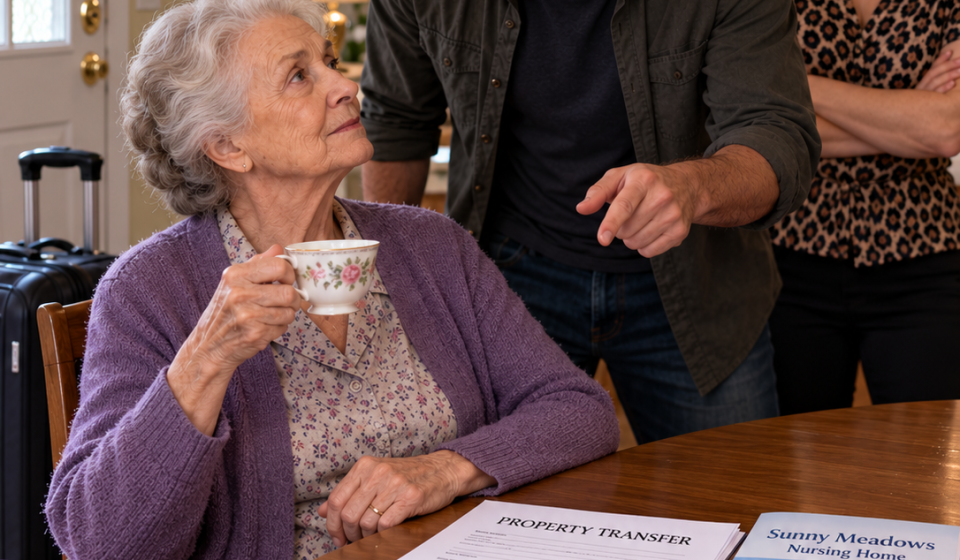

“I sold my house six months ago.
My son had no idea.
Yesterday, he placed my suitcase
beside the front door and told me,
“”There’s a bed waiting for you
at a nursing home, Mom.
Sign this house over to us
and be gone by Friday.””
I was eighty-one years old,
and my own son had already decided
I was no longer welcome
in the home where I’d spent
nearly fifty years.
His wife, Brenda, stood behind him
with her arms crossed,
watching me as though I were
a problem they had finally figured out
how to remove.
On the kitchen table lay
a transfer document, a black pen,
and a nursing home brochure
with a room number circled in red.
Neither of them knew
that the most important document
in that house had been hidden away
for six months.
I looked at the papers,
then at my son,
and slowly lifted my teacup.
“”Before I do anything, Luke,
you should ask the man
who owns this house,”” I said.
He laughed right in my face
and shook his head as though
I had finally lost my mind.
“”Mom, the only man
who ever owned this place
has been buried for two years.””
He was talking about his father, Patrick,
the man who built our house
with his own hands in 1974.
Patrick wasn’t wealthy,
but he was a carpenter
who believed that a family deserved
something solid to call its own.
He built the porch
where we drank our morning coffee,
the kitchen cabinets
where I stored my baking supplies,
and the little sewing room
overlooking the backyard.
Before he died, he promised me
I would always have a roof
over my head.
I believed him,
even after we buried him
two years ago.
What I hadn’t expected was that
our only son would become
the person I needed protection from.
Three days after Patrick’s funeral,
Luke arrived with Brenda
and a moving truck,
telling me they were worried
about my living alone.
I was still grieving, exhausted,
and grateful that someone wanted
to be near me.
“”You’re not getting any younger, Mom,””
Luke told me while Brenda
inspected the house.
“”We’ll move in, take care of things,
and make sure nothing happens to you.””
I didn’t ask why
they had already packed a truck
before discussing their plans with me.
Looking back, I realize
they weren’t asking permission
because they’d already made the decision.
Within two weeks,
Brenda had rearranged my kitchen,
packed away family photographs,
and started criticizing the furniture
Patrick had made.
By the end of the month,
she and Luke had moved
into my bedroom,
the same room where I’d slept
beside my husband for nearly fifty years.
I was given a narrow folding bed
in the sewing room,
surrounded by old fabric, boxes,
and the sound of their television
through the wall.
When I protested,
Brenda told me the smaller room
was more appropriate for someone my age.
I remember standing beside that folding bed,
holding Patrick’s photograph against my chest.
Our old bedroom was only
a few steps away,
but it might as well have been
in another state.
I could hear Brenda laughing
as she opened my closet
and moved her clothes inside.
That was the first night
I understood how a person could
be pushed out of her own life
without ever leaving her address.
By Thanksgiving,
Brenda was introducing the property
to visitors as “”our house.””
She talked about replacing the flooring,
repainting the walls,
and removing Patrick’s handmade bookshelves
because they looked outdated.
Luke never corrected her,
and whenever I mentioned that
the property was still mine,
he told me not to get worked up
over little things.
Apparently, fifty years of my life
had become a little thing.
Then the money started disappearing
from my pension.
Every month, Luke held out his hand
for three hundred dollars
and told me everyone had to contribute
to household expenses.
I watched him collect that money
while his brand-new pickup truck
sat gleaming in the driveway,
and I wondered when my son
had become a man who could charge
his widowed mother
for sleeping on a folding bed.
When I asked what the money covered,
he said I was being difficult
and reminded me how much
they were supposedly doing for me.
Brenda stopped including me
in dinner plans,
even when I was sitting
only a few feet away.
Sometimes I opened the refrigerator
and found a plate of leftovers
wrapped in plastic,
and sometimes there was nothing waiting
at all.
My favorite rocking chair disappeared
into the garage,
Patrick’s photograph vanished from the mantel,
and the sewing room slowly became
the only space where I felt welcome.
I began keeping crackers
beside my bed because I hated
asking Brenda whether I could make myself
something to eat.
I told myself Luke was still
the little boy I’d raised,
somewhere underneath the man
standing in my kitchen.
I remembered staying awake
through his childhood fevers,
helping him with schoolwork,
and watching Patrick teach him
how to hammer a nail straight.
A mother can spend years
excusing the behavior of her child
because she remembers who
that child used to be.
But one night in March,
I heard something
that made those excuses impossible.
It was nearly eleven
when I woke with a dry throat
and went toward the kitchen for water.
A light was shining beneath the door,
and I could hear Luke talking
on the telephone.
I stopped when he mentioned my age,
because his voice had the casual confidence
of someone discussing a business arrangement.
Then I heard him say something
I would remember
for the rest of my life.
“”She’s eighty-one,”” he said.
“”The house is worth four hundred thousand,
easy.
We’ll put it on the market
the second she’s gone.””
He paused,
listened to whoever was speaking,
and laughed.
Then he mentioned that Brenda
already had plans for the money
and that they might finally pay off
his truck.
I stood in the dark hallway
with one hand pressed against the wall.
My son wasn’t discussing
how to keep me healthy or comfortable,
and he wasn’t worried
about me living alone.
He was calculating how soon my death
might turn into four hundred thousand dollars.
Worse still,
he was laughing about it.
I didn’t confront him that night.
Instead, I returned to the sewing room
and sat on the edge
of my folding bed,
staring at the ceiling
where a small crack had been growing
for months.
I thought about Patrick spending
long evenings working on this house,
about every bill we’d paid together,
and about the sacrifices we’d made
so Luke could have a better life.
Then I realized that the son
I had raised was waiting
to inherit something
he had already decided belonged to him.
For the first time since Patrick died,
I stopped thinking about
how to keep Luke happy.
I began thinking about
how to keep myself safe,
because I finally understood
that my silence was helping him
take more and more.
I reached beneath my dresser
and pulled out Patrick’s old leather folder,
the one containing our property documents
and records from his estate.
I opened it carefully,
and there, among the papers,
was the deed showing
that the house belonged to me.
By sunrise,
I had made a decision
I never imagined I would have to make.
Luke believed my age made me helpless,
and Brenda believed
I would never have the courage
to stand against them.
Neither knew I was about to contact
someone my son had pushed out
of our family years earlier.
I picked up the telephone,
opened my old address book,
and found the number
I’d been keeping for exactly that reason.
And when I heard
the familiar young woman’s voice answer,
I knew I wasn’t going
to face Luke alone.”
Her name was Hannah.
My granddaughter.
Luke’s only daughter.
And the last person
he wanted standing beside me.
“Grandma?”
Her voice trembled with surprise.
“Is that really you?”
For a moment,
I couldn’t speak.
I hadn’t heard that voice
in almost three years.
“Yes, sweetheart.”
I swallowed.
“It’s me.”
There was a long silence.
Then she whispered something
that nearly broke my heart.
“I thought you didn’t want me anymore.”
I closed my eyes.
“Oh, Hannah.”
My fingers tightened around the telephone.
“Who told you that?”
She hesitated.
“Dad.”
The answer struck harder
than I expected.
“He said you were disappointed in me.”
I stared at the photograph
of Patrick beside my bed.
“He said you wanted me
to stay away.”
I felt something cold
move through my chest.
Luke hadn’t merely taken my bedroom.
He had taken my granddaughter.
And he’d done it
while I was too consumed
by grief to question him.
“Hannah, listen to me.”
My voice shook.
“I never stopped loving you.”
She began crying.
So did I.
For several minutes,
neither of us could say much.
Then she asked a question
that changed everything.
“Grandma, are you safe?”
I looked toward the bedroom door.
Beyond it,
I could hear Brenda moving
through the kitchen.
Luke was still asleep.
“I don’t think I am.”
Hannah became very quiet.
“Tell me what’s happening.”
So I told her.
Not everything at first.
Just the folding bed.
The money.
The meals.
The way Luke spoke
about the house.
And finally,
what I’d heard him say
the previous night.
When I finished,
Hannah didn’t immediately respond.
Then she asked,
“Does he have access
to your bank accounts?”
I thought about the pension card
Luke occasionally borrowed.
“Sometimes.”
“Does he know where
you keep your property documents?”
“No.”
“Good.”
Her voice had changed.
The frightened little girl
I remembered was gone.
In her place
was a woman who understood
that love sometimes required action.
“Grandma, don’t sign anything.”
“I won’t.”
“And don’t tell them
you called me.”
I glanced toward the hallway.
“All right.”
“I’m coming this morning.”
I nearly protested.
I didn’t want another family fight.
I didn’t want shouting.
And I certainly didn’t want Hannah
to become Luke’s next target.
But before I could speak,
she said something
that made me straighten my shoulders.
“You protected me
when I was little.”
Her voice softened.
“Please let me protect you now.”
I sat there
with the telephone against my ear
and began crying again.
Not because I was helpless.
Because someone had finally asked
what I needed.
Hannah arrived at ten that morning.
She parked two streets away.
I met her at the small grocery store
where I’d been shopping
for nearly forty years.
She was thirty-one now.
Her dark hair fell
just below her shoulders.
She wore a navy coat
and carried an enormous handbag.
But when she saw me,
her expression changed.
“Grandma.”
She crossed the parking lot
almost running.
Then she wrapped both arms
around my shoulders.
I hadn’t realized
how desperately I’d missed
being hugged without conditions.
We stood beside her car
until my knees began aching.
Then she stepped back
and looked at me carefully.
“You’ve lost weight.”
I shrugged.
“People do at my age.”
“Not like this.”
She touched my cheek.
“Have you been eating enough?”
I tried smiling.
She didn’t smile back.
That was when I understood
I could no longer hide
behind reassuring little lies.
“No, sweetheart.”
Her eyes filled.
I looked away.
“Some days, I haven’t.”
Hannah opened the passenger door.
“Then breakfast comes first.”
We drove to a small diner
outside town.
She ordered scrambled eggs,
toast, oatmeal, and coffee.
I laughed at the amount.
“Hannah, I’m not feeding an army.”
She took my hand.
“Eat whatever you want.”
And something about those words
made the tears return.
For nearly two years,
I’d been eating whatever Brenda allowed.
Now my granddaughter
was telling me I could choose.
It seemed like such a small thing.
Yet I could barely swallow.
While we ate,
Hannah told me why Luke
had stopped speaking to her.
It began five years earlier,
when she’d refused to cosign
a business loan for him.
He’d promised the money
would help him become independent.
But Hannah had already watched
him borrow from other relatives.
She’d asked for financial statements.
He’d accused her of disrespect.
Then Brenda had called her selfish.
Eventually,
Luke told Hannah
she was no longer welcome
at family gatherings.
“I tried calling you,” she said.
“I sent birthday cards.”
My fork stopped moving.
“I never received them.”
“I know that now.”
She looked toward the window.
“Dad said you didn’t want them.”
I remembered those years.
The missed birthdays.
The empty chair at Christmas.
The excuses Luke invented
whenever I asked about Hannah.
“She’s busy, Mom.”
“She doesn’t care about family anymore.”
“Don’t embarrass yourself by calling.”
I had believed him.
Or perhaps I’d been afraid
to discover the truth.
“I’m sorry,” I whispered.
Hannah shook her head.
“Grandma, you didn’t know.”
“But I should have asked.”
She squeezed my hand.
“Then we’re asking questions now.”
After breakfast,
she drove me
to a small law office
near the courthouse.
A brass plaque beside the door
read Elena Vargas,
Attorney at Law.
Hannah had called ahead.
Mrs. Vargas was in her sixties,
with silver-rimmed glasses
and a calm, steady voice.
She listened without interrupting
as I explained my situation.
When I finished,
she placed her pen down.
“Margaret, may I ask
you something directly?”
“Of course.”
“Do you want your son
living in your home?”
The question startled me.
I had spent so long
wondering what Luke wanted
that I hadn’t considered
my own answer.
I looked at Hannah.
She remained silent.
She wasn’t going
to decide for me.
“No,” I finally said.
The word seemed to linger
in the quiet office.
“No, I don’t.”
Mrs. Vargas nodded.
“And do you want
to continue living there yourself?”
That question was harder.
I thought about Patrick.
His workshop.
The porch.
The lilac bushes he’d planted
outside our bedroom window.
I thought about
forty-eight Christmas mornings,
birthday cakes,
and Sunday dinners.
Then I thought about
that folding bed.
The crackers.
The sound of my son laughing
about my death.
“I don’t know anymore.”
Mrs. Vargas leaned forward.
“That’s an acceptable answer.”
She explained that
I had several options.
I could establish clear boundaries
and require Luke to leave
through proper legal procedures.
I could change my estate plan.
I could arrange
for independent financial protection.
Or I could sell the house
and begin somewhere else.
No one could force me
into a nursing home
simply because I was old.
My age didn’t erase
my legal rights.
And Luke didn’t acquire ownership
by moving furniture
into my bedroom.
Mrs. Vargas examined the deed
I’d brought from Patrick’s folder.
Then she confirmed something
I’d needed to hear.
The property was mine.
Legally.
Entirely.
Luke had no ownership interest.
Not one dollar’s worth.
When she told me that,
I felt my breathing change.
For the first time
in almost two years,
the situation seemed possible
to escape.
Still,
I wasn’t ready
to make a decision.
“I need to think,” I said.
Mrs. Vargas nodded.
“Then take your time.”
She looked directly at me.
“But don’t mistake patience
for an obligation to endure mistreatment.”
Those words stayed with me.
That afternoon,
Hannah brought me home
before Luke returned from work.
I entered through the back door,
carrying a grocery bag
with the bread and milk
I’d originally claimed
I was going to buy.
Brenda glanced up
from the kitchen counter.
“Where have you been?”
“Shopping.”
She frowned.
“You were gone almost four hours.”
I kept walking.
“The store was busy.”
She watched me closely.
Then her eyes narrowed.
“Did you buy anything for dinner?”
I looked into the bag.
“Bread and milk.”
Brenda gave an irritated sigh.
“Wonderful. Very helpful.”
I didn’t answer.
For the first time,
her disappointment
didn’t feel like my responsibility.
That evening,
I ate dinner
in the sewing room.
But I wasn’t eating crackers.
Hannah had packed
a container of chicken soup,
fresh bread,
and a slice of apple pie.
I sat beside the window
and ate every bite.
Then I opened Patrick’s folder again.
Inside was the deed,
his death certificate,
old insurance papers,
and a yellowed photograph
of the house under construction.
Patrick stood on the front porch,
shirtless beneath his work overalls,
holding a hammer.
He was smiling.
Behind him,
there were no windows yet.
No curtains.
No furniture.
Just wooden beams
and the promise of something permanent.
I touched his face.
“Oh, Patrick.”
My voice sounded strange
in the empty room.
“What would you do?”
Of course,
the photograph didn’t answer.
But I remembered something
he used to tell me
whenever a customer demanded
an impossible repair.
“Margaret, rotten wood
doesn’t become strong
because you paint over it.”
I looked around my little room.
For two years,
I’d been painting over rot.
Making excuses.
Avoiding confrontations.
Pretending I couldn’t see
what was happening.
And suddenly,
I knew I couldn’t continue.
The next morning,
I called Mrs. Vargas.
“I’ve made my decision.”
She listened.
Then she asked me
to come back to her office.
I told her
I wanted to sell the house.
Not because Luke had driven me out.
Not because I was defeated.
I wanted to sell
because I was ready
to choose my own future.
And I wanted the decision
to belong entirely to me.
Mrs. Vargas made sure
I understood the consequences.
She suggested an independent appraisal,
a review of my finances,
and a thorough discussion
of where I would live afterward.
There would be no rushed signatures.
No secret promises.
No pressure from Hannah.
I agreed to everything.
Over the following weeks,
we began making arrangements.
Hannah helped me open
a new bank account
at a different institution.
Only I could authorize transactions.
I changed my pension deposit instructions.
I requested bank statements.
I replaced the debit card
Luke had occasionally used.
Then we discovered something
that made Hannah visibly angry.
Several withdrawals
had appeared on my account
without my permission.
Small amounts.
A hundred dollars here.
Two hundred there.
One withdrawal was nearly
nine hundred dollars.
The dates matched weekends
when Luke had borrowed my card.
He’d claimed
he was buying household necessities.
But the bank records
told a different story.
Mrs. Vargas advised me
to preserve every statement
and report the unauthorized transactions.
Hannah wanted to confront Luke immediately.
I stopped her.
“Not yet.”
She looked at me.
“Grandma, he stole from you.”
“I know.”
My voice was steadier
than I expected.
“But I want us safe first.”
She studied my face.
Then she nodded.
“All right.”
We documented everything.
Every withdrawal.
Every payment I’d given Luke.
Every expense Brenda claimed
I owed the household.
We photographed the folding bed.
The boxes crowding my room.
The belongings they’d moved
without asking.
Mrs. Vargas helped me
contact the appropriate elder-protection services
and make a safety plan.
She also urged me
to speak privately with my doctor.
Not because she doubted my judgment.
Because Luke might eventually
try to challenge it.
My doctor had known me
for more than fifteen years.
He examined me,
asked questions,
reviewed my medications,
and listened carefully.
Then he said something
that made me laugh.
“Margaret, you’re perfectly capable
of making your own decisions.”
He paused.
“Although I’d strongly recommend
you stop letting other people
make them for you.”
I smiled.
“So would I, Doctor.”
By early April,
the house was appraised.
The estimated market value
was just over four hundred thousand dollars.
Almost exactly what Luke
had predicted during that terrible phone call.
I stared at the figure.
Four hundred thousand dollars.
That was what my son saw
when he looked at our home.
Not Patrick’s workmanship.
Not my years of care.
Not the childhood memories
we had given him.
Just money.
For several days,
I worried about selling
to a complete stranger.
Then Hannah mentioned someone
I hadn’t thought about
in more than twenty years.
“Do you remember Thomas Delaney?”
I looked at her.
“Patrick’s apprentice?”
She nodded.
“He restores old houses now.”
Of course I remembered Thomas.
He’d been seventeen
when Patrick hired him
to help after school.
A tall, awkward boy
with a broken bicycle
and more enthusiasm than experience.
His father had died young.
His mother worked nights.
Patrick taught him carpentry,
but he also taught him
how to arrive on time,
how to keep promises,
and how to treat people fairly.
Thomas eventually started
his own construction business.
He visited us occasionally,
always bringing something
for Patrick’s workshop.
After Patrick died,
Thomas attended the funeral.
I remembered him standing
quietly near the back.
Luke had barely acknowledged him.
Hannah contacted him.
Two days later,
Thomas came to see the house
while Luke and Brenda were away.
He was in his late fifties now.
His hair had turned gray.
But I recognized his smile immediately.
“Mrs. Whitmore.”
He stood on the porch
holding his hat.
“I wish we were meeting
under happier circumstances.”
I invited him inside.
He walked slowly
through the living room.
His fingers brushed
the handmade bookshelves.
Then he stopped
beside the kitchen cabinets.
“Patrick built these himself.”
I nodded.
“Every one.”
Thomas opened a cabinet door
and examined the joinery.
He smiled sadly.
“He made me redo a drawer
seven times
because the corners weren’t square.”
I laughed.
“That sounds like him.”
Thomas glanced toward
the small workshop outside.
“May I?”
We walked into the backyard.
The workshop smelled
of old pine,
machine oil,
and dust.
Patrick’s tools still hung
above his workbench.
Some had been moved.
Others were missing.
Thomas stood silently
for a long moment.
Then he touched
the edge of the workbench.
“He taught me here.”
His voice softened.
“Everything important I know
about this business
started in this room.”
I felt my eyes burn.
Thomas turned toward me.
“Hannah told me
you’re considering selling.”
“Yes.”
“Are you certain?”
I looked back at the house.
“No.”
He smiled gently.
“That’s an honest answer.”
I drew a breath.
“But I’m certain
I can’t keep living this way.”
Thomas didn’t ask
for painful details.
He simply said,
“Then your peace matters
more than the property.”
We discussed the possibility
of his purchasing the house.
He wanted to restore it carefully,
preserving Patrick’s original craftsmanship.
He planned to use the workshop
to train young apprentices.
Not turn it into luxury rentals.
Not tear down the porch.
Not replace every handmade cabinet.
For the first time,
I could imagine the house
having a future
that didn’t involve Luke.
Thomas made a formal offer
after reviewing the appraisal
and obtaining his own inspection.
The offer was fair.
The negotiations were handled
through independent professionals.
Hannah received no commission.
No ownership.
No financial benefit.
Everything was documented.
And before I signed,
Mrs. Vargas met with me alone.
She asked whether anyone
had pressured me.
I said no.
She asked whether I understood
I would be giving up ownership.
I said yes.
Then she asked one final question.
“Margaret, why are you selling?”
I thought carefully.
Then I answered.
“Because I want to live
the rest of my life
without asking permission.”
She smiled.
“Then we can proceed.”
The sale closed six months
before the confrontation
at my kitchen table.
Thomas became the legal owner.
The deed was recorded.
The funds were transferred
into my protected account.
And our agreement allowed me
to remain in the house temporarily
while arranging my move.
That temporary occupancy
would end the following autumn.
Luke knew none of it.
Neither did Brenda.
The property documents
they occasionally glimpsed
were old copies
from Patrick’s estate.
They never checked
the county ownership records.
They never asked
whether I had made plans.
And they certainly never imagined
I could make a decision
without consulting them.
Meanwhile,
Hannah helped me find
a small single-story cottage
near her neighborhood.
It had two bedrooms,
a bright kitchen,
and a little garden
behind a white wooden fence.
There were no stairs
to climb at night.
The bathroom was accessible.
The porch had enough space
for two rocking chairs.
And the bedroom window
faced the morning sun.
The moment I stepped inside,
I felt something
I hadn’t felt for years.
Possibility.
Not happiness exactly.
Not yet.
Just the quiet realization
that my life
might still belong to me.
I bought the cottage
with part of the sale proceeds.
The remaining money
would support my retirement,
healthcare,
and whatever years
God chose to give me.
I updated my will
and other estate documents
with Mrs. Vargas.
I appointed Hannah
to handle specified decisions
if I ever genuinely needed help.
But the arrangements
preserved my independence
for as long as I remained capable.
Everything was carefully explained.
Everything was voluntary.
There were no blank signatures.
No hidden conditions.
And nobody suggested
I should be grateful
for the privilege
of sleeping in my own bedroom.
Over the next six months,
Hannah and I prepared quietly.
She helped me choose curtains.
We bought a proper mattress.
I selected pale blue paint
for the bedroom.
The same shade
Patrick had once used
in our first apartment.
Some afternoons,
Hannah took me shopping.
Other days,
we sat in her kitchen
and talked about all the years
we had lost.
I learned about her work.
Her friends.
Her disappointments.
The apartment she’d rented
after her father rejected her.
I learned how much
she had struggled
when Patrick died.
And how desperately
she’d wanted to attend the funeral
without being treated
like an unwelcome stranger.
“I stood outside the church,” she admitted.
“I watched everyone go inside.”
I covered her hand.
“Why didn’t you come in?”
She looked down.
“Dad said I’d cause a scene.”
I closed my eyes.
That was another memory
Luke had stolen.
Patrick had adored Hannah.
He taught her to plant tomatoes,
repair broken chair legs,
and recognize birdsong
from the backyard.
He would have wanted her
beside us that day.
“I’m sorry,” I whispered.
She shook her head.
“I don’t want apologies forever, Grandma.”
She leaned closer.
“I just want more time with you.”
So we gave ourselves time.
We cooked together.
We visited the library.
We took short walks
when my knees allowed.
And slowly,
I began remembering
that life contained
more than surviving
from one day to the next.
Still,
I had one unfinished responsibility.
I needed to tell Luke.
Part of me wanted
to make the announcement
over Sunday dinner.
To sit across from him
and explain everything calmly.
To give him time
to find another place.
But every time
I tried to imagine it,
I remembered
his laughter in the kitchen.
I remembered Brenda
standing over my folding bed,
telling me to stop complaining.
And I remembered
the way Luke looked
whenever I mentioned ownership.
Like a man waiting
for someone else’s death
to solve his financial problems.
Mrs. Vargas advised me
not to disclose the sale
until the arrangements
for my safety were complete.
Thomas knew
the house was occupied.
His attorney had reviewed
the situation carefully.
Any termination of occupancy
would follow the law.
No one planned
to change locks secretly.
No one intended
to throw belongings
onto the street.
There would be formal notices
and reasonable procedures.
The kind of consideration
Luke had never offered me.
Then came yesterday.
And everything changed.
I was sitting
in the sewing room,
folding a pale blue sweater,
when Luke appeared
in the doorway.
He wasn’t smiling.
“Mom, we need to talk.”
I put down the sweater.
“About what?”
“The house.”
He entered
without waiting for permission.
Brenda followed.
She carried a folder
and a glossy brochure.
I recognized the brochure immediately.
A residential care facility
on the other side of town.
Not one we’d visited.
Not one I’d chosen.
Luke placed it on the bed.
“We’ve made arrangements.”
I looked at him.
“Arrangements for whom?”
He sighed.
“Don’t start.”
Brenda opened the brochure
to a photograph
of a narrow bedroom.
“It’s a perfectly respectable place.”
She spoke slowly,
as though explaining something
to a stubborn child.
“They serve meals.”
I stared at her.
“So do restaurants.”
Her mouth tightened.
Luke ignored my remark.
“We can’t keep doing this forever.”
I looked around the sewing room.
“Doing what?”
“Taking care of you.”
For a moment,
I genuinely thought
I’d misheard him.
Taking care of me?
The man who collected
three hundred dollars a month?
The man who slept
in my bedroom?
The man who couldn’t remember
the last time
he’d asked whether I was hungry?
I looked into his face.
“Luke, when was the last time
you made me breakfast?”
He frowned.
“What does that have to do
with anything?”
“Answer me.”
Brenda rolled her eyes.
“This is exactly what I mean.”
Luke stepped closer.
“Mom, you need supervision.”
I almost laughed.
Instead,
I folded my hands.
“And who decided that?”
“We did.”
There it was.
Two words.
The entire philosophy
of my life under their roof.
We did.
Not you.
Never you.
Brenda placed another document
beside the brochure.
It was a property transfer form
prepared for my signature.
She set a black pen
on top of it.
“We need you to cooperate.”
I examined the page
without touching it.
The proposed transfer
named Luke and Brenda
as the recipients.
No purchase price.
No compensation.
Just my home.
Handed over.
As if fifty years
of work and sacrifice
could be erased
with one signature.
I asked Luke
whether he had spoken
with my doctor.
He shook his head.
“That’s unnecessary.”
Had he consulted a lawyer?
“Not your concern.”
Had he asked me
whether I wanted
to leave the house?
He grew irritated.
“Mom, stop making everything difficult.”
Then Brenda brought
my suitcase from the closet.
She placed it
beside the front door.
And Luke gave me
his final instruction.
Sign the house over.
Leave by Friday.
Go quietly.
That was when
something inside me settled.
Not shattered.
Not collapsed.
Settled.
Like dust after a storm.
I looked at my son
and understood
that I had spent
the previous six months
preparing for exactly this moment.
Now,
back at the kitchen table,
Luke was still laughing
at my suggestion
that another man owned the house.
He thought I was confused.
Brenda watched me
with growing impatience.
“Margaret, this isn’t funny.”
I set down my teacup.
“No, Brenda.”
I looked directly at her.
“It isn’t.”
Luke pushed the transfer document
closer to me.
“Sign it.”
I didn’t move.
“First, call Thomas Delaney.”
He blinked.
“Who?”
“Thomas.”
I repeated the name slowly.
“Your father’s old apprentice.”
Recognition crossed Luke’s face.
Then irritation.
“What does he have to do
with any of this?”
“Quite a lot.”
I reached into
the small drawer beside me.
Inside was a sealed envelope.
Mrs. Vargas had prepared it
for the day
I would finally tell them.
I placed it
on the kitchen table.
Luke stared.
“What’s that?”
“Open it.”
He looked at Brenda.
Then he tore the envelope.
Inside were certified copies
of the recorded deed,
the sale documentation,
and a letter from my attorney.
Luke unfolded the first page.
I watched his expression change.
Confusion came first.
Then disbelief.
Then something
I had never seen
on his face before.
Fear.
“What is this?”
I answered quietly.
“The deed.”
He scanned it again.
His mouth opened slightly.
Then he looked up.
“Why is Thomas Delaney’s name here?”
“Because he bought the house.”
Brenda leaned over his shoulder.
“What?”
I took another sip of tea.
“Six months ago.”
For several seconds,
the kitchen was completely silent.
The refrigerator hummed.
A bird chirped
outside the window.
Luke looked down
at the papers again.
Then he shook his head.
“No.”
I waited.
“No, that’s impossible.”
He slapped the document
against the table.
“You can’t sell this house.”
I looked at him.
“Apparently, I can.”
His face reddened.
“This is Dad’s house!”
“No, Luke.”
I kept my voice calm.
“It was our house.”
I touched my wedding ring.
“Then it was mine.”
Brenda snatched the deed
from his hands.
Her eyes moved
over the printed lines.
She looked at the date.
The recording information.
Thomas’s name.
The purchase details.
Then she looked at me
with an expression
I can only describe
as pure disbelief.
“You sold it?”
“Yes.”
“Without telling us?”
“Yes.”
Her voice rose.
“While we were living here?”
I nodded.
“That’s correct.”
Luke stood so suddenly
his chair scraped
against the floor.
“How dare you?”
The words hit me
like a slap.
For eighty-one years,
I had tried
to be a decent woman.
A loving wife.
A patient mother.
A generous grandmother.
And now my son
was demanding to know
how I dared
to sell something I owned.
I looked up at him.
“How dare I what, Luke?”
He stared.
“Make decisions about my own property?”
His jaw tightened.
“Or refuse to give you
four hundred thousand dollars?”
Brenda stepped forward.
“You’re being vindictive.”
I shook my head.
“No.”
I glanced at the suitcase
beside the door.
“Vindictive would have been
throwing your belongings outside
without warning.”
Neither answered.
I pointed toward
the nursing home brochure.
“Vindictive would have been
choosing where you live
without asking you.”
Brenda’s lips parted.
But no words came.
I looked back at Luke.
“Vindictive would have been
waiting for you to die
so I could sell
everything you worked for.”
His face changed.
The color seemed
to drain from it.
“What did you just say?”
I held his gaze.
“I heard you in March.”
Silence.
“The telephone call.”
His eyes flickered.
“The one about
four hundred thousand dollars.”
Brenda turned toward him.
I continued.
“The one where you laughed
about selling the house
after I was gone.”
Luke swallowed.
“Mom, you misunderstood.”
“No.”
I shook my head.
“For once, I understood perfectly.”
He stepped backward.
“That was just talk.”
“Perhaps.”
I glanced at the transfer form.
“But this is a document.”
Brenda quickly reached
for the paper.
I placed my hand
over it first.
“Leave it.”
Her expression hardened.
“That belongs to us.”
“No, Brenda.”
I slid it toward myself.
“It was prepared
for my signature.”
I folded the document carefully.
“And my attorney
will want to see it.”
That was when
the doorbell rang.
Luke turned sharply.
“Who’s that?”
I looked toward the hallway.
“Someone I invited.”
He walked to the door.
I heard him unlock it.
Then came a silence
long enough
to make me stand.
“Hello, Dad.”
Hannah.
Her voice was steady.
Luke didn’t answer.
Brenda hurried toward the hallway.
I followed slowly.
Hannah stood on the porch
beside Mrs. Vargas.
Behind them was Thomas Delaney.
He wore a brown jacket
and held a leather folder.
For one astonishing moment,
Luke looked almost young again.
Like a boy
who had been caught
breaking something valuable.
“Hannah?”
She nodded.
“Hello.”
He stared at her.
“What are you doing here?”
“I’m here for Grandma.”
His eyes narrowed.
Then realization struck.
“You.”
He pointed at her.
“You put her up to this.”
Hannah didn’t flinch.
“No, Dad.”
She stepped inside
when I invited her.
“Grandma made her own decision.”
Luke laughed bitterly.
“Of course she did.”
He turned toward Mrs. Vargas.
“My mother doesn’t understand
what she’s doing.”
Mrs. Vargas remained calm.
“Mr. Whitmore, I’m Elena Vargas.”
She introduced herself
as my attorney.
Then she explained
that the sale
had been completed lawfully.
The deed was recorded.
The purchase funds were paid.
The transaction was documented.
And I had received
independent legal advice.
Luke shook his head repeatedly.
“No.”
Then louder.
“No, she’s eighty-one!”
Mrs. Vargas looked at him.
“Being eighty-one
does not make someone
legally incapable of contracting.”
He jabbed a finger
toward Hannah.
“She manipulated her!”
Hannah’s expression tightened.
Mrs. Vargas answered first.
“Hannah has no ownership interest
in the property.”
She paused.
“She didn’t receive
any of the sale proceeds.”
Thomas stepped forward.
“I purchased the house, Luke.”
My son stared at him.
Thomas spoke quietly.
“Your mother approached the decision carefully.”
Luke looked him up and down.
“You were Dad’s helper.”
Thomas nodded.
“Once.”
“You had no right
to buy this place.”
Thomas’s expression saddened.
“Your mother had the right
to sell it.”
For a moment,
I thought Luke might shout again.
Instead,
he looked toward the kitchen.
His eyes moved
to the transfer document.
Then to Brenda.
And suddenly,
I understood
what frightened him most.
Not losing the house.
Losing the money
he had already spent
in his imagination.
He turned back toward me.
“What about my inheritance?”
The question hung
between us.
Hannah looked away.
Mrs. Vargas remained silent.
Thomas lowered his eyes.
And I felt
the last fragile illusion
I’d carried about my son
finally give way.
I answered slowly.
“Luke, I’m still alive.”
He stared.
I took a small breath.
“I’m standing right here.”
His mouth tightened.
“That’s not what I meant.”
“I know.”
My voice remained quiet.
“That’s the terrible part.”
For the first time,
I saw something
other than anger
cross his face.
But it vanished quickly.
Brenda stepped between us.
“Where did the money go?”
I looked at her.
“Excuse me?”
“The money from the sale.”
She folded her arms.
“Where is it?”
I almost smiled.
Not because anything was funny.
Because after everything,
she still believed
my finances were hers
to interrogate.
“Some of it bought
my new home.”
Luke jerked his head up.
“Your what?”
“My new home.”
I let the words settle.
“A little cottage
about fifteen minutes from Hannah.”
Brenda’s eyes widened.
“You bought another house?”
“Yes.”
“With our money?”
The room went still.
I looked directly at her.
“Your money?”
She hesitated.
I stepped closer.
“Tell me, Brenda.”
I kept my voice even.
“Which mortgage payments did you make?”
She said nothing.
“Which property taxes did you pay?”
Her eyes darted toward Luke.
“Which boards did you help Patrick carry?”
Silence.
“Which years did you spend
working two jobs
so the bank
wouldn’t take our home?”
Brenda looked away.
I continued.
“Because I remember every one.”
My hands were trembling now.
But I wasn’t afraid.
“Patrick and I paid for this house.”
I touched my chest.
“We earned it.”
Then I looked at Luke.
“And we raised you
inside it.”
His eyes lowered.
I felt tears gathering.
“But we never promised you
the right to take it
while I was still breathing.”
No one spoke.
Then Thomas cleared his throat.
“Luke, there’s another matter.”
He explained the temporary occupancy arrangement
Mrs. Vargas had prepared
when the sale closed.
My right to remain
would end shortly.
Thomas intended to take possession
according to our agreement.
The other occupants
would receive proper legal notice
and any required opportunity
to make arrangements.
There would be
no illegal lockout.
No forced midnight removal.
Every step would follow
the applicable legal process.
Luke listened
with an expression of disbelief.
Then he demanded,
“Where are we supposed to go?”
I looked at the suitcase
he’d placed beside the door.
I didn’t need to point.
He followed my gaze.
And for the first time,
I saw him understand
what he’d asked me
to endure.
“Mom.”
His voice softened suddenly.
“We’re family.”
I felt Hannah stiffen.
Mrs. Vargas glanced at me,
silently asking
whether I wanted
the conversation to end.
But I wasn’t finished.
“Yes, Luke.”
I nodded.
“We are.”
He took a step closer.
“So you can’t do this.”
I shook my head.
“Being family doesn’t mean
you can take
whatever you want from me.”
His face twisted.
“We took care of you!”
I looked toward the sewing room.
Then toward my suitcase.
“You gave me a folding bed.”
He opened his mouth.
I continued.
“You charged me rent.”
Brenda interrupted.
“Everyone contributes!”
I faced her.
“And everyone deserves dinner.”
She went pale.
I turned back to Luke.
“You moved into my bedroom.”
My voice shook.
“You packed away my husband’s photographs.”
A tear slipped down my cheek.
“You told my granddaughter
I didn’t want her.”
Hannah lowered her head.
Luke’s expression changed again.
I stepped closer.
“And yesterday,
you told me to sign away
a house I didn’t even own anymore.”
My breath caught.
“Then you told me
to disappear by Friday.”
For once,
he had no answer.
The silence
was almost unbearable.
Finally,
I said the words
I should have said
two years earlier.
“Luke, you need to leave.”
His eyes filled.
“Mom, please.”
I shook my head.
“Not because I hate you.”
My voice softened.
“Because I cannot trust you.”
He looked at Hannah.
“Tell her this is crazy.”
Hannah met his gaze.
“She’s telling you
what she needs.”
He laughed bitterly.
“You’re enjoying this.”
“No, Dad.”
Her voice broke.
“I’m not.”
She wiped her cheek.
“I wanted us to be a family.”
Then she added quietly,
“You made that impossible
long before Grandma sold anything.”
Luke turned away.
Brenda muttered something
about lawyers and manipulation.
Mrs. Vargas explained
that further communication
about the property
should go through her office
and the new owner’s representative.
Then she asked
whether I wanted
to discuss anything else.
I looked at the table.
At the brochure.
At the black pen.
At the transfer form
still folded in my hand.
“Yes.”
Everyone turned toward me.
“I want my belongings back.”
Brenda frowned.
“What belongings?”
“My photographs.”
I counted slowly.
“My rocking chair.”
“My sewing machine.”
“Patrick’s tools.”
I looked toward the garage.
“And the boxes
you moved without asking me.”
Brenda folded her arms.
“Some of that stuff is junk.”
I shook my head.
“Not to me.”
Thomas spoke gently.
“I’ll help make an inventory.”
Hannah nodded.
“So will I.”
Brenda looked toward Luke.
He remained silent.
And that silence,
strangely enough,
hurt almost as much
as his earlier words.
Because even then,
after everything,
my son couldn’t bring himself
to say that my memories mattered.
The meeting ended
without shouting.
That surprised me.
I’d spent months imagining
an enormous confrontation.
Broken dishes.
Threats.
An ambulance, perhaps.
Instead,
the truth sat on the table
in a stack of documents.
And there was nothing
Luke could do
to change their contents
by raising his voice.
Hannah walked me
back into the sewing room.
She closed the door.
Then she took my hands.
“Grandma, are you all right?”
I tried to answer.
But my face crumpled.
I sat on the folding bed
and began to cry.
Not delicate tears.
Not quiet tears.
I cried the way
I’d cried when Patrick died.
From somewhere deep
inside my chest.
Hannah knelt beside me.
She wrapped her arms
around my shoulders.
“I know,” she whispered.
I shook my head.
“No, sweetheart.”
I struggled to breathe.
“You don’t understand.”
She waited.
“I wanted him to love me.”
The words escaped
before I could stop them.
I looked at her.
“That’s all.”
My voice cracked.
“I wanted my son
to love me.”
Hannah began crying too.
And for a long time,
we sat together
on that narrow bed,
mourning something
neither of us could repair
with money or paperwork.
Eventually,
Hannah helped me stand.
She opened the window.
Cool afternoon air
drifted into the room.
Outside,
Patrick’s lilac bushes
were moving gently
in the breeze.
I took a deep breath.
For the first time,
the sewing room
felt less like a prison.
It was simply a room.
One I would soon leave.
That evening,
Hannah insisted
I come home with her.
I hesitated.
“My things are still here.”
“We’ll come back for them.”
“What about Luke?”
She looked at me carefully.
“Grandma, he’s a grown man.”
I almost laughed.
Such an obvious fact.
Yet for decades,
I’d treated Luke’s problems
as if they were mine
to solve.
He was fifty-three years old.
He had a job.
A truck.
A wife.
And two functioning hands
Patrick had taught
to work.
He didn’t need
an eighty-one-year-old woman
to provide him
with a free house.
I packed a small overnight bag.
Three sweaters.
My medication.
A photograph of Patrick.
And the old leather folder.
When I stepped
into the hallway,
Luke was standing
near the front door.
My suitcase remained
where he’d left it.
He looked at the bag
in my hand.
“You’re really leaving?”
I nodded.
“Tonight.”
His face tightened.
“Where will you go?”
I looked at him.
“Somewhere I’m welcome.”
The words weren’t planned.
They simply came.
Luke looked down.
For one brief second,
I saw the little boy
who used to hold my hand
crossing the street.
Then Brenda appeared
behind him.
“Well, don’t expect us
to come begging.”
I looked at her.
“I don’t.”
She gave a sharp laugh.
“You’ll get lonely.”
Perhaps I would.
I knew that.
At eighty-one,
loneliness wasn’t
an unfamiliar visitor.
But I had learned
there were worse things
than being alone.
I looked toward the bedroom
Patrick and I once shared.
Then I answered.
“I’d rather be lonely
than unwanted
in my own home.”
Brenda looked away.
I walked past them.
Hannah carried my bag.
At the doorway,
Luke said my name.
“Mom.”
I stopped.
He looked as though
he wanted to say something important.
Perhaps apologize.
Perhaps accuse.
Perhaps ask for money.
But all he managed was,
“What happens to us now?”
I looked at him
for a long moment.
Then I answered.
“That’s something
you and Brenda
will have to decide.”
I stepped onto the porch.
The evening sun
was turning the neighborhood
a soft golden color.
Patrick had once told me
that this was
the prettiest hour
to sit outside.
I stood there briefly,
looking at the porch railing
he had sanded by hand.
Then I walked away.
I didn’t look back
until I reached Hannah’s car.
When I did,
Luke was still standing
in the doorway.
And for the first time,
he looked like a guest
in a house
that no longer belonged
to either of us.
That night,
I slept in Hannah’s guest room.
There was a real bed.
Clean sheets.
A quilt.
A little lamp
beside the window.
Hannah brought me tea
and set it
on the bedside table.
“Do you need anything else?”
I shook my head.
“Just one thing.”
She smiled.
“What’s that?”
I reached for her hand.
“Promise me
you won’t disappear again.”
Her eyes filled.
“Grandma, I’m not going anywhere.”
I believed her.
But after she left,
I lay awake
for nearly an hour.
I could hear
the refrigerator humming downstairs.
A car passing outside.
The faint creak
of old floorboards.
And I realized
how tightly I’d been living
for the past two years.
Waiting for criticism.
Waiting for footsteps.
Waiting for someone
to open my door
and tell me
what I’d done wrong.
Even in safety,
my body hadn’t learned
how to relax.
I turned toward
Patrick’s photograph.
“Well, old man,” I whispered.
“I finally did something brave.”
I smiled through tears.
Then I closed my eyes.
The following morning,
my telephone rang
before breakfast.
Luke.
I watched his name
light up the screen.
My stomach tightened.
Hannah was making coffee
in the kitchen.
She saw my expression.
“You don’t have to answer.”
I looked at the telephone.
“I know.”
That was new.
Knowing I had a choice.
I let it ring.
An hour later,
he called again.
Then Brenda.
Then Luke once more.
By noon,
there were fourteen missed calls.
Finally,
a message appeared.
“Mom, we need to talk.
This has gotten out of hand.”
I read it twice.
Then another message arrived.
“Brenda is upset.
You need to fix this.”
I stared at those words.
You need to fix this.
For most of my adult life,
that had been
my assigned family role.
Someone was angry?
Margaret fixed it.
Someone had overspent?
Margaret helped.
Someone forgot a birthday?
Margaret made excuses.
Someone needed a loan?
Margaret found the money.
Someone hurt someone else’s feelings?
Margaret apologized.
I looked at Hannah.
Then I typed
a short response.
“Please communicate with my attorney
about the property.
I am safe.
I need some time.”
I pressed send.
Then I turned off the telephone.
It felt extraordinary.
Like locking a door
that had never been
mine to lock before.
Over the next week,
Mrs. Vargas helped me
complete several important tasks.
We reviewed my accounts
and protected the remaining proceeds.
We contacted the bank
about the unauthorized withdrawals.
We supplied copies
of the relevant statements.
An investigator began reviewing
the transactions.
I also made
a formal report
concerning the financial exploitation
and pressure I’d experienced.
The process wasn’t dramatic.
No officers burst
through the front door.
There were interviews.
Documents.
Dates.
Careful questions.
And the uncomfortable experience
of explaining
that the person
who might have taken my money
was my own son.
I cried afterward.
Hannah waited
until I was ready to speak.
Then she asked,
“Do you regret reporting it?”
I thought about that.
“Sometimes.”
She nodded.
I continued.
“But I would regret
doing nothing more.”
Mrs. Vargas also examined
the unsigned transfer document
Luke and Brenda
had placed before me.
She found several troubling details.
The proposed transfer
offered me no protection
or meaningful compensation.
It also contained statements
about my willingness
to enter residential care
that I had never authorized.
Mrs. Vargas preserved copies.
She explained
that the document itself
didn’t establish a completed transfer.
But it was important evidence
of what Luke and Brenda
had tried to accomplish.
I asked whether
they would go to prison.
She answered carefully.
“That isn’t something
I can predict.”
There would need
to be an investigation.
Evidence.
Appropriate legal findings.
I appreciated her honesty.
At my age,
I had no interest
in fantasies of instant revenge.
I wanted safety.
Accountability.
And enough peace
to enjoy my remaining years.
A few days later,
Hannah and I returned
to collect my belongings.
Thomas met us there.
So did a professional mover
Hannah had hired.
Luke was at work.
Brenda answered the door.
Her expression darkened
when she saw us.
“You again.”
I nodded politely.
“Good morning.”
She glanced at Thomas.
“What are all these people doing here?”
“Helping me move.”
She blocked the doorway.
“You can’t just take furniture.”
I looked at her.
“Brenda, it’s my furniture.”
She scoffed.
“How do we know that?”
Thomas opened his folder.
“We have an inventory.”
Brenda’s eyes narrowed.
He spoke calmly.
“Items sold with the property
are listed separately.
Mrs. Whitmore’s personal belongings
remain hers.”
Brenda looked furious.
But she stepped aside.
I walked into the living room.
The house smelled different.
Not because anyone
had changed the furniture.
Because I no longer felt
responsible for everything inside it.
I saw the curtains
Brenda had chosen.
The large television.
The modern decorations
that had replaced my photographs.
Then I noticed something
on the mantel.
A small silver frame.
Inside was a picture
of Luke and Brenda
at a seaside restaurant.
They looked happy.
I remembered when Patrick’s photograph
had occupied that exact spot.
I turned toward the hallway.
“Let’s start with the garage.”
My rocking chair
was beneath an old tarp.
One leg was scratched.
Dust covered the armrests.
But it was still beautiful.
Patrick had built it
for my fiftieth birthday.
He’d spent three months
making sure it rocked smoothly.
I ran my fingers
over the worn wood.
Then I sat down.
The chair moved gently
beneath my weight.
I closed my eyes.
For one moment,
I could almost hear Patrick.
“See, Margaret?”
He’d grinned
when he first presented it.
“Perfect balance.”
I opened my eyes.
Thomas was watching quietly.
“Your husband made beautiful furniture.”
I nodded.
“He did.”
Thomas crouched
beside the chair.
“Would you mind
if I repaired that leg?”
My throat tightened.
“I’d be grateful.”
He smiled.
“Patrick taught me how.”
We found my sewing machine
behind two plastic storage bins.
Several boxes contained
my old photographs.
One held Christmas decorations.
Another contained
letters Patrick had written
during the early years
of our marriage.
But one box was missing.
The cedar box.
A small handmade chest
Patrick had given me
on our twenty-fifth anniversary.
I searched every shelf.
Every corner.
Every cabinet.
Nothing.
I turned toward Brenda.
“Where is my cedar box?”
She shrugged.
“What cedar box?”
I described it.
Dark wood.
Brass hinges.
A carved flower
on the lid.
She looked impatient.
“I don’t keep track
of every old thing
you’ve got.”
I felt my chest tighten.
“It was important.”
She folded her arms.
“Maybe you threw it away.”
I stared at her.
“I didn’t.”
Thomas stepped closer.
“Let’s check the storage shelves.”
We searched for another hour.
Still nothing.
Then Hannah found something
beneath a pile
of flattened cardboard boxes.
A faded inventory list
Brenda had written
when she rearranged the house.
It included household decorations,
old books,
garage items,
and several pieces
of handmade furniture.
Beside one entry,
Brenda had written two words.
“Yard sale.”
My stomach sank.
I looked at her.
“Did you sell Patrick’s things?”
Brenda’s face changed.
“Some of it was clutter.”
“What did you sell?”
She shrugged.
“I don’t remember.”
“Brenda.”
My voice was sharper
than I’d intended.
“What did you sell?”
She looked toward the kitchen.
Then she muttered,
“A few old boxes.”
I closed my eyes.
“Did you sell the cedar chest?”
Her silence answered.
I could hear
Hannah drawing a breath.
Thomas looked away.
Brenda finally spoke.
“It was just a box.”
I opened my eyes.
“No.”
My voice trembled.
“It was something
my husband made for me.”
She sighed loudly.
“Margaret, you can’t keep everything forever.”
I looked around.
At the garage.
At the stacked belongings.
At the things
Brenda considered disposable.
Then I said,
“You’re right.”
She seemed surprised.
I continued.
“I can’t keep everything forever.”
My eyes filled.
“But you had no right
to decide what mattered to me.”
Brenda said nothing.
Hannah stepped beside me.
“We’ll try to find it.”
I shook my head.
The loss was already
settling into my bones.
“Let’s finish packing.”
We carried out
the photographs,
the sewing machine,
the letters,
and my rocking chair.
Thomas carefully wrapped
Patrick’s small tool chest.
I left the kitchen cabinets.
The bookshelves.
The workshop bench.
All the things
that belonged to the house
and would remain there.
But I took
the memories I could carry.
When the movers finished,
I walked into the sewing room
one last time.
The folding bed stood empty.
Without the boxes,
the room looked larger.
Sunlight poured
through the window.
I remembered the first night
I’d slept there.
Holding Patrick’s photograph.
Listening to Brenda laugh
in my bedroom.
I stood beside the bed
and placed my hand
on the thin mattress.
Then I whispered,
“Never again.”
Hannah appeared in the doorway.
“Ready?”
I looked around.
Then I smiled.
“Yes.”
And this time,
I meant it.
The next day,
Thomas telephoned me.
He’d made several calls
to local antique dealers
and secondhand shops.
He’d asked around
about the cedar box.
One shopkeeper remembered
a carved chest
sold months earlier.
A woman had purchased it
for twenty-five dollars.
Thomas had obtained
her contact information
through the shopkeeper,
who first asked her permission.
The woman lived
about forty minutes away.
Her name was Mrs. Bennett.
She collected handmade wooden boxes.
When Thomas explained
the circumstances,
she asked to speak with me.
I called that afternoon.
She had a kind voice.
“Mrs. Whitmore,
I believe I have your husband’s box.”
I sat down immediately.
“Does it have
a little flower carved
on the lid?”
“Yes.”
My eyes filled.
“And brass hinges?”
“Yes, ma’am.”
I covered my mouth.
She paused.
“Would you like it back?”
I could barely answer.
“More than you know.”
Mrs. Bennett refused payment.
She said she’d bought the box
because the craftsmanship
reminded her
of her late father.
Then she told me something
that brought tears
to both our eyes.
“I’d hate to think
someone sold his work
without your permission.”
Two days later,
Hannah drove me
to Mrs. Bennett’s home.
She opened the door
holding the cedar box
in both hands.
The moment I saw it,
my knees weakened.
There it was.
The carved flower.
The worn brass hinges.
The tiny scratch
Patrick had accidentally made
on our anniversary morning.
I reached for it.
My hands shook.
Mrs. Bennett placed it
gently into my arms.
I pressed it
against my chest.
“Thank you.”
She smiled.
“Take good care of it.”
I looked at her.
“I will.”
Then I opened the lid.
Inside were several
old anniversary cards,
a dried rose,
and a small envelope
I’d forgotten about.
The envelope was sealed.
Patrick’s handwriting
appeared across the front.
“To Margaret,
when the years grow quiet.”
I stared at it.
I didn’t remember
ever seeing those words.
Mrs. Bennett touched my arm.
“Perhaps you should open that
somewhere private.”
I nodded.
Hannah drove us home
without asking questions.
She understood
that some moments
needed silence.
That evening,
we sat on the porch
of my new cottage.
The movers had finished
setting up the furniture.
My rocking chair
stood beside Hannah’s.
The cedar box
rested on my lap.
The air smelled
of fresh grass
and distant rain.
For a long time,
I simply held the envelope.
Then Hannah asked gently,
“Do you want me to leave?”
I shook my head.
“Stay.”
I broke the seal.
Inside was
a single folded page.
Patrick’s handwriting
was familiar immediately.
A little crooked.
Firm.
Careful.
I unfolded it.
And began to read.
“My darling Margaret,
If you’re reading this,
then I’ve probably become
more trouble than company.”
I laughed through tears.
That was Patrick.
Always joking
when things became difficult.
I continued.
“You’ve spent your life
making a home for everyone.
For Luke.
For Hannah.
For me.
You made birthdays special
when money was tight.
You made ordinary Sundays
feel like holidays.
And somehow,
you made a stubborn carpenter
believe he was
the luckiest man alive.”
My lips trembled.
The words blurred.
Hannah put her arm
around my shoulders.
I wiped my eyes
and kept reading.
“I built our house
because I wanted
to give you something lasting.
But I’ve learned
that walls aren’t
what make a home.
You are.
And if the day comes
when those walls
no longer give you peace,
don’t stay because of me.”
I stopped breathing
for a moment.
Hannah pressed her hand
over mine.
The letter continued.
“Take your photographs.
Take the rocking chair.
Take the good memories.
Leave the rest.
I never wanted
a house to become
a burden on your heart.
I wanted you
to have somewhere safe
to grow old.
And if that place
turns out to be
somewhere different,
then I’ll be proud
of you for finding it.”
Tears fell
onto the paper.
I tried to stop them.
But I couldn’t.
There was one final paragraph.
“And Margaret,
don’t spend your last years
waiting for someone else
to give you permission
to be happy.
You gave me
a wonderful life.
Now promise me
you’ll give yourself one.”
Beneath the words,
he had written,
“Forever yours,
Patrick.”
I lowered the letter.
For a long time,
I stared into the garden.
The sun was setting.
A neighbor’s wind chimes
moved softly
beneath the porch roof.
Hannah was crying quietly
beside me.
I touched the paper.
“He knew.”
She looked at me.
“What?”
I smiled sadly.
“He knew I would struggle
to leave that house.”
Hannah nodded.
“He knew you loved him.”
I looked toward
my new front door.
Pale blue.
Freshly painted.
A little brass knocker
shaped like a bird.
I thought about Patrick
standing on our porch
fifty years earlier.
Then I looked at Hannah.
“He gave me permission.”
She squeezed my hand.
“No, Grandma.”
Her voice was gentle.
“He reminded you
that you already had it.”
I folded the letter carefully.
Then I placed it
back inside the cedar box.
That night,
I slept in my new bedroom.
For the first time
in two years,
I didn’t hear Luke
arguing with Brenda
through the wall.
I didn’t hear
someone changing television channels
in what had once been
my bedroom.
I didn’t worry
about whether I was allowed
to use the kitchen.
I lay beneath
a soft blue quilt,
watching moonlight
move across the ceiling.
And somewhere
between midnight and morning,
I slept.
Really slept.
Without fear.
But the consequences
of Luke’s decisions
were only beginning.
Two weeks after
our kitchen confrontation,
I received a letter
from Mrs. Vargas.
Thomas’s attorney
had served the required notices
concerning the property’s occupancy.
Luke and Brenda
had been informed
of the legal process
and the deadlines involved.
They had responded angrily.
Through their representative,
they argued
that I’d promised Luke
the property would eventually be his.
Mrs. Vargas explained
that an expectation of inheritance
was not ownership.
Nor did an alleged promise
change the recorded deed.
The house had been sold.
The sale had closed.
And Luke’s disappointment
couldn’t reverse it.
The matter proceeded
through the appropriate legal channels.
I did not attend
every meeting.
I didn’t need to.
That was one of
the greatest changes
in my new life.
Other people’s problems
could exist
without becoming
my daily emergency.
Still,
I followed what happened.
Thomas kept me informed
without sharing unnecessary details.
Luke and Brenda
eventually agreed
to vacate under
a written arrangement,
avoiding a prolonged court fight.
They moved into
a rented townhouse
on the other side of town.
It had two bedrooms,
a small garage,
and a monthly rent
they actually had to pay.
For the first time
in nearly two years,
Luke was responsible
for his own housing costs.
I didn’t celebrate.
I simply felt relieved.
Then the bank investigation
produced its findings.
Several transactions
were confirmed
as unauthorized.
The evidence included records
connected to Luke’s use
of my old debit card.
He had claimed
the money paid
for household expenses.
But the transactions
included personal purchases
that had nothing
to do with me.
When questioned,
Luke initially denied wrongdoing.
Later,
through an attorney,
he acknowledged making withdrawals
without my specific permission.
The matter resulted
in a formal repayment arrangement
for the documented losses.
I cooperated
with the investigation
and followed legal advice
about the remaining proceedings.
I didn’t demand
that anyone ignore the evidence
because he was my son.
And I didn’t pretend
the harm disappeared
because repayment was ordered.
Money could be restored.
Trust was another matter.
The accumulated three-hundred-dollar payments
were harder to untangle.
Some had been given
under enormous emotional pressure.
Others were described
as household contributions.
Mrs. Vargas explained
that recovering every dollar
would be uncertain
and could require
additional legal action.
I considered it carefully.
Then I chose
not to pursue
a separate lengthy dispute
over those particular payments.
Not because Luke deserved the money.
Not because I believed
what he’d done was acceptable.
But because I understood
that protecting my peace
sometimes meant choosing
which battles to continue.
The verified unauthorized withdrawals
would be repaid.
My accounts were secure.
My home was safe.
And my son
would never again
have access to my pension.
That was enough
for that part
of the story.
Brenda reacted differently.
When the repayment arrangement
became known,
she telephoned Hannah
and accused her
of destroying the family.
Hannah listened briefly.
Then she asked,
“Which family, Brenda?”
Brenda began shouting.
Hannah remained calm.
“The family where Grandma
had to ask permission
to eat dinner?”
Brenda went silent.
“Or the family where Dad
told me
my grandmother didn’t love me?”
There was no answer.
Hannah continued.
“Grandma didn’t destroy anything.”
She drew a breath.
“She stopped pretending
everything was fine.”
Then she ended the call.
For the first time
since I’d known her,
Hannah didn’t spend
the rest of the day
feeling guilty
for defending herself.
She came to my cottage
that evening
with a bag
of fresh strawberries.
We washed them together.
Then we sat outside
and ate them
with whipped cream.
It was such
an ordinary evening.
And I loved
every minute of it.
A month later,
Luke lost his truck.
Not because I took it.
Not because I had
anything to do with it.
He had simply fallen behind
on payments
he’d expected
an inheritance to cover.
The lender eventually repossessed it.
I heard about it
from a mutual acquaintance.
My first instinct
was immediate.
How much did he owe?
Could I help?
Would losing the truck
affect his work?
I actually reached
for my checkbook
before realizing
what I was doing.
Then I stopped.
I sat in my kitchen
holding the pen.
And I remembered
the black pen
Brenda had placed
on that transfer document.
For years,
I had used money
to soften consequences.
Whenever Luke overspent,
I helped.
Whenever he made
a poor financial decision,
I covered the difference.
Whenever he promised
to repay me,
I believed him.
Perhaps I’d confused generosity
with protection.
Perhaps I’d been afraid
that saying no
would make him stop loving me.
But I finally understood
that a mother’s job
isn’t to make
every consequence disappear.
Especially when the child
is fifty-three years old.
I put the checkbook away.
Then I made myself tea.
And let Luke
solve his own problem.
That same afternoon,
Hannah arrived
with a small package.
“What’s this?” I asked.
“Something for your kitchen.”
Inside was
a wooden cutting board.
Smooth maple.
Rounded corners.
A tiny carved flower
near one edge.
I stared at it.
“Did you make this?”
Hannah smiled shyly.
“Thomas let me use
Grandpa’s old workshop.”
My heart stopped
for a moment.
“He did?”
She nodded.
“I used to watch Grandpa
work in there.”
Her fingers brushed
the carved flower.
“I’d forgotten
how much I loved it.”
I looked up.
“Are you going
to keep woodworking?”
She smiled.
“Maybe.”
Then she added,
“Thomas said
Grandpa would have been proud.”
I ran my hand
over the smooth surface.
I could almost see Patrick
standing behind Hannah,
showing her
how to hold a tool.
How to follow the grain.
How to sand gently
instead of forcing the wood.
I held the cutting board
against my chest.
“He would have been.”
That evening,
I called Thomas
to thank him.
He laughed.
“Hannah did all the work.”
Then he paused.
“Margaret, I wanted
to tell you something.”
I waited.
“I’ve been repairing the porch.”
My heart tightened.
“Was something wrong?”
“Just the usual wear.”
He sounded cheerful.
“But I found
some old pencil marks
under the railing.”
I smiled.
“Patrick always marked everything.”
Thomas chuckled.
“He certainly did.”
Then he said,
“I’d like to keep
as much of his work
as possible.”
I looked toward
my cedar box.
“Thank you, Thomas.”
He grew quiet.
“I owe that man
more than I can repay.”
I thought about
the frightened boy
who’d arrived
at our house
with a broken bicycle.
Then the successful man
who’d bought the property
fifty years later.
“Patrick would tell you
to stop being sentimental.”
Thomas laughed.
“He would.”
I smiled.
“Then he’d ask
if you’d finished sanding
the porch railing.”
We both laughed.
And for the first time,
remembering the old house
didn’t make me feel
as though something
had been stolen from me.
It made me feel grateful
for what had existed there.
Summer passed slowly.
In the best possible way.
I planted tomatoes
beside the back fence.
Hannah helped me
choose two rosebushes.
One red.
One white.
I joined a small
community reading group.
I began attending
a weekly sewing circle
at the neighborhood center.
And I discovered
that several women there
had stories
remarkably similar to mine.
One had been pressured
to sign over savings.
Another had been told
her grandchildren
couldn’t visit
unless she paid
for a family vacation.
A third had spent years
caring for relatives
who barely acknowledged her.
We didn’t spend
every meeting complaining.
Mostly,
we talked about books,
gardens,
recipes,
and the peculiar experience
of growing older
while the world
assumed we had stopped
being capable of change.
But occasionally,
someone would say
something quietly painful.
And the rest of us
would understand.
I began to see
that my experience
wasn’t simply
a private family tragedy.
It was part
of a larger problem.
People sometimes mistook age
for weakness.
They mistook generosity
for unlimited obligation.
And they mistook
a parent’s unconditional love
for permission
to behave without consequences.
One afternoon,
the sewing circle asked me
to speak briefly
about protecting personal documents
and seeking trustworthy advice.
I was nervous.
I’d never considered myself
a public speaker.
But I agreed.
I told them
about keeping financial records,
maintaining independent accounts,
and consulting qualified professionals
before signing property documents.
I encouraged them
to stay connected
with friends
and family members
they trusted.
Then I said something
that surprised even me.
“Getting older doesn’t mean
you stop owning your life.”
The room became very quiet.
I continued.
“And loving your children
doesn’t mean
you have to surrender
your dignity.”
A woman near the window
began crying.
Afterward,
she approached me
and took my hands.
“Thank you.”
I asked why.
She hesitated.
Then she whispered,
“Because I thought
I was the only one.”
I hugged her.
And something inside me healed
a little more.
By early autumn,
my cottage felt
like a real home.
Not because it was beautiful.
Although it was.
Not because everything
was new and comfortable.
Although those things helped.
It felt like home
because nobody questioned
my right to be there.
I could leave a book
on the coffee table.
I could hang Patrick’s photograph
wherever I wanted.
I could cook breakfast
at ten in the morning
or eat pie
at midnight.
I could invite Hannah
without asking permission.
I could sit
on the porch
until the stars appeared.
And when I closed
my bedroom door,
I knew nobody
would enter
to tell me
I belonged somewhere smaller.
But there were difficult days.
Days when I missed
the old kitchen.
Days when I cried
over a photograph
of Luke as a boy.
Days when the telephone rang
and I hoped
it would be him.
Not asking for money.
Not demanding anything.
Just calling
to see how I was.
Sometimes I would remember
his sixth birthday.
Patrick had built him
a wooden train.
Luke spent all afternoon
pushing it
across the kitchen floor.
He’d looked up at me
with bright eyes.
“Mommy, Daddy made this forever!”
I had laughed.
“Forever is a long time, sweetheart.”
And Luke had answered
with the certainty
only children possess.
“Then I’ll keep it forever.”
I wondered
what had happened
to that little boy.
The question stayed with me.
But I no longer allowed it
to erase what
the grown man had done.
Love could remember
the good years
without denying
the terrible ones.
That was one
of the hardest lessons
I had ever learned.
Then one rainy afternoon,
Luke appeared
at my cottage.
I was in the kitchen
making vegetable soup.
Hannah was at work.
The doorbell rang twice.
I wiped my hands
on a towel
and looked through
the front window.
There he was.
My son.
Standing beneath
a dark umbrella.
He looked thinner.
Older.
His shoulders seemed
less certain.
For a moment,
I stood completely still.
Then I opened the door,
keeping the screen between us.
“Hello, Luke.”
His eyes moved
over my face.
“Hi, Mom.”
There was an awkward silence.
He glanced at the porch.
“Can I come in?”
I hesitated.
Then I said,
“We can talk out here.”
His expression tightened briefly.
But he nodded.
“Okay.”
I stepped outside
and sat in my rocking chair.
He took the other seat.
Rain tapped softly
against the porch roof.
For several minutes,
we listened
without speaking.
Then Luke cleared his throat.
“Brenda moved out.”
I looked at him.
“When?”
“Three weeks ago.”
He stared at his hands.
“She’s staying with her sister.”
I waited.
He continued.
“We’ve been arguing
about everything.”
I felt a familiar urge
to comfort him.
To tell him
it would all work out.
To offer money.
Advice.
A place to stay.
Instead,
I simply said,
“I’m sorry things are difficult.”
He nodded.
Then he looked at me.
“She says this is all your fault.”
I felt my stomach tighten.
“And what do you think?”
He looked away.
Rain spilled
from the gutter
onto the grass.
“I don’t know.”
I took a breath.
“Luke, if you came here
to ask me
to fix your marriage,
I can’t.”
He shook his head.
“That’s not why I’m here.”
“Then why?”
He rubbed his face.
For the first time
in years,
he looked genuinely unsure
of himself.
“I’ve been thinking
about what you said.”
I waited.
“About the phone call.”
His voice lowered.
“And the house.”
I didn’t respond.
He looked toward
the street.
“I said some ugly things.”
“Yes.”
He swallowed.
“I didn’t mean
for you to hear them.”
The words hurt.
Because they weren’t
an apology.
Not really.
I looked at him.
“Luke, do you understand
why that doesn’t help?”
He frowned.
“I said I was sorry.”
“No.”
I shook my head.
“You said you were sorry
I heard you.”
He stared at me.
“That’s different.”
He lowered his eyes.
I continued.
“If I hadn’t heard you,
you would still have
been waiting
for me to die.”
His face crumpled.
“Mom.”
My voice shook.
“Can you imagine
what that felt like?”
He covered his eyes.
For a long time,
he didn’t move.
Then I heard him
begin to cry.
I had seen Luke cry
perhaps a dozen times
in his adult life.
At Patrick’s funeral.
When Hannah’s mother died.
When he lost
his first business.
But this crying
was different.
There was no audience
to impress.
No immediate problem
I could solve.
Just a middle-aged man
sitting on his mother’s porch,
finally facing something
he couldn’t explain away.
When he lowered his hands,
his cheeks were wet.
“You’re right.”
I looked at him carefully.
He swallowed.
“I was waiting
for the house.”
Then he added,
almost too quietly to hear,
“I convinced myself
I deserved it.”
I felt tears gather.
He stared at the floor.
“Dad built everything.”
He shook his head.
“And I spent my life
thinking it was all
supposed to become mine.”
I waited.
Luke continued.
“When he died,
I thought…”
His voice broke.
“I thought I should
take over.”
I looked at him.
“Take over what?”
He opened his mouth.
Then closed it.
Finally,
he answered.
“Everything.”
The rain grew heavier.
He stared at his hands.
“Brenda said
you couldn’t manage alone.”
I felt myself stiffen.
“But I knew
you were managing.”
He looked at me.
“I knew.”
Those two words
hurt more than
his earlier excuses.
Because I had spent
months wondering
whether he genuinely believed
I needed help.
Now I knew.
He understood.
He had simply chosen
to ignore it.
I looked away.
A robin landed
beside the garden fence.
Then disappeared
beneath a rosebush.
Luke spoke again.
“I treated you badly.”
I nodded.
“Yes.”
“I took your room.”
“Yes.”
“I took money.”
I closed my eyes.
“Yes.”
He began crying harder.
“And I told Hannah
you didn’t want her.”
I opened my eyes.
He looked directly at me.
“I lied.”
There it was.
The truth.
Not wrapped
in excuses.
Not softened
by blaming Brenda.
Not explained away
by financial problems.
Just the truth.
I felt a deep ache
move through my chest.
“Why?”
He swallowed.
“Because she saw
what I was doing.”
I stared at him.
He continued.
“Even before Dad died,
Hannah kept asking me
why I borrowed money.”
His voice shook.
“She told me
I was hurting people.”
He looked down.
“And I couldn’t stand
hearing it.”
I sat very still.
He wiped his face.
“So I pushed her away.”
Another silence.
Then he whispered,
“And I pushed you away too.”
I looked at my son.
For the first time,
he was telling me
something I could believe.
Not because
he was crying.
Not because
his life had become difficult.
But because
he was finally describing
his own choices
without pretending
someone else had made them.
Still,
I knew an apology
couldn’t rebuild trust overnight.
I leaned forward.
“Luke, I love you.”
His face twisted.
“I always will.”
He began to speak.
I raised my hand gently.
“But loving you
doesn’t mean
I can trust you.”
He nodded slowly.
“I know.”
I continued.
“If you want
a relationship with me,
things have to change.”
He listened.
“No more money.”
He nodded.
“No access to my accounts.”
“Okay.”
“No decisions about my home.”
He looked toward the door.
“Okay.”
“And you must treat Hannah
with respect.”
His lips trembled.
“I know.”
I studied him.
“Not because
she helped me.”
I paused.
“Because she’s your daughter.”
He lowered his head.
For a long time,
neither of us spoke.
Then Luke asked,
“Will you ever forgive me?”
I felt my throat tighten.
I thought about
the folding bed.
The missing meals.
Patrick’s photograph
hidden away.
The transfer document.
The nursing home brochure.
I thought about
the little boy
who once held my hand
and promised
to keep his wooden train forever.
Then I answered honestly.
“I want to.”
He looked up.
“But I don’t know
how long it will take.”
A tear moved
down his cheek.
“I understand.”
I nodded.
“And forgiveness
doesn’t mean
everything returns
to the way it was.”
He swallowed.
“No.”
I leaned back.
“Perhaps that’s a good thing.”
For the first time,
he almost smiled.
Then he asked,
“Could I come back sometime?”
I considered it.
“Call first.”
He nodded.
“And don’t bring papers
for me to sign.”
He laughed once.
A small,
broken sound.
Then he wiped his eyes.
“I won’t.”
I watched him stand.
He moved toward
the porch steps.
Then stopped.
“Mom?”
“Yes?”
He turned.
“I’m glad you’re safe.”
My eyes filled.
I wanted to believe him.
Perhaps someday
I would believe him
without hesitation.
For now,
I simply nodded.
“Thank you, Luke.”
He walked to his car
through the rain.
I watched
until he drove away.
Then I sat quietly
in my rocking chair
and cried.
Not because
everything had been repaired.
Because something honest
had finally begun.
That evening,
I told Hannah
about the visit.
She listened carefully.
When I finished,
she remained silent.
I took her hand.
“You don’t have
to forgive him.”
She looked at me.
“I know.”
“And you don’t have
to see him
because I do.”
She nodded.
“Thank you.”
I studied her face.
“Are you angry?”
She thought about it.
“A little.”
Then she smiled sadly.
“Maybe a lot.”
I squeezed her hand.
“That’s allowed.”
She leaned against me.
“Grandma, I spent years
wanting Dad
to admit what he did.”
Her eyes filled.
“Now that he has,
I don’t know
what I’m supposed to feel.”
I kissed her hair.
“Then don’t decide tonight.”
She laughed softly.
“You’re getting good
at this advice thing.”
I smiled.
“Only took eighty-one years.”
We sat together
until the porch light
attracted tiny moths.
And I realized
that healing wasn’t
a single grand moment.
It was an accumulation
of small, honest choices.
One boundary.
One conversation.
One ordinary evening
without fear.
The weeks that followed
tested Luke’s apology.
He called before visiting.
He didn’t ask for money.
He began making
his repayment installments.
When a payment was late,
he contacted the proper representative
and explained the delay
instead of asking me
to make it disappear.
He found a counselor
to help him understand
his financial behavior
and the damage he’d caused.
I knew that
because he told me.
But I didn’t congratulate him
for every appointment.
He was doing
what he should have done
years earlier.
He also wrote
a letter to Hannah.
She didn’t open it immediately.
It sat on her kitchen counter
for eleven days.
Then one evening,
she brought it
to my cottage.
“Would you sit with me
while I read it?”
I nodded.
“Of course.”
We sat at the kitchen table.
She opened the envelope.
Inside were three pages.
Luke had written them
by hand.
He acknowledged
the lies he’d told
about me.
He admitted
he’d punished Hannah
for refusing to support
his financial decisions.
He described
the shame he’d felt
when she questioned him.
And he apologized
without asking her
to lend him money,
visit him,
or forgive him.
At the end,
he had written,
“I don’t expect
you to trust me.
I hope someday
I can become
someone who deserves it.
Until then,
I will respect
whatever distance you need.”
Hannah read those lines twice.
Then she folded the letter.
She sat silently
for several minutes.
Finally,
she whispered,
“I needed that.”
I reached across the table.
She took my hand.
“Does that mean
you’ll see him?”
She shook her head.
“Not yet.”
I nodded.
“Then not yet.”
And that was enough.
The following month,
Thomas invited Hannah and me
to visit the old house.
I hesitated.
I hadn’t been back
since moving my belongings.
Part of me worried
that seeing it again
would reopen everything.
But Thomas explained
that the restoration
was nearly complete.
He wanted to show us
something special.
So one clear Saturday morning,
Hannah drove me
along the familiar streets.
We passed the grocery store.
The church.
The old maple tree
where Luke used to wait
for the school bus.
Then we turned
onto my former street.
I saw the house
before Hannah stopped the car.
And my breath caught.
It looked almost exactly
as Patrick had intended.
The porch railing
was freshly restored.
The shutters
had been repaired.
The flower beds
were neatly tended.
And the handmade bookshelves
were visible
through the living room window.
Thomas stood
at the front steps,
smiling.
“Welcome back, Margaret.”
I stepped onto the walkway.
For a moment,
I couldn’t move.
Hannah touched my arm.
“Are you okay?”
I nodded.
“Yes.”
I took a breath.
“I think I am.”
Thomas opened the door.
Inside,
the house smelled
of polished wood
and fresh paint.
The oversized television
was gone.
The decorations Brenda had chosen
had disappeared.
But Patrick’s cabinets remained.
His shelves.
His hand-carved trim.
Everything Thomas could preserve
had been carefully restored.
I walked slowly
through the living room.
Then I noticed
a photograph on the mantel.
Patrick.
Not a picture of us
from our wedding.
Not the funeral photograph.
A photograph of Patrick
standing beside young Thomas
in the workshop.
Both were holding
a newly finished table.
Thomas saw me looking.
“I found it
in some old business records.”
He smiled.
“I thought it belonged here.”
I touched the frame.
“Patrick would love this.”
Thomas nodded.
“I hope so.”
Then he led us outside.
The workshop doors
were open wide.
Inside stood
three new workbenches.
Fresh tools lined the walls.
Safety equipment
hung neatly by the entrance.
And a small wooden plaque
had been mounted
above Patrick’s original bench.
I stepped closer.
The plaque read,
“Patrick Whitmore Workshop.”
Beneath it,
in smaller carved letters,
“Craftsmanship.
Patience.
Integrity.”
I covered my mouth.
Thomas stood beside me.
“I’m starting
a small apprenticeship program.”
He looked toward Hannah.
“For young people
who need someone
to give them a chance.”
I stared at the plaque.
Thomas continued.
“Patrick did that for me.”
His voice grew thick.
“I think he’d want
me to do it
for someone else.”
I began crying.
Hannah wrapped her arm
around my shoulders.
Thomas smiled gently.
“And I’ve asked Hannah
to help with
the community outreach.”
I looked at her.
She was smiling.
“You already knew?”
She laughed.
“A little.”
I shook my head.
“You two.”
Then I turned back
toward the workbench.
Patrick’s tools
were arranged carefully.
One familiar hammer
lay near the edge.
I recognized
the worn wooden handle.
Patrick had repaired it
three times.
He refused to replace it
because it fit his hand perfectly.
Thomas picked it up.
“Do you remember this?”
I smiled through tears.
“Of course.”
He handed it to me.
I held it carefully.
The weight was familiar.
Not heavy.
Not light.
Just right.
I could almost see
Patrick’s fingers
wrapped around the handle.
Then Thomas pointed
toward the underside
of the original bench.
“There’s something else.”
He crouched.
Hannah helped me
bend far enough to see.
Carved into the wood
was a small inscription.
Patrick’s initials.
And a date.
1974\.
Beneath them
were five words.
“Build something worth leaving behind.”
I stared at the carving.
For years,
I’d believed
that the house itself
was what Patrick
had left behind.
Four walls.
A roof.
A property worth money.
But standing
in that restored workshop,
looking at Thomas
and Hannah
and the benches waiting
for young apprentices,
I finally understood.
Patrick’s greatest legacy
wasn’t the house.
It was the good
he’d taught other people
to build.
Luke had wanted
to inherit the property.
Thomas had inherited
something far more valuable.
Patrick’s example.
And now he was passing it on.
I returned the hammer
to the workbench.
Then I touched the plaque.
“Thank you.”
Thomas wiped his eyes.
“No, Margaret.”
He smiled.
“Thank you
for trusting me
with this place.”
I looked around
one last time.
And I felt
something I hadn’t expected.
Not grief.
Not anger.
Peace.
The house was no longer mine.
But it was no longer
a place of fear.
The wood Patrick had shaped
would be cared for.
His workshop
would be full of life.
And the next generation
would learn
something worth carrying forward.
I left that morning
without wishing
I could move back.
That realization
felt like another kind
of freedom.
Autumn deepened.
The evenings grew colder.
Hannah and I
spent several weekends
making the cottage
ready for winter.
We cleaned the gutters.
Stored the garden cushions.
Put away the tomato stakes.
And arranged my photographs
on a narrow shelf
above the living room sofa.
One photograph
showed Patrick at twenty-five,
grinning beneath a ridiculous hat.
Another showed Hannah
holding her first birthday cake.
A third showed Luke
at seven years old,
missing both front teeth.
I kept that one.
Hannah noticed it
one afternoon.
“You’re not taking Dad’s picture down?”
I shook my head.
“No.”
She looked thoughtful.
“Even after everything?”
I studied the photograph.
“That little boy
was part of my life.”
I touched the frame.
“I loved him then.”
My eyes filled slightly.
“And I love him now.”
Hannah nodded.
I continued.
“But I can love him
without giving him
the keys to my house.”
She laughed softly.
Then she hugged me.
“That’s probably
the most important thing
you’ve ever taught me.”
I smiled.
“Then I wish
I’d learned it sooner.”
One evening in November,
Luke telephoned.
He sounded nervous.
“Mom, I wanted to ask
about Thanksgiving.”
I sat down.
“What about it?”
He hesitated.
“I know things
aren’t the same.”
“No.”
“I was wondering
if we could have dinner.”
I remained quiet.
He continued quickly.
“Not at your house.
I mean,
unless you wanted that.”
He took a breath.
“Maybe a restaurant.”
I thought about Hannah.
About the years
Luke had kept us apart.
About the steps
he’d taken
since his apology.
And about the fact
that Thanksgiving
had once been my favorite holiday.
“Luke, I need
to talk with Hannah.”
He answered immediately.
“Of course.”
I paused.
“And I want you
to understand something.”
“Okay.”
“If she doesn’t want
to see you yet,
I won’t pressure her.”
There was a silence.
Then he said,
“I understand.”
I believed
he was beginning to.
That evening,
Hannah came for dinner.
I told her
about the invitation.
She listened.
Then she asked,
“Do you want to go?”
I thought carefully.
“Part of me does.”
She nodded.
“And part of me is afraid.”
Hannah leaned back.
“I’m afraid too.”
I reached for her hand.
“We don’t have to.”
She considered that.
Then she smiled faintly.
“Maybe we could try.”
I looked at her.
“Are you certain?”
“No.”
She laughed nervously.
“But I don’t think
I’ll ever be completely certain.”
We talked
for nearly an hour.
About boundaries.
Expectations.
What we would do
if Luke became defensive.
Whether Brenda would attend.
Hannah was firm
about one thing.
She wasn’t ready
to see Brenda.
Neither was I.
I told Luke
we would consider
a short meal
with just the three of us.
He accepted.
No arguments.
No guilt.
No demands.
That alone
felt like progress.
Thanksgiving arrived
cold and bright.
We met at a modest restaurant
near the town square.
Luke was already there
when Hannah and I entered.
He stood immediately.
For a second,
I saw him hesitate.
Then he stepped back,
giving Hannah space.
“Hello.”
She nodded.
“Hi, Dad.”
They didn’t hug.
I was grateful
he didn’t insist.
We sat down.
The waitress brought water.
Menus.
A basket of bread.
For several minutes,
we discussed ordinary things.
The weather.
Work.
The upcoming holidays.
Luke asked Hannah
about her involvement
with Thomas’s workshop.
She answered cautiously.
He listened
without interrupting.
Then he said,
“Grandpa would’ve loved that.”
Hannah looked down.
“Yeah.”
Luke cleared his throat.
“He was proud of you.”
Her eyes lifted.
“He told me once
you were the only one
who could get him
to stop working
long enough to eat lunch.”
Hannah smiled despite herself.
“He’d forget the time.”
Luke nodded.
“Always.”
A small silence followed.
Then Hannah asked,
“Do you remember
the birdhouse he made
with me?”
Luke looked surprised.
“The crooked blue one?”
She laughed.
“Yes.”
He smiled.
“He put it outside
the kitchen window.”
“Even though the roof leaked.”
Luke laughed softly.
“He said
the birds wouldn’t mind.”
For a few minutes,
we remembered Patrick together.
Not as an inheritance.
Not as a property owner.
Just as a man
who loved his family
and built things
with his hands.
Then the waitress
brought our meals.
Luke waited
until she left.
He looked at Hannah.
“There’s something
I need to say.”
Her smile faded.
He put down his fork.
“I’m sorry I lied
about Grandma.”
Hannah watched him carefully.
He continued.
“I’m sorry I made you
feel unwanted.”
His voice shook.
“And I’m sorry
I made her believe
you didn’t care.”
Tears gathered
in Hannah’s eyes.
Luke took a breath.
“I don’t expect you
to forgive me today.”
He looked down.
“I just wanted
to say it to your face.”
Hannah remained silent.
Then she answered.
“Thank you for saying it.”
He nodded.
She continued.
“I’m not ready
to pretend we’re close.”
“I know.”
“But maybe…”
She paused.
“Maybe we can start
with being honest.”
Luke’s eyes filled.
“I’d like that.”
I looked between them.
And I felt
an old ache
beginning to ease.
Not disappear.
Not yet.
But ease.
We finished dinner.
We didn’t discuss money.
We didn’t discuss the house.
Luke paid for his own meal.
Hannah paid for hers.
I paid for mine.
And nobody
made a single remark
about who owed whom.
When we stood to leave,
Luke looked at me.
“Mom, can I hug you?”
I studied his face.
Then I nodded.
“Yes.”
He embraced me gently.
For a moment,
I remembered
lifting him from his crib.
His small arms
around my neck.
The scent
of baby soap.
The sound
of his laughter.
Then the memory passed.
And I was holding
a grown man
who had hurt me deeply,
but was beginning
to accept responsibility
for what he’d done.
I patted his back.
“Take care of yourself, Luke.”
He stepped away.
“I will.”
I looked at him carefully.
“Please mean that.”
He nodded.
“I do.”
Outside the restaurant,
Hannah took my arm.
We walked slowly
toward her car.
After a moment,
she asked,
“How do you feel?”
I considered the question.
“Tired.”
She laughed.
“Me too.”
Then I added,
“But lighter.”
She squeezed my arm.
“Yeah.”
I smiled.
“Lighter.”
That winter,
Luke and Brenda
formally separated.
Their marriage had problems
that went far beyond
my property.
The financial pressures
were only part of it.
I didn’t interfere.
I didn’t advise Luke
to leave her.
And I didn’t encourage him
to blame her
for everything that happened.
He had made
his own choices.
So had Brenda.
Each needed to face
the consequences
of those choices.
Brenda sent me
one final message.
It wasn’t an apology.
She said
I’d always disliked her
and that the house
had been the source
of our problems.
I considered responding.
Then I remembered
Mrs. Vargas’s advice
about unnecessary conflict.
I forwarded the message
for my records.
And I left it unanswered.
I didn’t need
Brenda to understand me
before I could be happy.
That was another freedom
I’d earned.
Meanwhile,
Luke continued
making his repayments.
It took time.
There were setbacks.
He sold several possessions.
He changed jobs
for steadier income.
He lived more modestly.
Sometimes he complained
about how difficult
his life had become.
When he did,
I listened briefly.
But I no longer offered
to rescue him.
One afternoon,
he said,
“I never realized
how much you and Dad
did for me.”
I looked at him.
“We wanted you
to have opportunities
we never had.”
He nodded.
“I think I started believing
that meant
I deserved everything.”
I smiled sadly.
“That’s the danger
of receiving something
without understanding
what it cost.”
He was quiet.
Then he asked,
“Do you think
Dad would be ashamed of me?”
The question hurt.
I thought about Patrick.
His patience.
His stubbornness.
His belief
that people should repair
what they’d damaged
whenever possible.
I answered carefully.
“I think he’d be disappointed
in what you did.”
Luke lowered his eyes.
“But I also think
he’d want you
to become a better man.”
He nodded.
I added,
“Not for his memory.”
I looked directly at him.
“For yourself.”
Luke sat with those words
for a long time.
Then he said,
“I’m trying.”
I nodded.
“Then keep trying.”
And that was enough
for the afternoon.
My eighty-second birthday
arrived the following spring.
I woke to sunlight
streaming through my bedroom curtains.
For a moment,
I lay still,
listening to birdsong.
Then I smiled.
Eighty-two.
Patrick would have joked
that I was finally
catching up with him.
I got out of bed,
put on my slippers,
and walked to the kitchen.
A vase of tulips
stood on the table.
Beside it
was a card from Hannah.
“Happy birthday, Grandma.
Thank you for showing me
that it’s never too late
to begin again.”
I pressed the card
against my chest.
Then the doorbell rang.
Hannah stood outside
holding a birthday cake.
Behind her
was Thomas
with a wrapped package.
And beside them
stood Luke.
He held a small bouquet
of white roses.
For a moment,
I looked at all three.
My granddaughter.
The man who’d preserved
Patrick’s workshop.
And my son,
still imperfect,
still learning,
still responsible
for rebuilding the trust
he’d broken.
Hannah smiled.
“Happy birthday!”
I laughed.
“You’re all very early.”
Thomas grinned.
“Patrick always said
the best work
starts before breakfast.”
I shook my head.
“That man
and his ridiculous sayings.”
We went inside.
I made coffee.
Hannah sliced the cake.
Thomas placed his package
on the table.
Luke set the roses
beside Patrick’s photograph.
Then he turned toward me.
“I brought something else.”
He reached into his jacket.
My stomach tightened instinctively.
For a brief moment,
I remembered
the transfer document.
The black pen.
The nursing home brochure.
Then Luke withdrew
a small wooden object.
It was a train.
A child’s toy.
The paint was faded.
One wheel
had been carefully repaired.
I stared at it.
“Oh, Luke.”
He held it out.
“Do you remember?”
I nodded.
“Your sixth birthday.”
He smiled sadly.
“Dad made it.”
I took the train.
It was worn smooth
from years of handling.
Luke looked at me.
“I found it
in an old storage box
after we moved.”
His voice trembled.
“I was going
to throw it away.”
My throat tightened.
“But then I remembered
what Dad said
when he gave it to me.”
I looked up.
Luke swallowed.
“He said,
if you take care of something,
it can last longer
than you expect.”
I nodded through tears.
“He did say that.”
Luke looked at the train.
“I didn’t take care
of the things
that mattered most.”
No one spoke.
Then he added,
“I’m trying to learn how.”
I felt tears
move down my cheeks.
I placed the train
beside Patrick’s photograph.
Then I looked at Luke.
“That’s a good place to start.”
He nodded.
No dramatic promises.
No miraculous transformation.
Just a damaged relationship
being treated
with more care
than it had received
in years.
Later that morning,
Thomas opened his package.
Inside was
a small wooden plaque
made from reclaimed oak.
Hannah helped me
turn it over.
On the front
were carved words.
“Margaret’s Cottage.”
Beneath them
was a tiny rose.
I ran my fingers
over the letters.
Thomas smiled.
“Hannah designed it.”
She grinned.
“Thomas did most
of the carving.”
I laughed.
“Then I suppose
you both deserve credit.”
We hung the plaque
beside my front door.
Everyone stepped back
to admire it.
The morning sun
warmed the pale blue paint.
The brass knocker gleamed.
And for one extraordinary moment,
I realized
how different my life
had become.
A year earlier,
I’d been sleeping
on a folding bed
inside a house I owned.
Now I stood
outside a small cottage
with my name
carved beside the entrance.
I didn’t have
as much space.
I didn’t have
the big backyard
or the old workshop.
But I had
something far more important.
Peace.
That afternoon,
after everyone had gone home,
I sat on the porch
with a cup of tea.
The birthday flowers
stood beside the window.
The wooden train
rested on my bookshelf.
Patrick’s letter
lay in my lap.
I read it again.
Slowly.
Carefully.
Especially the words
he’d written
about giving myself
a wonderful life.
I looked toward the garden.
The roses were beginning
to bloom.
The tomatoes were growing.
A little sparrow
landed on the fence.
And I thought about
everything that had happened.
The betrayal.
The fear.
The shame
of needing to hide crackers
beside my bed.
The terrible discovery
that my son
had been waiting
for my death.
The courage
it took
to make one telephone call.
The kindness
of a granddaughter
who came back
when I needed her.
The help
of a careful attorney.
The quiet dignity
of being listened to.
The courage
to sell a house
that held half a century
of memories.
And the unexpected joy
of beginning again
at eighty-one.
I didn’t pretend
that my life
had become perfect.
Some nights,
I still missed Patrick
so much
that my chest ached.
Sometimes,
I still felt angry
when I remembered
what Luke and Brenda
had done.
And sometimes,
when Luke called,
I still hesitated
before answering.
Trust was returning slowly.
Perhaps it would never return
exactly as it had been.
But I had learned
that healing didn’t require
forgetting the truth.
It required
living beyond it.
My telephone rang.
I looked at the screen.
Hannah.
I smiled
and answered.
“Hello, sweetheart.”
“Happy birthday again, Grandma.”
I laughed.
“You’ve already told me.”
“I know.”
She sounded cheerful.
“But I forgot to ask
what you want
for your next birthday.”
I looked around my porch.
At the roses.
The rocking chair.
The white fence.
The little plaque
beside my front door.
Then I smiled.
“Nothing expensive.”
Hannah laughed.
“That’s not an answer.”
I thought for a moment.
“All right.”
I looked toward the sky.
“I want another year
of mornings like this.”
She became quiet.
Then she said,
“I think we can work
on that.”
I laughed softly.
We talked
for another twenty minutes.
About her work.
The workshop.
The books she was reading.
The tomato plants.
Ordinary things.
Wonderful things.
After we hung up,
I went inside
and placed Patrick’s letter
back in the cedar box.
Then I walked
into my bedroom.
My bedroom.
Not a sewing room.
Not a storage space.
Not a place
someone else had assigned me.
A room I’d chosen.
I opened the curtains.
Sunlight covered the quilt.
I looked at Patrick’s photograph
and smiled.
“You were right, darling.”
My voice was soft.
“The walls weren’t
what made it home.”
I touched the photograph.
“It was the love.”
Then I added,
after a long silence,
“And I’m taking that
with me.”
That evening,
I made my favorite dinner.
Roast chicken.
Mashed potatoes.
Green beans
with a little butter.
I set the table
with my good china.
The plates Patrick and I
had purchased
for our twentieth anniversary.
I lit a candle.
Poured myself
a small glass of lemonade.
Then I sat down
to eat.
No one told me
the food was too expensive.
No one complained
about the dishes.
No one asked
why I was using
the good plates.
No one expected me
to clear the table
before I finished.
I ate slowly.
Enjoying every bite.
And when I was done,
I carried my plate
to the sink
and washed it.
Not because Brenda
had demanded it.
Not because Luke
had decided
I needed to contribute.
But because
it was my kitchen.
My plate.
My choice.
Before bed,
I stepped outside
one last time.
The sky was dark blue.
Stars shone
above the rooftops.
Somewhere nearby,
a dog barked.
The wind moved gently
through my rosebushes.
I sat in Patrick’s rocking chair.
The wood creaked softly
beneath me.
Perfect balance.
Just as he’d promised.
I closed my eyes.
For a moment,
I remembered
the day Luke placed
my suitcase
beside the front door.
I remembered
his angry voice.
His demand
that I sign away
everything we’d built.
I remembered
Brenda standing behind him,
certain that my age
had made me powerless.
They thought
they were sending me away
from my own life.
They had no idea
I was already preparing
to reclaim it.
I opened my eyes
and looked
at the little cottage.
Warm light
glowed through the windows.
My name
hung beside the door.
Inside were
Patrick’s photographs,
my sewing machine,
the cedar box,
and the wooden train
Luke had finally remembered
was worth keeping.
I smiled.
For nearly fifty years,
I’d believed
my greatest security
was the house
Patrick built.
Then I learned
the truth.
A house can be sold.
A deed can change hands.
Furniture can be moved.
And even people
you love deeply
can betray your trust.
But dignity
doesn’t belong
to whoever holds the keys.
And peace
isn’t something
a person should have
to beg for.
At eighty-two,
I no longer owned
the biggest house
I’d ever lived in.
I no longer had
a son who believed
my possessions
were already his.
I no longer had
to prove my usefulness
to earn a place
at the dinner table.
What I had
was a life
that belonged to me.
And for the first time
in many years,
that was enough.
I rocked gently
beneath the evening stars.
Then I whispered
the words
I’d been waiting
so long to say.
“I’m home, Patrick.”
The breeze stirred
the white roses.
My chair moved softly.
And I smiled.
Because this time,
no one could tell me
to leave.