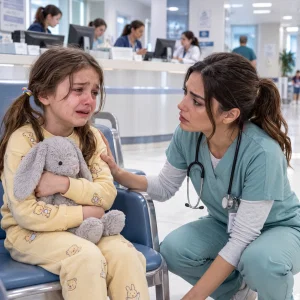
An 8-year-old girl had been left alone in a hospital for over two hours, crying, “Please, someone help me!” Everyone had ignored her. When I rushed to her side, I learned that her father was out at sea and her aunt was supposed to be caring for her.

I didn’t waste time arguing. I got the girl medical help and checked her phone. The last message from her aunt made my blood run cold.
PART 1

“If I die here, will somebody tell my dad?”
The question came from an 8-year-old girl who had been sitting in front of the reception desk at Harbor Naval Medical Center in Norfolk, Virginia, for almost 2 hours. Nobody answered. A clerk kept typing, and a few feet away, 2 doctors argued about where to order lunch.
I had just come down from pediatrics when I heard her. My name is Marianne Hargrove, I’m 39, and I’ve been a nurse for 11 years. I’ve heard grown men scream over a bandage, but I had never heard a little girl ask so calmly whether she was going to die.
I walked over. She wore a red sweater plastered to her body with sweat and a pair of patched-up sandals, and she held a stuffed rabbit with half an ear missing. Her breathing whistled. She clutched the toy as if it could hold her upright.
“What’s your name, sweetheart?”
“Lucy Brennan.”
“Who came with you?”
“Nobody. My dad said they take care of Navy families here.”
I knelt so I’d be at her level. Her forehead was burning. On the wall behind us, a sign read: Our mission is to care. I was ashamed to look at it.
At the desk, I asked why she hadn’t been sent for evaluation.
“She didn’t have an ID card or a responsible adult with her,” the clerk said. “We asked her to wait while we tried to locate someone.”
“Did anyone take her vitals?”
She didn’t answer. She checked her screen and looked away.
“Then she wasn’t waiting for care,” I said. “She was waiting for somebody to decide to see her.”
I asked for a wheelchair and called the pediatric emergency department. I didn’t need a relative’s permission to have a possible emergency evaluated. While the orderly came, Lucy tugged at my sleeve.
“Please don’t be mad at them. Maybe they’re too busy.”
That was what hurt the most. She was apologizing for being sick.
On the way down, I learned that she’d been coughing for 9 days, that the fever had gotten worse over the last 3 nights, and that she had barely eaten. Her mother had died a year and a half ago. Her father, Chief Petty Officer Owen Brennan, was deployed on a maritime patrol. They couldn’t always talk; communications depended on service and signal.
“And who do you stay with when he’s gone?”
“Mrs. Pruitt. She makes me soup and checks my homework.”
“Where is Mrs. Pruitt?”
Lucy looked down at the rabbit.
“They took her away in an ambulance. She said my Aunt Bernie was coming.”
“How long ago?”
She counted on her fingers. Ten days.
My stomach dropped. Ten days was far too long for any child, but she had learned not to make noise. She ate crackers, drank tap water, and locked the door when it got dark. She had come on 2 buses, following the address her father had written on the back of a photograph. She told me she’d counted the stops with a little pebble in her fist so she wouldn’t forget them when the fever got worse. One driver asked where her mother was, but she pretended to be asleep, afraid he’d call the police before she got there. When she got off, she walked 6 blocks holding on to the walls. She had picked this hospital because the people who worked here would understand why her father wasn’t home.
In the ER, the pulse oximeter read 88. The attending physician ordered oxygen, tests, and immediate monitoring. She didn’t argue about paperwork: first we had to get Lucy breathing better. While we fitted the mask, Lucy asked whether her rabbit could stay.
“Captain Floppy is scared of hospitals,” she explained.
“Then he stays with you,” I promised.
My daughter was 8 when she died, 8 years ago. I had avoided getting attached to patients ever since. Before working here, I’d served as a Navy corpsman and gotten used to handling emergencies without shaking. That afternoon, my hands trembled as I tucked the blanket around her. I remembered the nights when Ellie, my little girl, said all she needed was to see me sitting beside her bed to feel safe. Lucy didn’t even know whom to ask to sit with her. I looked at the chart, still blank, and understood that the problem hadn’t begun with the cough. Someone had turned a little girl into a piece of paperwork that could wait.
To find a relative, I asked Lucy’s permission to look through the contacts on an old cell phone in her backpack. The screen was cracked. There were messages from her, sent over several days to “Aunt Bernie”: I can’t find any food. Mrs. Pruitt isn’t coming back. I’m really hot and it hurts to breathe.
Every one of them showed as read.
The last message received was from that morning. I read it twice, certain I had misunderstood:
Don’t tell anyone you’re alone. I already told your dad you’re fine. If you make a scene, they’ll take you away from him.
PART 2
I looked at the screen again. Lucy was watching me over the oxygen mask, waiting for me to scold her too.
“Did your aunt know you’d been alone for days?”
She nodded.
“She said I was big enough to take care of myself. And that if I told, Dad would get in trouble.”
I didn’t ask her to tell me more. I put the phone in a bag with her belongings, wrote down what I’d seen, and called social work. A sick child with no caregiver needed protection, not an improvised promise that everything would be fine.
After the X-ray and lab work, the doctor confirmed pneumonia in both lungs. She would have to stay in the hospital on oxygen and treatment. Dehydration worried us too. When we explained she’d be here for several days, she asked whether she’d have to pay with the coins she kept in a sock.
“You just focus on getting better,” I told her. “The grown-ups will take care of the rest.”
But this time I wanted my words to mean something.
The front desk log showed that Lucy had arrived at 9:17. Her first medical evaluation began at 11:46. I asked that both times be recorded in an incident report; I wasn’t going to let anyone replace that wait with the phrase patient admitted without complications.
With a social worker, we tried to reach Bernadette Brennan, Owen’s sister and the alternate contact listed on a form Lucy had brought from school. She answered on the fourth try.
“I can’t walk out of work over every little tantrum,” she said, before asking about the girl.
“She has pneumonia and she’s been admitted. Did you know Mrs. Pruitt was in the hospital?”
There was a silence.