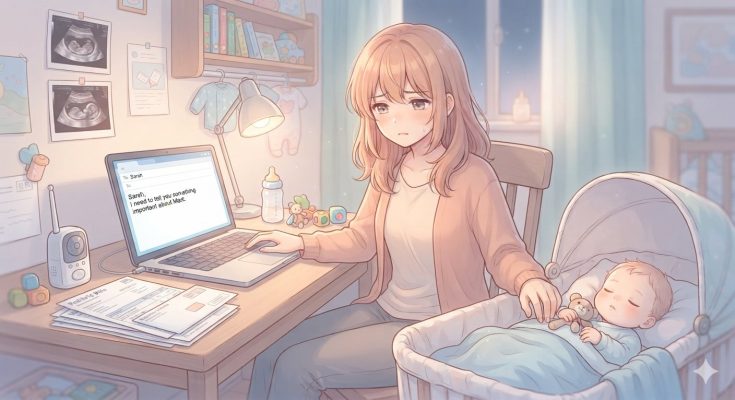
PART 1 – The Message I Sent His Wife at Two in the Morning Was Supposed to End Everything, but Her Answer Changed the Danger

At 2:13 in the morning, with my son asleep against my chest and Mark’s unanswered messages glowing on my phone, I typed a sentence I had spent three months being too frightened to write.
My name is Emily Parker. I think your husband is the father of my baby.
I read it until the words stopped looking like English.
Matthew shifted beneath my chin. His cheek was warm against the hollow of my throat, and one tiny fist had worked free of his blanket. I lowered the phone and pressed my lips to his hair. He smelled faintly of milk and the lavender detergent I had bought because the pediatrician said his skin might be sensitive.
The apartment was silent except for the refrigerator humming in the kitchen and Matthew’s uneven newborn breathing. Outside, tires hissed over wet pavement. Somewhere upstairs, plumbing knocked inside a wall.
I had imagined sending that message dozens of times. In every version, Mark’s wife called me a liar, threatened me, or posted my name online. Sometimes she simply forwarded the message to Mark, and he arrived furious that I had broken the only rule he still seemed capable of enforcing: stay quiet.
But I was tired of being quiet.
Matthew had been born six weeks earlier with Down syndrome.
Those words had frightened me once. Not because I loved him less, but because during pregnancy I had known almost nothing about what his diagnosis might mean. Every doctor seemed to have another list of possibilities. Heart problems. Feeding difficulties. Developmental delays. Therapies. Specialists. Tests.
I had gone home from appointments carrying folders thick enough to make my future feel like paperwork.
Mark had carried nothing.
He had stopped answering.
When I first told him I was pregnant, he stared at me across a restaurant table for so long that the waiter came twice to ask whether we wanted dessert.
“We’ll figure it out,” he had finally said.
I believed him.
That was before I knew about Sarah.
Mark had told me his marriage was effectively finished. Separate bedrooms. Separate lives. A relationship preserved on paper because of their daughter, Ava, and because divorces became complicated when property and family businesses were involved.
I knew he was technically married. That fact already sat heavily enough on my conscience. But he had made the marriage sound like an administrative inconvenience rather than a living relationship.
There were always reasons I could not visit his house.
There were always explanations for weekends he disappeared.
There were always promises about later.
Then my pregnancy became real enough to appear on an ultrasound screen, and “later” began retreating faster than I could reach it.
At twenty weeks, a specialist confirmed that our baby had Down syndrome.
Mark sat beside me during the appointment.
I remember that clearly because of what happened afterward.
He asked more questions than I did.
Not emotional questions. Precise ones.
How reliable were the results? Had the diagnosis been documented in the hospital system? Who had access to the records? Was genetic information confidential? Could an employer ever obtain it?
The doctor finally looked at him strangely.
“This is your child’s medical information,” she said. “Why are you asking about employers?”
Mark laughed as though embarrassed by his own nervousness.
“Work has made me paranoid about privacy.”
In the parking garage, he held me for almost a minute.
Then he disappeared for four days.
When he came back, he brought flowers and an envelope containing money.
I should have understood.
Instead, I cried against his shoulder because I was relieved he had returned.
That was the version of me I found hardest to forgive—the woman who accepted scraps because she was terrified of facing pregnancy alone.
By the seventh month, Mark rarely visited. When he did, he seemed distracted. Once I caught him photographing a medical appointment card lying on my counter.
“What are you doing?”
He lowered his phone immediately.
“Nothing.”
“You just took a picture.”
“I’m trying to remember your appointment.”
“You could ask me.”
His expression changed then. Only for a second.
I saw irritation before tenderness covered it.
“You’re exhausted, Em. I’m trying to help.”
He kissed my forehead.
I apologized.
That memory had bothered me ever since.
After Matthew was born, Mark came to the hospital once.
He stood several feet from the bassinet.
Matthew was two days old, wrapped tightly in a striped hospital blanket, his dark hair flattened against his head. I had spent the previous night learning how to feed him while a nurse patiently repositioned my hands.
I wanted Mark to touch him.
Instead, he stared.
“Does Sarah know?” I asked.
His face hardened.
“Not now.”
“When?”
“I said not now.”
“He’s your son.”
“Keep your voice down.”
I remember looking at Matthew and realizing that the man beside me was more worried about being overheard than about the child lying three feet away.
Mark left twenty minutes later.
He did not return.
For weeks I called him anyway.
Some days I hated myself for it.
Other days I told myself I was calling for Matthew, not me.
Then, three nights before I finally messaged Sarah, Mark sent me something different.
It was not an apology.
It was not a question about his son.
It was one sentence.
You need to stop making this bigger than it has to be.
I stared at those words until Matthew began crying.
Something in me changed.
I had spent months assuming Mark was afraid.
Now I wondered whether he had been planning.
That was why, at 2:13 that morning, I searched for Sarah’s profile, opened a blank message, and introduced myself.
I told her Mark and I had been involved.
I told her Matthew was six weeks old.
I told her Mark was his father.
Then I wrote the sentence that made my hands shake hardest.
Matthew was born with Down syndrome, and Mark has almost completely disappeared since the diagnosis.
I did not ask Sarah to forgive me.
I did not tell her Mark had said their marriage was over. It sounded pathetic now, even though it had once sounded convincing.
I simply finished:
You deserve to know. I am sorry this is coming from me.
Then I pressed send.
For fourteen minutes nothing happened.
I fed Matthew.
Changed him.
Walked the length of the living room until his eyelids grew heavy again.
At 2:31, my phone vibrated.
Sarah had read the message.
Three dots appeared.
Vanished.
Returned.
My stomach tightened so hard I thought I might be sick.
Then her answer arrived.
I know who you are.
I stopped breathing.
A second message appeared.
Please don’t contact Mark tonight.
Then:
And do not delete anything he has sent you.
I sat completely still.
That was not anger.
It was worse.
It sounded like a warning.
I typed, Why?
Sarah answered almost immediately.
Because I think my husband has been lying to both of us about more than the affair.
My fingers went cold.
What do you mean?
There was a long pause.
Then she wrote:
Is Matthew with you?
Yes.
Are your doors locked?
I looked toward the deadbolt.
The question frightened me enough that I stood and checked it.
Yes.
Sarah replied:
Good. I’m coming tomorrow morning. I have something you need to see.
I called her before I could reconsider.
She answered on the second ring.
Neither of us spoke.
Finally I said, “Sarah?”
Her breathing sounded controlled, but only barely.
“Yes.”
“I’m sorry.”
“I know.”
The answer was so quiet that it hurt more than shouting would have.
“I didn’t know everything,” I said. “Mark told me—”
“Emily.”
I stopped.
“I’m not ready to talk about what he told you.”
There was no cruelty in her voice. That made it harder.
“All right.”
“But I need you to listen carefully. Has anyone been following you?”
I looked toward the dark window.
“What?”
“Think before you answer.”
A memory surfaced.
A gray sedan outside my obstetrician’s office.
Another one near the pharmacy.
A man holding his phone too high when I left the hospital with Matthew.
At the time, none of it had seemed connected.
“I don’t know.”
“Has anyone photographed you?”
My pulse climbed.
“Why are you asking me this?”
Sarah exhaled.
“Because I found photographs.”
The room suddenly felt colder.
“Of what?”
“You.”
Matthew made a small sound against my shoulder.
I tightened my arm around him.
Sarah continued.
“Some were taken while you were pregnant.”
My knees weakened.
I sat down.
“How did you get them?”
“I found a folder in Mark’s home office.”
“Our home office,” she corrected herself after a moment, and the pain beneath those three words made me close my eyes.
“What kind of pictures?”
“You leaving medical appointments. Getting into your car. Going into your building.”
I could hear paper moving on her end.
“And there are dates.”
“What dates?”
“Appointments. Places. Times.”
I stared at the curtains covering my living-room window.
“Sarah, why would Mark have these?”
“I don’t know yet.”
She paused.
“But I intend to find out.”
The anger in her voice was no longer aimed only at me.
I asked the question that had been growing heavier with every second.
“Did he take them?”
“No.”
“How do you know?”
“Because he’s in two of them.”
I stood again without realizing I had moved.
Matthew startled.
I whispered an apology to him and rocked gently.
Sarah said, “There are payments too.”
“To who?”
“I haven’t identified the person.”
“Police?”
“Not yet.”
“Why not?”
“Because if I’m wrong about what this means, I don’t want to destroy evidence by frightening him.”
The word evidence landed differently from photographs.
This was no longer simply an affair being uncovered.
Someone had documented my pregnancy.
My appointments.
My movements.
“Why are you helping me?” I asked.
Sarah was silent.
When she finally answered, her voice sounded exhausted.
“I haven’t decided whether I’m helping you.”
Fair enough.
“But Matthew didn’t lie to me,” she continued. “He didn’t betray me. He didn’t make promises to either of us. Whatever Mark has done, that baby isn’t responsible.”
I looked down at my son.
His eyes were closed.
His mouth made the faint sucking motion he sometimes made in his sleep.
Tears blurred my vision.
Sarah spoke again.
“And there’s something else in the folder.”
“What?”
“I’m not discussing it over the phone.”
“Sarah—”
“Tomorrow. Ten o’clock.”
Then, after a hesitation:
“Emily, did Mark ever give you money?”
“Yes.”
“When?”
“Several times.”
“Cash?”
“Mostly transfers.”
“Did you ask him for it?”
“Sometimes for medical bills.”
“And the others?”
I thought about an unexpected deposit made shortly before Matthew’s birth.
“No.”
“How much?”
I told her.
Sarah became silent again.
“Why?”
“I found a transfer for the same amount.”
“That’s probably mine.”
“It has your name beside it.”
I almost laughed from confusion.
“Then it is mine.”
“No,” Sarah said. “That’s the problem.”
My fingers tightened around the phone.
“The transfer I found wasn’t sent to you.”
The refrigerator clicked off.
In the sudden silence, I could hear rain ticking against the window.
“Who received it?”
“I don’t know. The account number is partially hidden.”
She lowered her voice.
“But the note beside your name says ‘contingency.’”
I had no idea what that meant.
Apparently Sarah did not either.
Before hanging up, she repeated one instruction.
“Don’t tell Mark we spoke.”
I promised.
For the rest of the night, I did not sleep.
At dawn, I stood beside the window without opening the curtain and watched a thin line of sunlight appear around its edge.
At 7:40, my phone vibrated.
Mark.
For one hopeful, humiliating second, I wondered whether he was finally asking about Matthew.
His message contained only five words.
Did you contact my wife?
I stared at the screen.
Before I could decide whether to answer, another message arrived.
Emily, this is important. Answer me.
Then a third.
Whatever Sarah tells you, do not believe her.
I had never told him Sarah was coming.
And according to Sarah, she had not told him either.
I looked at Matthew sleeping in his bassinet.
Then at the locked front door.
For the first time, the question was no longer why Mark had abandoned us.
It was how he already knew.
PART 2 – Sarah Arrived Carrying Proof of My Affair, but the Photograph Beneath It Showed Someone Had Been Watching Long Before Matthew Was Born
At exactly ten the next morning, Sarah knocked twice and waited.
I knew it was her because I had spent the previous fifteen minutes standing behind the curtain, watching the street.
No gray sedan.
No unfamiliar man.
Only a delivery truck, a woman walking a terrier, and finally Sarah climbing from a dark blue SUV with a leather folder pressed against her ribs.
She looked nothing like the woman I had constructed in my imagination.
I had expected polished cruelty.
Mark had described her as cold, demanding, obsessed with appearances.
Instead she stood outside my door in jeans, flat shoes, and a wrinkled gray sweater. There were shadows beneath her eyes. Her dark hair had been twisted into a knot that looked as if she had done it without a mirror.
When I opened the door, we stared at each other.
“Emily.”
“Sarah.”
Neither of us offered a hand.
Matthew began fussing from his bassinet.
Sarah’s eyes moved past me.
Something changed in her face.
Not softness exactly.
Recognition.
“That’s him?”
I nodded.
She stepped inside only after I moved aside.
For several seconds she stood near the entrance, looking around the apartment.
I wondered what she saw.
The secondhand couch.
The bottles drying beside the sink.
Baby blankets draped over chairs because I never seemed to have enough clean ones.
A stack of medical paperwork on the table.
The life her husband had helped create and then abandoned.
“I know what you’re thinking,” I said.
Sarah looked at me.
“No, you don’t.”
“I know what this looks like.”
“That’s the problem with Mark. He’s spent years teaching everyone to worry about what things look like.”
I had no answer.
Matthew fussed again.
I lifted him from the bassinet.
Sarah watched closely.
“He’s small.”
“He was six pounds, two ounces.”
“Is he healthy?”
The question surprised me.
“Mostly. They’re monitoring his heart, but the cardiologist is optimistic. Feeding takes longer. We’ve started talking about early intervention.”
Sarah nodded as though storing each fact somewhere.
Then Matthew opened his eyes.
Sarah stopped moving.
I watched conflicting emotions cross her face too quickly to name.
This child was proof of her husband’s betrayal.
But he was also simply a baby looking at a stranger.
“May I?”
She raised one hand, then seemed embarrassed by the request.
I hesitated.
So did she.
Finally I passed Matthew to her.
Sarah held him carefully, supporting his head without needing instruction.
“You have a daughter,” I said.
“Ava. She’s eight.”
Matthew curled his fingers around the edge of Sarah’s sweater.
She looked down.
A breath escaped her that sounded almost like a laugh and almost like grief.
“Hello, Matthew.”
My throat tightened.
Mark had never spoken to him that gently.
Sarah sat on the couch with him.
I remained standing until she nodded toward the chair opposite her.
“Sit. We have a lot to discuss.”
She placed the folder on the coffee table.
For several seconds neither of us touched it.
“I need to say something first,” I told her.
Sarah looked up.
“I knew Mark was married.”
Her jaw tightened.
“He told me you were separated except legally. He said you were staying in the same house for Ava and finances. I should have verified it. I didn’t.”
“No, you should have.”
“I know.”
“He and I were sleeping in the same bed.”
The words hurt even though I had no right to be hurt by them.
“He came to Ava’s school performances. We had dinner together. We fought. We made plans. We were not separated.”
“I’m sorry.”
Sarah looked at Matthew.
“So am I.”
She did not forgive me.
I respected her more for that.
She opened the folder.
The first photograph showed Mark and me leaving a restaurant.
I remembered the evening immediately.
I had been five months pregnant.
Mark’s hand rested against my back.
The photograph had been taken from across the street.
The next showed me outside my obstetrician’s office.
Then another.
Then another.
Different clothes.
Different days.
Different angles.
Always distant.
Always unaware.
My skin prickled.
“How many?”
“Thirty-seven.”
I looked at her.
“Thirty-seven photographs?”
“That I found.”
She turned over a sheet of paper.
It contained dates and short descriptions.
Tuesday, 9:12 a.m.—medical building.
Thursday, 4:36 p.m.—pharmacy.
Saturday, 11:05 a.m.—mother’s residence.
Someone had documented my life in fragments.
My hands began shaking.
Sarah noticed.
“Take Matthew.”
I did.
The instant his weight settled against me, my breathing steadied.
Sarah pulled out another page.
“Payments.”
They were small enough not to attract attention individually.
Repeated transfers to the same recipient.
“Do you recognize the number?”
“No.”
“I searched it. Nothing.”
“Could this be something from Mark’s work?”
“Maybe.”
“You don’t believe that.”
“No.”
I looked through the photographs again.
One stopped me.
It showed me leaving the clinic after the appointment when Matthew’s diagnosis was confirmed.
Mark walked beside me.
My face was turned down.
His was angled directly toward the camera.
Not accidentally.
Directly.
“He knew,” I said.
Sarah frowned.
“What?”
“He knew whoever was taking this picture was there.”
She took it from me.
For the first time since arriving, her composure slipped.
“You’re right.”
The room seemed to narrow around us.
“He arranged this,” I said.
“I think so.”
“Why?”
Sarah looked at the folder.
“That’s what I’m trying to understand.”
She removed several printed messages.
Some were between Mark and a number without a saved name.
Need confirmation of schedule.
Appointment moved to Thursday.
Keep distance.
No direct contact.
My stomach rolled.
“Those are his?”
“The number is Mark’s old business phone.”
I looked at Matthew.
He had fallen asleep again.
“How long?”
“The earliest message I found is from when you were about four months pregnant.”
Before the Down syndrome diagnosis.
That mattered.
Whatever Mark had been afraid of had begun before we knew anything about Matthew’s condition.
“Did he think I was going to expose the affair?”
“Possibly.”
“But I wasn’t.”
“He may not have trusted you.”
The irony almost made me laugh.
Sarah reached deeper into the folder.
“This is where it gets stranger.”
She handed me a bank record.
My name appeared in Mark’s handwriting beside a transfer.
The amount matched the deposit I had received.
But the destination account was different.
“Maybe he transferred the same amount twice.”
“That’s what I thought.”
“To who?”
“I don’t know.”
“Then what does contingency mean?”
“I don’t know that either.”
I leaned back.
Matthew’s head rested beneath my chin.
“I feel like I’m looking at somebody else’s life.”
Sarah’s expression changed.
“I know that feeling.”
She told me what had happened after receiving my message.
She had waited until Mark fell asleep.
Then she entered the home office and searched the locked drawer she had seen him use for financial documents.
She already knew where he kept the spare key.
She expected to find proof of the affair.
Instead she found me catalogued.
Photographs.
Payments.
Appointment notes.
Copies of messages.
One sheet contained information about Matthew’s birth.
“Why would he need any of this?” I asked.
Sarah’s eyes remained on the folder.
“He wouldn’t.”
“Unless?”
“Unless he expected a fight.”
That frightened me.
“What kind of fight?”
“I don’t know.”
She pulled out another photograph.
It had been taken through my apartment window.
I was sitting on the couch, heavily pregnant, folding yellow baby clothes.
My stomach turned.
Someone had stood outside my home and photographed me through glass.
“This is illegal, isn’t it?”
“David will know.”
“David?”
“My cousin. He’s an attorney.”
“You told him?”
“Only enough to ask what I should preserve.”
My first instinct was embarrassment.
Then I remembered that embarrassment was exactly what had kept me quiet.
“Does he know about Matthew?”
“Yes.”
I looked away.
Sarah’s voice softened slightly.
“Emily, people are going to know. If this becomes a legal matter, you need to stop measuring every decision by whether somebody might judge you.”
Easy for her to say.
Then I looked at her face and realized it was not easy at all.
People would judge her too.
The wife who had not known.
The woman whose husband had fathered a child elsewhere.
The mother whose daughter would eventually learn why her family changed.
Mark had distributed humiliation generously.
“Why haven’t you confronted him?” I asked.
“Because last night he confronted me.”
My head snapped up.
“What?”
“He asked whether I had been in his office.”
My mouth went dry.
“What did you say?”
“No.”
“And he believed you?”
“No.”
That explained his messages to me.
“He knows the folder is gone?”
“He knows something is missing.”
“Sarah, then why bring it here?”
“Because my house isn’t safe for it.”
The sentence chilled me.
“Safe?”
“I don’t mean physically dangerous. I mean Mark controls that house. Cameras, alarm records, passwords. If I copied everything there, he could discover it.”
I stared at her.
“You’re scared of your husband.”
Sarah’s expression hardened.
“I’m cautious about a man I recently discovered has been paying someone to monitor his pregnant girlfriend.”
The words girlfriend and pregnant struck differently coming from her.
Matthew stirred.
Sarah watched him.
“Did Mark ever ask you to sign anything?”
“No.”
“Did he ever suggest giving you money if you stopped contacting him?”
“Not directly.”
“Think.”
I remembered an argument during my eighth month.
Mark had said he could arrange enough money for me to move somewhere better.
There had been conditions disguised as advice.
A fresh start.
Privacy.
No public paternity dispute.
No need to involve lawyers.
At the time I thought he was avoiding scandal.
Now the conversation felt rehearsed.
“He talked about helping me move.”
“Where?”
“Anywhere I wanted.”
“Did he mention putting something in writing?”
My pulse quickened.
“Yes.”
Sarah closed her eyes.
“What?”
“He said lawyers could make sure Matthew was financially protected without creating unnecessary conflict.”
“Those were his words?”
“Close to them.”
Sarah stood abruptly and walked to the window.
She looked outside without opening the curtain.
“What?”
She did not answer.
“Sarah.”
She turned.
“I found a contract.”
The room seemed to lose sound.
“What contract?”
“It isn’t signed.”
“For what?”
She returned to the couch but did not sit.
“I think it was meant for you.”
“Give it to me.”
“Emily—”
“Give it to me.”
Sarah removed several stapled pages from the folder.
Legal language covered them.
I could barely follow it.
Then certain phrases emerged.
Confidentiality.
Waiver.
No future claims beyond designated compensation.
No public identification of paternity.
No disclosure to media or employer.
I looked up.
“He wanted me to deny Matthew was his?”
“He wanted you never to establish publicly that he was.”
“For money.”
“Yes.”
My face burned.
I had expected abandonment.
This was different.
Abandonment could be cowardice.
This was architecture.
He had planned a future in which his son existed only as a private expense.
Matthew woke and began making the impatient little noises that meant he wanted feeding.
I stood automatically.
Sarah watched me prepare a bottle.
Normal movements suddenly felt important.
Measure.
Warm.
Test against my wrist.
Hold him upright.
Feed slowly.
This was what Mark had reduced to a liability.
Sarah stared at the contract.
“I thought finding out about you would be the worst thing that happened to me yesterday.”
I looked at her.
“What changed?”
“I found out my husband looked at a baby and started drafting ways to erase him.”
My eyes filled.
“Sarah…”
She shook her head.
“Don’t mistake this for forgiveness.”
“I won’t.”
“I am furious with you.”
“I know.”
“But I am more furious with him.”
Matthew finished half the bottle.
A knock sounded at the door.
Both of us froze.
Sarah looked at me.
“Are you expecting someone?”
“No.”
The knock came again.
Not violent.
Three controlled taps.
I carried Matthew toward the peephole.
A man in a dark jacket stood outside.
I did not recognize him.
He held an envelope.
“Emily Parker?”
I did not answer.
He knocked again.
Sarah approached silently and looked through the peephole.
Her face changed.
“You know him?” I whispered.
“No.”
The man waited another ten seconds, placed the envelope against the door, and walked away.
We listened to his footsteps disappear.
Sarah opened the door only after checking the hallway.
The envelope had my name printed across the front.
Inside was a single photograph.
Me.
Taken the previous night.
Standing behind my living-room curtain.
Watching the street.
On the back, someone had written six words.
You should have taken Mark’s offer.
Sarah read it twice.
Then she reached for her phone.
“Who are you calling?”
“David.”
Her hands were steady now.
Mine were not.
“Why?”
Sarah looked from the photograph to Matthew.
“Because whatever Mark was planning, somebody knows you didn’t cooperate.”
PART 3 – The Lawyer Said the Photograph Was More Dangerous Than the Contract, and One Payment Revealed Mark Had Been Preparing for My Refusal
David arrived forty minutes later carrying a laptop, two legal pads, and the expression of a man who had already decided he disliked everyone involved.
He was Sarah’s cousin, though they looked nothing alike. Sarah’s features were fine and controlled; David was broad-shouldered, with tired eyes and a habit of going completely still when someone told him something disturbing.
He examined the photograph without touching it at first.
“Who handled this?”
“Emily and me,” Sarah said.
“Envelope?”
“Kitchen counter.”
“Don’t touch either again.”
He photographed everything where it lay.
Then he asked me to describe the man outside.
Height.
Age.
Clothing.
Hair.
Anything distinctive.
I remembered almost nothing.
Fear had reduced him to a jacket and an envelope.
David did not criticize me.
“Do you have a door camera?”
“No.”
“Building cameras?”
“Lobby and elevator.”
He called the property manager immediately.
His manner changed on the phone. Courteous, precise, impossible to dismiss.
He requested that recordings from the previous twelve hours be preserved.
Then he sat opposite me.
“Now tell me everything from the beginning.”
I did.
Not the abbreviated version.
Everything.
How Mark and I met.
What he said about Sarah.
When I learned I was pregnant.
The diagnosis.
The disappearing acts.
The money.
The hospital.
The messages.
Every detail I wished I could remove from my own history.
David interrupted only to establish dates.
When I finished, he tapped his pen against the legal pad.
“Did Mark ever threaten you?”
“No.”
“Explicitly?”
“No.”
“Implicitly?”
I hesitated.
“What counts?”
“Statements suggesting consequences if you disclosed the relationship, sought paternity, contacted Sarah, or refused money.”
I remembered Mark standing in my kitchen when I was seven months pregnant.
You have no idea how ugly this could become.
At the time I thought he meant divorce.
I told David.
He wrote it down.
Sarah sat beside Matthew’s bassinet.
Her face tightened each time I repeated something Mark had said.
David finally looked at her.
“You brought everything?”
“Yes.”
He began examining the folder.
The contract interested him.
The payment records interested him more.
The photographs changed his expression completely.
“This wasn’t casual.”
“What do you mean?” I asked.
“Somebody was documenting a pattern of movement.”
“For Mark?”
“Apparently.”
“Is that illegal?”
“Following someone in public isn’t automatically illegal. Photographing through private windows, repeated surveillance, intimidation—that becomes another matter.”
He turned over the photograph delivered that morning.
“This is the part I care about immediately.”
“Why?”
“Because it arrived after Sarah removed the folder.”
My stomach tightened.
David continued.
“Someone knows the situation changed.”
Sarah folded her arms.
“Mark?”
“Maybe.”
“You don’t believe it’s him.”
“I don’t believe anything yet.”
He photographed each payment record.
Then he stopped.
“Sarah, where did you get this?”
“Mark’s drawer.”
“This particular page?”
“Same place.”
David enlarged something on his laptop after scanning it.
“Look.”
We gathered around him.
A series of transfers appeared.
Most went to the same unidentified account.
One was different.
Larger.
It had been sent three days before Matthew was born.
Beside it was a short reference code.
David searched through the other documents.
He found the same code on a printed invoice.
“What is it?” I asked.
“Security consulting.”
Sarah frowned.
“Mark’s company uses firms like that.”
“Which company?”
“Blackwell.”
David looked at her.
“Mark works for Blackwell?”
“You know that.”
“I knew he was an executive. I didn’t know these payments might touch corporate accounts.”
My pulse quickened.
“Why does that matter?”
“Because if Mark paid someone privately, this is one problem. If company resources were involved, it becomes a larger one.”
Sarah leaned toward the screen.
“That account isn’t Blackwell’s.”
“No. But the invoice references a vendor number.”
David searched again.
The room went quiet except for his keyboard.
Matthew woke.
I lifted him and carried him to the bedroom to change him.
For two minutes, I concentrated on the small things.
Fresh diaper.
Clean sleeper.
The way his left foot kicked whenever cold air touched his stomach.
I kissed his knee.
“You have terrible timing,” I whispered.
Matthew stared at me solemnly.
Then sneezed.
I laughed despite everything.
From the living room, David called my name.
The laughter vanished.
I carried Matthew back.
“What?”
David turned the laptop.
“I found the vendor.”
A security firm.
Private investigations.
Risk management.
Corporate intelligence.
The words made my apartment feel suddenly exposed.
“Is that who followed me?”
“Possibly.”
Sarah stared at the screen.
“Mark told me Blackwell used them during an internal theft investigation.”
“When?”
“Last year.”
David looked through the payments again.
“Some of these transfers begin before Emily’s diagnosis.”
“I know,” Sarah said.
“But they increase afterward.”
She and David exchanged a look.
I noticed.
“What aren’t you saying?”
David answered carefully.
“Nothing established.”
“Then tell me what you’re thinking.”
He leaned back.
“I think Mark initially wanted information because of the affair. After Matthew’s diagnosis, something made the monitoring more important.”
“His reputation.”
“Maybe.”
“His marriage.”
“Maybe.”
“His job?”
David did not answer immediately.
Sarah did.
“Mark has been trying for a senior position at Blackwell for almost two years.”
I looked at her.
“He told me he already had it.”
A bitter smile crossed her face.
“Of course he did.”
“What does any of this have to do with Matthew?”
“I don’t know.”
Matthew began sucking his fingers.
David closed the laptop.
“For now, we do three things. Preserve evidence. Stop direct communication with Mark unless necessary. And document any further contact.”
“Police?” I asked.
“With the photograph and the surveillance evidence, yes. At minimum, we make a report.”
Sarah nodded.
I felt strangely reluctant.
Not because I wanted to protect Mark.
Because reporting it made everything real.
David saw my hesitation.
“You’re worried about exposure.”
“Yes.”
“Understandable. But whoever delivered this already knows where you live.”
That ended the debate.
We went to the police station that afternoon.
Sarah came.
So did Matthew.
I gave my statement while he slept against my chest.
The officer copied the photograph and asked questions that made me hear my own story differently.
Had Mark ever entered my apartment without permission?
Did he possess a key?
Did he know my passwords?
Had he installed anything?
I remembered a smoke detector Mark had replaced after complaining mine looked old.
My stomach dropped.
When we returned to the apartment, David inspected it.
The detector was ordinary.
So were the outlets.
No obvious cameras.
I felt foolish for being relieved.
Then David examined my router.
“Did you set this password?”
“No. Mark did.”
He looked at me.
“When?”
“Months ago. My internet kept dropping.”
David unplugged the router.
“You’re changing it.”
“Why?”
“Because he knows the credentials.”
Sarah muttered something under her breath.
I did not ask her to repeat it.
That evening, she stayed.
Neither of us discussed whether she should.
She simply ordered food, sterilized bottles while I fed Matthew, and took a phone call from Ava in my kitchen.
Her voice transformed when she spoke to her daughter.
Warm.
Patient.
Normal.
I felt guilty listening.
Mark had not merely cheated on Sarah.
He had fractured Ava’s home.
After the call, Sarah stood staring at her phone.
“She asked when Daddy’s coming back.”
“What did you say?”
“That I don’t know.”
“I’m sorry.”
She gave me a tired look.
“So am I.”
We ate at the coffee table.
Halfway through dinner, my phone rang.
Mark.
We both stared at it.
“Don’t answer,” Sarah said.
It stopped.
Then rang again.
And again.
Finally a voicemail appeared.
David had told us to preserve everything.
I played it on speaker.
Mark sounded breathless.
“Emily, listen to me. I know Sarah is there. You need to stop whatever you’re doing. You don’t understand the situation. Those documents weren’t meant to hurt you. Call me before David turns this into something it isn’t.”
Sarah’s eyes narrowed.
“He knows David’s involved.”
“How?”
She grabbed her phone and called her cousin.
He answered immediately.
When she explained, David became quiet.
“Do not call Mark back.”
“Obviously.”
“I’m serious. Lock the door. I’m coming over.”
The call ended.
I stared at Sarah.
“How does he know?”
She shook her head.
My phone vibrated.
Another voicemail.
This time Mark’s voice sounded different.
Less angry.
More frightened.
“Emily, please. There are people involved who don’t care about you, me, Sarah, or that baby. I made mistakes, but I was trying to keep things contained. You need to trust me once.”
Sarah gave a humorless laugh.
“Trust him.”
I almost deleted it.
Then a third message arrived.
Not from Mark.
Unknown number.
A photograph loaded.
Matthew and me entering the police station that afternoon.
Underneath it:
That was unnecessary.
Sarah stood so quickly her chair struck the wall.
“Oh, hell no.”
Matthew startled and began crying.
I gathered him against me.
Sarah immediately apologized, but her eyes remained on the screen.
Someone had followed us to the police station.
David arrived twenty minutes later.
This time he brought another man with him, a former investigator he trusted.
They checked the hallway and building entrances.
The lobby camera had captured the envelope delivery.
The man’s face was partly visible.
Nobody recognized him.
The license plate on his vehicle was obscured.
Professional.
That was the word David used.
I hated it.
At eleven that night, after David finally convinced Sarah to leave with him, I locked myself inside the bedroom with Matthew’s bassinet beside my bed.
I kept the lights off.
Sleep did not come.
At 12:47, Matthew woke hungry.
I fed him in darkness.
His fingers wrapped around mine.
“You have no idea what’s happening, do you?”
He blinked at me.
“I wish I didn’t either.”
My phone lit up.
For a second I expected another threat.
Instead it was Sarah.
I found something.
I typed back.
What?
Three dots appeared.
Then:
The monitoring wasn’t Mark’s idea.
I sat upright.
How do you know?
Sarah called.
I answered immediately.
Her voice was low.
“I went through old emails.”
“You went home?”
“No. I had backups.”
“What did you find?”
“A message Mark sent to someone at Blackwell.”
“When?”
“Four months into your pregnancy.”
Before the diagnosis.
“What did it say?”
Sarah hesitated.
“Mark wanted the surveillance stopped.”
I felt as though the floor had shifted.
“What?”
“He wrote that it had gone too far. He said there was no reason to keep watching you.”
“Then who kept it going?”
“That’s what scares me.”
Paper moved on her end.
“The reply came from someone above him.”
“Who?”
“I don’t recognize the name.”
“What did they say?”
Sarah inhaled.
“Continue observation until exposure can be assessed.”
My skin prickled.
“Exposure to what?”
“I don’t know.”
Matthew shifted in my arms.
Sarah continued.
“But there’s a second message.”
I waited.
“This one was sent after your prenatal appointment.”
“The diagnosis?”
“Yes.”
“What does it say?”
Her voice became almost inaudible.
“Risk profile has changed. Increase monitoring.”
Neither of us spoke.
My affair with Mark had been shameful.
His betrayal of Sarah was real.
But this was something else.
Someone who had never met me had learned something about my unborn child and decided that made us more dangerous.
“Sarah?”
“Yes?”
“How did they know about Matthew’s diagnosis?”
Silence.
Then she said the words that changed everything.
“That’s exactly what I’m trying to find out.”