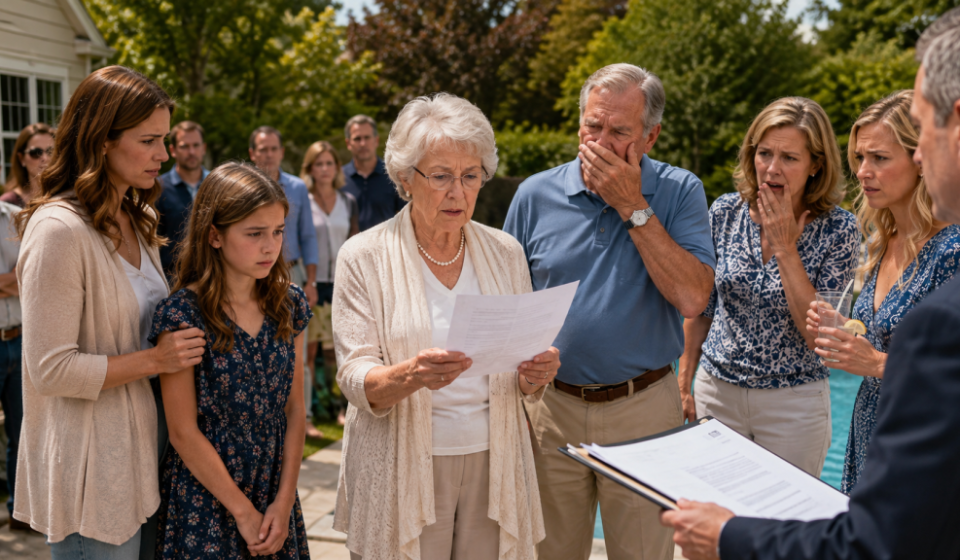

My parents sold my 11-year-old daughter’s antique cello — the one she got from my grandmother — for $87,000 and spent the money on a pool for my sister’s kids. When Grandma found out, she didn’t cry. She smiled and said, “The cello was …” My parents’ faces went pale.

“Where’s Lucy’s cello?” I asked.
My mother raised her coffee mug like I had interrupted a quiet morning instead of walking into a house that smelled like wet paint, sawdust, and money.
Dad sat at the kitchen table with his tablet. My sister Rachel leaned against the counter with her expensive-looking green drink.
Outside, machines had ripped open the backyard for a new in-ground pool.
Inside Grandma Margaret’s old music room, the corner where my eleven-year-old daughter’s antique cello had always rested was empty.
Lucy stood beside the empty stand, completely still.
Not crying. Not demanding answers. Just being careful, like she was afraid the wrong question might somehow make this her fault.
Mom gave me a thin smile. “Your father handled it.”
“Handled it how?”
Dad finally looked up. “We sold it.”
I stared at him.
“You sold Lucy’s cello?”
“It was valuable,” he said. “It was sitting there. Your grandmother wasn’t using it.”
“She gave it to Lucy.”
Rachel laughed. “She’s eleven.”
As if being eleven meant ownership disappeared the second an adult wanted something more.
Mom set her mug down. “Emily, don’t start.”
“How much?”
Dad’s mouth tightened. Rachel looked away.
“Eighty-seven thousand,” Mom said.
My hand closed around the edge of the counter.
Outside the window, the pool forms gleamed in the sunlight.
“You spent Lucy’s cello on that?”
Rachel straightened. “It’s for the kids.”
“My kid is a kid.”
Dad rubbed his forehead. “Lucy will be fine with a student cello. Plenty of children rent instruments.”
Lucy will be fine.
My family loved that sentence whenever Lucy was the one expected to lose something.
I found her back in the music room, touching the empty stand with two fingers before pulling her hand away.
“Did I do something wrong?” she whispered.
“No.” I knelt in front of her. “You did nothing wrong.”
That night she practiced on a battered student cello her teacher loaned us. The sound was thin and boxy compared with the warm voice of the antique instrument.
Lucy never complained.
She only said, “Maybe Great-Grandma didn’t mean for it to be mine yet.”
After she fell asleep, one sentence from my mother kept circling in my head.
You are not telling your grandmother.
Not, Don’t upset her.
Don’t tell her.
So the next morning, I drove to Grandma Margaret’s assisted living community and told her everything—the missing cello, the $87,000 wire transfer, the collector, the pool, and the warning that she was never supposed to know.
Grandma didn’t cry.
She asked one question.
“And Lucy?”
“She thinks you changed your mind.”
Grandma’s expression hardened.
She reached for her phone and made one quiet call.
Then she looked at me over her glasses. “I am not the one who should be worried.”
Six weeks later, my parents invited everyone over for the pool reveal.
Rachel’s kids were already splashing. Relatives and neighbors stood around the backyard. Mom worked the grill with her practiced family-host smile.
Lucy stayed beside me, holding her folded towel in both hands and staring at what her cello had become.
Then the back gate opened.
Grandma Margaret walked in wearing a crisp blouse.
Beside her was Andrew, her lawyer, carrying a slim folder.
Mom stopped smiling. Dad stared at the folder.
Grandma looked from the pool to my parents.
“Well,” she said pleasantly. “You’ve been busy.”
Mom forced out a laugh. “This is a party.”
“I know,” Grandma said. “That’s why I came.”
Andrew handed her the folder.
Grandma opened it while the pool motor hummed behind her. Rachel lowered her drink. Lucy found my hand and squeezed.
Grandma looked directly at my parents.
“I gave that cello to Lucy,” she said. “Not to you. Not to Rachel. To Lucy.”
Dad started to answer, but Grandma lifted the first page.
Then she smiled—the same calm smile that had scared me six weeks earlier—and placed the page in my father’s hand.
PART 2: THE CELLO WAS NEVER THEIRS TO SELL
Dad looked down at the paper Grandma had placed in his hand.
At first, his expression did not change.
Then he read the second paragraph.
The color drained from his face.
Mom noticed immediately.
“What?”
Dad did not answer.
Rachel pushed herself away from the counter.
“Dad?”
Grandma Margaret stood beside Andrew with both hands folded calmly in front of her.
Behind us, children were still splashing in the pool.
Someone laughed near the patio.
Music played softly from a speaker beside the grill.
It was a perfect summer family party.
Except my father suddenly looked like a man who had discovered the ground beneath his feet did not belong to him.
Mom stepped closer.
“What does it say?”
Dad folded the paper.
Too quickly.
Grandma smiled.
“No, Harold.”
Her voice was gentle.
“Read it aloud.”
My father looked at her.
“Mother.”
“Read it.”
Something in Grandma’s tone silenced everyone nearby.
The conversations around the patio faded.
Even Rachel’s husband, Scott, lowered his drink.
Dad looked toward Andrew.
The lawyer gave him no help.
Finally, Dad unfolded the page again.
His voice came out rough.
“The instrument identified as the 1742 Matteo Bellini violoncello…”
He stopped.
My heartbeat changed.
Bellini.
I knew the name.
Not because I knew antique instruments.
Because Lucy did.
She had once whispered it to me like a secret.
Great-Grandma says Mr. Bellini made it before America was a country.
I had laughed.
I thought she was exaggerating.
Dad continued.
“…is hereby transferred as an irrevocable inter vivos gift to my great-granddaughter, Lucy Anne Parker, upon execution of this instrument.”
He stopped again.
Rachel frowned.
“What does that mean?”
Andrew answered.
“It means Mrs. Margaret Bennett legally gave the cello to Lucy.”
“I already knew that,” I said.
Andrew looked at me.
“There’s more.”
Grandma nodded toward Dad.
“Keep reading.”
My father’s jaw tightened.
He continued.
“Until Lucy Anne Parker reaches the age of eighteen, physical custody of the instrument may remain at the Bennett residence solely for preservation and practice access…”
He swallowed.
“…but neither Harold Bennett nor Patricia Bennett shall acquire any ownership interest, right of sale, right of pledge, or right of transfer.”
Silence.
Mom’s face changed.
Rachel’s mouth parted.
I looked at Grandma.
“You had paperwork?”
“Of course I had paperwork.”
She sounded almost offended.
“I was married to a lawyer for forty-three years.”
Andrew smiled faintly.
Grandma added:
“Your grandfather believed a handshake was sacred.”
“He also believed paperwork kept dishonest people honest.”
My mother finally spoke.
“We didn’t know.”
Grandma looked at her.
“You did.”
Mom froze.
Grandma’s expression did not change.
“I gave you a copy.”
“I don’t remember that.”
“I do.”
“It was eight years ago.”
Grandma nodded.
“And apparently eight years was long enough for you to forget Lucy owned something worth taking.”
My mother’s face flushed.
Rachel stepped forward.
“Okay, everyone calm down.”
I almost laughed.
Of course.
Calm down.
The traditional family phrase for the moment someone who caused the disaster wanted everyone else to stop reacting to it.
Rachel looked at Grandma.
“The cello was sitting in this house.”
Grandma’s eyes sharpened.
“So?”
“We assumed it was part of the family property.”
“You assumed wrong.”
Rachel sighed.
“Nobody was trying to steal from Lucy.”
Lucy’s hand tightened around mine.
Grandma noticed.
She turned toward my daughter.
“Sweetheart.”
Lucy looked up.
“Yes?”
“Do you believe that cello was yours?”
Lucy hesitated.
Her eyes moved toward my parents.
That broke something inside me.
Even now, she was checking whether her answer might hurt adults.
Grandma walked toward her.
“Look at me.”
Lucy did.
“When I handed you that bow on your ninth birthday, what did I say?”
Lucy’s lower lip trembled.
“You said it was my turn to make it sing.”
Grandma smiled.
“And?”
“That you wanted me to keep it safe until somebody after me loved music enough to deserve it.”
Grandma nodded.
“Exactly.”
Lucy’s eyes filled.
“So was it mine?”
“Yes.”
Grandma said the word without hesitation.
“Completely.”
Lucy started crying.
Quietly.
She whispered:
“I thought maybe you changed your mind.”
Grandma’s face crumpled.
For the first time since she entered the backyard, the calm cracked.
“Oh, baby.”
She wrapped both arms around Lucy.
“No.”
“No, no, no.”
Lucy cried into her blouse.
Grandma held her tightly.
“I would never take it from you without telling you.”
“I’m sorry you spent even one minute believing that.”
I looked at my parents.
Mom looked away.
Dad stared at the ground.
Rachel crossed her arms.
And suddenly, the pool behind them seemed obscene.
Blue water.
Stone decking.
A little waterfall feature Rachel had posted pictures of before it was even finished.
Eighty-seven thousand dollars poured into concrete because three adults had decided an eleven-year-old would be easier to disappoint than themselves.
Grandma kissed Lucy’s hair.
Then straightened.
The softness disappeared again.
She looked toward my parents.
“Now.”
She said it quietly.
“Let’s discuss the part you apparently did not know.”
Dad’s head lifted.
“What part?”
Grandma smiled.
“The cello was not worth eighty-seven thousand dollars.”
Rachel actually laughed.
A quick, relieved sound.
“Well, there you go.”
She looked around.
“Maybe the collector overpaid.”
Grandma looked at her.
“No, sweetheart.”
The way she said sweetheart made Rachel stop smiling.
“He underpaid.”
Silence.
Dad’s eyes narrowed.
“How much?”
Grandma did not answer immediately.
Instead, she turned toward Andrew.
He opened the slim folder and removed another page.
He handed it to me.
I looked down.
An appraisal.
The date was six months earlier.
Instrument:
Matteo Bellini, Venice, 1742.
Provenance documented through six generations.
Condition:
Exceptional.
Estimated private-sale value:
$410,000 to $475,000.
My knees almost gave out.
I looked at Grandma.
“Four hundred thousand?”
She nodded.
Rachel stared.
“No.”
Dad reached for the page.
I did not give it to him.
He looked at Andrew instead.
“That cannot be right.”
Andrew replied:
“It is.”
Mom whispered:
“But the dealer said…”
Grandma turned.
“What dealer?”
Nobody answered.
There.
Grandma noticed too.
“What dealer?”
Dad rubbed his forehead.
“A man named Foster.”
“First name?”
“Daniel.”
Andrew immediately looked at his phone.
Grandma kept watching my father.
“And how did Mr. Foster find you?”
Dad hesitated.
Rachel looked toward the pool.
My stomach tightened.
“Dad.”
He exhaled.
“We contacted several places.”
“Several?”
“Yes.”
“You researched the value.”
“Of course we did.”
Grandma’s eyes became colder.
“So you knew enough to research the instrument.”
“But not enough to remember it belonged to Lucy.”
Dad’s face reddened.
“That is not what happened.”
“Then tell me.”
He looked around at the relatives now pretending not to listen.
His pride fought with the truth.
Eventually the truth won.
Barely.
“We needed cash.”
I stared at him.
“For the pool?”
Rachel interrupted.
“It wasn’t only the pool.”
I turned.
“What else?”
She said nothing.
Scott looked uncomfortable.
Grandma noticed.
“What else?”
Rachel’s expression hardened.
“This is ridiculous.”
“No.”
I stepped toward her.
“What else did they spend Lucy’s money on?”
“It wasn’t Lucy’s money.”
The words came out too fast.
Grandma’s eyes flashed.
Rachel corrected herself.
“I mean, they didn’t think it was.”
“Rachel.”
I said her name quietly.
“What else?”
She looked at Mom.
Mom looked at Dad.
Dad finally answered.
“Twenty-five thousand went toward Rachel’s credit cards.”
My mouth fell open.
Rachel closed her eyes.
Scott stared at her.
“What?”
She turned toward him.
“Not now.”
He laughed in disbelief.
“You told me your parents helped with the pool.”
“They did.”
“You didn’t tell me they paid off twenty-five thousand dollars in credit cards.”
“Scott.”
“How much debt?”
She snapped:
“It doesn’t matter.”
“It matters to me.”
Grandma raised one hand.
“Marriage counseling later.”
That almost would have been funny.
Almost.
She looked at my father.
“Continue.”
Dad’s shoulders dropped.
“Ten thousand went toward landscaping.”
“Part of the pool.”
“Yes.”
“Contractor deposit?”
“Thirty-two.”
“Rachel’s debt?”
“Twenty-five.”
“That’s sixty-seven.”
Grandma’s voice remained frighteningly calm.
“Where did the remaining twenty thousand go?”
My parents said nothing.
Andrew looked up from his phone.
Dad closed his eyes.
Mom whispered:
“Taxes.”
I stared.
“What taxes?”
Dad looked at me.
“Property taxes.”
My stomach turned.
“You couldn’t pay your property taxes?”
“We could.”
Mom answered quickly.
“We were behind.”
“How far?”
“Two years.”
Grandma stared at them.
The pain on her face finally showed.
This was not only anger now.
It was humiliation.
Not because they had financial trouble.
Because they had hidden it.
Then solved it with a child’s inheritance.
Dad said:
“We were going to replace the cello.”
I laughed.
It came out sharper than I intended.
“With what?”
“A student instrument?”
“No.”
He looked at Lucy.
“We would have found her something nice.”
Lucy stared at him.
Then said quietly:
“But not mine.”
Dad flinched.
Three words.
That was all.
But sometimes children can strip an adult’s excuse down faster than any lawyer.
Not mine.
Exactly.
Grandma walked toward my father.
“You know why I kept the Bellini?”
Dad looked tired.
“Because you loved it.”
“No.”
Grandma’s eyes filled.
“I loved what it carried.”
She looked at Lucy.
“My father bought that cello for me when I was seventeen.”
I had heard parts of the story.
Never all of it.
Grandma continued.
“He was not wealthy.”
“He owned a repair shop.”
“Worked six days a week.”
“He bought the Bellini from a widowed musician who needed money after the war.”
“Even then, it was worth more than he could afford.”
Dad’s eyes softened.
Grandma looked at him.
“You were little when your grandfather died.”
“You probably don’t remember him selling his truck to finish paying for that instrument.”
My father stared.
“I didn’t know.”
“No.”
Grandma smiled sadly.
“You never asked.”
She turned to Lucy.
“That cello paid for my conservatory audition.”
“It was beside me when I met your great-grandfather.”
“I played it at Emily’s christening.”
My throat tightened.
I had not known that.
Grandma looked at me.
“You screamed through the whole thing.”
A few relatives laughed nervously.
So did I, through tears.
Grandma smiled.
“Your mother said the cello upset you.”
“I told her you simply had strong musical opinions.”
Then she looked back at Lucy.
“When my hands became too stiff to play well, I did not want that instrument locked in a glass case.”
“I wanted music.”
“Not an investment.”
“Not money.”
“Music.”
Lucy was crying again.
Grandma touched her cheek.
“And then you came along.”
Lucy whispered:
“I’m not very good yet.”
Grandma smiled.
“You are eleven.”
“Your job is not to be good yet.”
“Your job is to love it enough to keep learning.”
That sentence made Lucy cry harder.
I did too.
Then Andrew cleared his throat.
Everyone turned.
He looked serious.
More serious than before.
“Mrs. Bennett.”
He was looking at Grandma.
“I found Daniel Foster.”
Dad stiffened.
“What?”
Andrew held up his phone.
“The purchaser.”
My father’s eyes narrowed.
“What about him?”
Andrew’s expression became unreadable.
“He is not an antique-instrument dealer.”
Dad frowned.
“Yes, he is.”
“No.”
“He owns Foster Fine Instruments.”
Andrew shook his head.
“Not according to state records.”
Dad stared.
Andrew continued.
“Foster Fine Instruments is a trade name registered four months ago.”
“To an LLC.”
“Who owns the LLC?”
I asked.
Andrew looked at Rachel.
Nobody breathed.
Rachel’s face drained of color.
Scott turned toward his wife.
“What?”
Grandma’s voice dropped.
“Rachel.”
She did not answer.
My heart started pounding.
“Rachel.”
I said her name again.
“What does this have to do with you?”
She backed toward the counter.
“It doesn’t.”
Andrew held out his phone.
“The LLC is owned by a company called Aldercrest Holdings.”
Scott frowned.
“I know that name.”
Rachel shot him a look.
Andrew nodded.
“You should.”
“Your wife is listed as its manager.”
The backyard went silent.
Even the children seemed quieter.
Scott stared at Rachel.
“You own the company that bought the cello?”
“No.”
Her answer came immediately.
Too immediately.
“I set it up for someone.”
“Who?”
She looked toward my parents.
Dad appeared genuinely confused now.
“Rachel?”
She said nothing.
Grandma’s calm vanished.
“What did you do?”
Rachel’s eyes filled.
“I didn’t steal anything.”
Andrew replied:
“No one said steal.”
That word hanging there made everything worse.
Rachel started talking quickly.
“I knew someone who knew collectors.”
“I was trying to help.”
“Help who?”
I asked.
“Mom and Dad.”
“With what?”
“The sale.”
My hands turned cold.
Dad looked at her.
“You told us Foster was legitimate.”
“He is.”
Andrew said:
“He exists.”
“But Foster Fine Instruments appears to have been established shortly before the sale.”
Rachel’s mouth tightened.
“So?”
“So the company bought a cello worth more than four hundred thousand dollars for eighty-seven thousand.”
“And your holding company is behind the purchaser.”
Scott stepped away from Rachel.
“Did you buy the cello?”
She looked at him.
“No.”
“Then explain it.”
She started crying.
“I didn’t know it was worth that much.”
Grandma’s expression sharpened.
“That was not the question.”
Rachel covered her face.
“I had a buyer.”
“What buyer?”
“A collector.”
“Name?”
“I don’t know if I’m allowed to say.”
Andrew almost laughed.
“You are going to need a better answer than that.”
Rachel stared at him.
“Why?”
He closed the folder.
“Because the cello belonged to a minor.”
“The sale was unauthorized.”
“And depending on what happened after the sale, several additional issues may exist.”
Dad’s face turned pale.
“What issues?”
“Conversion.”
“Fraud.”
“Possible civil conspiracy.”
“And if documentation was falsified…”
He paused.
“Potential criminal exposure.”
Mom grabbed the edge of the counter.
“Oh my God.”
Rachel shook her head.
“No.”
“No one is going to prison over a cello.”
Grandma looked at her.
“No one should have needed lawyers over a cello either.”
Rachel stared at Lucy.
For one terrible moment, I saw resentment.
Not guilt.
Resentment that this had become complicated.
That made me colder than anything else.
I stepped in front of Lucy.
“You knew the cello was hers.”
Rachel snapped:
“She’s eleven!”
“And?”
“She didn’t buy it.”
“Neither did you.”
“It came from Grandma.”
“To Lucy.”
Rachel’s voice rose.
“My kids deserve things too.”
There it was.
The sentence underneath the pool.
The debt.
The resentment.
My kids deserve things too.
I stared at her.
“This was never about what your children deserved.”
“It was about taking something from mine.”
She flinched.
“That’s not fair.”
“No.”
I nodded toward the pool.
“That isn’t fair.”
Lucy pulled my hand.
“Mom.”
I turned immediately.
“What?”
She looked terrified.
“Please don’t fight because of me.”
My heart broke.
I knelt.
“Sweetheart.”
“This is not because of you.”
“But the cello—”
“Belonged to you.”
“Yes.”
“And adults made choices.”
“Bad ones.”
“That responsibility stays with us.”
“Not you.”
Her eyes filled.
“Can we just forget it?”
Every adult nearby became still.
Lucy looked toward the pool.
“Cousins like the pool.”
She swallowed.
“And Great-Grandma can’t get the cello back anyway.”
Grandma’s expression changed.
Slowly.
Almost imperceptibly.
Then she smiled.
That same smile.
The one from the beginning.
Andrew noticed too.
So did I.
Dad stared at her.
“What?”
Grandma looked at Lucy.
“Oh, sweetheart.”
She brushed hair away from Lucy’s face.
“That is the part your grandparents have not figured out yet.”
My father frowned.
“What are you talking about?”
Grandma straightened.
Then looked at him.
“You sold the cello six weeks ago.”
“Yes.”
“To Daniel Foster.”
“Yes.”
“You received eighty-seven thousand dollars.”
“Yes.”
“And apparently nobody thought to ask why a man with a newly created company was willing to wire eighty-seven thousand dollars for an instrument within twenty-four hours.”
Dad looked confused.
“What are you saying?”
Grandma turned toward Andrew.
He removed a photograph from the folder.
A cello.
My stomach dropped.
Lucy gasped.
“That’s mine.”
She ran forward.
The photograph showed the Bellini lying on a padded table.
The same amber varnish.
The same tiny mark near the bridge.
The same worn patch where generations of hands had rested.
Lucy touched the photograph.
“Where is it?”
Grandma smiled.
“Safe.”
Nobody moved.
Dad whispered:
“What?”
Grandma looked directly at him.
“The cello never left the state.”
My father’s face went blank.
“What do you mean?”
Andrew answered this time.
“Mr. Foster did not resell it internationally as you apparently believed.”
Rachel’s eyes widened.
“How do you know?”
Andrew looked at her.
“Because we located the instrument three weeks ago.”
Lucy’s breath caught.
I grabbed Grandma’s arm.
“You found it?”
She nodded.
“Why didn’t you tell me?”
“Because finding it and getting it back are two different things.”
My happiness shrank.
“What do you mean?”
Grandma’s eyes turned toward Rachel.
“The person holding Lucy’s cello knows exactly what it is worth.”
Rachel went pale.
Scott looked at her.
“You know who has it.”
She did not answer.
Grandma stepped closer.
“Don’t you?”
Rachel’s lower lip trembled.
Dad stared at her.
“Rachel.”
She closed her eyes.
“Yes.”
My mother whispered:
“Oh, God.”
I felt sick.
“Who?”
Rachel began crying.
“I was going to fix it.”
“What does that mean?”
“I didn’t know it was worth four hundred thousand.”
“You keep saying that.”
I stepped forward.
“Who has my daughter’s cello?”
Rachel looked at Andrew.
Then Grandma.
Finally at me.
“A man named Victor Hale.”
Grandma’s face hardened.
That name clearly meant something to her.
“Victor Hale?”
Rachel nodded.
Andrew became very still.
Dad looked confused.
“Who is he?”
Grandma answered.
“A private collector.”
Then her voice changed.
“And a man I refused to sell that cello to twenty-two years ago.”
Silence.
My stomach dropped.
“What?”
Grandma looked at Lucy.
Then at the photograph.
“Victor offered me one hundred and fifty thousand dollars for the Bellini after your grandfather died.”
“I refused.”
“He contacted me again ten years later.”
“I refused.”
“Then again when I moved into assisted living.”
“I refused.”
Dad whispered:
“You never told us.”
Grandma looked at him.
“Because it wasn’t your business.”
I almost smiled despite everything.
Andrew added:
“Mr. Hale appears to have been monitoring the instrument’s ownership for some time.”
My skin prickled.
“What does that mean?”
He looked at Rachel.
“Someone told him it was available.”
Every face turned toward her.
She shook her head.
“I didn’t know the history.”
“But you contacted him?”
Andrew asked.
“Yes.”
“How?”
“A friend.”
“What friend?”
She hesitated.
“Someone from the club.”
Scott stared at her.
“What club?”
“The Hawthorne.”
His expression changed.
“You used my membership contacts?”
“Scott.”
“You told me those meetings were about the pool contractor.”
She looked away.
He laughed once.
A broken sound.
“How long have you been planning this?”
Rachel’s shoulders collapsed.
“Since March.”
My mouth fell open.
March.
Four months before the sale.
This was not opportunistic.
Not a sudden family decision.
It had been planned.
I whispered:
“You planned to sell Lucy’s cello for four months.”
Rachel shook her head.
“I planned to ask.”
“Who?”
“Grandma.”
Grandma looked at her.
“You never did.”
“Because Mom said you’d say no.”
My mother flinched.
There.
Another piece.
Grandma turned toward her daughter.
“You told her I would refuse.”
Mom began crying.
“I knew you would.”
“So instead of respecting my answer, you decided not to ask the question.”
“That isn’t…”
Grandma cut her off.
“Yes.”
“It is exactly that.”
Dad sank into a patio chair.
The pool behind him continued bubbling cheerfully.
The ridiculous little waterfall splashed into the blue water.
I suddenly hated the sound.
Grandma continued.
“What did Hale pay?”
Rachel looked away.
“Eighty-seven thousand.”
Andrew said:
“That was what your parents received.”
Rachel froze.
Everyone noticed.
Scott whispered:
“What did he pay?”
No answer.
My heartbeat started pounding.
“Rachel.”
She covered her face.
Grandma’s voice became almost gentle.
“How much?”
Rachel whispered:
“One hundred and sixty.”
The world seemed to stop.
My father stood so quickly the chair tipped backward.
“What?”
Rachel cried harder.
“I was going to use the difference to pay things off.”
Dad stared.
“You told us the offer was eighty-seven thousand.”
“I know.”
“You kept seventy-three thousand dollars?”
“I didn’t keep all of it.”
Scott looked physically sick.
“How much did you keep?”
“Forty-eight.”
“What happened to the rest?”
“Fees.”
“What fees?”
She had no answer.
Dad’s face went red.
“You stole from us.”
The hypocrisy was so enormous I almost laughed.
Grandma did.
One short, astonished laugh.
Everyone looked at her.
She shook her head.
“Harold.”
My father turned.
“You sold an eleven-year-old’s cello.”
“And now you are offended someone stole part of the stolen money from you?”
He went silent.
Grandma’s laughter disappeared.
“This is what happens when everyone decides somebody else’s property is available.”
She looked from Dad to Mom.
Then Rachel.
“Eventually, nobody remembers where entitlement is supposed to stop.”
That sentence settled over all of us.
Andrew closed his folder.
“There is one more matter.”
Rachel stared at him in horror.
“What now?”
He looked at Grandma.
She nodded.
Andrew said:
“Victor Hale knows the original transfer to him was unauthorized.”
My father frowned.
“How?”
“We notified him.”
“And?”
“He refused to return the instrument.”
Lucy’s face fell.
My heart tightened.
“Why?”
Andrew looked toward us.
“He claims he purchased it in good faith.”
“But he knew Grandma.”
I said.
“Yes.”
“He knew she refused to sell it.”
“Yes.”
“He knew it belonged to Lucy?”
Andrew hesitated.
“We believe he did.”
“Can you prove it?”
“That is what we have been working on.”
Lucy looked at Grandma.
“So he can keep it?”
Grandma crouched in front of her.
“No.”
Her voice was absolute.
“He does not get to keep something because adults made stealing it complicated.”
Lucy’s eyes filled.
Grandma smiled.
“Your great-grandfather sold his truck for that cello.”
“I think I can handle a few lawyers.”
Lucy laughed through her tears.
Then Andrew’s phone rang.
He looked at the screen.
His expression changed.
“Excuse me.”
He stepped away.
I barely noticed.
My parents were arguing quietly.
Scott had walked to the other side of the patio.
Rachel stood alone beside the pool, crying.
I should have felt victorious.
I didn’t.
There was nothing satisfying about watching a family discover how many ways greed had hollowed it out.
Mom approached me.
“Emily.”
I looked at her.
“I never wanted Lucy hurt.”
I stared.
“What did you think would happen when she walked into the room and her cello was gone?”
Mom’s face collapsed.
“I thought she’d adjust.”
There it was.
Again.
Lucy will be fine.
She’ll adjust.
Children are resilient.
Words adults use when they want children to absorb a cost they themselves refuse to carry.
“You wanted her to make the pain convenient.”
Mom cried.
“That is not fair.”
“No.”
I glanced toward Lucy.
“She was eleven.”
“It wasn’t fair.”
Dad approached.
His anger at Rachel had faded into exhaustion.
“We’ll pay it back.”
I looked at him.
“With what?”
He stared at the pool.
Exactly.
The money was gone.
Concrete does not care where the money came from.
It hardens anyway.
Dad whispered:
“We can take out a loan.”
Grandma looked toward him.
“Perhaps.”
He turned.
“Mother, please.”
“No.”
She walked closer.
“I am not discussing this at a pool party.”
“You started this here.”
Grandma smiled slightly.
“No.”
“You started this when you sold the cello.”
“I simply chose to finish the conversation where everyone could see what you bought with it.”
That landed.
Hard.
The relatives standing nearby looked away.
Dad’s face burned.
I understood Grandma then.
She had not come to humiliate them for sport.
She wanted the pool visible.
Not abstract.
Not a bank statement.
Visible.
Every stone.
Every jet.
Every gallon of water.
A monument to what Lucy had lost.
Andrew returned.
He walked quickly.
Too quickly.
Grandma noticed.
“What happened?”
He lowered his voice.
“Victor Hale’s attorney called.”
My heart started pounding.
“And?”
“He’s changed his position.”
Lucy squeezed my hand.
“Changed how?”
Andrew looked at her.
“He is willing to return the cello.”
Lucy gasped.
I nearly cried.
Grandma remained still.
“Conditions?”
Of course she asked that first.
Andrew nodded.
“He wants reimbursement of the amount he claims he paid.”
“How much?”
“One hundred sixty thousand.”
Rachel looked ill.
Dad stared.
Grandma’s eyes sharpened.
“No.”
Andrew nodded.
“I assumed.”
Lucy looked at Grandma.
“But if we pay him, I can get it back.”
Every adult went quiet.
Grandma turned toward Lucy.
“We are not buying your own cello from someone who had no right to take it.”
Lucy frowned.
“But what if that’s the only way?”
Grandma touched her face.
“Then we let a judge explain ownership to him.”
Andrew almost smiled.
“That was my recommendation.”
Then his phone buzzed again.
He checked it.
And froze.
“What?”
Grandma asked.
He looked at me.
Then at Rachel.
“Mr. Hale’s attorney sent a photograph.”
“Of what?”
He turned the phone.
A close-up of the Bellini’s interior.
Not the outside.
Inside the body of the cello, visible through one of the f-holes, was a tiny paper label.
Faded.
Handwritten.
Grandma stared at it.
Her entire expression changed.
“What is that?”
I asked.
She did not answer.
Her hand trembled.
For the first time since this began, Grandma Margaret looked frightened.
“Grandma?”
Lucy whispered.
Grandma took the phone.
Zoomed in.
Then closed her eyes.
“Oh.”
“What?”
I touched her arm.
“What is it?”
Grandma looked toward Andrew.
“He found it.”
Andrew frowned.
“Found what?”
Grandma handed the phone back.
“The second label.”
Nobody understood.
Dad stepped closer.
“What second label?”
Grandma looked at him.
Then at me.
Then finally at Lucy.
Her eyes filled with something I could not name.
Grief.
Memory.
Fear.
Maybe all three.
“I told you the cello belonged to my father before it belonged to me.”
“Yes.”
I whispered.
Grandma nodded slowly.
“What I never told anyone…”
She looked toward the photograph again.
“…is how my father really got it.”
My father frowned.
“You said he bought it from a widow.”
“He did.”
“But the widow did not actually own it.”
Silence.
Andrew’s expression sharpened.
“What are you saying?”
Grandma took a long breath.
“The Bellini disappeared from a European collection during the Second World War.”
My skin turned cold.
Rachel stopped crying.
Dad’s face went pale.
Grandma continued.
“My father spent years trying to trace the original family.”
“He never could.”
“So he kept records.”
“Names.”
“Letters.”
“Photographs.”
“And he placed a second identification label inside the instrument in case someone someday came looking.”
Lucy stared at her.
“Does that mean it isn’t mine?”
Grandma looked at her with extraordinary sadness.
“I don’t know yet.”
My heart dropped.
Andrew took the phone again.
“Mrs. Bennett…”
“If that provenance is real…”
“I know.”
Grandma nodded.
“This may no longer be a family-property dispute.”
My father whispered:
“What does that mean?”
Andrew looked toward the image.
“It means the cello may be connected to wartime art restitution.”
Every face went still.
The pool hummed behind us.
Eighty-seven thousand dollars.
One hundred sixty thousand.
Four hundred thousand.
Suddenly, none of those numbers felt important.
Grandma looked at Lucy.
Then she said the words that made my parents turn completely white.
“The cello was never just valuable.”
She swallowed.
“It was evidence.”
And before any of us could speak, Andrew’s phone rang again.
This time, he looked at the caller ID and immediately stepped away.
When he returned, his face had changed.
“Who was it?”
I asked.
He looked at Grandma.
“The museum in Vienna.”
No one moved.
Grandma closed her eyes.
Andrew continued.
“They recognize the second label.”
Lucy squeezed my hand so tightly it hurt.
“And?”
Andrew’s voice dropped.
“They believe they know which family the cello belonged to before the war.”
Grandma opened her eyes.
For the first time that day, there was no smile left on her face.
Only history.
And grief.
And a truth much older than any of us.
“They want to speak with Lucy.”
PART 3: THE SONG THAT BELONGED TO MORE THAN ONE FAMILY
“They want to speak with Lucy.”
For a few seconds, nobody moved.
Not Grandma.
Not my parents.
Not Rachel.
Even the children in the pool seemed quieter somehow, though that was probably only because the rest of us had stopped breathing.
Lucy looked up at me.
“Why me?”
Her voice was small.
Too small for everything that had just been placed around her shoulders.
I squeezed her hand.
“You don’t have to talk to anyone today.”
Andrew nodded immediately.
“She doesn’t.”
Grandma Margaret looked at Lucy with an expression I had never seen before.
Not anger.
Not even fear.
Regret.
The kind that comes when a secret survives long enough to reach someone innocent.
“I should have told your mother years ago.”
Lucy frowned.
“Told her what?”
Grandma looked toward the photograph of the second label.
Then she sat down.
For the first time since she walked through the gate, she looked every one of her eighty-six years.
My father pulled out a chair.
She ignored it.
I sat beside her.
“Grandma.”
She took a breath.
“My father’s name was Samuel Weiss.”
I nodded.
I knew that much.
“Before he changed it.”
I went still.
“What was it before?”
Grandma looked at me.
“Samuel Weisz.”
The sound was almost the same.
But somehow the difference changed the room.
“He was born in Hungary.”
Grandma continued.
“His family moved through Vienna before the war.”
“He apprenticed with instrument repairers there.”
“He loved cellos before he ever knew how to own one.”
Lucy sat on the grass at Grandma’s feet.
Grandma touched her hair.
“When the war came, families fled with what they could carry.”
“Some sold things cheaply because they needed passage.”
“Some hid things.”
“Some entrusted instruments to people who never came back.”
Her voice shook.
“My father survived.”
“A lot of people he knew did not.”
Nobody interrupted.
Grandma looked toward the house.
“When he came to America, he opened his repair shop.”
“One afternoon, years later, a woman brought him a cello.”
“A widow.”
“She said her husband had bought it from a European dealer after the war.”
“She needed money.”
“My father recognized the maker.”
“But more than that…”
Grandma swallowed.
“He recognized the label.”
“The second one.”
Andrew listened carefully.
Grandma continued.
“It had been added by a Viennese luthier who sometimes marked instruments connected to certain private collections.”
“Not for sale records.”
“For identity.”
“Insurance.”
“Family history.”
My father whispered:
“And he knew the family?”
Grandma nodded.
“By name.”
Lucy asked:
“Who?”
Grandma closed her eyes.
“The Rosenthal family.”
Andrew immediately wrote it down.
Grandma continued.
“Leopold Rosenthal was a cellist.”
“His wife, Clara, was a pianist.”
“They had two children.”
“David and Miriam.”
“The Bellini belonged to Leopold.”
Lucy’s face changed.
“Did he die?”
Grandma looked at her.
“I don’t know exactly how.”
That answer was merciful.
And honest.
“He disappeared during the war.”
“Clara and David too.”
“Miriam escaped.”
My throat tightened.
“How old was she?”
“Fourteen.”
Lucy looked down.
Almost her age.
Grandma said:
“My father tried to find her.”
“For years.”
“He wrote letters.”
“Jewish organizations.”
“Refugee registries.”
“Musicians.”
“Anyone who might know.”
“He never found her.”
“So he kept the cello?”
“Yes.”
“At first, he meant to hold it.”
“Then years became decades.”
Grandma’s eyes filled.
“He knew legally the story was messy.”
“Morally, he thought it was simple.”
“He believed that if the Rosenthal family ever appeared, the cello should go back.”
I stared at her.
“Then why did he give it to you?”
Her mouth trembled.
“Because he thought he was dying before he found them.”
“He told me everything.”
“He gave me the letters.”
“The label notes.”
“The names.”
“And he made me promise.”
“What promise?”
Grandma looked at Lucy.
“That if the real family ever came, we would listen.”
Lucy’s eyes filled.
“That means the cello isn’t mine.”
Grandma reached for her immediately.
“No.”
She knelt as far as her knees allowed.
“It means the cello has more than one story.”
“That is different.”
Lucy began crying.
Quietly.
“I just got it back.”
That broke me.
I sat beside her.
“Oh, sweetheart.”
“I know.”
She pressed her face into my shoulder.
“I thought the bad part was Grandma and Grandpa selling it.”
I held her.
“So did I.”
She cried harder.
Grandma rubbed her back.
Then Lucy whispered:
“If their family lost it because of the war…”
She looked at Grandma.
“Wouldn’t giving it back be the right thing?”
Nobody answered.
Not because we disagreed.
Because an eleven-year-old had just said the thing every adult was still struggling to reach.
Grandma started crying.
Not elegantly.
Not quietly.
She pulled Lucy toward her.
“My father would have adored you.”
Lucy sobbed into her shoulder.
I looked at my parents.
Mom was crying too.
Dad stared at the pool.
Rachel looked sick.
And for the first time since this disaster began, the cello stopped being the center of a family fight.
It became what it had apparently always been.
A witness.
To love.
To loss.
To greed.
To survival.
To memory moving through hands.
Andrew cleared his throat gently.
“We need to verify everything.”
Grandma nodded.
“Yes.”
“The museum may be right.”
“It may also be incomplete.”
“I understand.”
“No decisions today.”
Grandma looked at Lucy.
“No one decides anything for her in a backyard.”
That sentence was directed at my parents.
Dad flinched.
Good.
The next two weeks became a blur of documents.
Letters.
Photographs.
Appraisals.
Museum calls.
Provenance researchers.
Andrew coordinated everything.
Grandma opened a metal box she had not touched in nearly twenty years.
Inside were Samuel’s letters.
Old envelopes.
Names written in fountain pen.
Photographs of musicians I did not recognize.
And one picture of a young man sitting beside the Bellini.
On the back:
Leopold Rosenthal, Vienna, 1937.
Lucy stared at it for a long time.
“He looks happy.”
Grandma nodded.
“He does.”
“He’s holding it the way you do.”
Grandma smiled.
“The way musicians do.”
Then there was a photograph of Miriam.
Fourteen years old.
Dark hair.
Serious eyes.
Lucy sat beside me and whispered:
“She’s beautiful.”
I looked at my daughter.
Then at Miriam.
Two girls separated by almost a century.
Connected by wood and strings.
The museum traced Miriam.
She had survived.
France first.
Then England.
Eventually Canada.
She married.
Had one son.
That son had two daughters.
Miriam died in 1998.
Her granddaughter was still alive.
Her name was Anna Rosen.
She was sixty-three.
She lived in Toronto.
When Andrew first said her name, Grandma closed her eyes.
“We found them.”
She whispered it like a prayer.
Not:
They found us.
We found them.
That difference mattered.
Anna agreed to a video call.
Lucy asked to be there.
I told her she didn’t have to.
She said:
“I know.”
Then:
“I want to.”
So on a gray Thursday afternoon, we sat in Grandma’s assisted-living apartment.
Me.
Lucy.
Grandma.
Andrew.
And on a laptop screen appeared a woman with silver hair and kind eyes.
Anna Rosen.
She looked at Grandma for several seconds before speaking.
Then she said:
“You have my grandfather’s cello.”
Grandma began crying immediately.
“Yes.”
Anna cried too.
For a while, nobody said anything.
Then Grandma told her everything.
Samuel.
The widow.
The letters.
The search.
The promise.
The years.
Anna listened.
Sometimes closing her eyes.
Sometimes touching her mouth.
When Grandma finished, Anna said:
“My mother told me there had been a cello.”
Lucy looked up.
Anna noticed.
“And you must be Lucy.”
Lucy nodded.
“Hi.”
Anna smiled.
“I’ve heard about you.”
Lucy looked surprised.
“From who?”
“The museum.”
“They told me you play.”
“A little.”
Anna laughed softly.
“My grandfather apparently played badly when he was young.”
Lucy smiled.
“Me too.”
That broke the tension.
Then Anna’s expression softened.
“I need you to understand something.”
Lucy sat straighter.
“I do not think you stole anything from my family.”
Lucy’s eyes filled.
“I know.”
“My great-grandparents did.”
Anna shook her head.
“No.”
“They made mistakes.”
“But they did not create the war.”
“They did not take the cello in 1940.”
“They did not make Miriam run.”
She paused.
“And your great-great-grandfather tried to find her.”
Grandma covered her face.
Anna continued.
“That matters.”
A lot.
Grandma looked up.
“You still have a claim.”
“Yes.”
The room tightened.
Anna nodded.
“I do.”
Then she smiled sadly.
“But having a claim does not mean I know what the right ending is.”
That surprised me.
Lucy asked:
“What do you mean?”
Anna leaned closer to the camera.
“My grandmother spent her whole life grieving things she lost.”
“People.”
“Places.”
“Language.”
“Music.”
“She hated the idea that her children would grow up thinking our family was only loss.”
Lucy listened.
“So if this cello has been played…”
“Loved…”
“Passed down…”
“Then part of me is grateful.”
Grandma cried harder.
Anna smiled.
“But I also need to see it.”
“I need to touch something my grandfather touched.”
No one could argue with that.
So we arranged a meeting.
Not at my parents’ house.
Never there.
At the museum in Vienna.
Three months later.
Victor Hale fought the return.
At first.
He demanded repayment.
He claimed good faith.
He claimed he had invested in restoration and authentication.
Then Andrew produced the communications.
Messages between Rachel and Hale.
Messages showing he knew Grandma had refused to sell him the Bellini years earlier.
Messages where he asked whether “the old woman still had legal control.”
Messages where Rachel told him:
“Technically it belongs to the granddaughter, but the parents handle the house.”
I read that line twice.
The granddaughter.
Not Lucy.
Not a child.
A technical inconvenience.
That was the moment Rachel lost the last piece of sympathy I still had.
Hale returned the cello before the court hearing.
Not out of kindness.
Because his lawyer knew exactly what the messages would do to him.
The Bellini came back in a climate-controlled case.
Andrew arranged the handoff at his office.
Lucy was there.
So was Grandma.
I stood beside my daughter when the latches opened.
There it was.
Amber wood.
Fine scratches.
Darkened edges.
The tiny repaired seam near the lower bout.
Lucy stopped breathing.
Then she reached out.
But did not touch it.
Not immediately.
She looked at Grandma.
“Can I?”
Grandma smiled.
“It’s yours to hold until we know what happens next.”
Lucy lifted it carefully.
Her entire face changed.
Relief.
Grief.
Love.
All at once.
She rested the cello against her shoulder.
Then bowed one note.
Only one.
The sound filled the conference room.
Warm.
Deep.
Alive.
Grandma closed her eyes.
I cried.
Even Andrew looked away.
Lucy whispered:
“I missed you.”
I do not know whether she was speaking to the cello.
Or to everything it represented.
Maybe both.
My parents did not attend.
They were dealing with their own consequences.
The sale had been unauthorized.
The money could not simply be shrugged away as a family misunderstanding.
Andrew handled it civilly at first.
Grandma insisted.
Not because she wanted to protect them from everything.
Because she did not want Lucy’s childhood swallowed by courtrooms.
Dad and Mom agreed to repay the full eighty-seven thousand dollars into a protected account for Lucy.
They could not do it immediately.
The pool had eaten too much of it.
So they refinanced the house.
The irony was painful.
The pool they built with Lucy’s cello became part of the debt used to repay her.
Rachel was responsible for the additional seventy-three thousand she had hidden from them.
Her marriage nearly collapsed.
Scott moved out for three months.
He had not known.
Not about the holding company.
Not about the extra money.
Not about the collector.
Rachel sold her luxury SUV.
Canceled memberships.
Liquidated an investment account.
And signed a repayment agreement.
Victor Hale paid legal costs related to the return and withdrew all claim to the instrument.
Nobody went to prison.
Some people in the family called that mercy.
Others called it too easy.
Grandma called it:
“Enough consequence to make memory expensive.”
That sounded like her.
The pool remained.
That surprised people.
My parents asked if they should fill it in.
Grandma said no.
“You do not erase a mistake by spending more money to hide it.”
So the pool stayed.
But every time I saw it, I thought of the cello.
And I think they did too.
For a while, Lucy refused to visit their house.
I did not force her.
That was important.
Adults love to demand forgiveness from children because family dinners are easier when the child stops being hurt.
I would not do that to her.
Mom called.
Dad wrote letters.
Rachel sent one apology.
Not ten.
One.
Lucy read it.
Then placed it in a drawer.
Six months later, she asked if Grandma and Grandpa could come to her school recital.
Not Rachel.
Not yet.
Just my parents.
I asked:
“Are you sure?”
She nodded.
“They were wrong.”
“Yes.”
“But I think they know.”
That was more generous than anything I had managed.
They came.
Sat in the back row.
Did not make a scene.
Did not expect hugs.
Afterward, Dad walked toward Lucy slowly.
“You played beautifully.”
Lucy looked at him.
Then said:
“Thank you.”
He cried.
That was all.
No forgiveness speech.
No forced reconciliation.
Just one brick placed back into a bridge that would take years to rebuild.
In early spring, we flew to Vienna.
Grandma was too frail for a long commercial trip alone, so we arranged medical assistance.
She complained about the wheelchair.
Complained about airport food.
Complained about Andrew choosing a hotel with “chairs designed by enemies of the elderly.”
That reassured me.
She was herself.
Anna met us at the museum.
The moment she saw the cello case, she stopped walking.
Lucy carried it.
Carefully.
Not because anyone asked.
Because she wanted to.
Anna touched the case.
Then her face collapsed.
Grandma reached for her.
Two women.
One eighty-six.
One sixty-three.
Holding each other because men neither of them had really known had once loved the same instrument.
Inside a private room, a curator examined the Bellini.
The second label matched the museum archive.
The provenance was confirmed.
Leopold Rosenthal had owned the cello before the war.
Records showed it was seized along with other property after the family was forced from their apartment.
After that, the trail disappeared.
Until Samuel bought it in America.
Anna had a legitimate restitution claim.
Nobody argued.
Then came the question.
What happens now?
We all sat around a long table.
Lucy beside the cello.
Anna across from her.
Grandma between histories.
Andrew had explained options.
Return.
Settlement.
Shared ownership.
Long-term museum loan.
Sale with divided proceeds.
None felt right.
Finally, Anna looked at Lucy.
“What do you want?”
Lucy blinked.
“Me?”
“Yes.”
Lucy looked at me.
I said nothing.
This mattered.
Anna asked again.
“If nobody were angry.”
“If nobody were worried about money.”
“If nobody told you what was fair…”
“What would you want?”
Lucy looked at the cello.
Then at the photograph of Leopold.
Then at Anna.
“I’d want to play it.”
Anna smiled.
Lucy continued.
“But I’d want your family to have it too.”
“How?”
“I don’t know.”
She thought.
“Maybe nobody should own all of it.”
The adults looked at one another.
That was how the final arrangement began.
Not from lawyers.
From an eleven-year-old.
Anna and Grandma created a joint cultural trust.
The Bellini would not belong privately to either family.
It would be held in trust.
Its provenance would be preserved permanently.
The Rosenthal history would be attached to it.
Samuel’s search letters would be archived alongside it.
And until Lucy turned eighteen, she would be its designated student player.
After that, she could apply to continue using it if she remained serious about music.
If she stopped playing, another young cellist would be selected.
Preference given to students whose families could never afford such an instrument.
Anna loved that.
Grandma loved it more.
“What good is a cello in a vault?”
she said.
The museum agreed to display it periodically.
But only between performance loans.
Music first.
History second.
Money last.
Exactly the opposite of what had started the disaster.
The day the trust documents were signed, Anna brought something.
A small velvet case.
She opened it.
Inside was an old silver tuning key.
“My grandmother kept this.”
She said.
“Her whole life.”
“She said it belonged to her father’s cello.”
Lucy stared.
“Really?”
Anna nodded.
“We never knew if that was true.”
She handed it to the curator.
He compared it.
Then smiled.
“It fits.”
Anna started crying.
So did Grandma.
Lucy took the key carefully.
Then held it out to Anna.
“You should keep it.”
Anna shook her head.
“No.”
“Why?”
“Because I already had it for sixty-three years.”
She smiled.
“You use it.”
Lucy frowned.
“But it’s yours.”
Anna looked at her.
“So was the cello.”
Lucy went quiet.
Anna continued.
“Sometimes giving something forward is not the same as losing it.”
That sentence stayed with me.
Lucy kept the key.
Not as proof of ownership.
As proof of connection.
The recital happened that evening.
A small room inside the museum.
Thirty people.
Family.
Curators.
A few musicians.
Lucy wore a dark blue dress.
She was terrified.
I knew because she rubbed her thumb against the side of her index finger.
She had done that since kindergarten.
Grandma sat in the front row.
Anna beside her.
I sat behind them.
When Lucy walked onto the little stage carrying the Bellini, the room became very still.
She sat.
Adjusted the endpin.
Lifted the bow.
Then looked toward Grandma.
Grandma smiled.
Not the frightening smile from the pool reveal.
A soft one.
Proud.
Lucy began to play.
Bach.
Nothing flashy.
One slow movement.
Her teacher had helped her choose it because the music left room for mistakes.
There were mistakes.
Of course.
She was eleven.
One note went slightly sharp.
A bow change came late.
Nobody cared.
The Bellini sounded enormous in that room.
Warm.
Human.
Older than all of us.
I watched Anna crying.
Grandma crying.
Lucy playing.
And I thought about how many hands had held that cello.
Leopold.
Samuel.
Margaret.
Lucy.
Hands separated by war.
Migration.
Death.
Greed.
Love.
And yet the wood survived.
The music survived.
At the final note, Lucy lowered the bow.
Silence.
Then Anna stood.
She applauded first.
Everyone followed.
Grandma remained seated because standing hurt too much.
But she clapped harder than anyone.
Afterward, Lucy ran toward her.
“How was it?”
Grandma pretended to think.
“I’ve heard worse.”
Lucy laughed.
Then Grandma pulled her close.
“You made it sing.”
That was all Lucy had ever wanted.
Three years later, Grandma Margaret died.
Peacefully.
In her sleep.
The cello was not beside her.
That mattered.
She had never wanted it to become a deathbed object.
Lucy played at the memorial.
The same Bach movement.
Better this time.
Much better.
Anna flew in from Toronto.
My parents came.
Rachel came too.
She sat alone in the back.
By then, Scott had returned to their marriage, but carefully.
Rachel had completed every repayment.
She had apologized to Lucy more than once.
Never asked to be forgiven.
That was why, eventually, Lucy did.
Not because the money came back.
Because Rachel stopped asking the child she hurt to make her feel better.
After the service, Rachel approached Lucy.
“I brought something.”
She held out a small envelope.
Inside was a photograph.
The pool.
But drained.
Lucy looked confused.
Rachel smiled sadly.
“Mom and Dad finally took it out.”
I frowned.
“What?”
My mother approached.
“We filled it in last month.”
Grandma had told them not to.
Mom knew what I was thinking.
“I know what she said.”
“So why?”
Dad answered.
“Because we weren’t trying to erase the mistake anymore.”
He looked toward Lucy.
“We just didn’t want to keep living around it.”
The yard had been replanted.
No pool.
No waterfall.
Just grass.
And in one corner, a small maple tree.
Lucy asked:
“What’s the tree?”
Dad swallowed.
“For Grandma.”
Lucy looked at him.
Then nodded.
“Okay.”
That was enough.
Not everything needs a symbolic ending.
Sometimes a tree is just a tree.
Sometimes that is healthier.
By the time Lucy turned eighteen, she had become a serious musician.
Not famous.
Not a prodigy.
Serious.
The distinction mattered to her.
She auditioned for conservatories.
Practiced until her fingers ached.
Sometimes cried.
Sometimes threatened to quit.
Then practiced again the next day.
At eighteen, the trust board met.
Anna attended by video.
I sat quietly in the back.
Lucy applied to continue as the Bellini’s performer.
She did not receive special treatment.
Grandma would have hated that.
She submitted recordings.
Teacher letters.
An artistic plan.
A statement about the instrument’s history.
The board approved her unanimously.
Lucy came home that evening holding the decision letter.
She cried.
I hugged her.
Then she laughed.
“You know what’s weird?”
“What?”
“If Grandma and Grandpa hadn’t sold it…”
I immediately shook my head.
“No.”
She smiled.
“I know.”
“We are not doing ‘everything happens for a reason.’”
“Good.”
“Because sometimes people do terrible things and then better things grow around them.”
“That does not make the terrible thing necessary.”
Lucy looked at me.
“You sound like Great-Grandma.”
I smiled.
“Highest compliment of my life.”
Years passed.
The Bellini traveled.
Schools.
Museums.
Concert halls.
Always with the trust history.
Leopold Rosenthal.
Samuel Weisz.
Margaret Bennett.
Lucy Parker.
No ownership line hiding the truth.
One instrument.
Many hands.
When Lucy was twenty-six, she played her first major solo recital with it.
Anna was still alive.
So were my parents.
Rachel too.
We all sat in the audience.
Not as a perfect family.
We never became that.
Perfect families are usually just families whose stories have not been told honestly.
We became something better.
A family that knew exactly where it had broken.
And stopped pretending the cracks were decorations.
After the recital, Lucy came backstage.
Sweating.
Laughing.
Crying.
My father hugged her.
Carefully.
Even after all those years, he still waited for permission.
I noticed.
So did she.
Then he whispered:
“I’m glad you got it back.”
Lucy looked at him.
“It was never really about getting it back.”
He frowned.
“What was it about?”
She smiled.
“Learning what it meant to keep it.”
He cried.
So did I.
Later that night, Lucy handed the Bellini to a young student waiting backstage.
A thirteen-year-old girl from a public music program.
Her family could not afford a professional instrument.
The trust had selected her for a summer residency.
The girl stared.
“I can touch it?”
Lucy smiled.
“Carefully.”
The girl lifted it.
Her face transformed.
Exactly like Lucy’s had years earlier.
I watched my daughter.
She was not afraid.
Not possessive.
Not clutching.
She had learned what Grandma meant before any of us did.
An instrument does not live because one person owns it.
It lives because someone plays it.
That night, I thought again about the pool.
Eighty-seven thousand dollars.
Concrete.
Debt.
Greed.
The number once seemed enormous.
Later, four hundred thousand seemed enormous.
Then wartime history made all those numbers look small.
Because the most valuable thing about the Bellini had never been its price.
It was memory.
Proof that people existed.
That they loved music.
That they survived where they could.
That others remembered when they could not.
My parents thought they had sold an object.
Rachel thought she had found an opportunity.
Victor Hale thought he had purchased a rare instrument.
Grandma knew better.
That was why she smiled when she found out.
Not because she was happy.
Because she knew the truth was larger than the theft.
The cello was not simply expensive.
It was not simply Lucy’s.
It was not simply the Rosenthals’.
It carried too many lives to fit inside one family’s greed.
Years later, after one of Lucy’s concerts, a reporter asked her:
“What does it feel like to play a cello worth nearly half a million dollars?”
Lucy smiled.
Then shook her head.
“You’re asking the wrong question.”
The reporter laughed.
“What should I ask?”
Lucy looked down at the Bellini.
“Ask how many people loved it before me.”
The reporter went quiet.
Then did.
Lucy told the story.
Leopold.
Miriam.
Samuel.
Margaret.
Anna.
The sale.
The return.
The trust.
Not every ugly detail.
Enough truth.
At the end, the reporter asked:
“Who owns it now?”
Lucy smiled.
“No one.”
Then she corrected herself.
“Or maybe everyone who keeps the music alive.”
When I heard that interview, I cried.
Because eleven-year-old Lucy had once stood in an empty music room believing adults had taken something from her because she was too young to matter.
They were wrong.
She mattered.
Her grief mattered.
Her ownership mattered.
And because we finally listened to that hurt instead of telling her she would be fine, something larger became possible.
Not revenge.
Not victory.
Stewardship.
That was Grandma’s last lesson.
Some things are too important to possess carelessly.
A child’s trust.
A family’s history.
An old instrument.
A promise made by someone who is no longer here to enforce it.
You do not honor those things by saying:
It’s valuable.
You honor them by asking:
Who am I responsible to because I was lucky enough to receive it?
Lucy understood.
Eventually, so did the rest of us.
And every time the Bellini begins to sing, I still think of Grandma Margaret standing beside that ridiculous blue pool.
Her crisp blouse.
Andrew’s folder.
My father’s pale face.
That calm smile.
And the sentence that changed everything.
“The cello was never just valuable.”
She was right.
It carried a history bigger than money.
Bigger than ownership.
Bigger than our family.
And in the end, nobody saved it by keeping it.
We saved it by finally learning how to let it belong to the truth.
THE END STORIES! THANK YOU FOR READING GOOD LUCK !❤️